
The digital asset landscape has rapidly evolved, transforming from a niche interest into a significant component of the global financial conversation. For American investors, understanding how to navigate this dynamic market is crucial for participation. Cryptocurrencies offer a new frontier for wealth generation, portfolio diversification, and technological innovation, but entry requires careful consideration of regulatory frameworks, platform choices, security protocols, and tax implications specific to the United States. This guide aims to demystify the process, providing a professional, insightful, and engaging roadmap for individuals looking to acquire cryptocurrency within the USA. We will delve into the essential steps, from initial research and platform selection to transaction execution and ongoing asset management, all through the lens of sound financial practice.

Understanding the Crypto Landscape in the USA
Before diving into the mechanics of purchasing cryptocurrencies, it’s imperative to grasp the unique environment that governs digital asset transactions in the United States. The regulatory stance, while still evolving, plays a significant role in shaping the choices available to investors and the compliance obligations they face.
Regulatory Environment and Compliance
The United States has a fragmented regulatory approach to cryptocurrency, with various agencies – including the Securities and Exchange Commission (SEC), Commodity Futures Trading Commission (CFTC), Financial Crimes Enforcement Network (FinCEN), and state-level financial regulators – asserting jurisdiction over different aspects of the market. The SEC often views certain cryptocurrencies as securities, subjecting them to stringent disclosure requirements, while the CFTC generally considers Bitcoin and Ethereum as commodities. FinCEN primarily focuses on anti-money laundering (AML) and know-your-customer (KYC) regulations, requiring cryptocurrency exchanges to register as Money Service Businesses (MSBs).
This multi-faceted regulatory environment means that legitimate platforms operating in the USA must adhere to strict compliance standards. For investors, this translates into a generally safer marketplace compared to less regulated jurisdictions, but it also necessitates rigorous identity verification processes. It’s crucial to only use platforms that are demonstrably compliant with US laws to mitigate legal and financial risks. Staying informed about new regulations and enforcement actions is an ongoing responsibility for serious crypto investors.
Key Considerations Before Investing
Investing in cryptocurrency, like any financial venture, carries inherent risks and opportunities. Before committing capital, potential investors should conduct thorough due diligence and establish a clear investment thesis.
- Volatility: Cryptocurrencies are notoriously volatile. Prices can fluctuate wildly over short periods, leading to substantial gains or significant losses. Investors should only allocate capital they can afford to lose.
- Research: Understand the underlying technology, use case, market capitalization, and development team behind any cryptocurrency before investing. Avoid speculative “meme coins” unless you fully understand the extreme risks involved.
- Investment Goals: Define your objectives. Are you looking for long-term growth, short-term trading opportunities, or diversification? Your goals will dictate your investment strategy.
- Risk Tolerance: Assess your personal risk tolerance. Cryptocurrency is not suitable for everyone, particularly those with a low tolerance for market fluctuations.
- Diversification: While crypto can diversify a traditional portfolio, it’s also wise to diversify within the crypto space itself rather than putting all funds into a single asset.
- Long-Term vs. Short-Term: Decide whether you are approaching crypto as a long-term hodler (holding) or a short-term trader. Each approach has different implications for platform choice, security, and tax strategy.
Choosing the Right Platform: Exchanges and Brokers
The gateway to buying crypto in the USA is typically through a cryptocurrency exchange or broker. These platforms facilitate the conversion of fiat currency (like USD) into digital assets. Selecting the right platform is a critical decision that impacts security, fees, available assets, and user experience.
Centralized Exchanges (CEXs) vs. Decentralized Exchanges (DEXs)
- Centralized Exchanges (CEXs): These are the most common platforms for new investors. CEXs operate much like traditional stock exchanges, acting as intermediaries. They offer high liquidity, user-friendly interfaces, robust security measures (though not entirely immune to hacks), and customer support. Examples include Coinbase, Kraken, and Binance.US. A key characteristic of CEXs is that they require KYC/AML verification and you do not directly control your private keys for assets held on the exchange, making them “custodial.”
- Decentralized Exchanges (DEXs): DEXs allow peer-to-peer cryptocurrency trading directly from users’ wallets, without an intermediary. They offer greater privacy (no KYC typically required) and give users full control over their private keys. However, DEXs can be more complex to use, may have lower liquidity for certain pairs, and lack customer support. They are generally recommended for more experienced users. For buying crypto with USD, CEXs are almost always the starting point.
Top Platforms for US Users
Several reputable centralized exchanges cater specifically to the US market, offering varying features and fee structures.
- Coinbase: Often considered the most user-friendly platform for beginners. It offers a straightforward interface, a wide range of cryptocurrencies, and robust security. Fees can be higher for instant buys, but Coinbase Pro (now Coinbase Advanced Trade) offers lower fees for more active traders.
- Kraken: Known for its extensive selection of cryptocurrencies, competitive fees, and strong security posture. Kraken caters to both beginners and advanced traders with a comprehensive suite of tools.
- Binance.US: The US-specific arm of the global Binance exchange. It offers a large variety of altcoins and some of the lowest trading fees, making it popular among active traders. However, its regulatory standing has faced scrutiny.
- Gemini: Emphasizes security and compliance, making it a favorite for institutions and risk-averse investors. It offers a user-friendly interface and competitive fees, especially for its active trader platform. Gemini also offers earning programs.
- Crypto.com: A global platform with a strong presence in the US, offering a wide array of cryptocurrencies, low fees for high volume traders, and attractive staking/earning opportunities. It also has its own payment card.
Factors to Evaluate When Selecting a Platform
Making an informed choice requires comparing platforms across several key criteria:
- Fees: Understand the trading fees (maker/taker), deposit fees, and withdrawal fees. These can significantly impact your returns, especially for frequent trades or large transactions.
- Security: Prioritize platforms with a strong track record of security, robust encryption, two-factor authentication (2FA), and insurance policies (e.g., FDIC insurance for USD holdings, cold storage for crypto).
- User Experience (UX): For beginners, an intuitive and easy-to-navigate interface is paramount. More experienced traders might prefer platforms with advanced charting tools and order types.
- Asset Availability: Ensure the platform supports the cryptocurrencies you intend to buy. Some platforms specialize in major coins, while others offer a broader selection of altcoins.
- Customer Support: Access to responsive and helpful customer support can be invaluable, especially when encountering issues with transactions or account management.
- Regulatory Compliance: Confirm the exchange is licensed to operate in your specific US state and adheres to all federal regulations.
The Step-by-Step Process of Acquiring Cryptocurrency
Once you’ve selected a suitable platform, the actual process of buying crypto in the USA follows a predictable path, designed to ensure security and compliance.
Account Creation and Verification (KYC/AML)
The first step on any US-compliant centralized exchange is to create an account. This typically involves providing your email address, creating a strong password, and undergoing identity verification.
- Email and Password: Start with your email and create a unique, strong password. Enable 2FA immediately using an authenticator app (like Google Authenticator or Authy) rather than SMS, which can be vulnerable to SIM-swap attacks.
- Personal Information: You’ll be asked for personal details such as your full name, date of birth, physical address, and phone number.
- KYC/AML: To comply with Know Your Customer (KYC) and Anti-Money Laundering (AML) regulations, you’ll need to upload copies of government-issued identification (e.g., driver’s license, passport) and sometimes a selfie or live video verification. Some platforms may also request proof of address, like a utility bill. This process can take anywhere from a few minutes to several days, depending on the platform and the clarity of your submitted documents. It’s a critical step that enables you to deposit and withdraw funds.
Funding Your Account (Bank Transfer, Debit Card, Wire Transfer)
After your account is verified, you’ll need to deposit funds to purchase cryptocurrency. US exchanges offer several common methods:
- Bank Transfer (ACH): This is often the most popular and cost-effective method. You link your bank account, and funds are transferred directly. ACH transfers are usually free or have very low fees, but can take 3-5 business days for funds to clear and become available for withdrawal.
- Debit Card: This offers instant deposits, allowing you to buy crypto immediately. However, debit card purchases typically come with higher fees (often 3-4% per transaction) compared to ACH transfers.
- Wire Transfer: Ideal for larger sums, wire transfers usually clear faster than ACH (within 1-2 business days) but may incur higher fees from both your bank and the exchange.
- Credit Card: While some exchanges accept credit cards, many banks block these transactions, and they often come with high fees and potential cash advance charges from your card issuer. It’s generally not recommended for buying crypto due to costs and potential debt implications.
Placing Your First Order: Market vs. Limit Orders
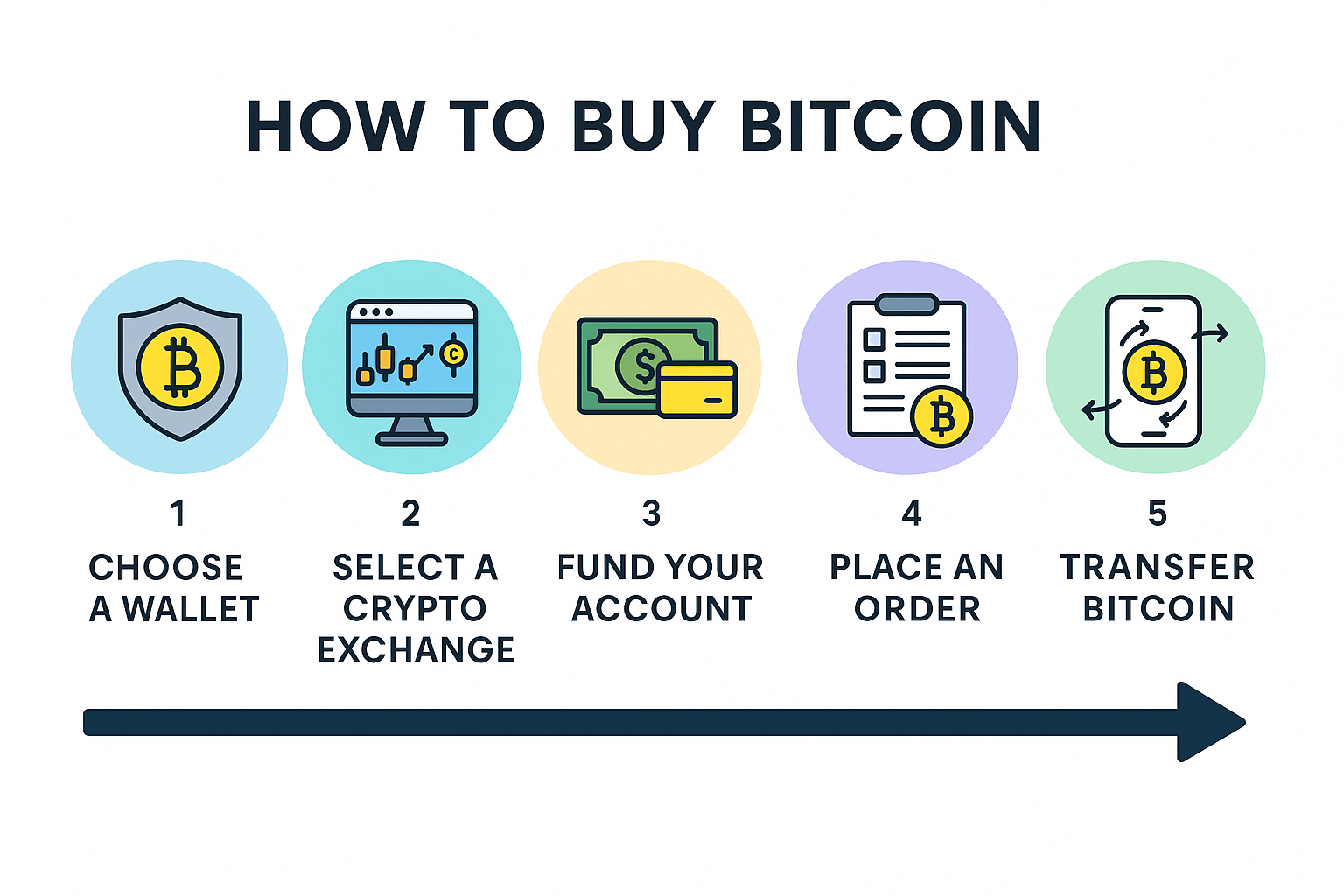
With funds in your account, you’re ready to make a purchase. Exchanges typically offer two primary order types:
- Market Order: This is the simplest option. You specify the amount of cryptocurrency you want to buy (e.g., “$100 worth of Bitcoin”), and the exchange executes the order immediately at the current market price. Market orders are convenient but may result in slightly worse prices during periods of high volatility due to slippage.
- Limit Order: A limit order allows you to set a specific price at which you want to buy (or sell) cryptocurrency. The order will only be executed if the market price reaches your specified limit price or better. This gives you more control over the entry price but means your order might not be filled immediately or at all if the price doesn’t hit your target. Limit orders are preferred by experienced traders to manage risk and achieve desired prices.
For beginners, a small market order for a major cryptocurrency like Bitcoin or Ethereum is a good starting point to familiarize yourself with the process.
Securing Your Investment: Wallet Management and Best Practices
Acquiring cryptocurrency is only half the battle; properly securing your investment is paramount. Unlike traditional bank accounts, there’s no central authority to reverse unauthorized transactions or recover lost funds in the crypto world. “Not your keys, not your crypto” is a fundamental mantra.
Understanding Crypto Wallets (Hot vs. Cold Wallets)
A cryptocurrency wallet is software or hardware that stores your public and private keys, allowing you to send, receive, and manage your digital assets.
- Hot Wallets: These are connected to the internet. Examples include wallets provided by exchanges (custodial), mobile apps (e.g., Exodus, Trust Wallet), and desktop software. Hot wallets are convenient for frequent trading and smaller amounts but are more susceptible to hacking due to their online nature. While exchange wallets are custodial (the exchange holds your keys), self-custodial hot wallets (like Exodus) give you control over your private keys.
- Cold Wallets (Hardware Wallets): These are physical devices that store your private keys offline, making them the most secure option for storing significant amounts of cryptocurrency. Examples include Ledger and Trezor. Cold wallets are immune to online hacks, but require careful handling to prevent physical loss or damage. They are highly recommended for long-term holdings and larger investments.
The general recommendation is to move significant crypto holdings from exchange hot wallets to a self-custodial cold wallet once purchased.
Essential Security Measures
Beyond choosing the right wallet, implementing robust security practices is critical:
- Two-Factor Authentication (2FA): Always enable 2FA on exchanges and any online wallets. Use an authenticator app (like Authy or Google Authenticator) instead of SMS-based 2FA, which is vulnerable to SIM-swap attacks.
- Strong, Unique Passwords: Use complex, unique passwords for each crypto-related account. A password manager can help.
- Seed Phrase Management: When setting up a self-custodial wallet, you’ll receive a recovery phrase (seed phrase) – typically 12 or 24 words. This phrase is the ultimate key to your funds. Write it down physically, store it in multiple secure, offline locations (e.g., a safe deposit box, fireproof safe), and never store it digitally or share it with anyone.
- Phishing Awareness: Be extremely wary of suspicious emails, messages, or websites claiming to be from your exchange or wallet provider. Always double-check URLs and never click on links from unsolicited communications.
- Software Updates: Keep your wallet software, operating system, and antivirus software up to date to patch known vulnerabilities.
- Private Key Security: Understand that your private keys are your ownership proof. If you use a self-custodial wallet, never expose your private keys to anyone or any online service.
Protecting Against Scams and Fraud
The cryptocurrency space, unfortunately, attracts various scams. Investors must remain vigilant:
- Fake Websites/Impersonation: Scammers create replica websites of legitimate exchanges to steal login credentials. Always verify the URL.
- Phishing Attempts: Emails or messages designed to trick you into revealing sensitive information.
- Investment Scams: Promises of guaranteed high returns, “pump and dump” schemes, or multi-level marketing (MLM) structures are red flags.
- Romance Scams: Scammers build relationships to eventually solicit crypto investments.
- Technical Support Scams: Someone pretending to be tech support asking for remote access to your computer or your seed phrase. Legitimate support will never ask for your private keys or seed phrase.
If something seems too good to be true, it almost certainly is. Always independently verify information and be skeptical of unsolicited advice or offers.
Navigating Taxes and Reporting for US Crypto Holders
One of the most complex aspects of cryptocurrency investment in the USA is understanding and complying with tax obligations. The IRS treats cryptocurrency as property, which has significant implications for how transactions are taxed.
IRS Guidance on Cryptocurrency
The IRS has issued guidance clarifying that cryptocurrency is treated as property for federal tax purposes. This means that general tax principles applicable to property transactions apply to transactions using cryptocurrency.
- Capital Gains/Losses: When you sell, exchange, or spend cryptocurrency, it’s considered a taxable event. The difference between the fair market value of the crypto when you acquired it (cost basis) and its value when you disposed of it results in a capital gain or loss.
- Short-Term Capital Gains: Apply if you held the crypto for one year or less. These are taxed at your ordinary income tax rates.
- Long-Term Capital Gains: Apply if you held the crypto for more than one year. These are typically taxed at lower preferential rates (0%, 15%, or 20% depending on income).
- Ordinary Income: Receiving cryptocurrency as payment for services, mining rewards, staking rewards, or airdrops is generally taxed as ordinary income at its fair market value on the date of receipt.
- Reporting: All taxable crypto transactions must be reported on your tax return. Form 8949 and Schedule D (Capital Gains and Losses) are typically used for sales and exchanges.
Tracking Transactions for Tax Purposes
Accurate record-keeping is crucial for proper tax reporting. You need to track:
- The date you acquired the cryptocurrency.
- Your cost basis (the price you paid, including any fees).
- The date of disposition (sale, exchange, spend).
- The fair market value of the crypto at the time of disposition.
- The proceeds you received from the disposition.
This can become incredibly complex if you have numerous transactions, especially across different platforms.

Tools and Resources for Tax Compliance
Given the complexity, many crypto investors turn to specialized tools and professional advice:
- Crypto Tax Software: Platforms like CoinTracker, Koinly, and TaxBit integrate with major exchanges and wallets to automatically import transactions, calculate capital gains/losses, and generate IRS-compliant tax forms. These tools are invaluable for simplifying the process.
- Professional Tax Advisors: For complex situations, high transaction volumes, or significant gains, consulting a tax professional specializing in cryptocurrency is highly recommended. They can provide tailored advice and ensure full compliance.
- IRS Resources: The IRS website (irs.gov) provides frequently asked questions (FAQs) and official notices regarding virtual currency, which can be a good starting point for understanding your obligations.
Failure to report crypto transactions can lead to penalties, interest, and even criminal charges. Proactive tax planning and diligent record-keeping are essential components of responsible crypto investing in the USA.
The journey to buying crypto in the USA is one of informed decision-making and continuous learning. By understanding the regulatory environment, carefully selecting platforms, mastering the transaction process, securing your assets, and diligently managing tax obligations, American investors can confidently and responsibly participate in the exciting world of digital finance. As with any investment, prudence, research, and a clear understanding of risk are your greatest allies.
aViewFromTheCave is a participant in the Amazon Services LLC Associates Program, an affiliate advertising program designed to provide a means for sites to earn advertising fees by advertising and linking to Amazon.com. Amazon, the Amazon logo, AmazonSupply, and the AmazonSupply logo are trademarks of Amazon.com, Inc. or its affiliates. As an Amazon Associate we earn affiliate commissions from qualifying purchases.