
In the realm of personal finance and professional business management, the ability to calculate and add percentages is more than just a basic mathematical skill—it is a fundamental pillar of fiscal literacy. Whether you are calculating the total cost of an investment including commissions, determining the final price of a product after sales tax, or projecting the growth of a retirement account through compound interest, understanding how to add percentages correctly is essential for making informed financial decisions.
While the concept may seem elementary, the application of percentage addition varies significantly depending on the context. In finance, adding a percentage often involves more than simple arithmetic; it requires an understanding of multipliers, compounding effects, and the difference between nominal and effective rates. This guide explores the diverse ways to add percentages within the “Money” niche, providing you with the tools to manage your wealth and business with precision.
The Role of Percentages in Personal Finance and Budgeting
Personal finance is built upon the foundation of percentages. From the portion of your income allocated to housing to the interest earned on a high-yield savings account, percentages allow us to standardize and compare financial data regardless of the raw numbers involved. Adding percentages correctly ensures that your budget remains balanced and that you are prepared for the true cost of living.
Understanding Tax Additions on Purchases
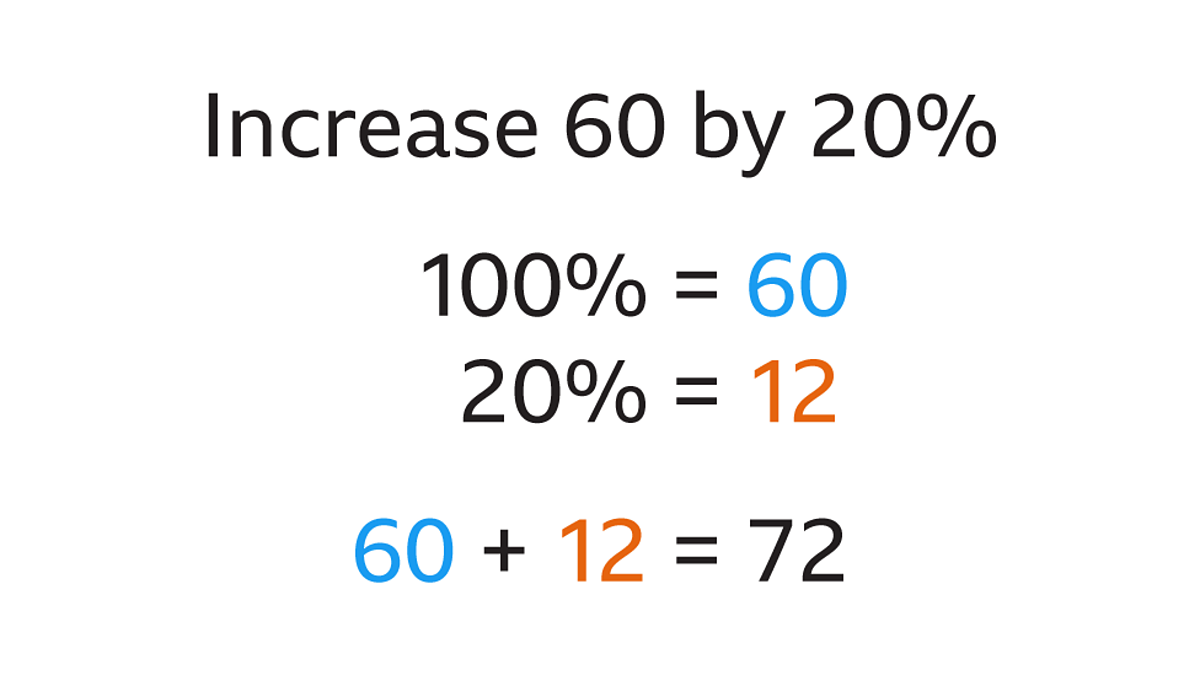
One of the most common scenarios for adding percentages is calculating sales tax or Value Added Tax (VAT). For a consumer, the “sticker price” is rarely the final price. To add a tax percentage to a base cost, you must convert the percentage into a decimal and apply it to the principal amount.
For example, if you are purchasing professional equipment for a side hustle priced at $1,200 with an 8.5% sales tax, you do not simply add 8.5 to 1,200. Instead, you multiply $1,200 by 0.085 to find the tax amount ($102) and add it to the original price, resulting in $1,302. In a professional financial context, this is often streamlined by multiplying the base price by 1 plus the tax rate (e.g., $1,200 times 1.085$). Mastering this quick calculation allows for more accurate real-time budgeting.
Incorporating Savings Rates into Monthly Budgets
When building wealth, the “Pay Yourself First” model suggests adding a specific percentage of your gross income to your savings or investment accounts before expenses. If you currently save 10% of your income and decide to add another 5% to your savings rate, you are performing a linear addition of percentages.
However, the financial impact is profound. Adding to your savings percentage doesn’t just increase your bank balance; it shifts your “burn rate”—the amount of money you spend. If you earn $5,000 a month, adding 5% to your savings rate moves an additional $250 from the “expense” column to the “wealth” column. Over a decade, that small percentage addition, when funneled into interest-bearing accounts, can result in tens of thousands of dollars in difference.
The Impact of Inflation on Future Purchasing Power
Inflation is effectively a percentage added to the cost of goods and services across the economy every year. To maintain your standard of living, your income must grow at a rate that “adds” at least the percentage of inflation to your previous year’s earnings. If inflation is at 3% and you do not receive a 3% raise, you have effectively taken a pay cut in terms of purchasing power. Understanding how to add these inflationary percentages to your future financial projections is vital for long-term retirement planning.
Advanced Investment Math: Compounding and ROI
In the world of investing, adding percentages becomes more complex due to the phenomenon of compounding. Unlike simple addition, where you add a fixed amount to a base, investment growth often involves adding a percentage to a balance that has already been increased by a previous percentage.
How to Add Annual Returns to Principal Capital
When evaluating the performance of an investment portfolio, “adding” returns over multiple years is not a matter of simple summation. If your portfolio grows by 10% in Year 1 and 10% in Year 2, your total growth is not 20%.
This is because the 10% growth in the second year is applied to the new, larger balance. If you start with $10,000, after Year 1 you have $11,000. Adding 10% in Year 2 means adding $1,100, bringing the total to $12,100. This is a 21% total increase. In financial modeling, we use the formula $(1 + r1) times (1 + r2) – 1$ to find the cumulative percentage added to the original capital.
Calculating the Total Value with Compound Interest
Compound interest is often called the eighth wonder of the world because it adds percentages onto percentages over time. When you add a percentage in the form of interest to a principal amount, and then leave that interest to earn its own interest, you create an exponential growth curve.
For someone focused on online income or side hustles, reinvesting profits is the equivalent of adding a growth percentage back into the business. If a digital asset generates a 5% monthly return and that 5% is added back to the “working capital” every month, the annual addition isn’t 60% (5% x 12); it is approximately 79.6% due to the compounding effect of adding percentages sequentially.
Portfolio Diversification and Weighted Average Returns

In a diversified investment strategy, you may have different assets growing at different percentage rates. To find the total percentage added to your net worth, you must calculate a weighted average.
If 60% of your money is in a stock index adding 8% annually and 40% is in bonds adding 3%, you do not simply add 8% and 3%. You calculate $(0.60 times 0.08) + (0.40 times 0.03)$, which equals a total portfolio addition of 6%. This nuanced approach to adding percentages is what separates amateur investors from professional wealth managers.
Percentage Strategies for Business Profitability
For business owners and entrepreneurs, adding percentages is a daily task related to pricing, margins, and scalability. Getting the math wrong here can mean the difference between a thriving enterprise and bankruptcy.
Applying Markups to Cost of Goods Sold (COGS)
One of the most vital applications of adding percentages is the “markup.” To ensure a business covers its overhead and generates profit, a percentage must be added to the cost of producing a product.
If a product costs $50 to manufacture and you want a 50% markup, you add $25 to the price, selling it for $75. However, it is important to distinguish this from “profit margin.” Adding a 50% markup results in a 33.3% profit margin. Business finance requires a clear understanding of how adding a percentage to the cost affects the final percentage of profit retained from the sale.
Calculating Sales Tax and Value Added Tax (VAT)
For businesses operating internationally or across different states, adding the correct tax percentage is a matter of legal compliance. Many software tools automate this, but a business owner must understand the underlying logic. Adding a 20% VAT to a service invoice requires multiplying the subtotal by 1.20. If the business fails to add this percentage correctly to the client’s bill, that tax amount will eventually have to be paid out of the business’s own profit margins.
Adjusting Pricing for Seasonal Surcharges
In many industries—such as travel, freelance consulting, or e-commerce—businesses may add a “peak season” percentage to their standard rates. This is a strategic way to manage demand and increase revenue during high-traffic periods. By adding a 15% surcharge to base rates, a business can offset higher operational costs or simply capitalize on increased market willingness to pay.
Tools and Methods for Precision in Financial Calculations
While mental math is a valuable skill, professional finance demands accuracy that is best achieved through specific tools and systematic methods.
Using Spreadsheet Software for Large-Scale Percentage Addition
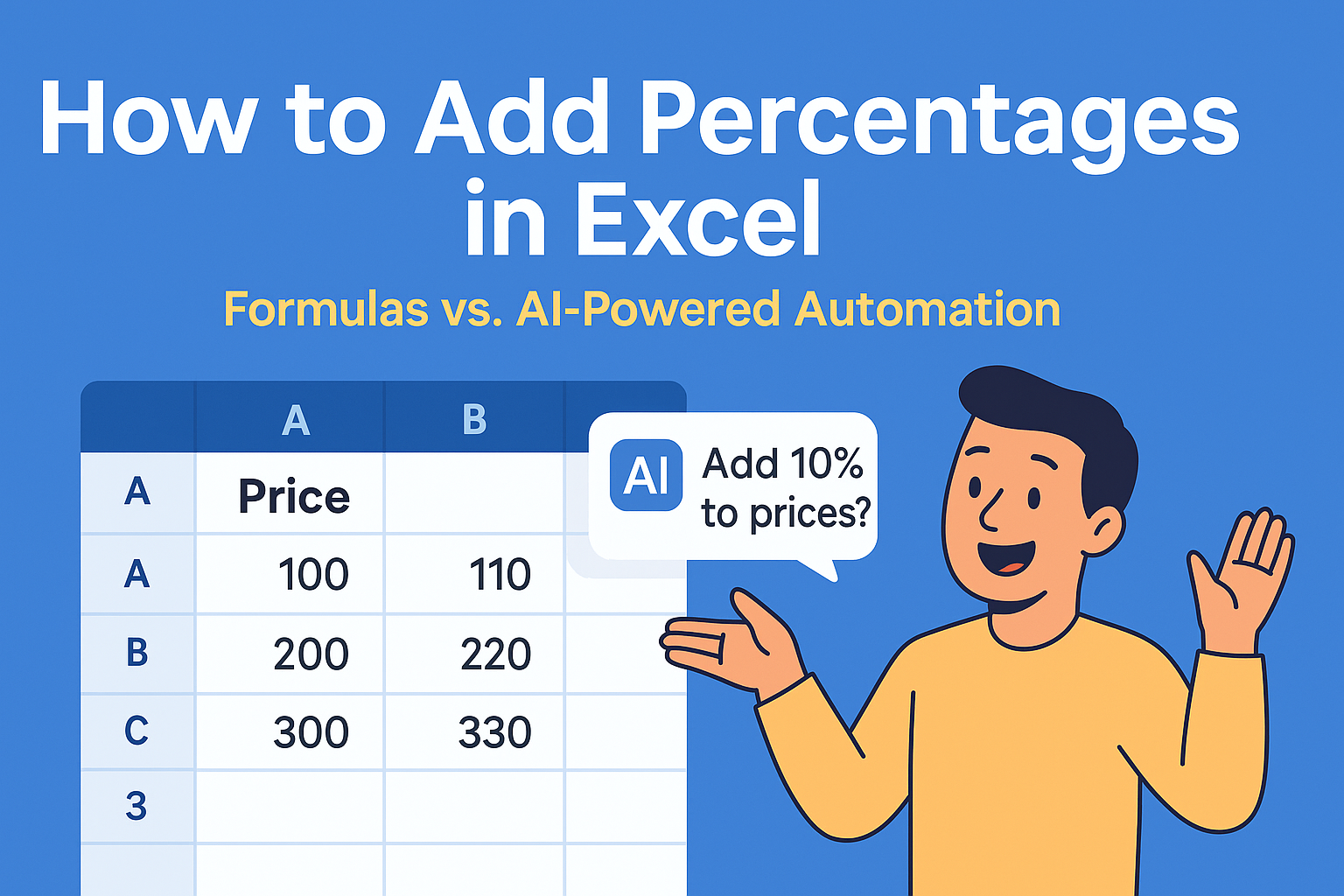
Excel and Google Sheets are the gold standard for financial modeling. To add a percentage in a spreadsheet, you use formulas that allow for dynamic updates. For instance, if cell A1 contains your initial investment and B1 contains the percentage growth, the formula =A1*(1+B1) automatically calculates the new total. For complex financial tracking, such as adding different percentage increases for inflation, taxes, and reinvestment across a 30-year timeline, spreadsheets are indispensable.
Mental Math Shortcuts for Quick Financial Decisions
In boardrooms or during networking events, you may need to add percentages on the fly. The “10% rule” is the most effective shortcut. To add 15% to a number, find 10% (move the decimal one place to the left), take half of that (which is 5%), and add them both to the original number.
If a business dinner costs $160 and you want to add a 20% tip, 10% is $16. Double that to get 20%, which is $32. $160 + $32 = $192. These shortcuts allow for quick decision-making without reaching for a calculator.
Avoiding Common Mistakes in Percentage Adjustments
The most common mistake in financial percentage addition is treating percentages as “absolute” numbers rather than “relative” ones. For example, if your investment drops by 50%, you cannot simply “add” 50% back to get to your original starting point.
If $100 drops 50%, you have $50. To get back to $100, you must add 100% to that $50. This “asymmetry of loss” is a crucial concept in risk management. Always remember that the base number changes once a percentage is added or subtracted, and your subsequent calculations must reflect that new reality.
By mastering the various ways to add percentages—from simple markups to complex compound interest—you equip yourself with the mathematical precision necessary for financial success. Whether you are managing a household budget, a stock portfolio, or a multinational corporation, the ability to accurately calculate growth and costs is the key to long-term fiscal stability and prosperity.
aViewFromTheCave is a participant in the Amazon Services LLC Associates Program, an affiliate advertising program designed to provide a means for sites to earn advertising fees by advertising and linking to Amazon.com. Amazon, the Amazon logo, AmazonSupply, and the AmazonSupply logo are trademarks of Amazon.com, Inc. or its affiliates. As an Amazon Associate we earn affiliate commissions from qualifying purchases.