
In the intricate world of finance, numbers are the universal language, and percentages serve as one of its most critical dialects. From the daily grind of budgeting and managing expenses to the strategic decisions in investing and business operations, the ability to confidently add a percentage to a number is not merely an academic exercise; it’s a foundational skill for financial literacy and empowerment. Whether you’re trying to calculate sales tax on a purchase, determine the total cost of a loan with interest, project investment growth, or understand a business markup, this seemingly simple mathematical operation underpins a vast array of financial scenarios.
This guide will demystify the process of adding a percentage to a number, transforming a potentially intimidating calculation into an intuitive and accessible tool. We’ll explore the fundamental principles, walk through step-by-step methods, delve into diverse real-world financial applications, and highlight best practices to ensure accuracy and confidence in your financial computations. By mastering this essential skill, you’ll gain greater control over your money, make more informed financial decisions, and navigate the complex financial landscape with newfound clarity and precision.
The Fundamentals: Understanding Percentages in Finance
Before we dive into the mechanics of adding percentages, it’s crucial to grasp what a percentage truly represents, especially within a financial context. A solid understanding of this fundamental concept is the bedrock upon which all subsequent calculations are built.
What is a Percentage? A Financial Perspective
At its core, a percentage is a way of expressing a number as a fraction of 100. The word “percent” literally means “per hundred.” So, 25% means 25 out of 100, or 25/100, which can also be written as the decimal 0.25. In finance, this concept is incredibly versatile, allowing us to quantify proportions, rates, and changes in a standardized and easily comparable manner.
Consider its utility:
-
Rates: Interest rates on savings accounts or loans (e.g., 5% annual interest) tell you how much of the principal you’ll earn or owe over a year.
-
Changes: Inflation rates (e.g., 3% increase year-over-year) indicate the percentage by which prices have risen. Stock market gains or losses are often expressed as percentages.
-
Proportions: A discount of 15% tells you what proportion of the original price is being subtracted. A sales tax of 7% tells you what proportion of your purchase price is added to the total.
-
Growth: Business growth is frequently measured in percentage terms, illustrating the rate at which revenue or profits are expanding.
The ability to translate percentages into decimals is paramount, as most mathematical calculations involving percentages require this conversion. To convert a percentage to a decimal, simply divide the percentage by 100 (or move the decimal point two places to the left). For example, 10% becomes 0.10, and 7.5% becomes 0.075.
The ‘Why’ Behind Adding Percentages
The act of “adding a percentage to a number” in finance is not just about increasing a value; it’s about reflecting real-world financial dynamics. This operation is indispensable in a multitude of scenarios, often representing an accrual, an increase, or an additional charge based on a principal amount.
Think about:
-
Taxes: When you buy goods or services, sales tax (a percentage) is added to the item’s base price to determine the total you pay. Income tax rates dictate what percentage of your earnings is owed to the government.
-
Tips: In many service industries, a tip (a percentage of the bill) is added to compensate staff.
-
Interest: On a savings account, interest (a percentage) is added to your principal, leading to growth. Conversely, on a loan or credit card, interest is added to the outstanding balance, increasing your debt.
-
Markups: Businesses add a percentage markup to the cost of goods to determine their selling price and ensure profitability.
-
Inflation: To understand the future cost of living or goods, one might add an estimated inflation percentage to current prices.
-
Investment Growth: Projecting the future value of an investment often involves adding a percentage return year after year.
Understanding why these percentages are added helps solidify the conceptual framework and makes the calculations more intuitive. It’s about reflecting the natural flow and requirements of financial transactions and economic phenomena.
Step-by-Step Guide: Adding a Percentage to a Number
Now, let’s explore the practical methods for performing this crucial calculation. There are primarily two approaches, both yielding the same result, but each offering slight advantages depending on the context and personal preference.
Method 1: The Two-Step Approach (Calculate and Add)
This method is perhaps the most intuitive for beginners, as it breaks the process into two clear, distinct steps.
Step 1: Convert the Percentage to a Decimal.
As discussed, divide the percentage by 100.
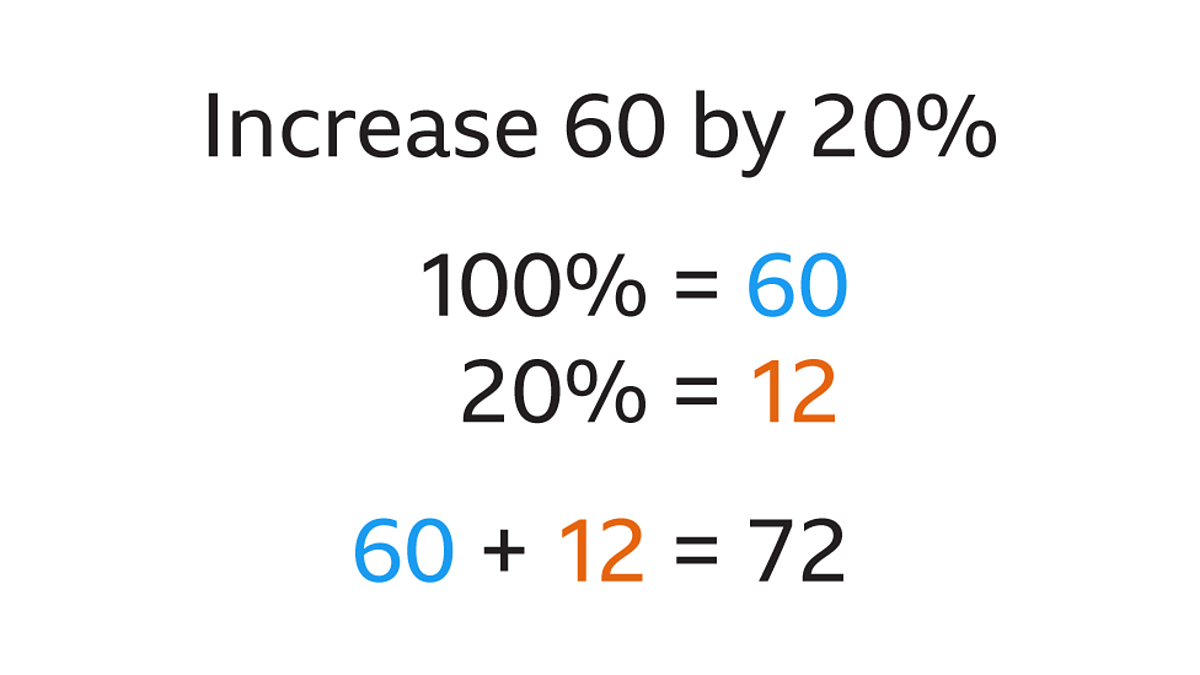
- Example: If the percentage is 8%, convert it to 0.08 (8 ÷ 100).
Step 2: Calculate the Percentage Amount.
Multiply the decimal form of the percentage by the original number. This gives you the value of the percentage that needs to be added.
- Example: If the original number is $200 and the percentage is 8%, then 0.08 * $200 = $16. This is the 8% “amount.”
Step 3: Add the Percentage Amount to the Original Number.
Simply add the value calculated in Step 2 to your original number. This gives you the final total.
- Example: $200 (original number) + $16 (percentage amount) = $216.
Case Study: Sales Tax Calculation
Imagine you’re buying a new gadget for $750, and the sales tax in your state is 6.5%.
-
Convert: 6.5% / 100 = 0.065
-
Calculate Percentage Amount: 0.065 * $750 = $48.75
-
Add: $750 + $48.75 = $798.75
Your total cost for the gadget, including sales tax, would be $798.75.
This method is excellent for demonstrating the individual components of the calculation – the base amount, the percentage add-on, and the final total – which can be particularly insightful for financial reporting or analysis.
Method 2: The Direct Calculation Approach (Factor Method)
This method streamlines the process into a single multiplication step, making it faster and often preferred for spreadsheet calculations or when you don’t need to see the intermediate percentage amount.
Step 1: Convert the Percentage to a Decimal and Add 1.
First, convert the percentage to its decimal form. Then, add 1 to this decimal. The “1” represents 100% of the original number itself. By adding the percentage (e.g., 0.08) to 1, you create a “factor” that simultaneously accounts for the original number and the added percentage.
- Example: If the percentage is 8%, convert it to 0.08. Then, 1 + 0.08 = 1.08.
Step 2: Multiply the Factor by the Original Number.
Multiply this factor directly by your original number. The result will be the original number plus the percentage amount.
- Example: If the original number is $200 and the factor is 1.08, then 1.08 * $200 = $216.
Case Study: Price Markup for a Business
A business purchases a product for $50 and wants to apply a 40% markup to determine its selling price.
-
Convert and Add 1: 40% / 100 = 0.40. Then, 1 + 0.40 = 1.40.
-
Multiply: 1.40 * $50 = $70.
The selling price of the product, after a 40% markup, would be $70. This method quickly reveals the profitable selling price.

Choosing the Right Method
Both methods are mathematically sound and will yield the same correct answer.
-
The Two-Step Approach is often better when you need to visualize or explicitly state the monetary value of the percentage addition (e.g., “$16 in taxes was added to your bill”). It can be clearer for explaining calculations to others or for internal auditing.
-
The Direct Calculation Approach is more efficient and compact, making it ideal for calculations involving multiple percentages, spreadsheet formulas, or quick mental estimations once you’re comfortable with it. When calculating compound interest over many periods, this method is especially powerful.
Ultimately, the choice comes down to personal preference and the specific context of your financial calculation. Familiarity with both methods provides flexibility and a deeper understanding.
Real-World Financial Applications and Case Studies
The ability to add percentages is not just a theoretical concept; it’s a practical skill with extensive applications across personal and business finance. Let’s explore some key areas where this calculation is routinely employed.
Sales Tax and Tips: Everyday Transactions
Perhaps the most common everyday application of adding percentages involves sales tax and tips.
-
Sales Tax: Almost every retail purchase involves sales tax. If an item costs $45 and the sales tax rate is 7%, using the direct method: $45 * (1 + 0.07) = $45 * 1.07 = $48.15. This quickly gives you the total out-the-door price.
-
Tips: When dining out, you often add a tip (e.g., 15-20%) to your bill. If your meal is $60 and you want to leave a 18% tip: $60 * (1 + 0.18) = $60 * 1.18 = $70.80. This tells you the total amount you’ll pay, including the tip. Mastering this helps manage your spending and ensure proper gratuity.
Interest Calculations: Savings, Loans, and Investments
Interest is essentially the cost of borrowing money or the reward for lending/saving money, expressed as a percentage.
-
Savings Accounts/Investments: If you have $1,000 in a savings account earning 2% annual interest, after one year: $1,000 * (1 + 0.02) = $1,000 * 1.02 = $1,020. This is how your money grows. Over multiple years, this becomes a compound interest calculation, where the interest is added to the principal, and then the next year’s interest is calculated on the new, larger principal.
-
Loans/Credit Cards: If you owe $5,000 on a credit card with an 18% annual interest rate, and no payments are made for a month (simplified monthly calculation): $5,000 * (1 + (0.18/12)) = $5,000 * 1.015 = $5,075. Your balance grows by the interest charged. Understanding this helps illustrate the true cost of debt and the power of compound interest working against you.
Business Finance: Markups, Margins, and Price Increases
For businesses, adding percentages is fundamental to profitability and financial strategy.
-
Product Markups: If a clothing store buys a shirt for $25 and wants a 100% markup (to double the price) to cover overhead and profit: $25 * (1 + 1.00) = $25 * 2 = $50. This is the selling price.
-
Service Price Adjustments: A consultant charges $150 per hour but decides to increase their rate by 10% next year due to demand: $150 * (1 + 0.10) = $150 * 1.10 = $165. This calculation is crucial for managing revenue and perceived value.
-
Budget Increases: If a department’s annual budget is $50,000 and it’s projected to increase by 5% next year: $50,000 * (1 + 0.05) = $50,000 * 1.05 = $52,500. This helps in forward planning and resource allocation.
Economic Growth and Inflation
On a macroeconomic level, percentages are used to describe the overall health and changes within an economy.
-
Inflation: If the cost of a basket of goods was $100 last year and inflation is 3% this year, the equivalent cost today would be $100 * (1 + 0.03) = $103. Understanding inflation helps individuals and businesses plan for rising costs.
-
GDP Growth: A country’s Gross Domestic Product (GDP) might grow by a certain percentage year-over-year. If GDP was $20 trillion last year and grew by 2% this year: $20 trillion * (1 + 0.02) = $20.4 trillion. This metric is a key indicator of economic expansion or contraction.
These examples underscore the ubiquitous nature of percentage additions in financial decision-making, from the personal budget to the national economy.
Common Pitfalls and Best Practices
While adding percentages might seem straightforward, certain pitfalls can lead to errors. Adopting best practices can ensure accuracy and build confidence in your financial calculations.
Avoiding Decimal Conversion Errors
The most frequent mistake involves incorrectly converting percentages to decimals.
-
Rule: Always divide the percentage by 100, or move the decimal point two places to the left.
-
Common Error: Forgetting to move the decimal two places, or mistakenly using a percentage directly in a calculation (e.g., multiplying by “5” instead of “0.05” for 5%).
-
Example: 5% is 0.05, not 0.5. 0.5 represents 50%.
-
Best Practice: Double-check your decimal conversion, especially for single-digit percentages or percentages with decimal points (e.g., 7.25% becomes 0.0725).
Understanding the Base Number
It’s critical to always identify the correct “base number” to which the percentage is being added. A percentage is always “of” something.
-
Problem: Applying a percentage to the wrong number. For instance, calculating a raise on a post-tax salary instead of the gross salary, or calculating interest on a payment instead of the principal.
-
Example: If an item is on sale for $80 (after a 20% discount from its original price), and you want to find the original price, you cannot simply add 20% to $80. The 20% discount was off a different (higher) base number. This scenario requires a different calculation (division, not addition).
-
Best Practice: Before calculating, explicitly ask yourself: “What is this percentage of?” Ensure you’re multiplying the percentage (in decimal form) by the correct initial amount.
Leveraging Financial Tools
While mental math and manual calculations are excellent for understanding the process, financial tools enhance efficiency and reduce human error, especially for complex or repetitive calculations.
-
Calculators: Basic and scientific calculators are indispensable. Many modern calculators even have a “%” button, though understanding the manual conversion to decimal is still recommended for conceptual clarity.
-
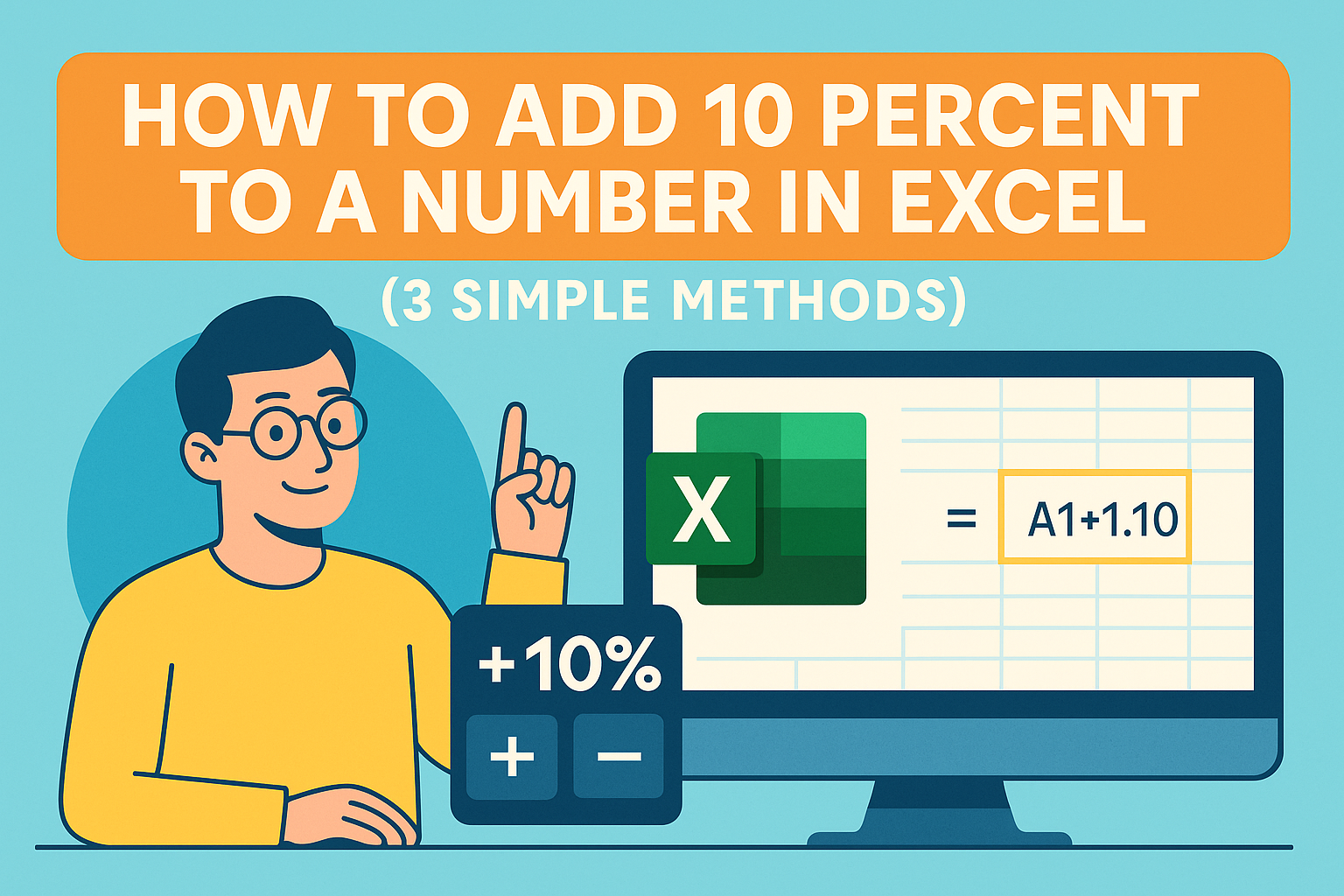
Spreadsheets (e.g., Excel, Google Sheets): Spreadsheets are incredibly powerful for financial calculations. They allow you to set up formulas (e.g.,
B2*(1+C2)) that automatically update if numbers change, build complex financial models, and perform calculations on large datasets. -
Online Converters and Apps: Many online tools and smartphone apps are designed for specific financial calculations (e.g., tip calculators, loan interest calculators). While convenient, always verify the logic they use, especially for critical financial decisions.
-
Best Practice: For any significant financial planning or business operation, learn to use spreadsheets. Their accuracy and flexibility are unparalleled for managing financial data and projections.
By being mindful of these common pitfalls and adopting best practices, you can perform percentage additions with confidence, accuracy, and efficiency, enhancing your overall financial acumen.
Conclusion
Mastering the art of adding a percentage to a number is far more than a simple arithmetic skill; it is a cornerstone of financial literacy. In a world increasingly driven by data and numerical analysis, the ability to confidently navigate percentages empowers individuals and businesses alike to make astute, informed decisions.
From calculating the everyday costs of sales tax and tips to understanding the growth trajectory of investments, the true cost of loans, or the profitability of a business, this fundamental mathematical operation is woven into the very fabric of financial life. By understanding the underlying concepts, applying the step-by-step methods, and being aware of common pitfalls, you equip yourself with a powerful tool for managing money effectively.
Embrace the clarity that comes with financial understanding. Practice these calculations regularly, leverage the power of financial tools, and continuously seek to deepen your comprehension of how percentages shape your financial landscape. This seemingly small skill will unlock a greater sense of control and confidence, enabling you to build a more secure and prosperous financial future.
aViewFromTheCave is a participant in the Amazon Services LLC Associates Program, an affiliate advertising program designed to provide a means for sites to earn advertising fees by advertising and linking to Amazon.com. Amazon, the Amazon logo, AmazonSupply, and the AmazonSupply logo are trademarks of Amazon.com, Inc. or its affiliates. As an Amazon Associate we earn affiliate commissions from qualifying purchases.