
In the modern digital economy, the ability to accept credit card payments online is no longer a luxury—it is the bedrock of business liquidity and growth. For entrepreneurs and established enterprises alike, the transition from traditional invoicing to automated digital clearinghouses represents a fundamental shift in how capital is managed. However, navigating the complex web of merchant accounts, payment gateways, and fee structures requires more than just a technical setup; it requires a sophisticated understanding of business finance.
Selecting the right method to process payments impacts your bottom line, your cash flow, and your long-term financial stability. This guide explores the financial mechanisms of online payments, helping you optimize your revenue collection while minimizing the overhead costs associated with digital transactions.

The Financial Infrastructure: Understanding the Payment Ecosystem
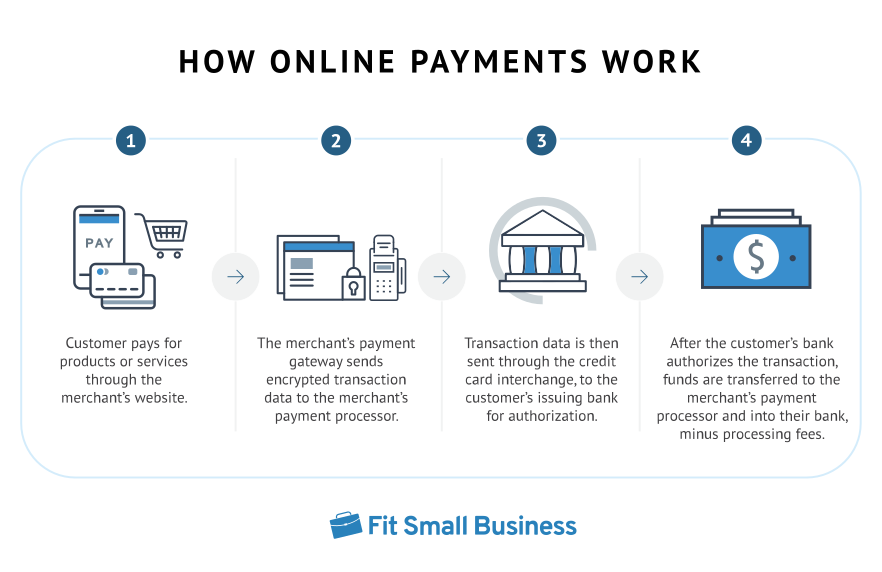
Before a single dollar reaches your business bank account, it travels through a sophisticated financial circuit. Understanding this infrastructure is the first step in making an informed decision about which providers to trust with your company’s revenue.
Merchant Accounts vs. Payment Service Providers (PSPs)
In the realm of business finance, there are two primary ways to hold the funds you collect: a dedicated merchant account or a Payment Service Provider (PSP). A dedicated merchant account is a specialized bank account created specifically for your business. While it often involves a more rigorous underwriting process and monthly fees, it provides greater stability and often lower transaction rates for high-volume businesses.
Conversely, PSPs like Stripe, PayPal, or Square aggregate thousands of small businesses into a single merchant account. This model is ideal for startups and mid-sized businesses because it offers rapid onboarding and a “pay-as-you-go” structure. From a financial planning perspective, PSPs offer predictability, though they may carry a slightly higher risk of sudden account freezes if your transaction patterns appear irregular.
The Role of the Payment Gateway
Think of the payment gateway as the digital equivalent of a physical point-of-sale terminal. Its primary financial function is to authorize transactions and ensure that the funds are available in the customer’s account. The gateway encrypts sensitive financial data and communicates between the “Acquiring Bank” (your bank) and the “Issuing Bank” (the customer’s bank). Choosing a gateway that integrates seamlessly with your existing financial tools is crucial for maintaining clean books and automated reconciliation.
Evaluating the Cost of Acceptance: Decoding Fee Structures
The most significant impact on your net profit margin comes from processing fees. In the world of business finance, not all fees are created equal. To maintain healthy margins, you must look beyond the “sticker price” of a provider.
Flat-Rate vs. Interchange-Plus Pricing
Most PSPs utilize a flat-rate pricing model (e.g., 2.9% + $0.30 per transaction). This is simple for financial forecasting because the cost remains constant regardless of the card type used. However, for businesses with high transaction volumes, this can be expensive.
Interchange-plus pricing is often considered the most transparent and cost-effective model for growing businesses. “Interchange” is the wholesale fee set by card networks (Visa, Mastercard), while the “Plus” is the markup taken by the processor. By using this model, businesses benefit from lower costs on debit cards or non-premium credit cards, which carry lower interchange rates. If your financial goal is to maximize every cent of margin, advocating for interchange-plus pricing is a strategic move.
Hidden Costs: Chargebacks and Monthly Maintenance
A comprehensive financial analysis of payment processing must account for “hidden” costs. Chargebacks occur when a customer disputes a charge with their bank. Beyond the loss of the sale, businesses are often hit with a chargeback fee ranging from $15 to $50. High chargeback rates can lead to your business being labeled “high-risk,” which increases your processing costs significantly.
Additionally, some traditional merchant accounts charge monthly statement fees, PCI compliance fees, and minimum processing fees. When calculating your effective rate—the total amount paid in fees divided by your total sales—you must include these fixed costs to get an accurate picture of your financial health.
Strategic Selection of Financial Tools and Integration
Accepting payments is only half the battle; the other half is managing that money once it arrives. The tools you choose to accept credit cards should act as an extension of your financial department.
Integration with Accounting and ERP Systems
Modern business finance relies on automation. The payment processor you select should offer deep integration with accounting software like QuickBooks, Xero, or NetSuite. When a credit card payment is accepted online, the transaction should automatically trigger an entry in your general ledger, update your accounts receivable, and account for the processing fee. This level of synchronization reduces human error, saves administrative hours, and provides real-time insights into your company’s cash position.
Managing Recurring Billing and Subscription Revenue
For businesses operating on a subscription model, the financial logic changes. You need a system capable of handling “dunning”—the process of communicating with customers when a credit card is declined or nears expiration. Automated dunning management is a vital financial tool that prevents “passive churn,” ensuring that your recurring revenue remains stable without requiring constant manual intervention from your billing team.
Risk Management and Financial Security Protocols
In digital finance, security is a form of asset protection. A breach of payment data is not just a technical failure; it is a catastrophic financial event that can result in massive fines, legal fees, and loss of consumer trust.
PCI Compliance and the Transfer of Liability
The Payment Card Industry Data Security Standard (PCI DSS) is a set of requirements designed to ensure that all companies that process, store, or transmit credit card information maintain a secure environment. From a financial risk perspective, it is often wise to use a “hosted” payment page or “tokenization.”
By using these methods, sensitive card data never actually touches your servers; instead, it goes directly to the processor, who returns a “token” for the transaction. This effectively transfers the bulk of the security liability to the processor, significantly lowering your insurance premiums and audit costs.
Optimizing Payout Timelines and Cash Flow
Cash flow is the lifeblood of any business. Different payment processors have different payout schedules, often ranging from “instant” to “T+3” (transaction plus three days). While some providers offer faster payouts for an extra fee, a disciplined financial manager will weigh the cost of that fee against the business’s immediate liquidity needs.
If your business operates on thin margins, waiting three days for funds to clear can be a challenge. Conversely, paying an extra 1% for instant access to funds can erode your annual profits. Balancing these payout cycles is a key component of effective treasury management.
Conclusion: The Financial Advantage of Optimized Payments
Accepting credit card payments online is a sophisticated financial operation that sits at the intersection of revenue generation and cost management. By looking past the ease of setup and focusing on the underlying financial structures—such as fee transparency, accounting integration, and risk mitigation—business owners can turn their payment processing from a mere utility into a competitive financial advantage.
As you scale, continue to audit your effective processing rates and reassess your provider as your volume increases. In the world of online business, your choice of how to accept money is just as important as how you earn it. By treating payment acceptance as a pillar of your financial strategy, you ensure that your business remains agile, profitable, and ready for the future of digital commerce.
aViewFromTheCave is a participant in the Amazon Services LLC Associates Program, an affiliate advertising program designed to provide a means for sites to earn advertising fees by advertising and linking to Amazon.com. Amazon, the Amazon logo, AmazonSupply, and the AmazonSupply logo are trademarks of Amazon.com, Inc. or its affiliates. As an Amazon Associate we earn affiliate commissions from qualifying purchases.