
The landscape of modern entrepreneurship has undergone a fundamental shift. No longer is a prestigious office address a prerequisite for commercial success. For the modern professional, the home has become the ultimate incubator for innovation and wealth creation. Starting a business from home is not merely a lifestyle choice; it is a sophisticated financial strategy that minimizes overhead, maximizes tax efficiency, and provides a direct path to diversified income streams. This guide explores the financial mechanics of launching a home-based enterprise, focusing on high-margin models, fiscal management, and long-term wealth building.
Identifying High-Margin Home Business Models
The primary advantage of a home-based business is the drastic reduction in fixed costs. Without the burden of commercial rent, utilities, and commuting expenses, a higher percentage of every dollar earned can be retained as profit. However, not all business models are created equal in terms of financial viability.
Service-Based Consulting and Professional Freelancing
For those with specialized skills—such as financial analysis, legal consulting, digital marketing, or project management—the service-based model offers the lowest barrier to entry. This model is built on “intellectual capital,” meaning your primary investment is time rather than inventory. From a wealth-building perspective, service-based businesses offer high margins because the cost of goods sold (COGS) is negligible. The goal here is to transition from hourly billing to value-based pricing, allowing you to decouple your income from the number of hours worked.
E-commerce and Strategic Arbitrage
The rise of global supply chains and digital marketplaces has made e-commerce a cornerstone of the home-based economy. Whether through dropshipping, private labeling, or artisanal production, the financial core of e-commerce is inventory turnover and margin management. Successful home-based retailers focus on high-demand niches with low return rates. By utilizing third-party logistics (3PL) providers, an entrepreneur can manage a global retail operation from a home office without ever touching a physical product, effectively turning a basement or spare room into a high-yield command center.
Digital Assets and Information Products
Scalability is the holy grail of finance. Digital products—such as online courses, proprietary software (SaaS), or subscription-based newsletters—allow for infinite replication at zero marginal cost. Once the initial asset is created, every subsequent sale is almost entirely profit. This model leverages the “build once, sell twice” philosophy, providing a powerful engine for passive income that can eventually be reinvested into traditional financial markets like stocks or real estate.
Financial Planning and Capital Management for Home-Based Startups
A business is only as strong as its balance sheet. Transitioning from an employee mindset to an owner mindset requires a rigorous approach to financial planning. Even the most innovative idea will fail if the cash flow is mismanaged.
Calculating Startup Costs and Lean Operations
The “Lean Startup” methodology is particularly effective for home-based businesses. Before launching, it is essential to create a comprehensive list of “Minimum Viable Costs.” This includes legal registration fees, basic technology infrastructure, and initial marketing spend. By avoiding “shiny object syndrome”—the tendency to buy unnecessary equipment or software—you preserve your capital for activities that generate a direct return on investment (ROI). Your initial goal is to reach the “break-even point” as quickly as possible to mitigate personal financial risk.
Managing Cash Flow and Separating Finances
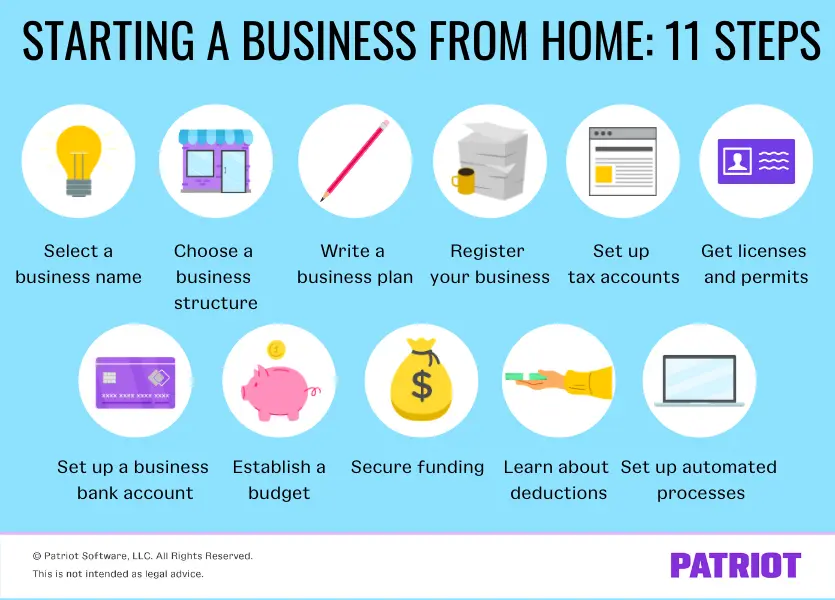
One of the most common mistakes home-based entrepreneurs make is the co-mingling of personal and business funds. From day one, it is imperative to open a dedicated business bank account and a business credit card. This separation is vital for two reasons: legal protection and financial clarity. It allows you to track business profitability accurately and simplifies the process of auditing your cash flow. Effective cash flow management involves maintaining a “cash cushion”—typically 3 to 6 months of operating expenses—to protect the business against seasonal fluctuations or unexpected market shifts.

Tax Implications and the Home Office Deduction
From a personal finance perspective, the tax benefits of a home-based business are significant. In many jurisdictions, entrepreneurs can deduct a portion of their home expenses—including mortgage interest, rent, utilities, and internet—provided the space is used exclusively for business. Understanding these deductions is critical for lowering your effective tax rate. Furthermore, home business owners can often take advantage of more generous retirement account contributions, such as a SEP-IRA or a Solo 401(k), which allow for higher tax-deferred savings than traditional employment-based plans.
Navigating Legal Structures and Financial Security
Choosing the right legal framework for your business is a foundational financial decision. The structure you choose affects your personal liability, your tax obligations, and your ability to raise capital or sell the business in the future.
Choosing the Right Business Entity
For most home-based businesses, the choice lies between a Sole Proprietorship, a Limited Liability Company (LLC), or an S-Corp. While a Sole Proprietorship is the simplest to set up, it offers no protection for personal assets. An LLC is often the preferred choice for the home-based entrepreneur as it creates a “corporate veil,” protecting personal savings and property from business-related lawsuits or debts. As the business grows and net income reaches a certain threshold, transitioning to an S-Corp can provide significant savings on self-employment taxes, allowing the owner to distribute a portion of the profits as dividends.
Insurance and Risk Mitigation
Operating from home does not exempt a business from risk. Standard homeowners’ insurance policies rarely cover business-related liabilities or equipment. To protect your financial health, it is necessary to investigate professional liability insurance (errors and omissions) and general liability insurance. If you have inventory or specialized equipment, an “in-home business policy” or a rider on your existing insurance can prevent a single catastrophic event from wiping out your business capital.
Retirement Planning for the Self-Employed
One of the greatest challenges of leaving a corporate job is the loss of structured retirement benefits. However, the home-based business owner has access to powerful wealth-building tools that are often superior to those offered by employers. The Solo 401(k), for instance, allows for contributions both as an employee and as an employer, significantly increasing the amount of capital that can be moved into tax-advantaged investments. Consistent, automated contributions to these accounts ensure that your home business is not just paying today’s bills, but also securing your financial future.
Scaling Income Through Reinvestment and Outsourcing
The ultimate goal of a home-based business should be to evolve from a “job you own” into a “wealth-generating asset.” This transition requires a strategic approach to scaling and the intelligent reinvestment of profits.
Transitioning from Solopreneur to Business Owner
Many entrepreneurs get trapped in the “technician” phase, doing all the work themselves. To scale, you must begin to outsource low-value tasks. This might mean hiring a virtual assistant to handle administrative duties or a specialized agency to manage digital advertising. From a financial standpoint, if your time is worth $100 an hour and you can outsource a task for $25 an hour, you are creating a $75 per hour “profit” in the form of reclaimed time. This time can then be spent on high-level strategy, business development, or exploring new revenue streams.
Reinvesting Profits for Compound Growth
Wealth is built by putting your money to work. Once your home-based business is profitable and you have established an emergency fund, the excess cash should be strategically deployed. This can take two forms: internal reinvestment or external diversification. Internal reinvestment might involve upgrading your technology stack to increase efficiency or increasing your marketing budget to capture more market share. External diversification involves taking profits out of the business and investing them in diversified index funds, real estate, or other income-producing assets. This creates a multi-layered financial safety net, ensuring that your net worth continues to grow regardless of the business’s performance in any given month.

The Exit Strategy: Building a Saleable Asset
Even if you have no immediate plans to stop working, you should build your home business as if you intend to sell it. This means documenting all processes, maintaining impeccable financial records, and ensuring the business can operate without your constant involvement. A business that is dependent on the owner’s constant presence is merely a job; a business that runs on systems and processes is a saleable asset. When a home business is structured this way, it can eventually be sold for a multiple of its annual earnings, providing a significant “liquidity event” that can fund retirement or the launch of a much larger venture.
Starting a business from home is a journey toward financial sovereignty. By selecting a high-margin model, maintaining rigorous fiscal discipline, and viewing the enterprise through the lens of long-term wealth creation, the home-based entrepreneur can achieve a level of financial security and freedom that traditional employment rarely provides. The home office is no longer just a room in the house; it is the engine of your financial future.
aViewFromTheCave is a participant in the Amazon Services LLC Associates Program, an affiliate advertising program designed to provide a means for sites to earn advertising fees by advertising and linking to Amazon.com. Amazon, the Amazon logo, AmazonSupply, and the AmazonSupply logo are trademarks of Amazon.com, Inc. or its affiliates. As an Amazon Associate we earn affiliate commissions from qualifying purchases.