
For countless investors worldwide, understanding the mechanics of their holdings is paramount. Among the most popular and widely held investment vehicles is the Vanguard S&P 500 ETF, commonly known by its ticker symbol, VOO. This exchange-traded fund offers broad exposure to 500 of the largest U.S. companies, making it a cornerstone for many diversified portfolios. A frequent question that arises for both new and seasoned investors alike concerns its dividend distribution: “How often does VOO pay dividends?”
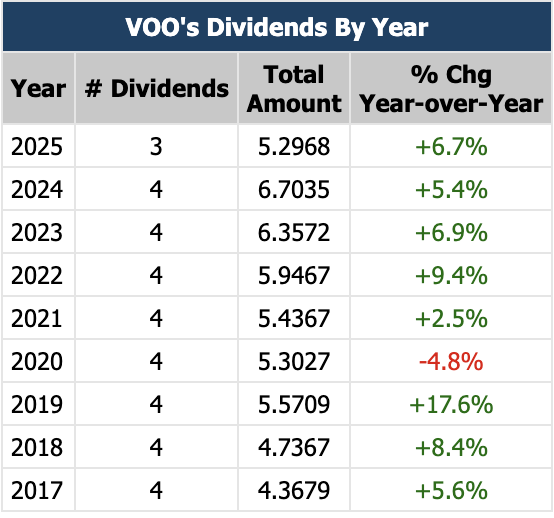
The straightforward answer is that VOO pays dividends on a quarterly basis. This means investors can expect to receive distributions four times a year. While the frequency is consistent, delving deeper into VOO’s dividend structure, the underlying mechanics, and how these dividends can impact your overall investment strategy provides a much richer understanding. Dividends, after all, represent a crucial component of total return, offering either direct income or the powerful potential for compounding growth through reinvestment.
Understanding VOO and Its Dividend Mechanism
To fully appreciate VOO’s dividend schedule, it’s essential to first grasp what VOO is and how it functions as an investment vehicle designed to track the performance of the S&P 500 index.
What is VOO?
VOO is an Exchange-Traded Fund (ETF) managed by Vanguard, one of the world’s largest investment companies. Its primary objective is to mirror the performance of the S&P 500 Index, which comprises 500 of the largest publicly traded companies in the United States, selected by Standard & Poor’s based on criteria like market size, liquidity, and sector representation. By investing in VOO, you effectively gain exposure to a broad swath of the U.S. economy, benefiting from the collective growth and profitability of these corporate giants.
ETFs like VOO offer several advantages: they provide instant diversification across hundreds of companies, typically have very low expense ratios (meaning more of your money works for you), and are highly liquid, trading on stock exchanges throughout the day like individual stocks. Unlike actively managed funds that aim to beat the market, VOO is a passive index fund, striving simply to match the market’s performance, which historically has been a winning strategy for long-term investors.
How ETFs Generate Dividends
The dividends distributed by VOO don’t magically appear; they originate from the underlying companies within its portfolio. When you own shares of VOO, you indirectly own tiny fractions of all 500 companies in the S&P 500. Many of these companies regularly pay out a portion of their profits to their shareholders in the form of dividends.
VOO, as a fund, collects these dividends from the hundreds of individual stocks it holds. Because its mandate is to track the index and operate efficiently, VOO then pools these collected dividends and distributes them proportionally to its own shareholders (you, the investor), after deducting its minimal operating expenses. This means that VOO’s dividend payout is essentially an aggregation of the dividends paid by the constituent companies of the S&P 500. It’s a diversified stream of income, less susceptible to the dividend policy changes of a single company.
The Importance of Dividend Frequency
For many investors, dividend frequency is more than just a logistical detail; it’s a strategic consideration. Quarterly payouts offer a consistent, albeit not monthly, stream of income that can be predictable enough for financial planning. For those in retirement or seeking to supplement their income, quarterly dividends contribute to a regular cash flow. For growth-oriented investors, frequent dividends mean more opportunities for compounding through dividend reinvestment plans (DRIPs), where the distributed cash is used to purchase additional shares of VOO, thereby accelerating the growth of their investment. Understanding this rhythm allows investors to align their expectations and financial goals with the fund’s distribution schedule.
The Quarterly Payout Schedule of VOO
Knowing that VOO pays dividends quarterly is the first step. The next is understanding when these distributions typically occur and the critical dates associated with them.
Specific Payout Months
VOO generally follows a consistent schedule for its dividend distributions, typically paying out in the months of March, June, September, and December. While these are the standard months, it’s important to note that the exact payment date within each month can vary slightly from quarter to quarter and year to year. Vanguard, like other fund managers, announces these dates officially well in advance, usually a few weeks before the payment is made. This allows investors to plan accordingly, whether they are relying on the income or have set up automatic reinvestment.
Key Dividend Dates to Know
Several key dates dictate eligibility and timing for dividend payments. Understanding these helps investors manage their expectations and ensure they qualify for a particular distribution.
- Declaration Date: This is the date on which Vanguard’s board of directors formally announces the dividend, specifying the amount per share, the ex-dividend date, the record date, and the payment date.
- Ex-Dividend Date: This is arguably the most crucial date for investors. To receive the upcoming dividend, you must purchase VOO shares before the ex-dividend date. If you buy on or after this date, the seller (who owned the shares before this date) will receive the dividend, not you. On the ex-dividend date, the share price of VOO typically drops by roughly the amount of the dividend, reflecting that new buyers will not receive the distribution.
- Record Date: This date, usually one or two business days after the ex-dividend date, is when Vanguard officially records who its shareholders are. Anyone listed as a shareholder on the record date will receive the dividend.
- Payment Date: This is the date when the declared dividend is actually paid out to eligible shareholders. The funds are typically deposited directly into your brokerage account.
Keeping track of these dates, especially the ex-dividend date, is vital for investors looking to time their purchases or sales around dividend distributions, though for long-term investors, the day-to-day timing is less critical than the overall strategy.
Where to Find Official Dividend Information
For the most accurate and up-to-date information regarding VOO’s dividend schedule and amounts, investors should always refer to official sources. The Vanguard official website for VOO is the primary and most reliable source. Here, you can find historical dividend data, upcoming distribution schedules, and official announcements. Additionally, most reputable brokerage platforms provide detailed dividend histories and upcoming payment information for the ETFs and stocks they offer. Financial news websites and data aggregators also compile this information, but cross-referencing with Vanguard’s official site is always a good practice to ensure accuracy.
Factors Influencing VOO’s Dividend Yield and Amount
While VOO’s dividend frequency is consistent, the actual amount distributed per share and its corresponding yield can fluctuate. These variations are influenced by a range of factors inherent to the nature of an S&P 500 index fund.
Performance of Underlying S&P 500 Companies
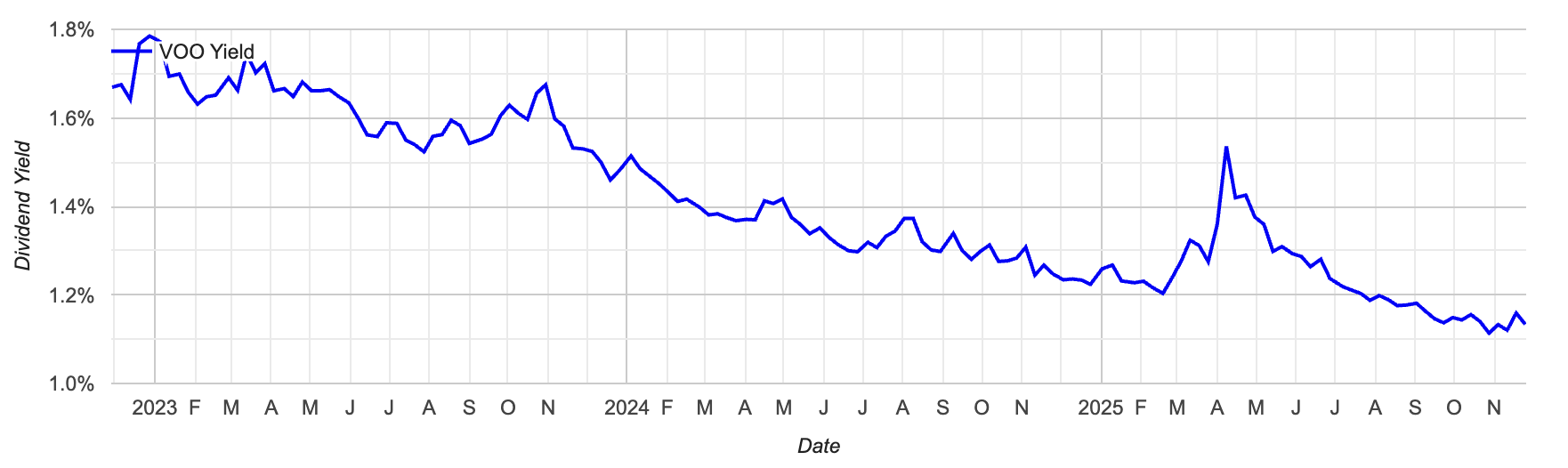
The most significant factor influencing VOO’s dividend is the collective performance and dividend policies of the 500 companies it holds. If a large number of these companies experience strong earnings growth and decide to increase their dividend payouts to shareholders, VOO will collect more in dividends, leading to higher distributions for its own investors. Conversely, during economic downturns or periods of corporate stress, companies may reduce or even suspend their dividends to conserve cash. Such widespread actions among S&P 500 constituents would naturally lead to a reduction in VOO’s dividend payouts. VOO is a reflection of the S&P 500’s underlying health, including its dividend-paying capacity.
Overall Market Conditions
Broader economic cycles and market conditions play a crucial role. In a robust economic environment, corporate profits tend to be higher, encouraging companies to reward shareholders with increased dividends. During recessions or periods of uncertainty, companies often become more cautious, prioritizing reinvestment or debt reduction over dividend increases. Furthermore, interest rate environments can also indirectly affect dividend policies; for instance, in a low-interest-rate environment, dividends might become more attractive relative to bond yields, potentially influencing corporate decisions to increase payouts.
VOO’s Expense Ratio
While minuscule, VOO’s expense ratio does have a marginal impact on the net dividend distributed. An ETF’s expense ratio is the annual fee charged as a percentage of assets under management. VOO is renowned for its ultra-low expense ratio (currently 0.03%), meaning only a tiny fraction of the dividends collected from underlying companies is retained to cover fund operating costs. While this effect is minimal, it’s technically a factor that slightly reduces the gross dividends collected before they are passed on to shareholders. Other S&P 500 ETFs with higher expense ratios would, all else being equal, distribute slightly less in dividends.
Reinvestment Strategy vs. Income Generation
The decision to reinvest dividends or take them as income can also be viewed as influencing the effective ‘amount’ an investor receives, though not the declared dividend per share. If you opt for a Dividend Reinvestment Plan (DRIP), the cash dividend is automatically used to purchase more VOO shares. This increases your total share count, which in turn means you’ll receive a larger cash distribution in subsequent quarters (assuming the dividend per share remains constant). For those focused on long-term growth and compounding, reinvesting dividends amplifies future returns. Those seeking income, however, will receive the cash directly, which provides immediate liquidity but foregoes the compounding effect. The choice ultimately depends on individual financial goals and current needs.
Integrating VOO Dividends into Your Investment Strategy
Understanding how VOO pays dividends is just the beginning. The real value lies in strategically incorporating these distributions into your broader investment plan to maximize your financial outcomes.
Compounding Power Through Reinvestment
One of the most powerful strategies for long-term wealth accumulation is dividend reinvestment. When you choose to reinvest VOO’s quarterly dividends, the cash received is automatically used to purchase additional shares or fractional shares of VOO. This process creates a “snowball effect.” Each new share you acquire generates its own dividends in subsequent quarters, which then buys even more shares, and so on. Over decades, this compounding can significantly enhance your total returns, often contributing a substantial portion of an investment’s overall growth, particularly in broad market index funds like VOO. For young investors or those with a long investment horizon, setting up a DRIP for VOO is often considered a highly effective and disciplined approach.
Using Dividends for Income Generation
While compounding is attractive for long-term growth, many investors, particularly those in or approaching retirement, prioritize current income. VOO’s quarterly dividends can serve as a reliable source of passive income. Instead of reinvesting, these investors can choose to have the dividend payouts deposited as cash into their brokerage account, which can then be used to cover living expenses, fund other investments, or simply provide supplemental cash flow. While VOO is not typically considered a high-yield dividend ETF, its broad market exposure means the income stream is diversified and generally stable, albeit subject to market fluctuations. It can be a component of a larger income-focused portfolio when combined with other higher-yielding assets.
Tax Implications of Dividends
It’s crucial to consider the tax implications of VOO dividends, as they are typically taxable events unless held in a tax-advantaged account. Dividends from U.S. companies (which VOO largely holds) are generally classified as either “qualified” or “ordinary” dividends. Qualified dividends are taxed at lower long-term capital gains rates, while ordinary dividends are taxed at your regular income tax rate. Most dividends from VOO are considered qualified, which is generally favorable for investors.
However, the specific tax treatment can vary based on your income level, tax bracket, and whether the VOO shares are held in a taxable brokerage account or a tax-advantaged account like an IRA or 401(k). In tax-advantaged accounts, dividends typically grow tax-deferred or tax-free until withdrawal, offering a significant benefit. It’s always advisable to consult with a qualified tax professional to understand how VOO dividends will affect your personal tax situation and to strategize for tax efficiency.
VOO vs. Other Dividend-Focused ETFs
While VOO pays dividends quarterly, it’s important to differentiate its role from that of ETFs specifically designed for higher dividend yields or dividend growth.
VOO as a Growth-Oriented Dividend Payer
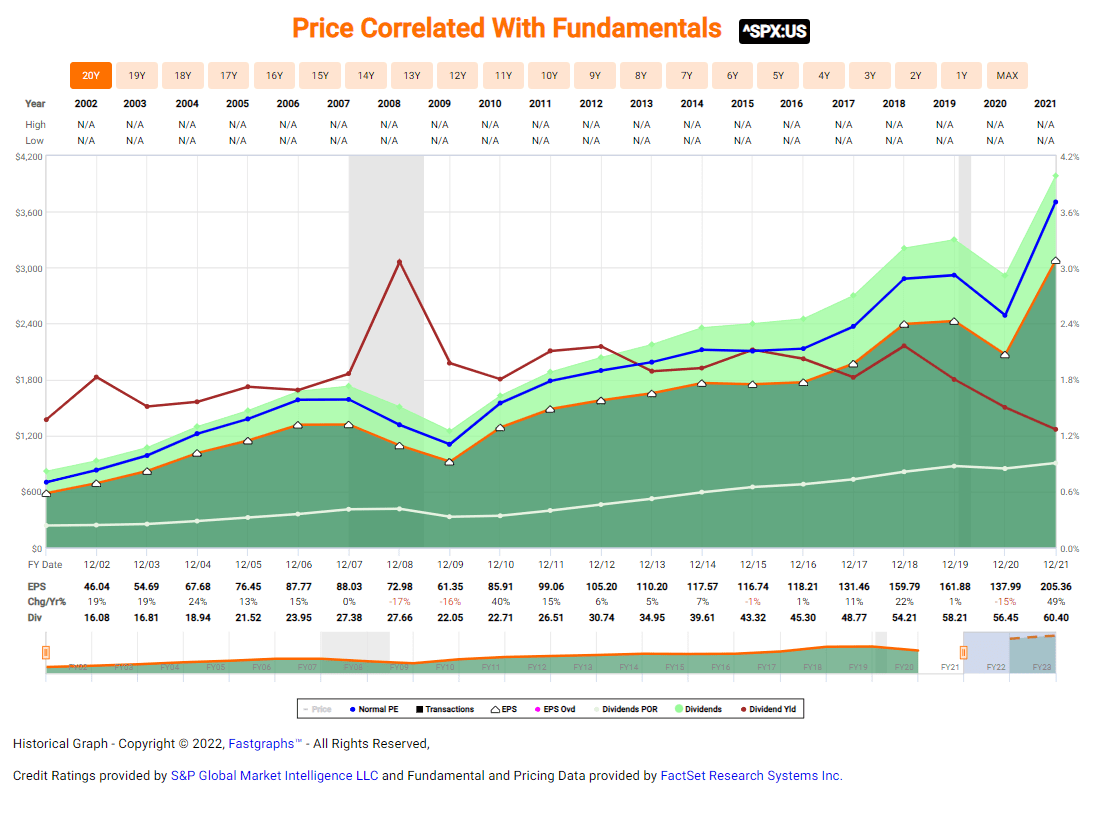
VOO’s primary objective is capital appreciation by tracking the S&P 500. Its dividends are a natural byproduct of the underlying companies’ profitability, not the fund’s main focus. As such, VOO typically offers a moderate dividend yield, reflecting the average yield of the large-cap U.S. market. It’s an excellent choice for investors seeking broad market exposure with the benefit of consistent, growing dividends from high-quality companies, rather than prioritizing a very high current yield. The growth potential of the S&P 500, combined with its dividends, contributes to robust total returns over the long term.
When to Consider Dedicated Dividend ETFs
For investors whose primary goal is to maximize current income or focus specifically on companies with a strong history of dividend growth, there are other ETFs that might be more suitable. These dedicated dividend ETFs often employ specific screening criteria, such as investing in companies with consistently increasing dividends (dividend aristocrats/champions) or those with historically higher yields. Examples include:
- Vanguard Dividend Appreciation ETF (VIG): Focuses on companies with a history of increasing their dividends.
- Vanguard High Dividend Yield ETF (VYM): Targets companies with higher-than-average dividend yields.
- Schwab U.S. Dividend Equity ETF (SCHD): A popular choice for a blend of dividend quality, growth, and yield.
These funds might offer a higher current yield or more predictable dividend growth, but they typically deviate from the broad market exposure of the S&P 500 and might come with different risk/reward profiles, sector biases, or expense ratios.
The Role of VOO in a Diversified Portfolio
Despite the existence of specialized dividend ETFs, VOO still plays a crucial role in many income-oriented portfolios. Its strength lies in its diversification and low cost, providing a solid foundation of broad market exposure. For investors seeking both growth and income, VOO can serve as a core holding, providing exposure to the overall market’s dividend growth while other, more specialized dividend ETFs or individual dividend stocks can be added to complement it and boost the portfolio’s overall yield or dividend growth rate. A balanced approach often involves a combination of these strategies, tailored to individual financial objectives, risk tolerance, and time horizon.
In conclusion, VOO offers a consistent quarterly dividend payout, making it a reliable component for investors seeking both long-term capital appreciation and a predictable stream of income from the U.S. large-cap market. Understanding its dividend mechanics, schedule, and strategic integration can significantly enhance your investment planning and contribute to achieving your financial goals.
aViewFromTheCave is a participant in the Amazon Services LLC Associates Program, an affiliate advertising program designed to provide a means for sites to earn advertising fees by advertising and linking to Amazon.com. Amazon, the Amazon logo, AmazonSupply, and the AmazonSupply logo are trademarks of Amazon.com, Inc. or its affiliates. As an Amazon Associate we earn affiliate commissions from qualifying purchases.