
Navigating the complexities of government benefits can be daunting, especially when facing a disability that impacts your ability to work. One crucial program designed to provide a financial safety net is Supplemental Security Income (SSI). For many, the most pressing question isn’t just if they qualify, but how much they can expect to receive. Understanding your potential SSI benefit amount requires delving into a multifaceted calculation influenced by federal guidelines, state supplements, and your individual financial circumstances. This article aims to demystify the process, offering a clear, professional, and insightful guide to help you estimate your potential SSI payments and plan your financial future.

Demystifying Supplemental Security Income (SSI)
Before diving into the specifics of benefit amounts, it’s essential to grasp the fundamental nature of SSI and distinguish it from other disability programs. This foundational understanding will set the stage for comprehending the variables that influence your potential monthly payment.
What is SSI and Who Qualifies?
Supplemental Security Income (SSI) is a needs-based federal program administered by the Social Security Administration (SSA). It provides financial assistance to eligible adults and children who have a disability or are blind, and who have limited income and resources. Unlike Social Security Disability Insurance (SSDI), which is based on your work history and contributions to Social Security taxes, SSI does not require any work credits. Instead, it focuses on financial need.
To qualify for SSI, an individual must meet several strict criteria:
- Age, Blindness, or Disability: Applicants must be age 65 or older, blind, or have a qualifying disability as defined by the SSA. For adults, the disability must prevent them from engaging in substantial gainful activity (SGA) and be expected to last for at least 12 months or result in death.
- Limited Income: The applicant’s countable income must be below a certain threshold. This is a critical factor directly impacting the benefit amount.
- Limited Resources: The applicant’s countable resources (assets) must not exceed a specific limit, currently $2,000 for an individual and $3,000 for a couple. Resources include cash, bank accounts, stocks, bonds, and certain other property.
- U.S. Citizenship or Qualified Alien Status: Generally, applicants must be U.S. citizens or fall under specific categories of qualified aliens.
- Residency: The applicant must reside in one of the 50 states, the District of Columbia, or the Northern Mariana Islands.
It’s important to note that even if you meet the medical definition of disability, failing the income or resource tests will preclude you from receiving SSI.
Differentiating SSI from SSDI
One of the most common sources of confusion for disability applicants is distinguishing between SSI and SSDI. While both programs provide financial assistance to individuals with disabilities, their eligibility requirements and funding mechanisms are fundamentally different.
- SSI (Supplemental Security Income): This is a needs-based program for those with limited income and resources, regardless of their work history. It’s funded by general tax revenues. Eligibility is primarily determined by financial need and medical disability.
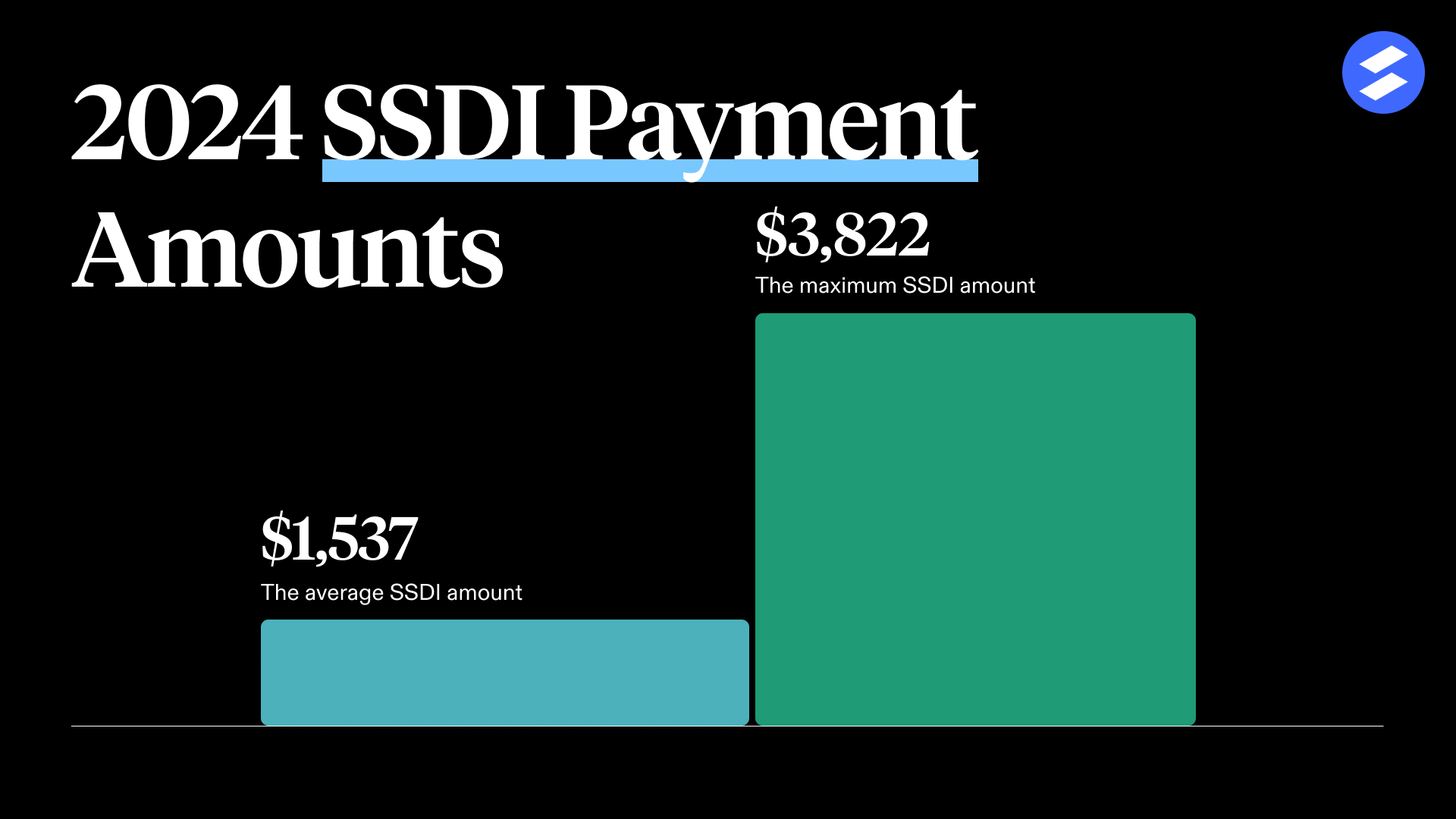
- SSDI (Social Security Disability Insurance): This is an entitlement program for individuals who have worked long enough and paid Social Security taxes. It’s funded by FICA taxes. Eligibility is based on a qualifying disability and having accumulated sufficient “work credits.”
An individual may qualify for one, both, or neither program. In some cases, a person might receive both SSDI and SSI, often referred to as “concurrent benefits,” if their SSDI payment is low enough to still meet SSI’s income limits. Understanding which program applies to your situation is the first step toward estimating your potential benefit.
Key Factors Influencing Your SSI Benefit Amount
The question “how much will I receive?” is not met with a simple, universal answer for SSI. Instead, the monthly benefit amount is determined by a precise calculation that takes into account several critical variables. These factors interact to establish your individual payment.
The Federal Benefit Rate (FBR): Your Baseline
Every year, the Social Security Administration (SSA) sets a Federal Benefit Rate (FBR), which serves as the maximum federal SSI payment an eligible individual or couple can receive. This rate is adjusted annually based on the Cost-of-Living Adjustment (COLA) to account for inflation.
For example, in 2024, the FBR is $943 per month for an eligible individual and $1,415 per month for an eligible couple. This FBR acts as the starting point for your benefit calculation. It’s the maximum amount you would receive if you had no other countable income. However, very few SSI recipients receive the full FBR because most have some form of countable income or other financial contributions.
The Role of State Supplementary Payments (SSP)
Beyond the federal component, many states opt to provide an additional payment to SSI recipients, known as a State Supplementary Payment (SSP). These state supplements vary significantly by state, and some states do not offer them at all.
- States with SSPs: In states that offer supplements, the amount can depend on various factors, including your living arrangements (e.g., living independently, in someone else’s household, or in a medical facility) and your specific needs. These supplements can significantly increase your total monthly SSI payment.
- States without SSPs: If you reside in a state that does not provide a supplement, your maximum potential SSI payment will be limited to the federal benefit rate (minus any countable income).
It’s crucial to check with your state’s Social Services agency or the SSA to determine if your state offers an SSP and what the current rates and eligibility criteria are, as these can change.
Impact of Countable Income on Your Benefit
Perhaps the most significant factor affecting your individual SSI payment is your “countable income.” The SSA defines income broadly to include almost anything you receive that can be used to meet your needs for food or shelter. However, not all income is counted equally, and some types are entirely excluded.
The general rule is: your SSI payment is reduced dollar-for-dollar by your countable income.
The SSA has a specific formula for calculating countable income:
- Exclude General Income: The first $20 of most income is excluded.
- Exclude Earned Income: An additional $65 of earned income (money from wages or self-employment) is excluded.
- Count Half of Remaining Earned Income: After the initial $65 exclusion, only half of your remaining earned income is counted. This is designed to encourage work.
- Count Most Unearned Income: Most unearned income (e.g., pensions, SSDI benefits, unemployment benefits, interest) is counted dollar-for-dollar after the initial $20 exclusion.
This calculation means that if you have some income, your SSI benefit will be less than the FBR. The higher your countable income, the lower your SSI payment, until your income reaches a point where it completely offsets the FBR, making you ineligible for SSI.
Resource Limits: A Crucial Eligibility Factor
While not directly impacting the amount of your monthly benefit once approved, your “countable resources” are a critical determinant of your eligibility for SSI. If your resources exceed the limits, you will not qualify for SSI, regardless of your income or disability status.
- Individual Limit: $2,000
- Couple Limit: $3,000
“Resources” include cash, money in bank accounts, stocks, bonds, mutual funds, vehicles (with some exclusions), and other liquid assets.
However, many assets are excluded from this calculation:
- The home you live in and the land it’s on.
- One vehicle (regardless of value) if it’s used for transportation for you or a member of your household.
- Household goods and personal effects.
- Life insurance policies with a face value of $1,500 or less.
- Burial plots for you and your immediate family.
- Up to $1,500 in funds set aside for burial expenses.
- Property essential for self-support (e.g., tools needed for a job).
It is vital to accurately report all resources and understand what is countable and what is excluded. Misreporting or exceeding these limits can lead to denial of benefits or even overpayment issues.
Calculating Your Potential SSI Payment: A Practical Approach
Estimating your actual SSI payment requires more than just knowing the FBR. It involves a personalized calculation based on your unique financial situation and living arrangements. Let’s break down how the SSA typically arrives at your final monthly benefit.
Understanding Countable Income Deductions
The SSA uses a series of exclusions and deductions to determine your “countable income.” This is the amount that will be subtracted from the FBR (plus any state supplement) to arrive at your benefit.
Here’s a simplified breakdown of the deduction process:
- Total Gross Income: Start with all income you receive in a month.
- General Income Exclusion: Deduct $20 from the total. This applies to most income types, whether earned or unearned.
- Earned Income Exclusion: If you have earned income, deduct an additional $65 from the earned portion.
- Work Incentive Deduction: Subtract half of the remaining earned income.
Example:
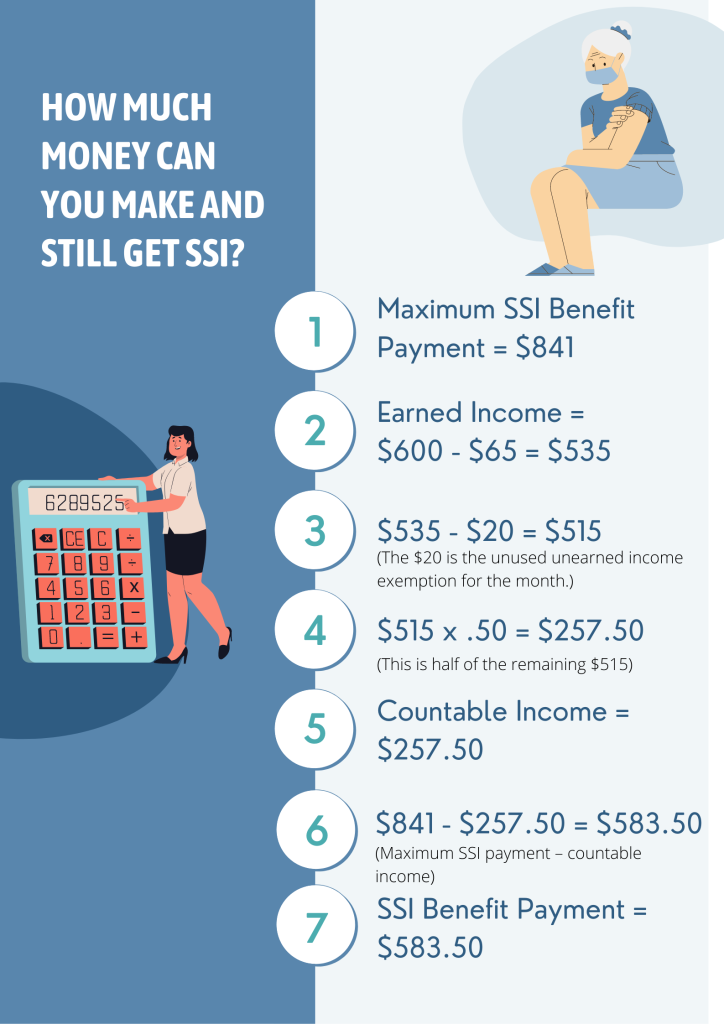
Suppose the FBR for an individual is $943, and you earn $500 from part-time work in a month and have no other income.
- Gross earned income: $500
- Subtract general income exclusion: $500 – $20 = $480 (This $20 exclusion is applied first, whether income is earned or unearned, or a combination. If you have unearned income, the $20 typically applies to that first.)
- Subtract earned income exclusion: $480 – $65 = $415
- Count half of remaining earned income: $415 / 2 = $207.50
- Your countable income for the month is $207.50.
- Your SSI benefit: $943 (FBR) – $207.50 (countable income) = $735.50
This example illustrates how working part-time can reduce your SSI benefit but doesn’t necessarily eliminate it, and in fact, you often end up with more total income (SSI + wages) than if you received only the maximum SSI.
Navigating Different Income Types: Earned vs. Unearned
The distinction between earned and unearned income is crucial because they are treated differently in the SSI calculation.
- Earned Income: Wages, net earnings from self-employment, honoraria, and other income received in exchange for work. The SSA applies the $20 general exclusion, the $65 earned income exclusion, and then counts only half of the remainder. This treatment is more favorable, designed to incentivize work among those who are able.
- Unearned Income: Pensions, veterans’ benefits, Social Security benefits (like SSDI or retirement), annuities, interest income, dividends, rental income, and cash from friends or family. After the initial $20 general exclusion, most unearned income is counted dollar-for-dollar. This means a $100 unearned income payment will reduce your SSI benefit by $100 (after the first $20 is applied).
If you receive both earned and unearned income, the SSA applies the $20 general exclusion first, usually to the unearned income. If there’s less than $20 in unearned income, the remainder of the $20 exclusion is applied to the earned income. Understanding this hierarchy is key to accurate calculation.
Living Arrangements and Their Financial Implications
Your living situation can also affect your SSI benefit, particularly if you live in someone else’s household and do not pay your fair share of food and shelter expenses. This is known as the “in-kind support and maintenance” rule.
- “Living in the Household of Another” Rule: If you live in someone else’s home and receive free or reduced-cost food or shelter, the SSA may apply a “one-third reduction rule” or a “Presumed Maximum Value” (PMV) rule.
- One-Third Reduction (OTR): If you receive both food and shelter from someone else who owns/rents the place you live, your FBR is automatically reduced by one-third. This means your maximum federal benefit would be two-thirds of the FBR.
- Presumed Maximum Value (PMV): If you receive only food or only shelter (not both), or if the value of the support you receive is less than the one-third reduction amount, the SSA will presume a maximum value of the support you receive, typically one-third of the FBR plus the $20 general income exclusion. Your benefit is then reduced by the PMV amount.
These rules aim to account for the financial support you are receiving, ensuring that SSI primarily supplements actual unmet needs. Accurately reporting your living arrangements is crucial to avoid overpayments or underpayments.
Beyond the Monthly Check: Additional Considerations
Receiving SSI benefits extends beyond just the monetary payment. It often opens doors to other vital support systems and requires ongoing adherence to reporting requirements. Understanding these aspects is essential for long-term financial stability and compliance.
Access to Medicaid and Other Benefits
One of the most significant non-cash benefits of qualifying for SSI is automatic eligibility for Medicaid in most states. Medicaid provides comprehensive health coverage, which can be invaluable for individuals with disabilities who often face significant medical expenses. In some states, SSI eligibility automatically grants Medicaid; in others, you might need to file a separate application, but the income and resource rules are often aligned.
Beyond Medicaid, SSI recipients may also become eligible for other federal and state programs, such as:
- SNAP (Supplemental Nutrition Assistance Program): Formerly known as food stamps, SNAP helps low-income individuals and families purchase food.
- Low-Income Home Energy Assistance Program (LIHEAP): Helps with heating and cooling costs.
- Housing assistance programs: Such as Section 8 housing vouchers.
These additional benefits can collectively provide substantial support, significantly improving an individual’s quality of life and reducing overall financial strain.
Reporting Changes to the SSA
Maintaining your SSI eligibility and receiving the correct benefit amount hinges on timely and accurate reporting of changes to the SSA. Because SSI is a needs-based program, even minor changes in your circumstances can affect your eligibility or payment amount.
You must report changes within 10 days after the end of the month in which the change occurred. Critical changes to report include:
- Income: Any change in earned income (wages, self-employment) or unearned income (pensions, other benefits).
- Resources: If your bank account balance or other countable assets increase or decrease significantly, especially nearing the $2,000/$3,000 limits.
- Living Arrangements: Moving, changes in who you live with, or changes in who pays for your food and shelter.
- Marital Status: Getting married, separated, or divorced.
- Work Status: Starting or stopping work, or changes in hours/pay.
- Medical Condition: Improvements that might affect your disability status (though these are often reviewed periodically by the SSA).
- Absences from the U.S.: Leaving the country for 30 consecutive days or more can affect eligibility.
Failure to report changes promptly can lead to overpayments (which you’ll have to pay back) or underpayments, and in some cases, even penalties or loss of benefits.
The Importance of Professional Guidance
Calculating your potential SSI benefit can be complex, especially with varying income types, living arrangements, and state supplements. Errors in application or reporting can lead to delays, denials, or financial hardship. Therefore, seeking professional guidance is often a wise investment.
- Social Security Administration (SSA): While the SSA processes applications, they cannot always provide personalized financial advice. However, they are the ultimate authority for your specific claim.
- Disability Advocates and Attorneys: These professionals specialize in Social Security law and can help you understand eligibility criteria, navigate the application process, appeal denials, and accurately estimate your potential benefits. They are particularly valuable if your case is complex or if you are initially denied.
- Financial Planners Specializing in Disability: Some financial planners focus on assisting individuals with disabilities, helping them understand how benefits integrate with other financial resources and plan for long-term financial stability.
Understanding “how much would I receive in SSI disability” requires diligence, attention to detail, and often, expert assistance. By grasping the core principles of SSI, the federal benefit rate, state supplements, income and resource rules, and the importance of accurate reporting, you can better estimate your potential benefit and make informed decisions about your financial future.
aViewFromTheCave is a participant in the Amazon Services LLC Associates Program, an affiliate advertising program designed to provide a means for sites to earn advertising fees by advertising and linking to Amazon.com. Amazon, the Amazon logo, AmazonSupply, and the AmazonSupply logo are trademarks of Amazon.com, Inc. or its affiliates. As an Amazon Associate we earn affiliate commissions from qualifying purchases.