
The global financial landscape is currently undergoing a paradigm shift, transitioning from legacy settlement systems to decentralized, high-speed digital ledgers. At the heart of this evolution is XRP, the native digital asset of the XRP Ledger (XRPL). As investors look toward the medium-term future, specifically the year 2026, the question of XRP’s valuation becomes a focal point of strategic financial planning. Predicting the price of any cryptocurrency involves a complex interplay of regulatory outcomes, institutional adoption, macroeconomic trends, and technological utility. By 2026, many of the “unknowns” currently suppressing XRP’s price are expected to be resolved, potentially positioning the asset for a significant valuation adjustment.
The Regulatory Horizon: Beyond the SEC Litigation
For years, the primary weight on XRP’s market performance has been the legal battle between Ripple Labs and the U.S. Securities and Exchange Commission (SEC). This litigation has created a cloud of uncertainty that deterred many institutional investors in the United States from engaging with the asset. However, as we look toward 2026, the legal landscape appears significantly more favorable for XRP.
Establishing Legal Precedent
The 2023 summary judgment, which stated that XRP in itself is not a security, provided a foundational layer of clarity that most other digital assets lack. By 2026, the appeals process and any remaining secondary litigation are likely to have concluded. This provides a “clean slate” for XRP, allowing it to be integrated into regulated financial products, such as Exchange Traded Funds (ETFs) or institutional custody platforms, without the fear of sudden regulatory intervention.
Global Regulatory Frameworks
While the U.S. has been a bottleneck, regions like the European Union (through MiCA), the UK, Singapore, and the UAE have established clear guidelines for digital assets. By 2026, these global frameworks will have matured. XRP’s role as a bridge currency for cross-border payments thrives in environments with high regulatory compliance. As more jurisdictions align their digital asset laws, the liquidity of XRP is expected to deepen, creating a more stable and higher floor for its price.
Institutional Adoption and the “Internet of Value”
The intrinsic value of XRP is tied directly to its utility within the RippleNet ecosystem and the broader XRP Ledger. Unlike speculative assets that rely purely on retail hype, XRP’s valuation model is increasingly driven by its use as a liquidity tool for international banking.
The Role of On-Demand Liquidity (ODL)
Ripple’s On-Demand Liquidity (now often referred to as Ripple Payments) uses XRP to bridge two different currencies in seconds. This eliminates the need for pre-funded “nostro/vostro” accounts, which currently trap trillions of dollars in stagnant capital globally. By 2026, if even a small percentage of global remittance and interbank settlement shifts to the XRPL, the demand for XRP could skyrocket. Since the supply of XRP is finite and a small amount is burned with every transaction, a high-velocity environment combined with fixed supply is a classic recipe for price appreciation.
Integration with CBDCs and ISO 20022
The financial world is moving toward the ISO 20022 standard—a global language for financial messaging. XRP is one of the few digital assets that is fully compliant with this standard. Furthermore, many central banks are currently in the pilot phases of Central Bank Digital Currencies (CBDCs). Ripple has positioned the XRPL as a “bridge” for these CBDCs, allowing different national digital currencies to interact seamlessly. By 2026, several of these pilots will likely have moved into live production, placing XRP at the center of the new digital monetary system.
Macroeconomic Trends and the Crypto Market Cycle
To understand where XRP will be in 2026, one must look at the broader economic cycle. Historically, the cryptocurrency market follows four-year cycles, largely dictated by the Bitcoin halving events.
The Post-Halving Correction and Consolidation
The most recent Bitcoin halving occurred in 2024, which typically leads to a massive market-wide bull run in 2025. By 2026, the market often enters a “cool down” or consolidation phase. However, there is a growing school of thought that the 2026 cycle may differ from previous ones. With the influx of institutional capital and the approval of spot ETFs, the volatility of the crypto market may begin to dampen. Instead of a 90% crash, we may see a “higher low,” where XRP maintains a significant portion of its 2025 gains due to its underlying utility.
Inflation and the Search for Yield
As traditional fiat currencies continue to face inflationary pressures, institutional and retail investors alike are seeking assets with programmed scarcity. XRP’s escrow system, which releases a set amount of tokens each month to ensure market stability, provides a level of predictability that fiat central banks cannot offer. If the global economy in 2026 is characterized by a “soft landing” or a period of stable growth, risk-on assets like XRP often perform exceptionally well as capital seeks higher returns than those offered by government bonds.
Price Projections: Analyzing the Bull and Bear Cases
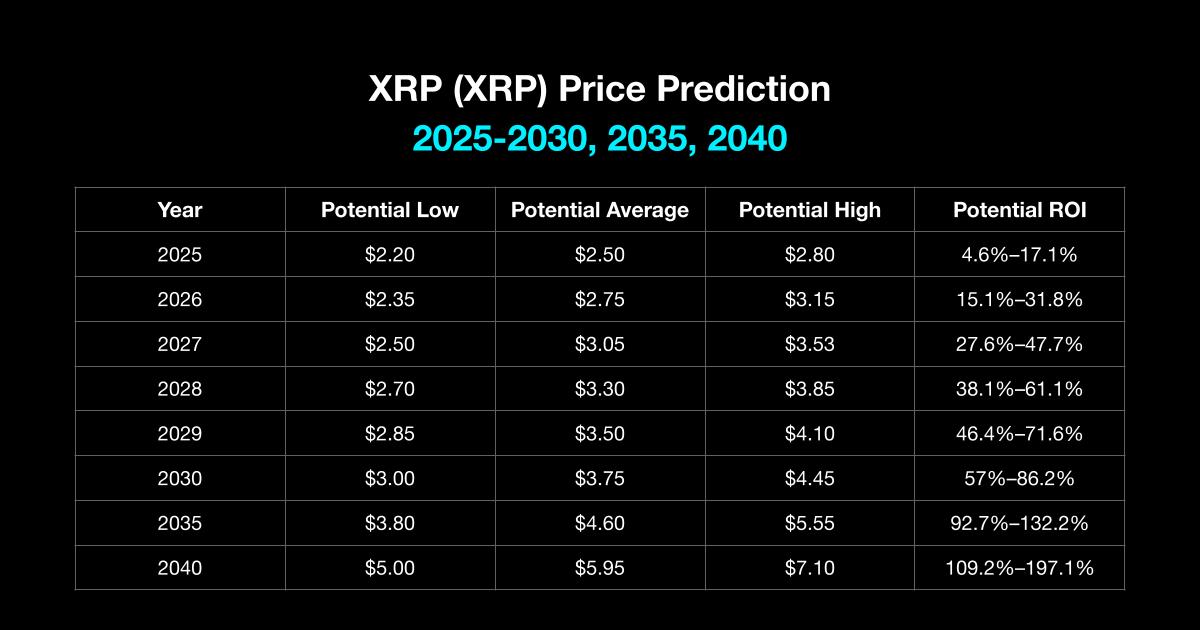
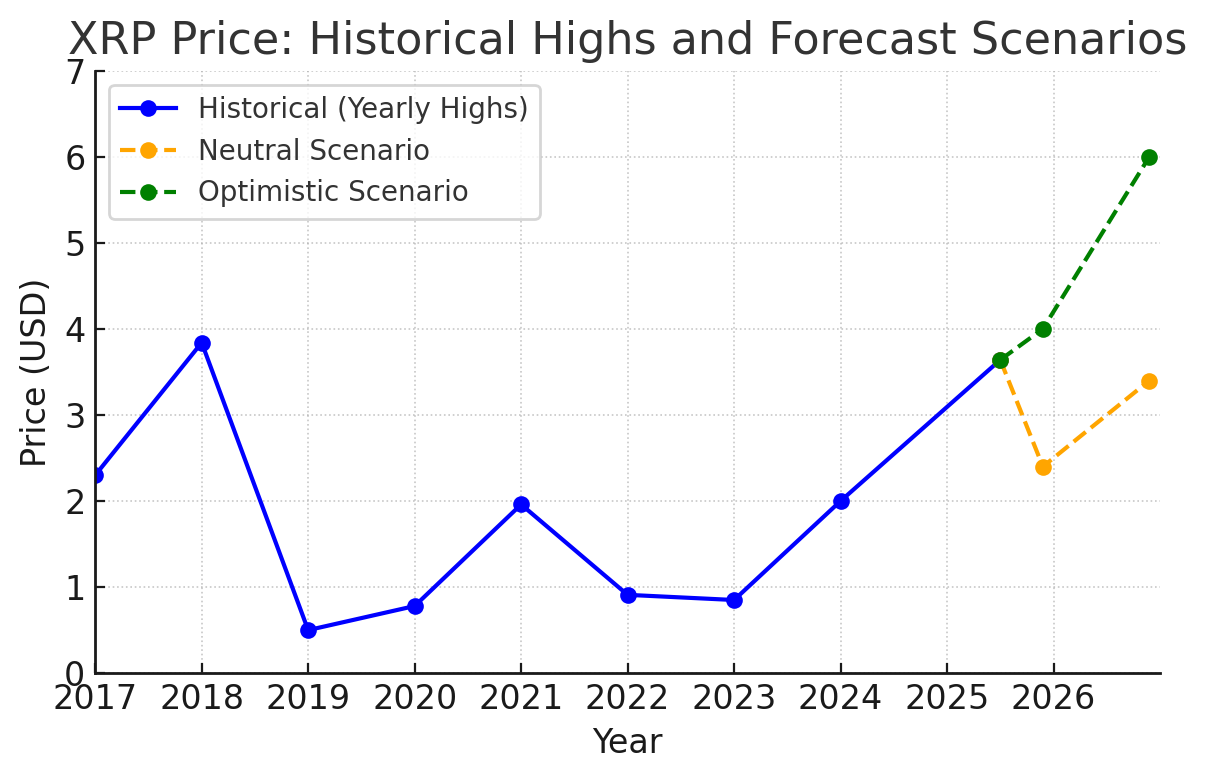
While no one can pinpoint an exact dollar amount, we can establish a realistic range for XRP in 2026 based on market capitalization and adoption metrics.
The Bear Case: Stagnation and Competition
In a bearish scenario, XRP could face stiff competition from other “Layer 1” protocols or proprietary banking coins (like JPMorgan’s JPM Coin). If regulatory hurdles in the U.S. persist or if the global adoption of CBDCs bypasses public ledgers in favor of private, siloed systems, XRP might struggle to break its previous all-time highs. In this scenario, XRP could find itself trading between $1.50 and $2.50—a significant gain from current levels, but perhaps disappointing to those expecting a “moon” shot.
The Base Case: Steady Growth and Integration
A more likely scenario involves steady integration into the global financial fabric. As the legal cases conclude and more banks announce the use of XRP for settlement, we could see a steady climb. This would likely place XRP in the $3.00 to $7.00 range. This valuation would be supported by actual transaction volume rather than just speculative trading, making the price more resilient to market swings.
The Bull Case: The “New Gold” Scenario
The “blue sky” scenario for 2026 involves XRP becoming the primary liquidity bridge for the global financial system. If Ripple captures even 5% of the global cross-border payment market, the demand for XRP would necessitate a much higher price to handle the transaction volume. In a high-liquidity, high-utilization environment, analysts have suggested targets ranging from $10 to $20. While these numbers seem high compared to today’s prices, they represent a market capitalization that is consistent with other major global financial assets and infrastructure providers.
The Evolution of the XRP Ledger Ecosystem
By 2026, the value of XRP will not be determined solely by its use in banking. The XRP Ledger is a versatile platform that is currently expanding into several other lucrative financial niches.
Decentralized Finance (DeFi) and Sidechains
The introduction of the Automated Market Maker (AMM) on the XRPL and the development of EVM-compatible sidechains are opening the door for Decentralized Finance. By 2026, we can expect a robust ecosystem of lending, borrowing, and trading directly on the XRPL. As more capital is “locked” into DeFi protocols on the ledger, the circulating supply of XRP effectively decreases, putting upward pressure on the price.
Tokenization of Real-World Assets (RWAs)
One of the biggest financial trends for the next decade is the tokenization of real-world assets, such as real estate, commodities, and stocks. The XRPL is uniquely suited for this due to its low fees and high throughput. If major financial institutions begin issuing tokenized bonds or property deeds on the XRPL by 2026, the demand for XRP as the “gas” for these transactions will grow exponentially. This transition from “speculative asset” to “essential financial infrastructure” is the key driver for long-term value.
Conclusion: Preparing for 2026
The year 2026 is shaping up to be a milestone for XRP. The convergence of legal clarity, institutional adoption, and the maturation of the XRP Ledger’s technology creates a compelling case for growth. While the path will undoubtedly be volatile, the shift from a speculative market to a utility-driven market is well underway. Investors looking toward 2026 should focus less on the daily price fluctuations and more on the expanding footprint of XRP in the global financial system. If the current trajectory of partnerships and technological implementation continues, XRP is positioned to be not just a participant, but a cornerstone of the future of money.
aViewFromTheCave is a participant in the Amazon Services LLC Associates Program, an affiliate advertising program designed to provide a means for sites to earn advertising fees by advertising and linking to Amazon.com. Amazon, the Amazon logo, AmazonSupply, and the AmazonSupply logo are trademarks of Amazon.com, Inc. or its affiliates. As an Amazon Associate we earn affiliate commissions from qualifying purchases.