
Navigating the complexities of modern banking requires a keen understanding of how financial institutions handle transactions that exceed your available balance. For Chase Bank customers, the question of “how much” one can overdraft is not answered by a single, static number. Instead, it is governed by a set of policies, account types, and discretionary limits that the bank applies to each individual account holder. Understanding these nuances is essential for effective personal finance management and avoiding unnecessary fees that can quickly erode your savings.
In the current economic landscape, where digital transactions are instantaneous and automated payments are the norm, falling into a negative balance is a common occurrence. Chase, as one of the largest financial institutions in the United States, has evolved its overdraft policies significantly over the last few years, introducing features like “Chase Overdraft Assist” to provide a safety net for consumers. However, there are still strict boundaries and costs associated with spending more than you have.
The Mechanics of Chase Overdraft Limits
Unlike a credit card, which provides a clear “credit limit,” Chase does not publicly disclose a specific dollar amount that every customer is allowed to overdraft. Instead, the bank uses an internal, automated system to decide whether to authorize a transaction that would result in a negative balance. This decision is based on several factors, including your account history, the frequency of your deposits, how long you have been a customer, and your overall track record of managing your finances.
The Discretionary Nature of Overdrafts
It is important to understand that Chase is under no obligation to cover any transaction that exceeds your balance. For “Standard Overdraft Practice,” which typically applies to checks and recurring preauthorized transactions (like a gym membership or utility bill), the bank decides on a case-by-case basis. If you are a long-standing customer with a history of regular deposits and few instances of negative balances, the bank may be more likely to “honor” a larger overdraft, potentially up to several hundred dollars. Conversely, for a new account with inconsistent funding, the bank may decline even a small overage.
Chase Overdraft Assist: The $50 Buffer
One of the most important developments in Chase’s policy is “Chase Overdraft Assist.” This feature essentially provides a $50 cushion. If you overdraw your account by $50 or less at the end of the business day, Chase will not charge you an Insufficient Funds Fee. This applies regardless of whether the bank authorized the transaction or if it was a check that cleared. This $50 threshold is effectively your “guaranteed” overdraft limit in terms of fee avoidance, though the bank may still allow you to go deeper into the negative at its own discretion.
Maximum Daily Fee Limits
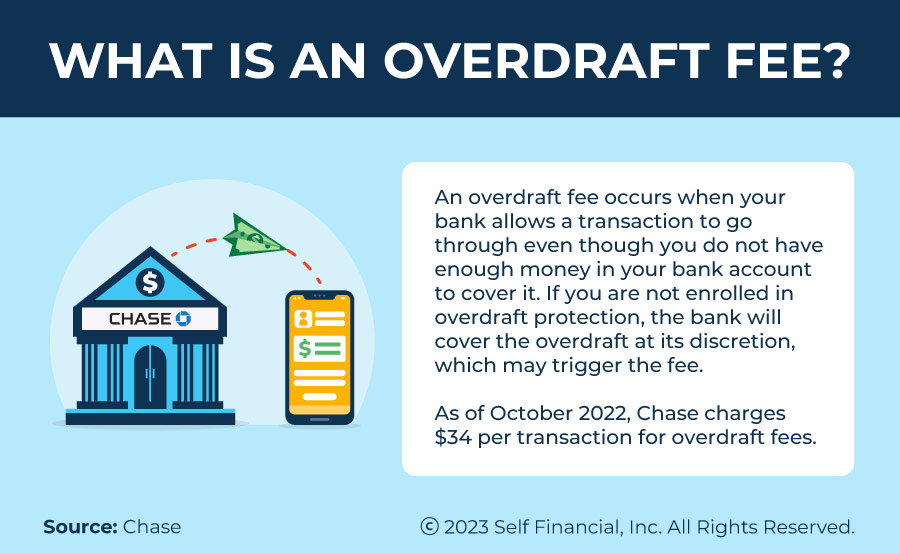
While there isn’t a hard cap on the total negative balance you can carry, there is a cap on the fees. Chase charges a $34 Insufficient Funds Fee per transaction. However, they limit this to a maximum of three fees per business day. This means that if you trigger multiple overdrafts in a single day, you will not be charged more than $102 in fees for that day. This serves as a structural limit on the “cost” of overdrawing, even if the bank continues to allow transactions to pass through.
Understanding Different Overdraft Services
How much you can overdraft also depends heavily on which specific services you have opted into. Chase offers different levels of protection, and your choice determines whether your debit card will be declined at the point of sale or if the transaction will be allowed to proceed into a negative balance.
Standard Overdraft Practice
By default, most Chase checking accounts (such as Chase Total Checking) come with Standard Overdraft Practice. Under this policy, Chase may pay overdrafts for checks, ACH transactions, and recurring debit card payments. However, they generally do not cover everyday, one-time debit card transactions (like buying groceries or gas) unless you specifically “opt-in” to Debit Card Coverage. If you do not opt-in, your card will simply be declined at the register if you have insufficient funds, which prevents you from incurring a fee but also prevents the purchase.
Debit Card Coverage (Opt-In)
If you choose to opt-in to Chase Debit Card Coverage, you are giving the bank permission to authorize one-time debit card transactions even if you don’t have enough money in your account. This is where the discretionary limit becomes most visible. If you are at a store and try to spend $100 when you only have $20, and you have opted-in, the bank may allow the transaction to go through, leaving you with an $80 negative balance and a $34 fee (unless you bring the balance back to within $50 negative by the end of the day).

Chase Secure Banking: The “No Overdraft” Option
For those who want to eliminate the risk of overdrawing entirely, Chase offers the “Chase Secure Banking” account. This account is specifically designed to prevent overdrafts. It does not allow for a negative balance; if the funds aren’t there, the transaction is declined, and there are no overdraft fees. This is an excellent tool for students or individuals looking to rebuild their financial standing without the fear of cascading fees.
The Real Cost: Fees and Timelines
To manage a Chase account effectively, you must understand the timeline of how transactions are processed. The “end of the business day” is a critical concept in determining whether you will be hit with a $34 fee.
The 11 PM ET Cutoff
Chase provides a grace period to rectify a negative balance. If you overdraw your account by more than $50, you have until 11 PM ET (8 PM PT) on the next business day to deposit or transfer enough funds to bring your account balance to a level that is overdrawn by $50 or less. If you meet this deadline, the $34 Insufficient Funds Fee for the prior day’s transactions will be waived or refunded. This “extra time” effectively extends your functional limit by allowing you to “borrow” the bank’s money for about 24 to 36 hours for free, provided you can cover the gap quickly.
The $5 Threshold
In addition to the $50 Overdraft Assist buffer, Chase has a policy where they do not charge a fee if the transaction that caused the overdraft is $5 or less. For example, if you have a $0 balance and you use your debit card to buy a $4 coffee, you will not be charged a $34 fee. This is a vital protection for small, accidental overages that would otherwise result in a fee many times the value of the original purchase.
Overdraft Protection from Linked Accounts
The safest way to “overdraft” is through Overdraft Protection. This involves linking your Chase checking account to a Chase savings account. If the checking account runs out of money, Chase will automatically pull the necessary funds from the linked savings account to cover the transaction. There is no fee for this transfer. In this scenario, your “overdraft limit” is exactly equal to the amount of money you have in your linked savings account. This is the most professional and cost-effective way to manage cash flow gaps.
Strategies for Avoiding Overdrafts and Managing Your Balance
While knowing the limits is helpful, the ultimate goal of sound personal finance is to avoid the need for overdrafts entirely. Chase provides several digital tools that can help you stay within your means and manage your liquidity.
Utilizing Mobile Alerts
The Chase Mobile app allows you to set up real-time alerts. You can receive a push notification or text message whenever your balance falls below a certain threshold (e.g., $100). By setting these alerts, you can be notified of a potential shortfall before you ever reach the point of an overdraft, giving you time to transfer funds or adjust your spending.
Monitoring Pending Transactions
One common pitfall for bank customers is confusing the “Available Balance” with the “Present Balance.” The Present Balance is the total amount of money in the account, but the Available Balance subtracts “pending” transactions that haven’t fully cleared yet. Chase bases its overdraft decisions on the Available Balance. If you have $200 in your account but a $150 pending charge for a hotel stay, your Available Balance is only $50. Spending more than that $50 could trigger an overdraft, even if the $200 is technically still in the account.
Building a Cash Buffer
From a strategic financial perspective, the best “overdraft limit” is the one you set for yourself. Financial advisors often recommend maintaining a “buffer” in your checking account—a minimum balance that you treat as $0. If you decide that $500 is your personal “zero,” you create a self-imposed safety net that protects you from bank fees and the stress of a negative balance.

Conclusion: Professional Management of Your Liquidity
Chase Bank offers a flexible but structured approach to overdrafts. While they do not provide a fixed maximum dollar amount, their $50 Overdraft Assist buffer and the 11 PM ET next-day grace period are among the more consumer-friendly policies in the national banking market. However, the $34 fee remains a significant penalty for those who exceed these buffers.
By understanding the difference between Standard Overdraft Practice and Debit Card Coverage, utilizing linked accounts for protection, and leveraging mobile technology for real-time monitoring, you can ensure that you never have to worry about how much Chase will let you overdraft. Financial health is not just about how much money you earn, but about how effectively you manage the movement of that money and avoid the unnecessary costs of “convenience” banking features. Whether you are using a Total Checking account or the more restrictive Secure Banking option, the key is to remain proactive rather than reactive in your relationship with your balance.
aViewFromTheCave is a participant in the Amazon Services LLC Associates Program, an affiliate advertising program designed to provide a means for sites to earn advertising fees by advertising and linking to Amazon.com. Amazon, the Amazon logo, AmazonSupply, and the AmazonSupply logo are trademarks of Amazon.com, Inc. or its affiliates. As an Amazon Associate we earn affiliate commissions from qualifying purchases.