
The year 2009 marks a pivotal, yet largely unnoticed, moment in financial history. It was the year an anonymous entity known as Satoshi Nakamoto unleashed Bitcoin upon the world, an innovation that would quietly lay the groundwork for a complete paradigm shift in how we perceive money, value, and financial systems. Yet, for all its groundbreaking potential, asking “how much was Bitcoin worth in 2009?” is a question that requires a nuanced answer, one that transcends simple numerical figures and delves into the very essence of asset creation, market formation, and the birth of a new financial frontier. In its nascent stage, Bitcoin wasn’t just cheap; it was, for all practical purposes, worthless in traditional monetary terms. Its value resided entirely in its revolutionary concept, its underlying technology, and the vision of a decentralized future, rather than any established market price.

The Genesis of a Digital Revolution: Bitcoin’s Inception
To understand Bitcoin’s “worth” in 2009, one must first journey back to its very genesis, a period characterized by theoretical exploration and the painstaking assembly of its foundational infrastructure. This was a time before exchanges, before widespread adoption, and certainly before the dramatic price swings that would later captivate the global financial community.
Satoshi Nakamoto’s Vision: A Peer-to-Peer Electronic Cash System
On October 31, 2008, a whitepaper titled “Bitcoin: A Peer-to-Peer Electronic Cash System” was published by Satoshi Nakamoto. This document outlined a radical new concept: a digital currency that could be sent directly from one party to another without the need for a financial institution. The core problem it aimed to solve was the “double-spending” issue inherent in digital currencies, proposing a solution based on a public, immutable ledger known as a blockchain. This vision was not merely about creating another digital payment method; it was about empowering individuals with financial sovereignty, bypassing intermediaries, and building a truly decentralized monetary system. The initial worth of Bitcoin, therefore, was ideological — the value of an idea poised to challenge established norms.
The Whitepaper and the Genesis Block: Laying the Foundations
The principles laid out in the whitepaper came to life on January 3, 2009, with the mining of the “Genesis Block” – Block 0 of the Bitcoin blockchain. Embedded within this first block was a message: “The Times 03/Jan/2009 Chancellor on brink of second bailout for banks.” This timestamp was not merely a date; it was a clear political statement, highlighting the very systemic flaws of traditional finance that Bitcoin sought to address in the wake of the 2008 financial crisis. For the first few days and weeks following the Genesis Block, Nakamoto was the sole miner, accumulating thousands of Bitcoins without any transaction or market determining their value. The system was alive, but it was a closed circuit, a proof-of-concept operating in isolation.
The Absence of Monetary Value: A Currency Without a Market
In 2009, there were no exchanges where Bitcoin could be bought or sold for fiat currency like US dollars or euros. There were no trading platforms, no liquidity, and no established demand from investors or consumers. Consequently, assigning a traditional monetary value to Bitcoin during this period is fundamentally misleading. It existed as a technological curiosity, a set of cryptographic puzzles solved by a handful of enthusiasts, rather than a tradable asset. Its “price” was effectively zero. The costs associated with acquiring Bitcoin were limited to the electricity consumed by computers running the mining software, a negligible expense for early adopters who were more interested in the intellectual challenge and the philosophical implications than immediate financial gain.
The Zero-Value Era: Bitcoin’s Early Days and First Transactions
While 2009 saw Bitcoin come into existence, it remained largely a theoretical construct in terms of market value. The path from zero to a tangible monetary worth was gradual, beginning with the very first instances of real-world use, driven by curiosity and an early belief in the system’s potential.
Mining for the Future: Early Adopters and the Proof-of-Work Mechanism
In the early days of 2009, acquiring Bitcoin meant “mining” it. This involved using computer processing power to solve complex cryptographic puzzles, thereby verifying transactions and adding new blocks to the blockchain. As a reward for this “proof-of-work,” miners received newly minted Bitcoins. The difficulty of these puzzles was extremely low in 2009, meaning even basic computers could mine hundreds, if not thousands, of Bitcoins daily. Early adopters like Hal Finney, who received the first Bitcoin transaction from Satoshi Nakamoto on January 12, 2009, were primarily computer scientists and cypherpunks. They were drawn to the technological elegance and the libertarian ideals, not the prospect of a get-rich-quick scheme. Their “investment” was in time, computing resources, and intellectual engagement, not capital.
The First Real-World Transaction: Pizza for 10,000 BTC
The year 2009 passed without any significant financial transactions. It wasn’t until May 22, 2010, that Bitcoin made its first widely recognized real-world commercial transaction. Laszlo Hanyecz, a programmer, famously paid 10,000 Bitcoins for two pizzas delivered to his Florida home. At that point, the Bitcoins were valued at approximately $41, based on another early user’s willingness to exchange them for a small amount of fiat currency. This event, now commemorated annually as “Bitcoin Pizza Day,” is crucial because it was the first time an external, albeit informal, “price” was assigned to Bitcoin by a direct exchange for goods. It demonstrated that Bitcoin could function as a medium of exchange, transitioning it from a purely academic concept to a nascent commodity with a perceived, albeit tiny, monetary worth. Before this 2010 event, in 2009, there was no such benchmark.
From Theoretical Concept to Nascent Commodity: The Early “Price” Discovery
The journey from a purely theoretical asset to one with a discernible market value is a complex process. For Bitcoin in 2009, this process hadn’t even begun. There was no public market, no supply and demand dynamics in a financial sense. The only “demand” was from early enthusiasts interested in testing the protocol or participating in its development. The concept of “price discovery” – the mechanism by which buyers and sellers interact to determine a market price – was non-existent. Bitcoins were transferred between individuals with similar interests, often for free or in exchange for technical assistance. The value was purely in its utility as a digital token within a closed system, not as a convertible currency.
Understanding Bitcoin’s “Worth” in 2009: A Nuanced Perspective
While a precise dollar figure for Bitcoin in 2009 is elusive because it simply didn’t exist, it’s possible to analyze its “worth” through other lenses, recognizing the fundamental difference between intrinsic value and market price in its earliest days.
The Immaterial Value: Computing Power, Ideology, and Potential

In 2009, Bitcoin’s value was primarily immaterial. It was derived from the computing power dedicated to its network by early miners, signifying a commitment to the system’s security and operation. More profoundly, its worth was ideological. It represented a bold statement against centralized financial control, a belief in censorship-resistant transactions, and a vision of a more equitable financial future. This ideological worth attracted early proponents who saw Bitcoin as a tool for economic freedom rather than a speculative asset. Furthermore, its potential, though largely unrecognized by the mainstream, was immense. The creation of a truly scarce, decentralized digital asset was a groundbreaking technological achievement, and this inherent potential held a form of future value, even if untranslatable into present-day dollars.
The Lack of Exchange and Liquidity: A Non-Existent Market
The absence of a market infrastructure was the primary reason for Bitcoin’s zero monetary worth in 2009. There were no dedicated exchanges like Mt. Gox (which would emerge in 2010), Coinbase, or Binance. People couldn’t simply log on and buy BTC with fiat currency. The only way to acquire it was to mine it, receive it as a gift, or perhaps engage in highly informal, person-to-person trades facilitated through online forums like Bitcointalk.org. Even then, such trades were rare and often involved exchanges for computing resources, services, or simply out of intellectual curiosity rather than a standardized monetary conversion. This lack of liquidity and a formal trading venue meant that there was no collective price discovery mechanism, and thus, no established “worth.”
The Long-Term Vision vs. Immediate Returns: A Paradigm Shift
For those few individuals involved with Bitcoin in 2009, the focus was overwhelmingly on the long-term vision rather than immediate financial returns. Satoshi Nakamoto disappeared in 2010, having launched a system designed to outlive its creator. This long-term perspective underscored the belief that Bitcoin was more than just a fleeting digital novelty; it was a fundamental shift in economic design. Early participants understood that they were contributing to an experiment, and any eventual financial gains were a distant, speculative hope rather than an expectation. This mindset stands in stark contrast to the modern cryptocurrency market, where volatility and short-term speculation often dominate discourse. In 2009, the “investment” was in an idea, not an asset with a market cap.
The Butterfly Effect: How 2009 Shaped Bitcoin’s Future Value
While Bitcoin had no measurable dollar value in 2009, the fundamental groundwork laid in that year was absolutely critical in shaping its eventual trajectory and explosive growth. The principles established then are what ultimately underpinned its monumental rise.
The Power of Scarcity and Decentralization: Core Tenets for Future Appreciation
The architecture designed by Satoshi Nakamoto in 2009 embedded two critical features that would become central to Bitcoin’s future financial appeal: scarcity and decentralization. The supply of Bitcoin is capped at 21 million coins, a hard limit that makes it inherently deflationary and comparable to precious metals like gold. The mining process, which began in 2009, established this scarcity from day one. Concurrently, the decentralized nature of the network, meaning no single entity controls it, fostered trust and resilience, allowing it to operate without political interference or single points of failure. These two tenets, present from its inception, are arguably the most significant drivers of its long-term appreciation and its emergence as a “store of value” in the digital age.
A Glimpse into the Future: The Astounding Growth of a Zero-Value Asset
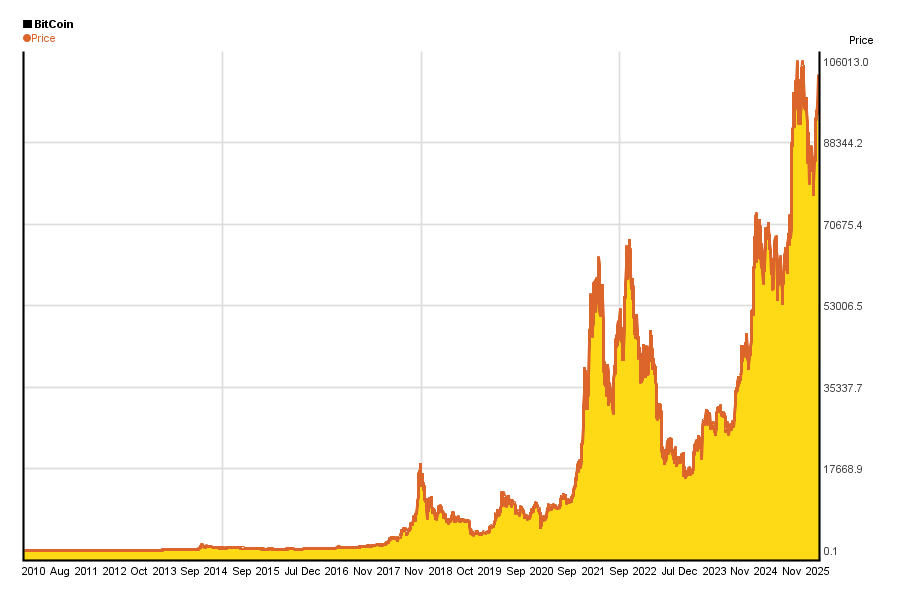
The staggering journey from zero in 2009 to its all-time highs of tens of thousands of dollars per coin is one of the most remarkable financial stories of the 21st century. Those early miners and enthusiasts who held onto their Bitcoins, often acquired for mere fractions of a penny’s worth of electricity, became accidental millionaires, even billionaires. This incredible appreciation underscores the transformative power of disruptive technology and the immense difficulty of predicting the future value of nascent innovations. It serves as a powerful reminder of how initial “worthlessness” can evolve into extraordinary wealth creation for those with foresight, patience, and a high tolerance for risk.
Lessons from Early Bitcoin: Investing in Innovation and Understanding Risk
The story of Bitcoin in 2009 offers profound lessons for modern investors. It highlights the potential rewards of investing in truly disruptive innovation at its earliest stages, often before any conventional market value has been established. However, it equally emphasizes the colossal risks involved. For every Bitcoin that exploded in value, countless other early-stage technological ventures faded into obscurity. Investing in such frontier technologies requires a deep understanding of the underlying principles, a belief in the long-term vision, and a readiness to accept the possibility of total loss. It’s not about chasing headlines or quick profits, but about discerning genuine technological breakthroughs that could reshape industries.
Beyond the Price Tag: The Enduring Financial Legacy of Bitcoin’s Genesis
The seemingly unremarkable financial snapshot of Bitcoin in 2009 belies its profound and ongoing impact on the global financial landscape. Its birth was not just the launch of a new digital currency, but the catalyst for a much broader financial and technological revolution.
The Birth of a New Asset Class: Digital Gold and Beyond
Bitcoin’s journey from an obscure digital token to a globally recognized asset has led to the creation of an entirely new asset class: cryptocurrencies. It has earned the moniker “digital gold” due to its scarcity and role as a hedge against inflation and economic uncertainty. Its success has spawned thousands of other digital assets, each with unique functionalities and economic models, forming the diverse ecosystem we see today. From utility tokens to stablecoins and decentralized finance (DeFi) protocols, the entire cryptocurrency market owes its existence and foundational principles to the pioneering work done in 2009.
Decentralized Finance (DeFi) and Blockchain’s Impact on Traditional Systems
Beyond Bitcoin itself, the underlying blockchain technology, first implemented in 2009, has catalyzed the emergence of Decentralized Finance (DeFi). DeFi aims to recreate traditional financial services – lending, borrowing, trading, insurance – on public blockchains, removing intermediaries and increasing transparency and accessibility. This ongoing revolution directly traces its lineage back to Bitcoin’s original vision of a peer-to-peer electronic cash system. The financial industry, initially dismissive, is now grappling with how to integrate or compete with these decentralized innovations, demonstrating the long-term financial resonance of Bitcoin’s early days.
The Ongoing Debate: Store of Value, Medium of Exchange, or Speculative Asset?
Even today, the debate rages on about Bitcoin’s ultimate financial identity. Is it primarily a store of value, akin to gold, meant to preserve wealth over time? Is it a viable medium of exchange for everyday transactions, fulfilling Satoshi’s original goal? Or is it predominantly a speculative asset, driven by market sentiment and prone to extreme volatility? While its role as a medium of exchange remains limited for now, its adoption as a store of value by institutional investors and even nation-states is growing. The financial implications of this ongoing evolution, rooted in the principles laid down in 2009, continue to shape investment strategies, regulatory frameworks, and the very future of global finance.
In conclusion, Bitcoin’s monetary worth in 2009 was effectively zero in any conventional financial sense. It was a groundbreaking technological experiment, nurtured by a small community of visionaries. Its value lay in its conceptual brilliance, its ideological challenge to existing systems, and its latent potential. The seeds sown in that quiet year, however, blossomed into a financial phenomenon that has reshaped investing, personal finance, and the entire global economic conversation, proving that sometimes, the most valuable innovations begin as utterly “worthless” ideas.
aViewFromTheCave is a participant in the Amazon Services LLC Associates Program, an affiliate advertising program designed to provide a means for sites to earn advertising fees by advertising and linking to Amazon.com. Amazon, the Amazon logo, AmazonSupply, and the AmazonSupply logo are trademarks of Amazon.com, Inc. or its affiliates. As an Amazon Associate we earn affiliate commissions from qualifying purchases.