
The meteoric rise of Bitcoin is perhaps the most significant financial phenomenon of the 21st century. Today, Bitcoin is discussed in the boardrooms of Wall Street, integrated into exchange-traded funds (ETFs), and held as a reserve asset by sovereign nations. However, its beginnings were so humble that the concept of a “price” didn’t even exist for the first several months of its life.
To understand how much Bitcoin was when it first came out, one must look past the charts of modern exchanges and delve into a world where digital currency was a philosophical experiment rather than a trillion-dollar asset class. This article explores the financial journey of Bitcoin from its zero-value inception to its status as a cornerstone of modern personal finance and investing.

The Humble Beginnings: Bitcoin’s Zero-Value Era (2009)
When Satoshi Nakamoto mined the “Genesis Block” on January 3, 2009, Bitcoin had no market value. There were no cryptocurrency exchanges, no digital wallets with sleek user interfaces, and certainly no institutional interest. At that moment, the “price” of Bitcoin was effectively $0.00.
The Genesis Block and Early Mining
In the early days of 2009, Bitcoin was primarily a hobbyist project for cryptographers and “cypherpunks.” These individuals mined Bitcoin using standard home computers. Because there was no secondary market where one could buy or sell the coins, the only cost associated with acquiring Bitcoin was the electricity required to run a CPU. For nearly a year, Bitcoin remained a closed ecosystem where coins were sent back and forth between enthusiasts as a proof of concept, carrying no inherent purchasing power in the physical world.
The First Exchange Rate: New Liberty Standard
The first recorded “official” price for Bitcoin didn’t appear until October 2009. A website called New Liberty Standard established an exchange rate to enable people to buy and sell the digital currency. The rate they set was 1,309.03 BTC to $1 USD.
To put that into perspective, a single dollar could buy well over a thousand Bitcoins. This valuation wasn’t based on market demand or speculation but was calculated based on the cost of electricity. New Liberty Standard divided $1 by the average amount of electricity it took to run a computer to mine a single Bitcoin. At this stage, Bitcoin was less of an investment and more of a commodity priced strictly by its “production cost.”
The Infamous Pizza Transaction and the Birth of Market Value
For any currency to have value, it must be exchangeable for goods or services. Throughout 2009 and early 2010, Bitcoin was a financial ghost. It existed on a ledger, but you couldn’t use it to buy a cup of coffee or pay rent. That changed on May 22, 2010, an event now immortalized in the financial world as “Bitcoin Pizza Day.”
May 22, 2010: The $41 Million Pizza Order
Laszlo Hanyecz, a programmer and early Bitcoin miner, posted on a forum offering 10,000 BTC to anyone who would order two large pizzas for him from Papa John’s. A student took him up on the offer, paying roughly $25 for the pizzas and receiving 10,000 BTC in return.
At the time, this transaction valued a single Bitcoin at approximately $0.0025. While this seems infinitesimally small today, it was a monumental moment in financial history. It represented the first time a decentralized digital asset was successfully used to purchase a physical good. At today’s market prices, those two pizzas would be worth upwards of $600 million, making it perhaps the most expensive meal in human history.
Moving from “Toy Money” to a Financial Asset
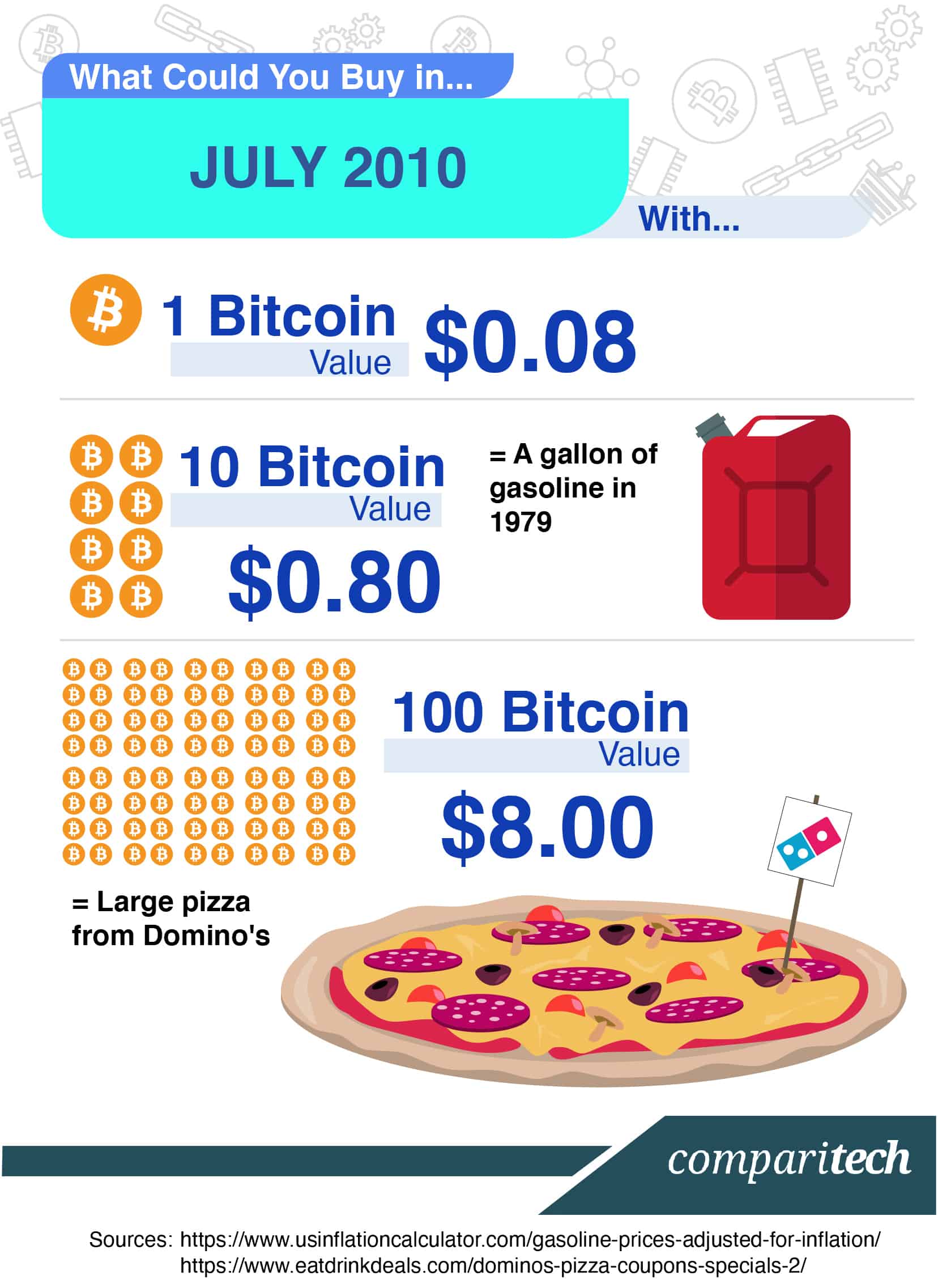
The pizza transaction proved that Bitcoin had utility. Shortly after, the first major exchanges began to emerge, most notably Mt. Gox in July 2010. By the end of that summer, the price of Bitcoin had jumped from a fraction of a cent to $0.08 per coin. This ten-fold increase in value signaled the transition of Bitcoin from a technological toy to a speculative financial asset. Investors began to realize that if a digital token could be used to buy pizza, it could potentially be used to store and transfer vast amounts of wealth globally.
The Meteoric Rise: Key Milestones in Bitcoin’s Price History
Following its first brush with real-world value, Bitcoin entered a decade of unprecedented volatility and growth. For the modern investor, tracking these milestones is essential to understanding the asset’s behavior as a “high-risk, high-reward” component of a diversified portfolio.
Reaching Dollar Parity
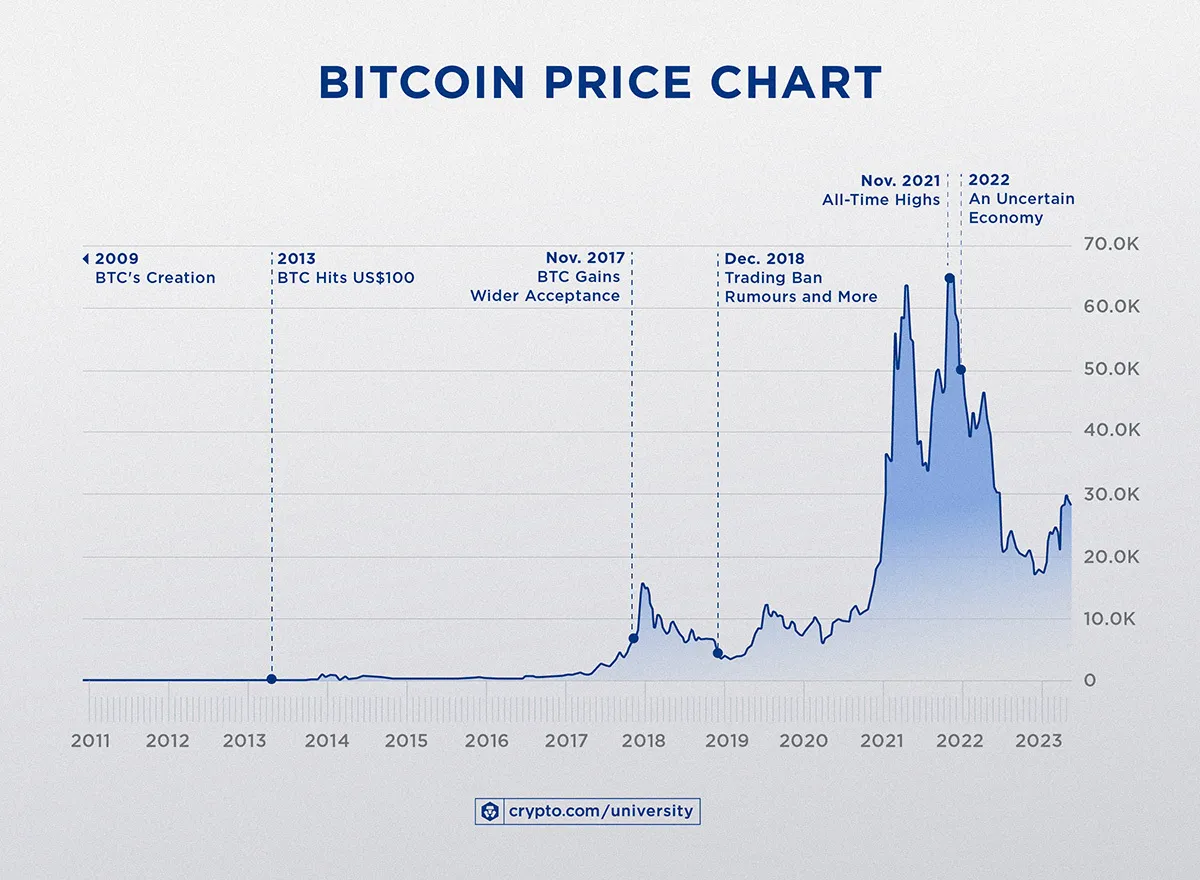
The first major psychological milestone occurred in February 2011, when Bitcoin reached parity with the US Dollar. For the first time, 1 BTC was equal to $1 USD. This was a watershed moment for early adopters; it validated the idea that a decentralized currency could hold equal weight with the world’s primary reserve currency. The achievement of parity drew the attention of mainstream media and a new wave of retail investors, driving the price to nearly $30 later that year before its first major market “crash.”
The 2013 and 2017 Bull Runs
In 2013, Bitcoin surged past $100 and eventually topped $1,000 for the first time. This era was defined by the realization that Bitcoin could serve as “Digital Gold”—a hedge against traditional fiat currency inflation. However, the most famous explosion in value occurred in 2017.
Starting the year at around $900, Bitcoin climbed relentlessly to nearly $20,000 by December. This period introduced the concept of “Initial Coin Offerings” (ICOs) and brought cryptocurrency into the daily lexicon of personal finance. The 2017 bull run transformed Bitcoin from a niche interest into a global financial phenomenon, creating a new class of “crypto-millionaires” and forcing traditional financial institutions to take notice.
Why Bitcoin’s Initial Price Matters for Modern Investors
Reflecting on Bitcoin’s starting price isn’t just an exercise in nostalgia; it provides critical insights into the nature of investing in emerging technologies and the mechanics of market cycles.
Understanding Volatility and Risk
The journey from $0.0007 to over $60,000 highlights the extreme volatility inherent in the crypto market. For a personal finance enthusiast, Bitcoin’s history serves as a masterclass in risk management. Those who invested early and held through 80% or 90% drawdowns saw life-changing returns. However, the path was fraught with “black swan” events, such as exchange hacks and regulatory crackdowns. Understanding that Bitcoin started from zero helps investors appreciate that its value is derived entirely from network effects, scarcity, and collective belief, rather than physical backing.
The Concept of Scarcity and Digital Gold
One of the primary reasons Bitcoin’s price rose so dramatically from its first cent is its fixed supply. Only 21 million Bitcoins will ever exist. In the world of finance, scarcity drives value. As more people sought to own a piece of this limited supply, the price naturally adjusted upward. Early investors recognized this “disinflationary” model early on, comparing it to gold. Unlike the US Dollar, which can be printed by the trillions, Bitcoin’s “monetary policy” is written in code, making its initial low price a reflection of a time before the world understood the value of digital scarcity.
Lessons in Long-Term Wealth from the Crypto Frontier
The history of Bitcoin’s price offers several timeless lessons for anyone interested in building long-term wealth and navigating modern financial markets.
The Power of Asymmetric Risk
Bitcoin is the ultimate example of asymmetric risk: an investment where the potential upside significantly outweighs the potential downside. In 2010, an investor could have put $100 into Bitcoin. The most they could lose was $100 (a 100% loss). The potential upside, however, was thousands of percentage points. In personal finance, identifying these “asymmetric bets”—small allocations of capital into high-growth potential assets—can be a powerful strategy for accelerating net worth.
Financial Tools for Navigating the Modern Market
Today, you no longer need to navigate shady exchanges or mine on a home computer to gain exposure to Bitcoin. The financial landscape has matured to include:
- Spot ETFs: Allowing investors to hold Bitcoin in traditional brokerage accounts (like a 401k or IRA).
- Regulated Exchanges: Platforms like Coinbase or Kraken provide insurance and security measures that didn’t exist in 2009.
- Yield-Bearing Accounts: Some platforms allow users to earn interest on their digital holdings, treating crypto more like a traditional savings or investment vehicle.
While the days of buying 1,300 BTC for a single dollar are long gone, the underlying principles that drove that growth—decentralization, scarcity, and global accessibility—remain. For the modern investor, Bitcoin represents a shift in how we define value. By looking back at its humble beginnings, we gain a clearer perspective on its future potential as a permanent fixture in the global financial system.
aViewFromTheCave is a participant in the Amazon Services LLC Associates Program, an affiliate advertising program designed to provide a means for sites to earn advertising fees by advertising and linking to Amazon.com. Amazon, the Amazon logo, AmazonSupply, and the AmazonSupply logo are trademarks of Amazon.com, Inc. or its affiliates. As an Amazon Associate we earn affiliate commissions from qualifying purchases.