
Charitable giving is a cornerstone of a healthy society, allowing individuals and organizations to support causes they believe in and contribute to the well-being of their communities. Beyond the inherent altruism, the U.S. tax code offers significant incentives for these acts of generosity in the form of tax deductions. Understanding “how much tax write-off for donations” you can claim is not merely about reducing your tax burden; it’s about making your giving more strategic and impactful, ensuring that both your chosen charity and your personal finances benefit. This guide delves into the nuances of charitable contribution deductions, helping you navigate the rules, maximize your benefits, and keep compliant with IRS regulations.

Understanding Charitable Contributions and Their Tax Implications
Before diving into the specifics of deduction limits, it’s crucial to grasp what constitutes a deductible charitable contribution and how it impacts your tax situation. Not all giving is created equal in the eyes of the IRS.
What Qualifies as a Charitable Contribution?
To be deductible, a donation must be made to a qualified organization. The IRS maintains a searchable database of eligible organizations, typically 501(c)(3) public charities, religious organizations, and certain governmental entities. Donations to individuals, political organizations, or lobbying groups are generally not deductible.
- Cash Contributions: This includes checks, credit card payments, electronic fund transfers, and actual cash. It’s the most straightforward type of donation.
- Non-Cash Contributions (Property): This encompasses a wide range of assets, such as stocks, bonds, real estate, vehicles, household items, clothing, and even intellectual property. The deduction amount for property depends on its fair market value (FMV) and how long you’ve owned it.
- Out-of-Pocket Expenses: While you cannot deduct the value of your time or services volunteered, you can deduct unreimbursed out-of-pocket expenses incurred while performing services for a qualified organization. This includes mileage (at a special charitable rate), travel expenses, and supplies.
- What Doesn’t Qualify: Raffle tickets, bingo, tuition, dues for clubs, the value of blood donations, or direct gifts to needy individuals are generally not deductible. If you receive a benefit in exchange for your donation (e.g., tickets to a gala, merchandise), you can only deduct the amount that exceeds the fair market value of the benefit received.
The Difference Between Itemizing and Taking the Standard Deduction
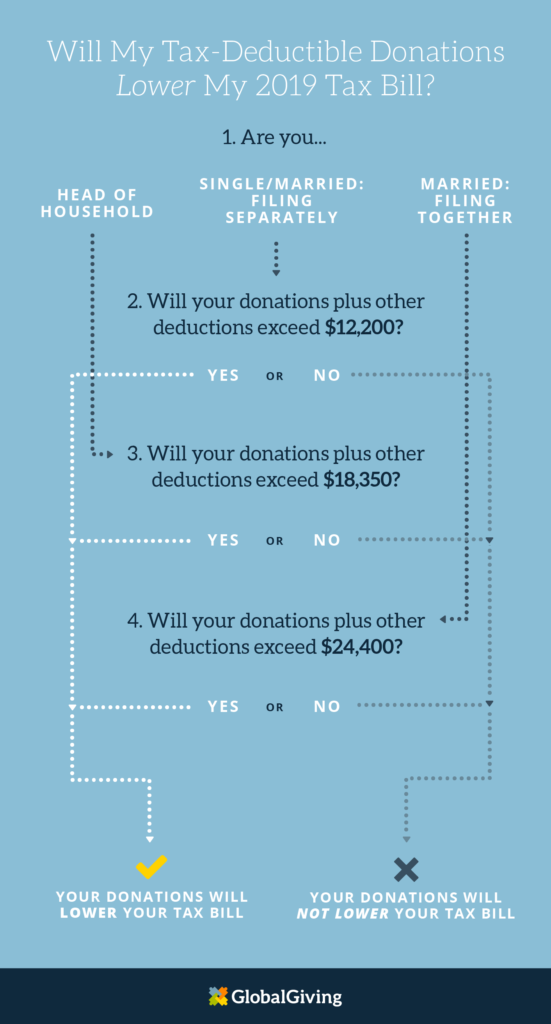
The ability to deduct charitable contributions hinges on whether you itemize your deductions on Schedule A (Form 1040) or take the standard deduction. For many taxpayers, the standard deduction has increased significantly in recent years, leading fewer people to itemize.
- Itemizing: If your total itemized deductions (including state and local taxes, mortgage interest, medical expenses, and charitable contributions) exceed your standard deduction amount, then itemizing makes financial sense. This is where your charitable donations can directly reduce your taxable income.
- Standard Deduction: If your itemized deductions are less than the standard deduction for your filing status, you’ll typically take the standard deduction. In this scenario, your charitable contributions do not directly reduce your taxable income, unless special provisions apply (like those enacted during the COVID-19 pandemic, which allowed a limited above-the-line deduction for cash contributions for non-itemizers in certain years). It’s crucial to check current year tax laws for such temporary provisions.
Who Can Claim Donations?
Both individuals and businesses can claim deductions for charitable contributions.
- Individuals: Most commonly, individuals claim these deductions on their personal tax returns if they itemize.
- Businesses: Corporations, partnerships, and S-corporations can also deduct charitable contributions, subject to their own specific limitations and rules. For partnerships and S-corporations, the deduction typically flows through to the owners’ individual tax returns.
Navigating the Limits: Deduction Ceilings and Carryovers
The IRS doesn’t allow unlimited deductions for charitable giving. Instead, there are specific Adjusted Gross Income (AGI) limitations that dictate how much you can deduct in any given tax year.
Adjusted Gross Income (AGI) Limitations for Cash Donations
For most individual taxpayers, cash contributions to public charities are generally deductible up to 60% of your AGI. This means if your AGI is $100,000, you can deduct up to $60,000 in cash donations in a single year. There have been temporary exceptions, such as during 2020 and 2021, when Congress allowed a 100% AGI limit for cash contributions to public charities as part of COVID-19 relief, but these were temporary provisions. For permanent law, the 60% rule generally applies.
AGI Limitations for Non-Cash Contributions
Non-cash contributions have different AGI limits based on the type of property and to whom it’s donated.
- Ordinary Income Property: This is property that, if sold, would result in ordinary income or short-term capital gain (e.g., inventory, property held for one year or less, or property with depreciation recapture). The deduction is generally limited to your cost basis (what you paid for it) and capped at 50% of your AGI.
- Capital Gain Property: This is property that, if sold, would result in long-term capital gain (held for more than one year) and would have appreciated in value. Examples include appreciated stocks or real estate. For gifts of capital gain property to a public charity, the deduction is typically limited to 30% of your AGI, based on its fair market value. However, you can elect to deduct it at your cost basis, which would then be subject to the 50% AGI limit. This election might be beneficial if the 30% limit would otherwise prevent you from deducting a significant portion of the donation.
The Power of the Carryover Provision
What happens if your generous donations exceed your AGI limits in a particular year? The IRS has a carryover provision for this. Any amount of charitable contributions that you couldn’t deduct in the current year due to AGI limitations can be carried forward and deducted in future tax years for up to five years. This allows you to eventually receive the tax benefit for your entire contribution, even if it’s too large for a single year’s deduction. Proper record-keeping is vital to track these carryovers.
Valuing Your Non-Cash Contributions Correctly
Donating property rather than cash can be a powerful way to give, especially appreciated assets. However, determining the correct deduction amount requires careful attention to valuation rules.
Fair Market Value (FMV): The Golden Rule
For non-cash donations, the general rule is that you can deduct the property’s fair market value (FMV) at the time of the donation. FMV is defined as the price at which property would change hands between a willing buyer and a willing seller, neither being under any compulsion to buy or to sell and both having reasonable knowledge of relevant facts. This is often easier said than done.

Specifics for Different Asset Types
- Clothing and Household Items: The IRS states that clothing and household items donated to charity must be in “good used condition or better” to be deductible. You generally deduct the FMV, which is what a willing buyer would pay for the item in its current condition. Thrift store values are often a good guide.
- Securities: For publicly traded stocks or bonds, FMV is easily determined by averaging the high and low selling prices on the date of the gift.
- Vehicles: If the deduction for a donated vehicle is over $500, the amount you can deduct depends on how the charity uses the vehicle. If the charity sells it, your deduction is generally limited to the gross proceeds from the sale. If the charity keeps and uses it, or makes significant improvements to it, you can deduct the FMV.
- Real Estate: Donating real estate requires a professional appraisal to determine its FMV.
The Importance of Qualified Appraisals
For non-cash contributions exceeding certain thresholds, a qualified appraisal performed by a qualified appraiser is mandatory.
- Over $5,000: A qualified appraisal is generally required for any single non-cash item or group of similar items (e.g., a collection of art) for which you claim a deduction of more than $5,000.
- Publicly Traded Securities: There’s an exception for publicly traded securities for which market quotations are readily available, which do not require an appraisal regardless of value.
- Vehicles: Vehicles are subject to special rules; typically, if the value is over $500, the charity provides an acknowledgment form (Form 1098-C) stating the gross proceeds from its sale.
Failing to obtain a required appraisal can lead to the IRS disallowing your deduction entirely.
Essential Record-Keeping and Documentation
The most critical aspect of claiming charitable deductions is maintaining meticulous records. Without proper documentation, the IRS can disallow your deductions, regardless of how genuine your charitable intent was.
Substantiation Requirements for Cash Donations
- Any Amount: For all cash donations, you must keep records such as a bank statement, a canceled check, or a receipt from the charity.
- $250 or More: For any single cash contribution of $250 or more, you must obtain a written acknowledgment from the charitable organization. This acknowledgment must state the amount of the cash contribution, whether the organization provided any goods or services in return for the contribution, and if so, a description and good faith estimate of the value of those goods or services. This acknowledgment must be received by the date you file your return.
Substantiation for Non-Cash Donations
- Under $250: For non-cash contributions valued under $250, you must keep a written record of the contribution, including the name of the charity, the date and location of the contribution, a detailed description of the property, its fair market value, and the method used to determine FMV.
- $250 to $500: Similar to cash, you need a written acknowledgment from the charity describing the property donated and stating whether any goods or services were provided in return.
- Over $500: In addition to the written acknowledgment, you must complete and attach Form 8283, Noncash Charitable Contributions, to your tax return.
- Over $5,000: For contributions exceeding $5,000 (other than publicly traded securities), you must also attach a qualified appraisal to Form 8283 and have the donee organization sign Part IV of the form to acknowledge receipt of the property.
Form 8283: Noncash Charitable Contributions
Form 8283 is an essential document for non-cash contributions over $500. It requires detailed information about the property, its value, and the method of valuation. For contributions over $5,000, it also includes sections for the appraiser’s signature and the donee organization’s acknowledgment. Accurately completing this form is vital for claiming your deduction.
Strategic Charitable Giving: Beyond Basic Deductions
While understanding basic deduction limits and record-keeping is essential, advanced planning can amplify the benefits of your charitable giving, both for you and your chosen causes.
Donor-Advised Funds (DAFs): A Flexible Giving Tool
A Donor-Advised Fund (DAF) is a charitable giving vehicle administered by a public charity that allows you to make a charitable contribution, receive an immediate tax deduction, and then recommend grants from the fund to your favorite charities over time. DAFs are increasingly popular because they simplify charitable giving, allow you to donate appreciated assets without incurring capital gains tax, and provide flexibility in grant timing. You get the deduction when you contribute to the DAF, even if the actual grants to charities happen years later.
Qualified Charitable Distributions (QCDs) from IRAs
For individuals aged 70½ or older, a Qualified Charitable Distribution (QCD) from an IRA offers a unique tax-efficient way to give. You can directly transfer up to $100,000 per year from your IRA to a qualified charity. This distribution counts towards your Required Minimum Distribution (RMD) but is excluded from your gross income. Unlike a deduction, which reduces taxable income, a QCD reduces your AGI, which can be beneficial for various tax calculations and thresholds. It’s a powerful strategy for those who might not itemize or want to reduce their taxable income in retirement.
Leveraging Appreciated Stock for Greater Impact
Donating appreciated stock or mutual fund shares held for more than one year is often more tax-efficient than donating cash. If you donate appreciated long-term capital gain property directly to a public charity, you can deduct the fair market value of the stock, and you avoid paying capital gains tax on the appreciation. If you were to sell the stock first, pay capital gains tax, and then donate the cash, your donation would be smaller. This strategy allows your full investment to benefit the charity and provides you with a larger deduction.
When Professional Advice is Key
The rules surrounding charitable contributions can be complex, especially with high-value donations, unique assets, or complex financial situations. Consulting with a qualified financial advisor, tax professional, or an estate planning attorney is highly recommended to:
- Determine the most tax-efficient giving strategies for your specific circumstances.
- Ensure proper valuation and documentation of complex assets.
- Navigate AGI limits, carryovers, and special provisions.
- Integrate charitable giving into your overall financial and estate plan.
Their expertise can help ensure compliance, maximize your tax benefits, and ultimately enhance your philanthropic impact.
In conclusion, understanding “how much tax write-off for donations” involves more than just a simple calculation. It requires knowledge of IRS regulations, meticulous record-keeping, and often, strategic planning. By familiarizing yourself with these guidelines, you can ensure that your generosity not only supports meaningful causes but also provides you with the maximum allowable tax benefits, making your giving even more rewarding.
aViewFromTheCave is a participant in the Amazon Services LLC Associates Program, an affiliate advertising program designed to provide a means for sites to earn advertising fees by advertising and linking to Amazon.com. Amazon, the Amazon logo, AmazonSupply, and the AmazonSupply logo are trademarks of Amazon.com, Inc. or its affiliates. As an Amazon Associate we earn affiliate commissions from qualifying purchases.