
Navigating the complexities of government benefits can be a daunting task, especially when your financial stability depends on it. For many individuals facing disabilities, age-related challenges, or severe financial limitations, Supplemental Security Income (SSI) offers a vital lifeline. But the question that most frequently arises, often shrouded in uncertainty, is: “How much SSI will I receive?” Understanding your potential benefit amount is not as simple as looking up a single figure; it involves a nuanced calculation based on a multitude of personal financial circumstances, living arrangements, and other contributing factors.
This comprehensive guide aims to demystify the SSI benefit calculation process, providing clarity on the federal standards, state supplements, and the various elements that can increase or decrease your monthly payment. We’ll delve into the intricacies of countable income, resource limits, and the critical role your living situation plays, empowering you with the knowledge to better understand your potential SSI entitlement and plan for your financial future.
Understanding Supplemental Security Income (SSI)
Before diving into the numbers, it’s crucial to grasp what SSI is and who it’s designed to help. This program, administered by the Social Security Administration (SSA), is fundamentally different from other Social Security benefits and targets a specific demographic with acute financial needs.
What is SSI and Who Qualifies?
Supplemental Security Income (SSI) is a needs-based federal program that provides monthly payments to adults and children with disabilities or blindness who have income and resources below specific financial limits. It also provides payments to people aged 65 or older who meet the financial limits, even if they are not disabled. The primary goal of SSI is to provide a minimum level of income for basic necessities like food and shelter.
Unlike Social Security Disability Insurance (SSDI) or retirement benefits, eligibility for SSI is not based on your prior work history or contributions to Social Security taxes. Instead, it’s determined by financial need:
- Age: You must be 65 or older.
- Blindness: You must meet the SSA’s definition of blindness.
- Disability: You must meet the SSA’s definition of disability, which generally means you cannot engage in substantial gainful activity due to a medically determinable physical or mental impairment that is expected to last for a continuous period of not less than 12 months or result in death.
- Limited Income: Your countable income must be below the federal benefit rate (FBR) and any applicable state supplement.
- Limited Resources: Your countable resources (assets) must be below the federal limits ($2,000 for an individual, $3,000 for a couple).
Differentiating SSI from Social Security Disability Insurance (SSDI)
It’s common for people to confuse SSI with Social Security Disability Insurance (SSDI), but they are distinct programs with different eligibility criteria and funding mechanisms. Understanding this distinction is vital for anyone exploring disability benefits:
-
SSI (Supplemental Security Income):
- Needs-Based: Eligibility is based on financial need (limited income and resources).
- No Work History Required: You don’t need a work history or have paid Social Security taxes to qualify.
- Federally Funded: Paid for by general tax revenues, not Social Security trust funds.
- Benefit Amount: Typically lower, varies based on income, resources, and living arrangements.
- Medicare/Medicaid: Generally qualifies recipients for Medicaid in most states.
-
SSDI (Social Security Disability Insurance):
- Work-Based: Eligibility is based on your work history and having paid Social Security taxes for a sufficient period.
- No Financial Need Test: Your current income and resources generally do not affect eligibility (though Substantial Gainful Activity (SGA) limits apply).
- Social Security Trust Funds: Funded by payroll taxes.
- Benefit Amount: Higher, based on your average lifetime earnings.
- Medicare/Medicaid: Generally qualifies recipients for Medicare after a 24-month waiting period.
Some individuals may qualify for both SSI and SSDI, receiving a “concurrent” benefit if their SSDI payment is low enough to still meet SSI’s income limits. In such cases, the SSDI payment is considered unearned income when calculating the SSI benefit.
The Core Calculation: Federal Benefit Rate and Beyond
The journey to determining your SSI payment begins with a foundational understanding of the Federal Benefit Rate (FBR) and how other factors layer onto this baseline. This rate sets the maximum federal SSI payment an eligible individual can receive.
The Baseline: Federal Benefit Rate (FBR)
The Federal Benefit Rate (FBR) is the maximum monthly SSI payment set by the federal government for a single eligible individual or an eligible couple. This rate is adjusted annually to reflect cost-of-living increases, much like Social Security benefits. For example, for 2024, the FBR is $943 for an eligible individual and $1,415 for an eligible couple. This figure represents the absolute highest amount you could receive from the federal government if you have no other countable income.
It’s crucial to remember that very few recipients actually receive the full FBR. The vast majority have their benefits reduced due to various income sources or living situations, which we will explore in subsequent sections. The FBR is merely the starting point for the calculation.
The Role of State Supplementary Payments
Many states recognize that the federal FBR alone might not be sufficient to meet the cost of living within their borders. As a result, 46 states and the District of Columbia provide an additional payment, known as a State Supplementary Payment (SSP), on top of the federal SSI benefit. These state supplements vary significantly by state, and sometimes within a state, based on factors like living arrangements and marital status.
Some states administer their own SSPs directly, while others have the SSA administer them. If your state provides an SSP, your total SSI payment will be the federal FBR (minus any countable income) plus the state supplement. This can significantly increase your total monthly benefit, making it vital to check if your state offers such a supplement and what its specific criteria are. For instance, California, New York, and Massachusetts are known for having relatively generous state supplements.
How “Countable Income” Reduces Your Benefits
The most significant factor in determining how much SSI you will receive is your “countable income.” SSI is a needs-based program, meaning the more income you have from other sources, the less SSI you will receive. However, not all income is counted. The SSA has specific rules for calculating countable income, which include various exclusions and deductions designed to encourage work and self-sufficiency.
Here’s a simplified breakdown of how countable income works:
- Identify All Gross Income: This includes earned income (from work), unearned income (Social Security benefits, pensions, unemployment, interest, dividends, etc.), in-kind income (food or shelter received for free or less than fair market value), and deemed income (income from a spouse, parent, or sponsor that is considered available to you).
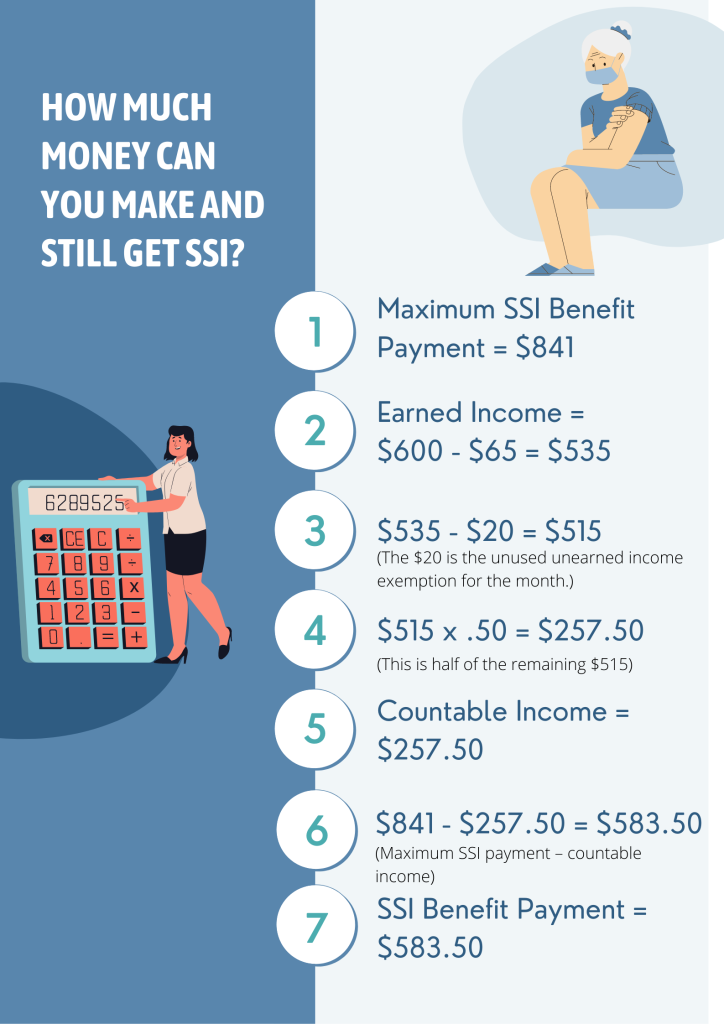
- Apply General Income Exclusion: The first $20 of most income received in a month is not counted.
- Apply Earned Income Exclusions: If you have earned income, the SSA applies further exclusions:
- The first $65 of earned income is not counted.
- Half of the remaining earned income is not counted.
- This means that for every $2 you earn above $85, your SSI benefit is reduced by $1.
- Apply Other Exclusions: There are specific exclusions for things like income set aside for an Achieving a Better Life Experience (ABLE) account, certain scholarships, or infrequent/irregular income.
- Calculate Countable Income: The remaining amount after all applicable exclusions is your countable income.
- Subtract from FBR + SSP: Your countable income is then subtracted from the FBR (plus any state supplement) to determine your final SSI benefit amount.
Example: If the FBR is $943 and you have $100 in unearned income, your countable income would be $100 – $20 (general exclusion) = $80. Your SSI benefit would then be $943 – $80 = $863. If you had $500 in earned income, your countable income would be ($500 – $65 – $20) / 2 = $207.50. Your SSI benefit would be $943 – $207.50 = $735.50.
Understanding these calculations is paramount, as even small amounts of income can affect your monthly payment.
Key Factors That Influence Your Monthly SSI Payment
Beyond direct income, several other critical factors play a substantial role in determining your final SSI benefit amount. These elements reflect the “needs-based” nature of the program, where the SSA assesses your overall financial situation and support structure.
Earned Income: Work Incentives and Reductions
The SSA has a strong incentive to encourage SSI recipients to work if they are able. To facilitate this, they have established various work incentives that allow individuals to earn a certain amount of income without losing all their benefits. As detailed in the “countable income” section, only a portion of earned income reduces your SSI benefit. The first $65 of earned income, plus half of the remainder, is excluded. This means you can often earn a significant amount before your SSI benefit is entirely eliminated.
Other work incentives include:
- Impairment Related Work Expenses (IRWE): Costs for items or services you need to work because of your disability (e.g., wheelchairs, attendant care, specialized transportation) can be deducted from your earnings when calculating countable income.
- Blind Work Expenses (BWE): Similar to IRWEs, these are deductions for blind individuals for expenses related to earning income (e.g., guide dog expenses, specialized equipment).
- Plan to Achieve Self-Support (PASS): This allows you to set aside money and resources for a specific work goal (e.g., education, vocational training, starting a business) without those funds counting against your income or resource limits.
These provisions are designed to help SSI recipients achieve greater financial independence while still relying on some level of support.
Unearned Income: Pensions, Investments, and Other Sources
Unearned income is income you receive that isn’t from work. This includes a wide array of sources such as:
- Social Security benefits (retirement, SSDI, survivors’ benefits)
- Pensions (private or government)
- Unemployment benefits
- Workers’ compensation
- Veterans’ benefits
- Interest from savings accounts
- Dividends from stocks
- Rental income
- Gifts or inheritances
Unlike earned income, unearned income is generally treated less favorably in SSI calculations. After the initial $20 general income exclusion, almost all remaining unearned income is counted dollar-for-dollar against your FBR and state supplement. This means that if you receive a $100 SSDI benefit, it would effectively reduce your SSI by $80 (after the $20 exclusion), whereas $100 in earned income would reduce it by only $17.50 (after the $65 and half-of-remainder exclusions). This difference highlights the SSA’s policy to prioritize and encourage earned income.

Living Arrangements and In-Kind Support and Maintenance (ISM)
Your living arrangements can significantly impact your SSI benefit amount. The SSA assumes that if you live with others and don’t pay your fair share of household expenses, you are receiving “in-kind support and maintenance” (ISM). This ISM is considered unearned income and can reduce your SSI benefit.
There are generally two rules applied:
- Value of the One-Third Reduction (VTR) Rule: If you live in another person’s household throughout a month and receive both food and shelter from them, and you do not pay your pro rata share of the household operating expenses, your federal SSI benefit is reduced by one-third of the FBR. This is a fixed reduction, regardless of the actual value of the support received.
- Presumed Maximum Value (PMV) Rule: If you are not subject to the VTR rule (e.g., you live alone but someone else pays your rent, or you receive only food or only shelter from someone else), the value of the ISM you receive is generally counted as unearned income, but it cannot exceed one-third of the FBR plus $20.
If you live in a medical treatment facility where Medicaid pays for more than half the cost of your care, your SSI benefit is typically capped at a lower rate, known as the “institutionalized rate” (e.g., $30 per month).
Accurately reporting your living arrangements is critical to avoid overpayments and ensure your benefit is correctly calculated.
Resource Limits: What You Own Matters
In addition to income, your resources (assets) are also subject to limits for SSI eligibility. These limits are:
- $2,000 for an individual
- $3,000 for a couple
Resources include cash, bank accounts, stocks, bonds, certain vehicles, and any other items you own that can be converted to cash to be used for your support. However, many assets are excluded from this count, including:
- The home you live in and the land it’s on.
- One vehicle (regardless of value) if it’s used for transportation for you or a member of your household.
- Household goods and personal effects.
- Life insurance policies with a face value of $1,500 or less.
- Burial plots for you and immediate family.
- Up to $1,500 set aside for burial funds.
- Funds in an ABLE account.
- Certain trusts.
If your countable resources exceed these limits, you will generally be ineligible for SSI until your resources fall below the threshold. It’s important to keep track of your assets and understand what counts and what doesn’t.
Deeming Rules: When Others’ Income Affects Yours
For certain SSI applicants and recipients, the income and resources of other people might be “deemed” (considered available) to them. This is primarily applicable in three scenarios:
- Spousal Deeming: If you are married and live with your spouse, and your spouse does not receive SSI, a portion of their income and resources may be deemed to you, even if they don’t actually give you money.
- Parental Deeming: If you are a child under age 18 and live with your parents, a portion of your parents’ income and resources may be deemed to you. This calculation is complex and depends on the number of parents, whether they work, and other dependents in the household.
- Sponsor Deeming: If you are a non-citizen and have an immigration sponsor, their income and resources may be deemed to you for a certain period after your immigration, depending on the affidavit of support.
Deeming rules can significantly impact your eligibility and benefit amount, making it crucial to understand how they apply to your specific family situation.
Navigating the Application Process and Maintaining Eligibility
Successfully applying for SSI and ensuring continuous benefits requires careful attention to detail and ongoing communication with the Social Security Administration. The process can be lengthy, and diligence is key.
Steps to Apply for SSI Benefits
The application process for SSI can be initiated online, by phone, or in person at a local Social Security office. While an online application can be started, a significant portion often requires follow-up directly with the SSA.
- Contact the SSA: You can begin by calling the SSA at 1-800-772-1213 or visiting your local office.
- Complete the Application: This involves filling out forms that detail your financial situation (income, resources, living arrangements), personal information, and if applicable, your medical history for disability determination.
- Disability Determination (if applicable): If applying based on disability, your medical records will be reviewed by the Disability Determination Services (DDS) in your state. You may need to attend a consultative examination.
- Interview: The SSA will conduct an interview, usually over the phone or in person, to clarify information and collect additional details.
- Wait for a Decision: The processing time can vary significantly, often taking several months for disability claims.
Essential Documents and Information Required
To streamline the application process and avoid delays, gather the following documents and information:
- Personal Information: Birth certificate, Social Security card, proof of U.S. citizenship or lawful alien status.
- Financial Information: Bank statements, proof of all income (pay stubs, benefit statements, tax returns), details of resources (property, vehicles, stocks).
- Living Arrangement Details: Rent receipts, mortgage statements, names and birth dates of anyone you live with.
- Medical Information (for disability claims): Names, addresses, and phone numbers of all doctors, clinics, and hospitals that have treated you; dates of treatment; names of medications; and results of medical tests.
- Work History (for disability claims): Details of jobs held in the last 15 years, including dates and types of work.
Having these documents readily available will greatly assist the SSA in processing your application efficiently.
Reporting Changes and Avoiding Overpayments
Once you are approved for SSI, it is imperative to understand that your benefit amount is dynamic and subject to change. The SSA requires recipients to report any changes in their circumstances promptly. Failure to do so can lead to an “overpayment,” where the SSA determines you received more benefits than you were entitled to, and you will be required to pay it back.
Changes you must report include:
- Income changes: Any increase or decrease in earned or unearned income.
- Resource changes: If your countable assets go above the $2,000/$3,000 limit.
- Living arrangement changes: Moving, getting married, separation, divorce, someone moving into or out of your household.
- Marital status changes: Marriage, divorce, annulment.
- Work activity: Starting, stopping, or changing jobs; changes in earnings.
- Medical status: If your condition improves and you are no longer disabled (for disability recipients).
- Travel outside the U.S.: SSI benefits stop if you are outside the U.S. for a full calendar month or 30 consecutive days.
- Changes for children: If a child recipient is turning 18, their eligibility will be re-evaluated under adult disability rules.
You typically have 10 days after the end of the month in which a change occurred to report it. Reporting changes accurately and on time is crucial for maintaining your benefits and avoiding financial complications.
Maximizing Your SSI Benefits and Planning for Financial Stability
While SSI is a safety net, understanding its nuances can help recipients not just receive benefits, but also strategically manage their finances for greater stability and independence.
Understanding Work Incentives for SSI Recipients
The SSA offers a variety of work incentives specifically designed to help people with disabilities return to work or work for the first time without immediately losing their vital cash benefits or healthcare. These include:
- Trial Work Period (TWP): This applies to SSDI but is often relevant for concurrent beneficiaries. It allows recipients to test their ability to work for nine months, during which they can earn any amount and still receive full benefits.
- Extended Period of Eligibility (EPE): Following the TWP, SSDI recipients enter a 36-month period where they can still receive benefits for any month their earnings fall below Substantial Gainful Activity (SGA) levels.
- Continuation of Medicaid/Medicare: Programs like 1619(a) and 1619(b) allow eligible SSI recipients to continue receiving Medicaid even if their earned income becomes too high for a cash benefit. 1619(b) is particularly powerful, allowing continued Medicaid eligibility with earnings significantly above the FBR, depending on the state’s Medicaid threshold.
- PASS (Plan to Achieve Self-Support): As mentioned earlier, this allows you to set aside money for a specific work goal, excluding it from income and resource counts.
Leveraging these incentives can be a powerful strategy for increasing overall financial well-being while navigating the complexities of disability and work.
The Impact of ABLE Accounts and Trusts
For SSI recipients and their families, managing assets without jeopardizing eligibility has always been a major challenge due to the stringent resource limits. Two financial tools have emerged as critical solutions:
- Achieving a Better Life Experience (ABLE) Accounts: These tax-advantaged savings accounts allow individuals with disabilities (onset before age 26) to save money without losing eligibility for SSI, Medicaid, and other public benefits. Up to $100,000 in an ABLE account is exempt from the SSI resource limit. Funds can be used for “qualified disability expenses,” including housing, transportation, education, employment training, health care, and assistive technology.
- Special Needs Trusts (SNTs): These are legal arrangements that allow a person with a disability to hold assets (often from an inheritance, settlement, or personal savings) without those assets counting against SSI or Medicaid resource limits. Funds in an SNT must be used for the beneficiary’s “special needs” (not basic food and shelter, which SSI covers), such as medical care not covered by Medicaid, education, recreation, or travel.
These tools offer invaluable pathways for individuals with disabilities to build financial security and enhance their quality of life, far beyond what basic SSI benefits can provide alone.
Seeking Professional Guidance
Given the intricate rules, ever-changing regulations, and personalized nature of SSI benefit calculations, seeking professional guidance is often the most prudent course of action.
- Social Security Administration: While they administer the program, their guidance can be limited to general information.
- Disability Advocates and Attorneys: These professionals specialize in navigating the application and appeals process and can help you understand complex deeming rules or work incentives.
- Financial Planners Specializing in Disability: A financial advisor with expertise in disability benefits can help you strategically manage assets, understand ABLE accounts, or set up special needs trusts without jeopardizing your benefits.
The question “How much SSI will I receive?” doesn’t have a simple, universal answer. It’s a complex equation with many variables unique to each individual. By understanding the Federal Benefit Rate, countable income, resource limits, living arrangement rules, and available work incentives, you can gain a clearer picture of your potential SSI benefits and take proactive steps toward securing your financial future.
aViewFromTheCave is a participant in the Amazon Services LLC Associates Program, an affiliate advertising program designed to provide a means for sites to earn advertising fees by advertising and linking to Amazon.com. Amazon, the Amazon logo, AmazonSupply, and the AmazonSupply logo are trademarks of Amazon.com, Inc. or its affiliates. As an Amazon Associate we earn affiliate commissions from qualifying purchases.