
Deciding when to claim Social Security benefits is one of the most significant financial decisions many Americans will make as they approach retirement. For many, age 62 represents the earliest possible opportunity to begin receiving these benefits, yet it comes with a critical trade-off: a permanent reduction in your monthly payment. Understanding the mechanics of this decision, the factors that influence your benefit amount, and the long-term implications is paramount for securing a stable financial future. This comprehensive guide will delve into the specifics of claiming Social Security at 62, helping you navigate this complex landscape with clarity and confidence.

Understanding Social Security Retirement Benefits
Before we delve into the specifics of claiming at age 62, it’s essential to grasp the fundamental principles of Social Security retirement benefits. This bedrock of American retirement planning is more than just a check; it’s an intricate system designed to provide financial security for millions.
The Basics of Social Security
Social Security is a federal insurance program primarily funded through payroll taxes. Workers and their employers contribute a percentage of earnings into the system, which then provides benefits to retirees, survivors, and disabled individuals. For retirees, benefits are based on a worker’s earnings history over their lifetime. The system is designed to replace a portion of pre-retirement income, with lower-income workers receiving a higher percentage of their past earnings compared to high-income earners. It acts as a safety net, providing a reliable income stream that is inflation-adjusted, a crucial advantage in long-term financial planning. Unlike private pensions, Social Security benefits are guaranteed by the federal government and are subject to annual Cost-of-Living Adjustments (COLAs), which help maintain purchasing power against inflation.
Eligibility Requirements
To qualify for Social Security retirement benefits, you generally need to have worked and paid Social Security taxes for a minimum period. This period is measured in “credits.” In 2024, you earn one Social Security credit for every $1,730 in earnings, up to a maximum of four credits per year. Most individuals need 40 credits, or 10 years of work, to be eligible for retirement benefits. It’s important to note that these 10 years don’t have to be consecutive. You can accumulate credits throughout your working life. Once you’ve earned 40 credits, you are “fully insured” and eligible to receive benefits when you meet the age requirements. Without sufficient credits, you will not be eligible for your own Social Security retirement benefits, though you might be eligible for spousal or survivor benefits based on someone else’s work record.
The Concept of Full Retirement Age (FRA)
Your Full Retirement Age (FRA) is a pivotal concept in Social Security planning. It’s the age at which you are entitled to receive 100% of your primary insurance amount (PIA), which is your full unreduced benefit. The FRA isn’t static; it depends on your birth year. For those born between 1943 and 1954, FRA is 66. For those born in 1960 or later, FRA is 67. If you were born between 1955 and 1959, your FRA falls somewhere between 66 and 67, increasing by a few months for each successive birth year. Claiming benefits before your FRA results in a permanent reduction, while delaying benefits past your FRA can lead to increased monthly payments, up to age 70. Understanding your specific FRA is the first step in determining the true impact of claiming early.
The Impact of Claiming at Age 62
Claiming Social Security at age 62 is a common choice, largely because it’s the earliest age you can begin receiving retirement benefits. However, this convenience comes with a significant and lasting financial consequence: a permanent reduction in your monthly benefit amount.
Permanent Reduction in Benefits
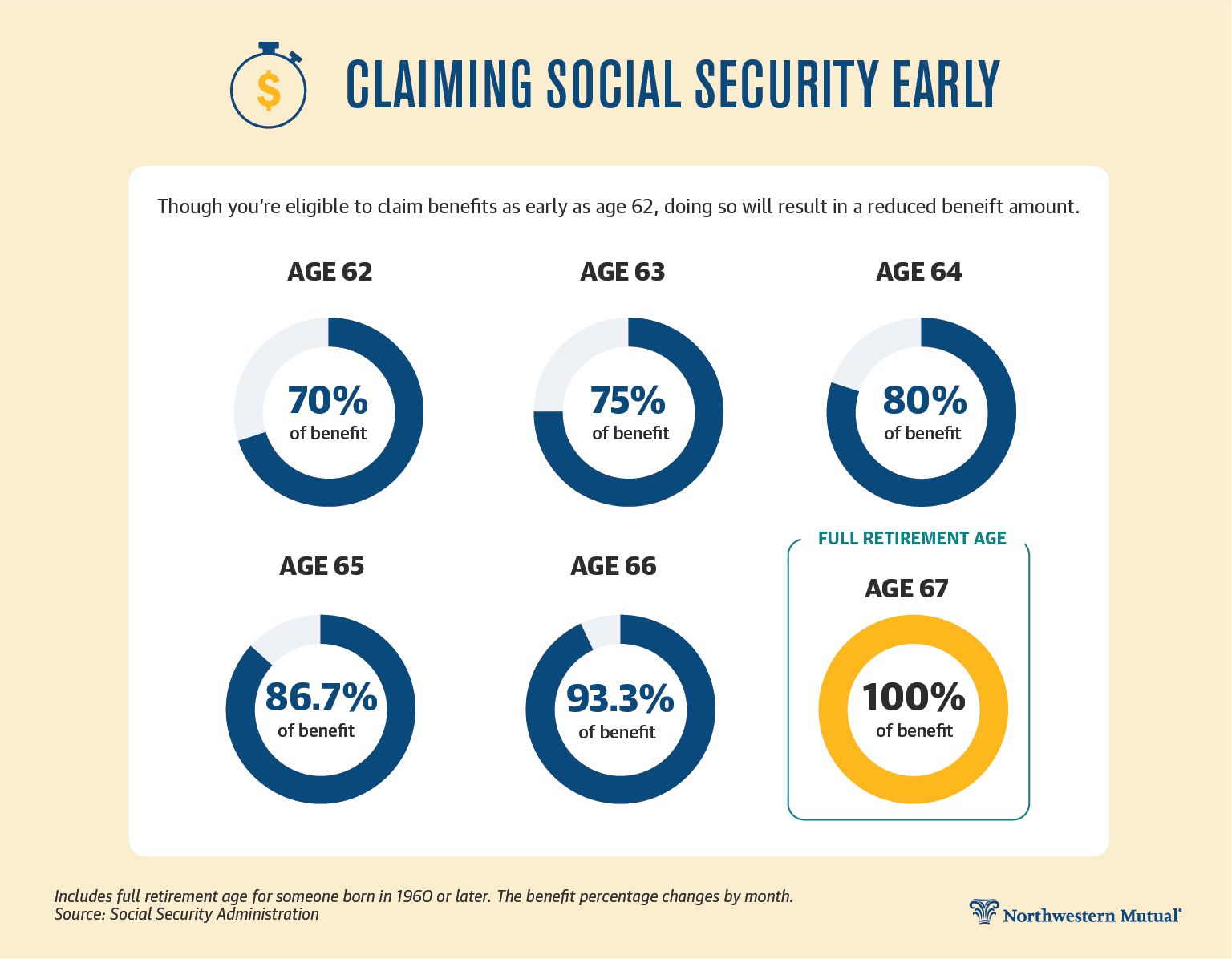
When you claim Social Security at 62, you are opting to receive benefits for a longer duration but at a lower monthly rate. This reduction is not temporary; it’s permanent. The Social Security Administration (SSA) applies an actuarial reduction because you are expected to receive benefits for more years compared to someone who waits until their Full Retirement Age (FRA). This means that for the rest of your life, your monthly Social Security check will be smaller than if you had waited. This reduction also affects any future Cost-of-Living Adjustments (COLAs), as the percentage increase will be applied to a smaller base amount. Therefore, the long-term cumulative impact of this early claim can be substantial.
How the Reduction is Calculated
The reduction for claiming before FRA is calculated based on the number of months you are away from your FRA.
- For the first 36 months early: Your benefit is reduced by 5/9 of 1% for each month. This translates to a 6.67% reduction per year.
- For months beyond 36 (if your FRA is later than 65): Your benefit is further reduced by 5/12 of 1% for each month. This equates to an additional 5% reduction per year.
Let’s illustrate with an example:
Suppose your Full Retirement Age (FRA) is 67. If you claim at 62, you are claiming 60 months early (5 years).
- The first 36 months (3 years) result in a 36 * (5/9 of 1%) = 20% reduction.
- The remaining 24 months (2 years) result in a 24 * (5/12 of 1%) = 10% reduction.
- Total reduction: 20% + 10% = 30%.
This means if your Primary Insurance Amount (PIA) at FRA was $2,000 per month, claiming at 62 would reduce your monthly benefit to $1,400 ($2,000 * 0.70). This 30% reduction is substantial and persists for the duration of your benefit receipt.
Spousal Benefits and Early Claiming
The decision to claim early can also impact spousal benefits. If your spouse claims benefits based on your work record, their benefits may also be affected by your claiming age. Generally, a spouse can receive up to 50% of your unreduced (FRA) benefit. If you claim early and reduce your benefit, their potential spousal benefit might also be reduced. However, a spouse claiming spousal benefits before their own FRA will also see their benefit reduced independently. The calculation here can be complex, and it’s critical for couples to coordinate their claiming strategies to maximize their combined lifetime benefits. If a spouse claims spousal benefits at their earliest eligibility age (62) and their FRA is 67, their spousal benefit could be reduced by as much as 35% to 37.5%.
Factors Influencing Your Benefit Amount
While the decision to claim at age 62 leads to a standard reduction, the underlying amount of your Social Security benefit is not arbitrary. It’s meticulously calculated based on your earnings history, reflecting your contributions to the system over your working life.
Your Earning History
The foundation of your Social Security benefit is your lifetime earnings. The Social Security Administration (SSA) looks at your earnings over your entire career, up to the annual Social Security taxable maximum. For each year you worked, the SSA records your earnings. Importantly, only earnings up to the annual taxable maximum are considered. For instance, in 2024, the taxable maximum is $168,600. If you earned $200,000, only $168,600 of that would count towards your Social Security benefit calculation for that year. The SSA then takes your 35 highest-earning years, indexed for inflation, to calculate your Average Indexed Monthly Earnings (AIME). If you have fewer than 35 years of earnings, zero-earning years will be factored in, which can significantly lower your AIME and thus your eventual benefit. This highlights the importance of consistent employment and earning a good income throughout your career.

The AIME Calculation
The Average Indexed Monthly Earnings (AIME) is the core component in determining your Primary Insurance Amount (PIA), which is your full unreduced benefit at your Full Retirement Age (FRA).
- Indexing Earnings: Your actual earnings from past years are first “indexed” to account for changes in average wages across the national economy over time. This process brings past earnings up to a comparable current dollar value, ensuring that earlier earnings have similar purchasing power to more recent ones. This protects you from inflation eroding the value of your early contributions.
- Identifying High-Earning Years: From these indexed earnings, the SSA selects the 35 years with the highest amounts.
- Calculating the Average: These 35 highest indexed earning years are summed and then divided by 420 (35 years x 12 months) to arrive at your AIME.
Once your AIME is determined, it is plugged into a progressive formula with “bend points” to calculate your PIA. This formula ensures that lower-income earners receive a proportionally higher benefit relative to their past earnings compared to higher-income earners. The bend points change annually, but the principle remains: a higher AIME generally leads to a higher PIA.
Cost-of-Living Adjustments (COLAs)
One of the most valuable features of Social Security benefits is the annual Cost-of-Living Adjustment (COLA). COLAs are increases in benefits that occur most years to help ensure the purchasing power of Social Security benefits is not eroded by inflation. The COLA is based on the increase in the Consumer Price Index for Urban Wage Earners and Clerical Workers (CPI-W) from the third quarter of the prior year to the third quarter of the current year. If there is an increase, benefits will be adjusted upward starting in January of the following year. While the percentage increase is the same for all beneficiaries, it’s applied to your specific benefit amount. This means that if you claimed at 62 and have a reduced base benefit, your COLA-adjusted payment will still be lower in absolute terms than if you had waited and had a higher base benefit. COLAs are a critical component in maintaining financial stability throughout what can be a very long retirement.
Navigating the Decision: Pros and Cons of Early Claiming
The decision to claim Social Security at 62 is multifaceted, balancing immediate financial needs against long-term financial security. There are valid reasons why individuals might choose this path, as well as significant drawbacks that warrant careful consideration.
Potential Advantages of Taking Benefits at 62
- Immediate Income: The most obvious advantage is receiving income sooner. This can be crucial for individuals who have lost their jobs, face health challenges preventing continued work, or simply need the money to cover living expenses in early retirement.
- Bridge to Other Retirement Funds: For some, early Social Security benefits can serve as a bridge, allowing other retirement savings (like 401(k)s or IRAs) to continue growing untouched for a few more years, potentially maximizing their long-term value.
- Health Considerations: If you have a serious health condition or a family history of shorter lifespans, taking benefits early might make sense. You would receive more total payments over your anticipated shorter lifespan than if you waited for a higher monthly payment that you might not collect for long.
- Freedom from Work: Some individuals are simply ready to stop working entirely at 62, regardless of the financial implications, prioritizing quality of life over maximizing benefits. Social Security provides the means to achieve this earlier retirement.
Significant Disadvantages and Long-Term Implications
- Permanent Reduction: As discussed, the most significant drawback is the permanent reduction of your monthly benefit, which can be as much as 30% if your FRA is 67. This lower payment lasts for the rest of your life.
- Reduced Lifetime Income (Potentially): While you get more payments early, if you live a long life, the cumulative amount you receive over your lifetime could be substantially less than if you had waited to claim. The “breakeven point” (the age at which total cumulative benefits for early vs. delayed claiming become equal) is typically in your late 70s or early 80s.
- Impact on Spousal/Survivor Benefits: Your reduced benefit also impacts the maximum amount your spouse or survivors could receive. If you are the higher earner, your claiming decision affects your entire family’s long-term financial security.
- Working While Claiming: If you claim Social Security at 62 and continue to work, your benefits might be subject to the Social Security earnings test. If your earnings exceed a certain limit ($22,320 in 2024), your benefits will be temporarily withheld. For every $2 you earn above the limit, $1 in benefits is withheld. This penalty is only temporary; the SSA will recalculate your benefit at your FRA, giving you credit for the withheld amounts. However, it still means less immediate income.
Considering Your Health and Life Expectancy
This is perhaps the most personal and difficult factor to assess. If you anticipate a shorter-than-average lifespan due to health issues or genetics, claiming early might lead to greater total lifetime benefits. Conversely, if you are in excellent health and expect to live into your 80s or 90s, delaying benefits would likely yield a much higher cumulative payout. This calculation involves a degree of uncertainty, but it’s a critical element in making an informed decision. Consult with your doctor and consider your family health history when making this personal assessment.
Impact on Other Income Sources (e.g., Working While Claiming)
As mentioned, working while claiming before your FRA can lead to a reduction or withholding of benefits due to the earnings test. This means that if you’re working part-time to supplement your early Social Security, you might not see the full benefit of those combined incomes. It’s crucial to understand the earnings limits and how they apply to your specific situation. This can influence your decision to work or delay claiming until you are fully retired or at your FRA, when the earnings test no longer applies.
Strategic Considerations and Alternatives
For many, claiming at 62 is not the optimal strategy for maximizing lifetime benefits. Exploring alternatives and strategic approaches can significantly enhance your financial security in retirement.
Maximizing Your Benefits by Delaying
Delaying Social Security past age 62, and ideally past your Full Retirement Age (FRA), can substantially increase your monthly benefit. For each year you delay claiming past your FRA, up to age 70, your benefit increases by approximately 8% per year. This is known as Delayed Retirement Credits (DRCs). These credits are applied to your benefit, making your monthly check permanently larger.
- Example: If your FRA is 67 and your PIA is $2,000, delaying until age 70 would increase your monthly benefit by 24% (3 years x 8% per year). Your new monthly benefit would be $2,480. This is a significant difference compared to the $1,400 you’d receive at 62.
For those who can afford to wait, perhaps by working longer, drawing on other savings, or living off a spouse’s income, delaying Social Security can be one of the most effective strategies for guaranteed income growth in retirement. It acts as an inflation-adjusted annuity, providing a higher level of income for life.
Bridging the Gap: Other Retirement Income Sources
If you wish to delay Social Security past age 62 but need income, consider how other retirement savings vehicles can bridge the gap.
- 401(k)s and IRAs: Withdrawals from these accounts can provide necessary income in the years before you claim Social Security, allowing your benefits to grow.
- Brokerage Accounts/Savings: If you have non-retirement investment accounts or substantial savings, these can be used to cover expenses.
- Part-time Work: Earning some income through part-time work or a “bridge job” can help defer Social Security claiming, but be mindful of the earnings test if you are below your FRA.
- Annuities: Certain types of annuities, particularly deferred income annuities, can be structured to provide income at a later age, complementing Social Security.
Strategic use of these resources allows you to maximize the value of your Social Security benefits by letting them grow.
The Importance of Financial Planning
Ultimately, the decision of when to claim Social Security should be an integral part of your broader financial retirement plan. It’s not a standalone choice.
- Assess Your Needs: Understand your anticipated expenses in retirement, your current savings, and other income sources.
- Model Scenarios: Use tools provided by the Social Security Administration (like my Social Security account) or financial planning software to model different claiming ages and their impact on your lifetime income.
- Consider Your Spouse: If married, coordinate your claiming strategies. Often, one spouse delaying benefits can provide a higher survivor benefit for the remaining spouse.
- Consult a Professional: A qualified financial advisor can provide personalized guidance, helping you weigh the pros and cons based on your unique financial situation, health, and goals. They can help you integrate Social Security into your overall retirement strategy, ensuring you make the most informed decision.
Conclusion
Claiming Social Security at age 62 offers the immediate gratification of an early income stream, but it comes at a significant and permanent cost: a reduced monthly benefit for life. For some, due to health issues, immediate financial necessity, or a desire for early retirement, this trade-off may be justified. However, for many others, particularly those with good health and a reasonable life expectancy, delaying benefits to Full Retirement Age or even age 70 can result in substantially higher lifetime income.
Understanding your Full Retirement Age, the mechanics of benefit reduction, the impact of your earnings history, and the potential for delayed retirement credits are all crucial elements in this complex decision. By carefully weighing the advantages and disadvantages, considering your personal circumstances, and ideally consulting with a financial advisor, you can make an informed choice that aligns with your long-term financial goals and helps secure a more prosperous retirement. Your Social Security claiming strategy is a cornerstone of your financial well-being; approach it with diligence and foresight.
aViewFromTheCave is a participant in the Amazon Services LLC Associates Program, an affiliate advertising program designed to provide a means for sites to earn advertising fees by advertising and linking to Amazon.com. Amazon, the Amazon logo, AmazonSupply, and the AmazonSupply logo are trademarks of Amazon.com, Inc. or its affiliates. As an Amazon Associate we earn affiliate commissions from qualifying purchases.