
The question of how much one needs to retire is perhaps the most significant financial query an individual will ever face. It is a moving target, influenced by inflation, lifestyle choices, market volatility, and the unpredictable nature of longevity. Retirement is no longer a static event signaled by a gold watch and a pension; it is a dynamic phase of life that requires rigorous mathematical planning and a deep understanding of personal finance.
To determine your “retirement number,” you must look beyond simple savings accounts and delve into the mechanics of withdrawal rates, tax diversification, and the compounding power of various asset classes. This guide provides a professional blueprint for calculating your needs and securing your financial future.
Determining Your Retirement Number: The Foundation of Financial Planning
Before you can determine how much you need, you must understand how your capital will support you. The “retirement number” is the total value of your investable assets required to generate enough income to cover your expenses indefinitely, or at least for the duration of your life.
The 4% Rule and Its Modern Relevance
For decades, the “4% Rule”—derived from the Trinity Study—has been the gold standard for retirement planning. It suggests that if you withdraw 4% of your initial portfolio value in the first year of retirement and adjust that amount for inflation every year thereafter, your money has a high probability of lasting 30 years. To find your number using this rule, you simply multiply your desired annual income by 25. For example, if you need $80,000 per year, your target is $2 million.
However, in today’s environment of fluctuating interest rates and extended life expectancies, many financial planners suggest a more conservative withdrawal rate of 3% to 3.5%. If you opt for a 3% rate, you would need to multiply your expenses by 33.3, raising the requirement for that same $80,000 income to approximately $2.6 million.
Assessing Your Expected Retirement Lifestyle
Your retirement number is inextricably linked to your “burn rate.” A common mistake is assuming that expenses will drastically drop once you stop working. While commuting costs and professional wardrobes may disappear, they are often replaced by increased spending on travel, hobbies, and leisure.
Financial experts often recommend the “Replacement Ratio” method, suggesting you aim to replace 70% to 85% of your pre-retirement gross income. If you earned $150,000 annually, you should plan for a lifestyle costing between $105,000 and $127,500. Adjusting this based on whether you plan to downsize your home or relocate to a lower-tax jurisdiction is a critical step in refining your estimate.
Factoring in Inflation and Healthcare Costs
Inflation is the “silent killer” of purchasing power. Even at a modest 3% annual inflation rate, the cost of living doubles roughly every 24 years. This means the $5,000 you spend today will feel like $10,000 mid-way through a long retirement.
Furthermore, healthcare remains the largest “wildcard” expense. Recent data suggests that an average 65-year-old couple retiring today may need approximately $315,000 (after-tax) just to cover medical expenses throughout retirement, excluding long-term care. Building a dedicated healthcare buffer, such as a Health Savings Account (HSA), is an essential component of a robust retirement strategy.
Milestones and Benchmarks by Age
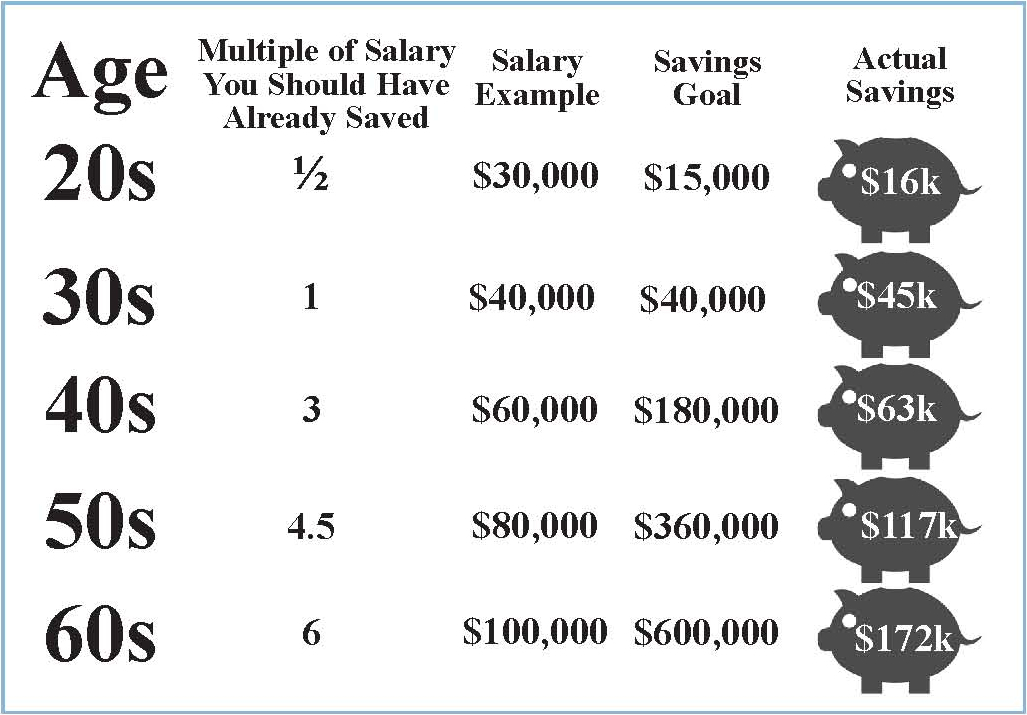
While the total number is the ultimate goal, it is helpful to have intermediate benchmarks to ensure you are on track. These milestones serve as a diagnostic tool for your financial health across different decades of your career.
Where You Should Be in Your 30s and 40s
In your 30s, the focus is on the “accumulation phase.” A general professional benchmark is to have one times your annual salary saved by age 30, and three times your salary by age 40. At this stage, time is your greatest asset. Due to the effects of compound interest, a dollar invested in your 30s is worth significantly more than a dollar invested in your 50s.
During these decades, the emphasis should be on aggressive growth. High-equity allocations in diversified index funds or ETFs allow you to capture market premiums. It is also the time to eliminate high-interest consumer debt, which acts as a drag on your ability to compound wealth.
The “Catch-Up” Phase: Strategies for Your 50s
By the time you reach your 50s, the benchmark typically moves to six times your annual salary. This decade is often the “peak earning years,” providing a unique opportunity to supercharge your savings.
The IRS allows “catch-up contributions” for individuals aged 50 and older for 401(k)s and IRAs. Utilizing these allows you to shield more income from taxes while aggressively padding your nest egg. This is also the period to transition from a pure growth mindset to a “risk-adjusted growth” mindset, ensuring that a market downturn just before retirement doesn’t derail your plans.

Longevity Risk: Planning for a 30-Year Retirement
Modern medicine and healthier lifestyles mean that “longevity risk”—the risk of outliving your money—is higher than ever. It is no longer sufficient to plan for a retirement that lasts until age 80. Financial models should now stress-test portfolios to age 95 or even 100. This requires a portion of your portfolio to remain invested in equities even after you stop working, ensuring that your capital continues to grow and outpace inflation.
Diversifying Your Income Streams
A secure retirement is rarely built on a single savings account. Instead, it is a “multi-legged stool” consisting of various income sources that offer different tax advantages and risk profiles.
Maximizing Employer-Sponsored Accounts (401k/403b)
The foundation for most corporate employees is the 401(k) or 403(b). The primary advantage here is the employer match—essentially a 100% return on your initial investment. Professionally managed retirement planning suggests contributing at least enough to capture the full match before looking at other vehicles. These accounts allow your investments to grow tax-deferred, meaning you only pay taxes when you withdraw the funds in retirement, presumably when you are in a lower tax bracket.
The Power of Roth IRAs and Tax-Advantaged Growth
While traditional retirement accounts offer a tax break today, Roth accounts offer a tax break tomorrow. Contributions to a Roth IRA are made with after-tax dollars, but the withdrawals in retirement are entirely tax-free.
Tax diversification is crucial because we cannot predict what tax brackets will look like 20 or 30 years from now. Having a “bucket” of tax-free money allows you to manage your taxable income in retirement, potentially keeping you in a lower bracket and reducing the amount of Social Security benefits that are subject to taxation.
Real Estate and Passive Income as Buffers
For many, paper assets (stocks and bonds) are supplemented by “hard assets” like real estate. Rental income provides a cash flow stream that often keeps pace with inflation and offers unique tax deductions through depreciation. Diversifying into real estate or other side-income ventures creates a “floor” of income that reduces the pressure on your investment portfolio to perform during bear markets.
Tools and Methods for Precise Calculation
To move from an educated guess to a professional financial plan, you must employ advanced analytical tools and consider external income factors.
Using Monte Carlo Simulations for Stress Testing
Simple linear projections (assuming a steady 7% return every year) are dangerous because the market is volatile. Professional advisors use Monte Carlo simulations, which run thousands of “what-if” scenarios involving different market conditions. This provides a probability of success (e.g., “You have a 92% chance of not running out of money”). Aiming for a success probability of 85% or higher is generally considered a “safe” plan.
The Role of Social Security and Pensions
While you shouldn’t rely solely on Social Security, it remains a vital component of the retirement equation. The timing of your claim is critical; for every year you delay claiming past your Full Retirement Age (up to age 70), your benefit increases by approximately 8%. If you have a high life expectancy, delaying your claim can act as a form of longevity insurance, providing a higher inflation-adjusted floor for your income.
Rebalancing Your Portfolio as You Approach the “Red Zone”
The five years before and the five years after retirement are known as the “Retirement Red Zone.” This is when your portfolio is most vulnerable to “sequence of returns risk”—the risk that a market crash occurs just as you begin making withdrawals.
To mitigate this, investors often move toward a “Bucket Strategy.”
- Bucket 1: 2–3 years of cash/liquid assets for immediate spending.
- Bucket 2: 5–7 years of fixed-income assets (bonds/CDs) for stability.
- Bucket 3: Long-term equities for growth.
By having a cash bucket, you avoid being forced to sell stocks at a loss during a market downturn, giving your equity investments time to recover.

Conclusion
Determining how much you need to retire is not a one-time calculation but an evolving strategy. It requires a balance between aggressive accumulation in your early years and sophisticated risk management as you approach your target date. By understanding the 4% rule, accounting for healthcare and inflation, and diversifying your tax buckets, you can move toward retirement with confidence.
Ultimately, the goal of financial planning is not just to reach a specific number, but to build a resilient system that provides the freedom to enjoy your post-career life without the shadow of financial insecurity. Start by assessing your current trajectory today—because the best time to adjust your retirement plan was ten years ago, and the second-best time is now.
aViewFromTheCave is a participant in the Amazon Services LLC Associates Program, an affiliate advertising program designed to provide a means for sites to earn advertising fees by advertising and linking to Amazon.com. Amazon, the Amazon logo, AmazonSupply, and the AmazonSupply logo are trademarks of Amazon.com, Inc. or its affiliates. As an Amazon Associate we earn affiliate commissions from qualifying purchases.