
For the vast majority of households, a vehicle represents the second-largest financial asset on the balance sheet, surpassed only by real estate. However, unlike a primary residence, which typically appreciates over time, a car is a depreciating asset. Navigating the complexities of this depreciation is a cornerstone of sound personal finance. When a consumer asks, “How much is my car worth?” they are usually directed toward Kelley Blue Book (KBB). Since 1926, KBB has served as the gold standard for automotive valuation, providing a data-driven framework that helps individuals make informed decisions about trading, selling, or insuring their vehicles.

Understanding your car’s value through the lens of KBB is not merely about satisfying curiosity; it is a strategic move in managing your net worth. Whether you are looking to free up liquid capital, optimize a trade-in for a new investment, or assess your total asset value for a loan application, mastering the KBB ecosystem is essential.
The Financial Logic Behind Vehicle Valuation
To understand the numbers KBB generates, one must first understand the economic principles of the automotive market. A car’s value is not a static figure but a fluid data point influenced by macro and microeconomic factors. KBB utilizes a proprietary algorithm that synthesizes massive amounts of data, including actual transactions, auction prices, and regional supply and demand.
The Role of Depreciation in Personal Finance
Depreciation is the silent killer of wealth in the automotive world. A new car can lose up to 20% of its value within the first year and roughly 60% after five years. For the savvy financial planner, tracking this depreciation via KBB allows for “equity tracking.” By knowing exactly when a car’s market value is likely to drop below the remaining balance on an auto loan—a state known as being “underwater”—an individual can take preemptive steps to pay down principal or sell the asset before the loss becomes unmanageable.
Market Volatility and the Used Car Index
In recent years, the used car market has seen unprecedented volatility due to supply chain disruptions and shifts in consumer behavior. KBB’s real-time data helps owners capitalize on these shifts. For instance, during periods of high fuel prices, fuel-efficient hybrids and EVs often see a spike in their KBB value, whereas heavy-duty trucks might see a dip. Monitoring these trends through valuation tools allows owners to treat their vehicles more like a tradable commodity than a permanent fixture.
Decoding KBB Metrics: Trade-In, Private Party, and Retail
When you input your VIN or make and model into KBB, you are presented with several different values. Distinguishing between these is the difference between a successful financial transaction and leaving thousands of dollars on the table.
Trade-In Value: The Price of Convenience
The Trade-In Value is the amount a dealership is willing to offer you toward the purchase of another vehicle. From a financial perspective, this is almost always the lowest valuation. Dealerships must account for their own overhead, including reconditioning costs, marketing, and their desired profit margin.
However, the Trade-In Value offers a specific tax advantage in many jurisdictions. In many states, you only pay sales tax on the “price difference” between your new car and your trade-in. If you are buying a $40,000 car and trading in a $20,000 car, you only pay tax on the remaining $20,000. For many, this tax shield offsets the lower valuation provided by the dealer.
Private Party Value: Maximizing Direct Returns
The Private Party Value is what you can expect to receive if you sell the car yourself to another individual. This figure is significantly higher than the trade-in value because it cuts out the middleman. For those looking to maximize their liquid cash, this is the target metric. However, it requires a higher “cost of labor”—the time spent listing the car, vetting buyers, and handling the legal paperwork. From a side-hustle perspective, the “spread” between trade-in and private party value can often be viewed as the hourly wage you earn for doing the work of a dealership yourself.
KBB Instant Cash Offer
A newer feature in the KBB arsenal is the Instant Cash Offer (ICO). This is a fixed price, backed by a physical inspection, that participating dealers will pay you for your car immediately. In a fast-moving economy, the ICO provides a baseline “floor” for your asset’s value. It acts as a financial safety net, ensuring you have a liquid exit strategy if you need to move the asset quickly to cover other financial obligations or investment opportunities.
Strategic Variables: What Really Drives Your Car’s Market Price

A common mistake in personal finance is overestimating the value of one’s own assets. When using KBB, accuracy is paramount. Several key variables dictate where your car falls within the valuation range.
The Myth of “Excellent” Condition
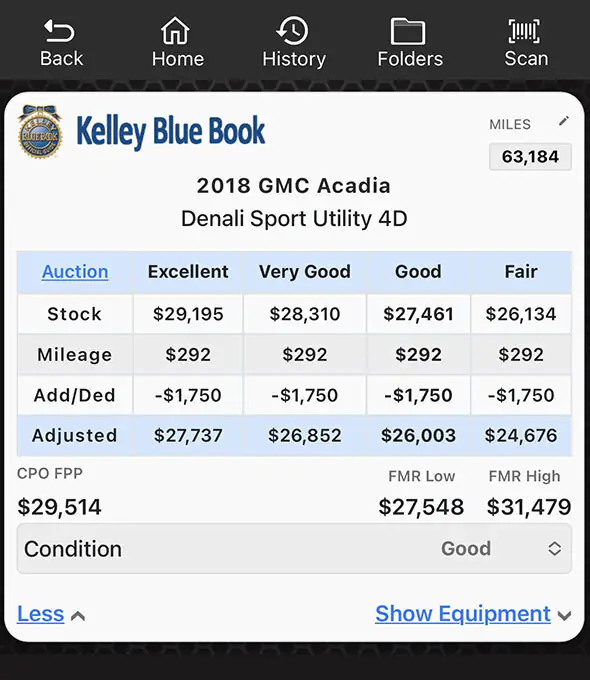
One of the most sobering aspects of the KBB process is the condition report. KBB categorizes cars into Fair, Good, Very Good, and Excellent. Statistically, fewer than 5% of used vehicles truly qualify as “Excellent.” Most owners emotionally inflate their car’s condition, leading to unrealistic financial expectations. In professional financial planning, it is always safer to value your asset at “Good” or “Fair” to ensure your net worth calculations remain conservative and realistic.
Mileage and the “Threshold” Effect
In the world of automotive finance, mileage is the primary metric of wear and tear. However, value doesn’t drop linearly; it often drops in “cliffs.” Crossing the 36,000-mile mark (often the end of bumper-to-bumper warranties), the 60,000-mile mark, and the 100,000-mark results in significant valuation shifts. If you are approaching one of these milestones, KBB data might suggest that selling the vehicle 500 miles before the threshold could save you thousands in realized depreciation.
Geographical Valuation Differences
The “where” is often as important as the “what.” A rear-wheel-drive convertible has a higher KBB value in Florida or California than it does in a snowy Montana winter. KBB uses your zip code to adjust for regional demand. For the highly motivated, this presents an arbitrage opportunity: buying a vehicle in a region where it is undervalued and selling it in a region where KBB reflects a premium.
Maximizing Equity: Financial Tactics for Selling or Trading
Once you have established your car’s worth via KBB, the next step is execution. How do you ensure you actually receive the value the tool suggests?
The ROI of Reconditioning
Not all repairs are created equal. If KBB suggests your car is worth $15,000 in “Good” condition but only $12,000 in “Fair” condition, and the repairs to move it from Fair to Good cost $1,000, you have a clear 200% return on investment. Focus on high-visibility areas: professional detailing, fixing windshield chips, and replacing worn tires. These are small capital outlays that directly influence the “perceived value” which allows you to hit the higher end of the KBB range.
Documentation as a Value Add
In personal finance, data is a form of currency. A vehicle with a meticulous service history, documented through receipts and a clean Carfax, will always command the top tier of the KBB Private Party Value. Buyers are essentially paying a premium for “reduced risk.” By maintaining these records, you are effectively buying insurance for your car’s future resale value.
Timing the Market
Much like the stock market, the car market has seasonal cycles. Convertible values peak in the spring, while 4WD SUVs peak just before the first snowfall. Furthermore, the end of the fiscal quarter or the end of the calendar year is often the best time to negotiate a trade-in, as dealerships are eager to hit volume targets. Use KBB to track your car’s value month-over-month to identify the optimal “exit window.”
Integrating Car Valuation into Your Long-Term Wealth Strategy
Viewing your car as a revolving financial instrument rather than a permanent possession is key to long-term wealth building. By regularly checking “how much my car is worth” on KBB, you stay in control of your largest depreciating asset.
The “Sinking Fund” Approach
Once you know your car’s current KBB value and its projected depreciation rate, you can calculate the “gap” between your current asset and your next desired vehicle. This allows you to create a “sinking fund”—a dedicated savings account where you deposit the difference each month. This ensures that when the time comes to replace the vehicle, you can do so with cash or a minimal, low-interest loan, keeping your debt-to-income ratio healthy.
Insurance and Total Loss Protection
KBB values are also vital for insurance purposes. If your vehicle is totaled, the insurance company will offer a “Fair Market Value” settlement. If you haven’t checked KBB recently, you might accept an offer that is significantly below what it would cost to replace the asset. Keeping a quarterly record of your KBB valuation provides you with the leverage needed to negotiate with insurance adjusters, protecting your financial downside.
Ultimately, Kelley Blue Book is more than a pricing guide; it is a strategic advisor for one of the most significant line items in your personal budget. By understanding the nuances of trade-in versus private party values, the impact of mileage thresholds, and the importance of objective condition assessment, you transform a simple car into a well-managed financial asset. In the landscape of personal finance, knowledge is the only tool that can effectively combat the inevitable forces of depreciation.
aViewFromTheCave is a participant in the Amazon Services LLC Associates Program, an affiliate advertising program designed to provide a means for sites to earn advertising fees by advertising and linking to Amazon.com. Amazon, the Amazon logo, AmazonSupply, and the AmazonSupply logo are trademarks of Amazon.com, Inc. or its affiliates. As an Amazon Associate we earn affiliate commissions from qualifying purchases.