
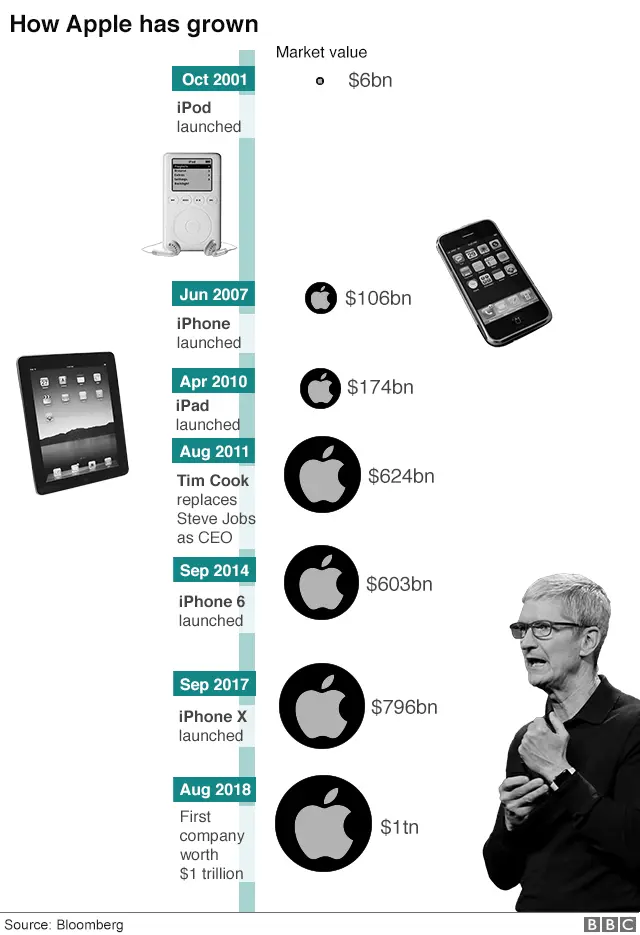
Apple Inc. stands as a titan of the modern global economy, often serving as the primary barometer for the health of the technology sector and the broader stock market. When investors and analysts ask “how much money is Apple worth,” the answer is multifaceted, involving a blend of market capitalization, enterprise value, liquid assets, and the intangible value of its global ecosystem. As the first company to ever cross the $1 trillion, $2 trillion, and $3 trillion market cap milestones, Apple’s valuation is a testament to its unparalleled ability to monetize innovation and maintain consumer loyalty.

Understanding Market Capitalization: The $3 Trillion Benchmark
To determine Apple’s worth, the most common metric used is market capitalization. This figure is calculated by multiplying the current price of a single share of Apple stock (AAPL) by the total number of outstanding shares. While this number fluctuates daily based on market sentiment and economic data, Apple has consistently hovered around the $3 trillion mark, making it one of the most valuable entities in human history.
The Significance of the $3 Trillion Threshold
A $3 trillion valuation is more than just a psychological milestone; it represents a massive concentration of capital. To put this in perspective, Apple’s market cap is larger than the Gross Domestic Product (GDP) of many G7 nations, including France and the United Kingdom. This scale allows Apple to exert significant influence over global supply chains, interest rates, and institutional investment portfolios. For most individual investors, Apple represents a “core” holding, often occupying the largest slot in the S&P 500 and the Nasdaq-100.
Enterprise Value vs. Market Cap
While market cap provides a snapshot of equity value, “Enterprise Value” (EV) offers a more holistic view of what the company is worth if it were to be acquired. EV is calculated by taking the market cap, adding total debt, and subtracting cash and cash equivalents. Apple’s enterprise value remains exceptionally high because, despite having significant debt used for tax-efficient capital returns, its cash reserves are among the largest in the corporate world. This balance sheet strength provides a safety net that few other companies can match.
The Role of Stock Buybacks
Apple’s valuation is also heavily influenced by its aggressive share repurchase program. By buying back its own stock, Apple reduces the number of shares outstanding, which increases the Earnings Per Share (EPS) and often puts upward pressure on the stock price. Since 2012, Apple has spent hundreds of billions of dollars on buybacks, a strategy that signals to the market that the company believes its own stock is the best investment available. This reduces the “dilution” of value and concentrates the worth of the company into fewer, more valuable pieces.
Revenue Streams and Profitability: The Engines of Valuation
Apple’s worth is not merely a product of market speculation; it is backed by staggering financial performance. The company’s ability to generate massive amounts of free cash flow is the primary driver of its high valuation. By diversifying its income across hardware, software, and services, Apple has built a resilient financial engine.
The iPhone: The Anchor of the Empire
The iPhone remains the primary driver of Apple’s revenue, often accounting for more than 50% of its total sales. However, the financial story of the iPhone has shifted from unit growth to “Average Selling Price” (ASP) optimization. By pushing consumers toward “Pro” and “Pro Max” models, Apple has maintained high margins even as the global smartphone market matures. The iPhone isn’t just a product; it’s a gateway to the Apple ecosystem, ensuring that every hardware sale leads to years of recurring revenue.
The High-Margin Services Pivot
The most significant transformation in Apple’s financial profile over the last decade has been the growth of its Services division. This includes the App Store, iCloud, Apple Music, Apple Pay, and Apple TV+. Services revenue is particularly valuable to investors for two reasons: it is recurring and it carries much higher gross margins than hardware (often exceeding 70%). As the installed base of active Apple devices grows to over 2 billion, the ability to monetize these users through software and subscriptions adds a layer of “predictable” worth that justifies a higher price-to-earnings multiple.
Wearables and the “Other Products” Category
Apple’s “Wearables, Home, and Accessories” segment—comprising the Apple Watch, AirPods, and Vision Pro—has grown into a business the size of a Fortune 100 company on its own. These products create “stickiness” within the ecosystem. A consumer who owns an iPhone, an Apple Watch, and AirPods is statistically far less likely to switch to a competitor, creating a “moat” that protects Apple’s long-term value.
Key Financial Metrics for Investors

To understand why Apple is valued so highly, one must look at the specific financial ratios and balance sheet metrics that professional fund managers prioritize. Apple’s worth is a reflection of its efficiency, not just its size.
Price-to-Earnings (P/E) Ratio
The P/E ratio measures how much investors are willing to pay for every dollar of profit. Historically, Apple traded at a discount compared to other tech firms because it was viewed as a “hardware” company subject to cyclical swings. Today, Apple trades at a premium multiple, often between 25x and 30x earnings. This shift reflects the market’s recognition of Apple as a software and services powerhouse with stable, predictable cash flows.
Free Cash Flow (FCF) Generation
Free cash flow is the cash a company produces after accounting for cash outlays to support operations and maintain its capital assets. Apple is a cash-generating machine, often producing over $100 billion in FCF annually. This liquidity allows the company to fund research and development (R&D), acquire smaller startups for their intellectual property, and return capital to shareholders through dividends and buybacks without needing to take on expensive external financing.
Dividend Growth and Yield
While Apple is not typically classified as a “yield play,” it has become one of the largest dividend payers in the world in terms of total dollars distributed. For conservative investors and pension funds, Apple’s consistent dividend increases provide a steady income stream, adding “tangible” worth to the stock beyond simple price appreciation. This makes the stock attractive during periods of market volatility, as it offers a combination of growth and defensive stability.
Future Outlook: Growth Drivers and Market Risks
The valuation of Apple is not just a reflection of its past successes but a prediction of its future potential. As the company moves into new territories, the market adjusts its “worth” based on perceived risks and opportunities.
Artificial Intelligence and the Next Supercycle
The integration of generative AI (Apple Intelligence) across the iOS ecosystem represents the next major catalyst for valuation. Analysts believe that AI-driven features will trigger a massive hardware upgrade cycle, as older devices will lack the processing power required for on-device AI. If Apple can successfully position itself as the leader in “private” and “integrated” AI, its market cap could see another significant upward expansion.
Regulatory Challenges and Antitrust Risks
The greatest threat to Apple’s valuation comes from regulatory bodies in the United States and the European Union. Antitrust lawsuits targeting the App Store’s commission structure and the “closed” nature of the ecosystem could potentially impact the high-margin Services revenue. Investors closely monitor these legal battles, as any forced opening of the ecosystem could dilute the “moat” that currently protects Apple’s profit margins.
Diversification of the Supply Chain
From a business finance perspective, Apple’s heavy reliance on manufacturing in China has been a point of concern. The company is currently investing billions to diversify its supply chain into India, Vietnam, and other regions. While this transition involves significant capital expenditure, it reduces geopolitical risk, thereby “derisking” the valuation for long-term institutional investors.
The Intangible Value of the Brand
Finally, any discussion of Apple’s worth must include the value of its brand equity. In branding and finance, the “Apple” name is an asset that doesn’t appear directly on the balance sheet but drives every transaction.
Consumer Loyalty and Price Elasticity
Apple possesses a rare level of “price elasticity,” meaning it can raise prices on its flagship products without seeing a significant drop in demand. This brand power is a financial asset that allows Apple to maintain its margins even during inflationary periods. The brand represents a promise of quality and status, which translates into a lower cost of customer acquisition compared to competitors like Samsung or Google.
The Ecosystem Moat
The “Walled Garden” is perhaps Apple’s most valuable financial construct. By ensuring that its devices and software work seamlessly together—and less so with third-party products—Apple creates a high “switching cost” for users. This ecosystem effect ensures long-term customer lifetime value (LTV), a metric that investors weigh heavily when determining the company’s multi-year growth trajectory.
In conclusion, the question of “how much money Apple is worth” cannot be answered by a single number. While the $3 trillion market cap is the headline figure, the true value lies in its $100 billion annual free cash flow, its 2 billion-device installed base, and a brand that command’s global loyalty. Whether viewed as a hardware giant, a software service provider, or a luxury brand, Apple’s financial architecture is designed for sustained value creation, making it the gold standard for corporate valuation in the 21st century.
aViewFromTheCave is a participant in the Amazon Services LLC Associates Program, an affiliate advertising program designed to provide a means for sites to earn advertising fees by advertising and linking to Amazon.com. Amazon, the Amazon logo, AmazonSupply, and the AmazonSupply logo are trademarks of Amazon.com, Inc. or its affiliates. As an Amazon Associate we earn affiliate commissions from qualifying purchases.