
In the landscape of global commerce, few entities command as much financial influence as Amazon. Since its inception as an online bookstore in the mid-1990s, the company has evolved into a multi-headed titan spanning e-commerce, cloud computing, digital streaming, and artificial intelligence. For investors, financial analysts, and the general public, the question of “how much money Amazon has” is not just about a single number on a balance sheet; it is an inquiry into the liquidity, asset value, and revenue-generating capacity of one of the world’s most complex financial machines.

To understand Amazon’s wealth, one must look beyond its daily stock price fluctuations and delve into its cash reserves, its diversified revenue streams, and its massive infrastructure investments. As of recent fiscal reporting, Amazon’s financial stature remains a testament to the “Flywheel Effect”—a strategy of reinvesting nearly every dollar of profit back into the business to achieve exponential growth.
Understanding Amazon’s Liquidity: Cash and Marketable Securities
When evaluating how much “liquid” money a corporation holds, the most critical metric is its “Cash, Cash Equivalents, and Marketable Securities.” This represents the funds Amazon could theoretically access almost immediately to fund an acquisition, cover operational costs, or weather an economic downturn.
Breaking Down the Liquidity Reserves
As of the most recent fiscal years, Amazon consistently maintains a cash cushion that would rival the GDP of many small nations. Typically, this figure hovers between $70 billion and $85 billion. This liquid wealth is categorized into two main buckets: immediate cash (bank deposits and highly liquid short-term paper) and marketable securities (stocks or bonds that can be liquidated quickly).
Having nearly $80 billion in liquid assets provides Amazon with an unparalleled competitive advantage. While smaller competitors may struggle to secure financing during high-interest periods, Amazon’s massive internal “bank” allows it to self-fund major projects, such as the expansion of its satellite internet constellation (Project Kuiper) or the build-out of its proprietary delivery fleet.
The Philosophy of “Day 1” and Cash Reinvestment
It is important to note that while Amazon holds tens of billions in cash, it is rarely “sitting idle.” Jeff Bezos, and now Andy Jassy, have maintained a “Day 1” philosophy that prioritizes long-term free cash flow over short-term accounting profits. Unlike many legacy corporations that return value to shareholders via dividends, Amazon has historically avoided dividends in favor of aggressive reinvestment. This means that while the company “has” a lot of money, it is constantly moving that money into new ventures, which keeps its actual net income lower than it might otherwise be for a company of its size.
The Revenue Engines: How Amazon Generates Its Fortune
To understand the scale of Amazon’s wealth, one must examine the engines that generate its massive cash inflows. Amazon’s total annual revenue has surpassed $570 billion, a figure that places it among the highest-earning entities in human history. This wealth is generated through three primary segments: AWS, the North American retail market, and its International operations.
Amazon Web Services (AWS): The Profit Powerhouse
While the retail side of Amazon is the most visible, Amazon Web Services (AWS) is arguably the company’s most important financial asset. AWS provides cloud computing infrastructure to government agencies, tech startups, and Fortune 500 companies.
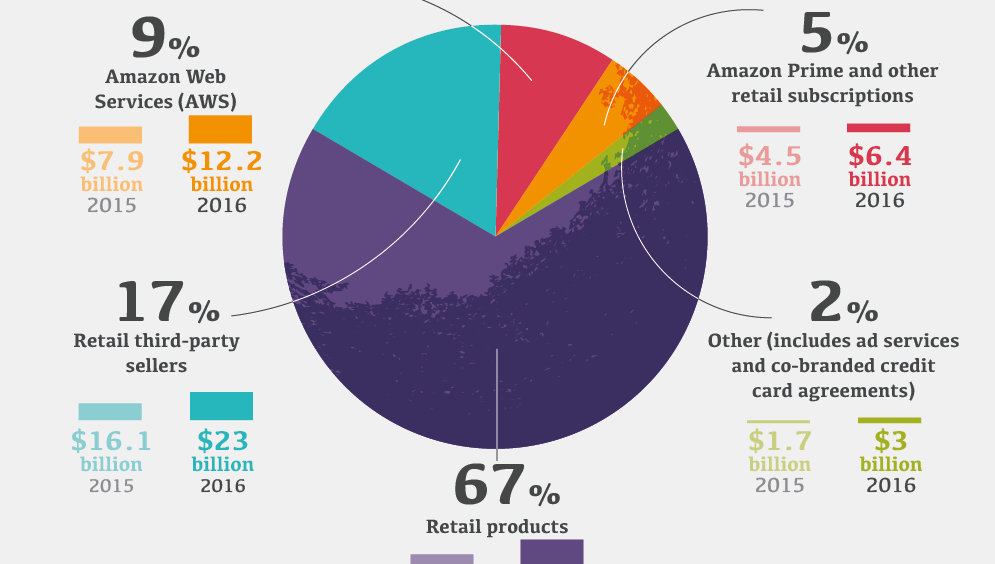
Financially, AWS is a marvel. While it often accounts for only 15% to 16% of Amazon’s total revenue, it frequently generates over 60% of the company’s total operating income. The high margins of cloud computing allow Amazon to subsidize its lower-margin retail operations. When we talk about how much money Amazon has “to spend,” much of that capital is the direct result of the high-margin profitability of its cloud business.
Advertising and Subscription Services
In recent years, Amazon has quietly become an advertising juggernaut. Amazon Advertising now generates upwards of $45 billion annually. Because the infrastructure for the store already exists, advertising represents a high-margin revenue stream that flows directly into the company’s cash reserves.
Additionally, subscription services—primarily Amazon Prime—generate over $40 billion in recurring annual revenue. This provides a predictable, steady stream of liquidity that allows the company to budget for massive capital expenditures years in advance.
Third-Party Seller Services
Amazon has transitioned from being a direct retailer to a platform. More than 60% of the items sold on Amazon come from third-party sellers. Amazon “makes money” here by charging fulfillment fees, referral fees, and storage fees. This model is highly efficient because it allows Amazon to generate revenue without the risk and capital tied up in owning the physical inventory itself.
Assets and Valuation: Beyond the Liquid Cash
If we define “how much money Amazon has” as its total net worth or total assets, the number climbs significantly higher. Amazon’s total assets are valued at over $530 billion. This includes the tangible and intangible property that the company owns, which could be leveraged or sold if necessary.
Real Estate and Logistics Infrastructure
A significant portion of Amazon’s wealth is tied up in its physical footprint. The company owns or leases hundreds of millions of square feet of warehouse space, fulfillment centers, and sorting facilities. Following the COVID-19 pandemic, Amazon doubled its logistics footprint, essentially building a shipping network that rivals UPS and FedEx in just a few short years. These assets are worth tens of billions of dollars and form a “moat” that makes it nearly impossible for competitors to catch up.
Intellectual Property and AI Investment
Amazon’s intangible assets—its patents, software code, and brand equity—are worth hundreds of billions more. The company is currently shifting its financial focus toward Artificial Intelligence, investing billions into proprietary chips (Trainium and Inferentia) and generative AI models (Bedrock). This shift in capital allocation demonstrates that Amazon views its “money” not just as currency, but as a tool for securing the next decade of technological dominance.
Strategic Acquisitions
Amazon’s wealth is also reflected in its portfolio of acquired companies. From Whole Foods Market ($13.7 billion) to MGM Studios ($8.5 billion) and One Medical ($3.9 billion), Amazon uses its cash reserves to buy its way into new industries. Each acquisition adds to the company’s total asset value and provides new avenues for revenue generation.
Debt and Financial Liabilities: The Other Side of the Ledger
To have a professional understanding of Amazon’s financial standing, one must balance its massive cash reserves against its liabilities. No company, regardless of its size, operates entirely without debt.
Long-Term Debt and Interest
Amazon carries a significant amount of long-term debt, often exceeding $60 billion. However, in the world of corporate finance, debt is often used strategically. Amazon takes on debt when interest rates are low to fund capital-intensive projects, preserving its liquid cash for operational flexibility. Because its “Debt-to-Equity” ratio remains healthy, and its ability to service that debt is backed by its massive cash flow, this debt is viewed by analysts as a sign of efficient capital management rather than financial distress.
Capital Expenditures (CapEx)
Amazon spends more on capital expenditures than almost any other corporation on earth. In a single year, the company might spend $50 billion to $60 billion on property and equipment. This includes building data centers for AWS and buying delivery vans for its retail arm. This massive spending is the reason Amazon’s “cash on hand” doesn’t grow even larger; the company prefers to convert its cash into productive assets that will generate more money in the future.

The Future of Amazon’s Wealth
As we look toward the future, the question of how much money Amazon has will likely be dictated by its success in three key areas: International expansion, Healthcare, and AI.
Currently, Amazon’s international segment often operates at a loss or thin margins as the company spends heavily to establish dominance in markets like India and South America. As these markets mature and become profitable—mimicking the trajectory of the North American segment—Amazon’s cash flow is expected to surge.
Furthermore, the integration of healthcare through Amazon Pharmacy and One Medical represents a trillion-dollar market opportunity. If Amazon can capture even a small percentage of the global healthcare spend, its financial reserves will reach heights previously thought impossible for a private corporation.
In conclusion, Amazon’s financial power is a multifaceted phenomenon. It possesses approximately $80 billion in liquid cash, over $530 billion in total assets, and an annual revenue stream exceeding half a trillion dollars. However, its true wealth lies in its ability to generate massive amounts of free cash flow and its disciplined commitment to reinvesting that money into the future of technology and commerce. Amazon is not just a company with a lot of money; it is a self-sustaining financial ecosystem designed for perpetual growth.
aViewFromTheCave is a participant in the Amazon Services LLC Associates Program, an affiliate advertising program designed to provide a means for sites to earn advertising fees by advertising and linking to Amazon.com. Amazon, the Amazon logo, AmazonSupply, and the AmazonSupply logo are trademarks of Amazon.com, Inc. or its affiliates. As an Amazon Associate we earn affiliate commissions from qualifying purchases.