
Apple Inc. stands as an undisputed titan of the global economy, a company whose products define generations and whose brand resonates across continents. Yet, beyond the sleek designs of its iPhones and the ubiquitous presence of its App Store, lies a financial powerhouse whose immense valuation consistently captures headlines. The question “how much is Apple worth?” isn’t merely a matter of curiosity; it’s a window into the dynamics of global capital markets, the power of innovation, and the sustained confidence of investors worldwide. This article will delve into the financial metrics that define Apple’s staggering worth, exploring the drivers behind its colossal valuation and the factors that shape its financial destiny.

Understanding Apple’s Valuation: Market Capitalization Explained
At the heart of determining “how much a company is worth” in the public eye is its market capitalization, often simply called “market cap.” This metric provides a real-time snapshot of a company’s total value as perceived by the stock market.
The Basics of Market Cap
Market capitalization is calculated by multiplying a company’s current share price by the total number of its outstanding shares. For instance, if a company has 10 billion shares outstanding and each share trades at $150, its market cap would be $1.5 trillion. This figure represents the collective value that investors are willing to pay for ownership in the company at any given moment. It’s a dynamic number, fluctuating with every trade, reflecting investor sentiment, company performance, and broader economic conditions. For a company like Apple, with billions of shares traded daily, this figure can shift significantly within hours.
Apple’s Trillion-Dollar Journey
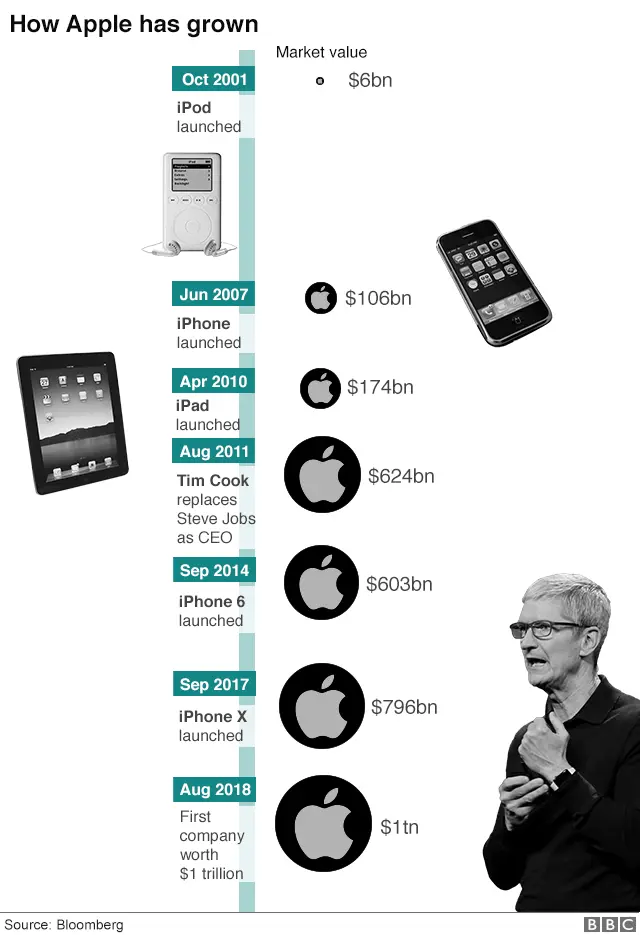
Apple has consistently been at the forefront of reaching unprecedented valuation milestones. It was the first U.S. company to achieve a $1 trillion market capitalization in August 2018, a testament to its consistent growth and profitability. This was followed by its ascension to a $2 trillion valuation in August 2020 and, remarkably, a brief touch of $3 trillion in January 2022. These milestones are not just symbolic; they represent the sheer scale of capital allocated to Apple stock by institutional and individual investors globally. Each trillion-dollar leap signifies an exponential increase in investor confidence and a belief in the company’s long-term financial prospects and ability to generate massive profits. Such valuations place Apple among the most valuable enterprises ever to exist, influencing everything from global stock indices to investment strategies.
Fluctuation and Factors
Apple’s market capitalization, while consistently high, is far from static. It’s a living figure, influenced by a multitude of factors that financial analysts scrutinize daily. Key among these are the company’s quarterly earnings reports, which reveal revenue, profit, and future guidance; major product launches, which can either excite or disappoint the market; and the overall economic outlook, including interest rate changes, inflation, and consumer spending trends. Investor sentiment, driven by news, rumors, and analyst upgrades or downgrades, also plays a critical role. Geopolitical events, supply chain disruptions, and regulatory actions can further introduce volatility, causing Apple’s market cap to gain or lose hundreds of billions of dollars in short periods. Understanding these dynamics is crucial to appreciating the complex nature of its financial worth.
Beyond Market Cap: Other Valuation Metrics and Their Implications
While market capitalization provides a headline figure, a comprehensive understanding of Apple’s financial worth requires examining other key valuation metrics that offer deeper insights into its operational health and investor appeal.
Revenue and Profitability
Apple’s financial strength is underpinned by its gargantuan revenue streams and consistently high-profit margins. The company regularly reports hundreds of billions of dollars in annual revenue, derived from its diverse product portfolio (iPhone, Mac, iPad, Apple Watch, AirPods) and its rapidly growing services segment. Crucially, Apple maintains some of the highest gross margins in the tech industry, enabling it to convert a significant portion of its sales into profit. This robust profitability fuels investor confidence, indicating a company with strong pricing power, efficient operations, and a highly valued brand that customers are willing to pay a premium for. High profits also provide the capital for research and development, acquisitions, and shareholder returns.
Free Cash Flow (FCF) and Dividends
Free Cash Flow (FCF) is arguably one of the most vital indicators of a company’s financial health and its ability to create shareholder value. FCF represents the cash a company generates after accounting for cash outflows to support its operations and maintain its capital assets. Apple consistently generates tens of billions of dollars in FCF each quarter, signifying its immense operational efficiency and liquidity. This substantial FCF enables Apple to pursue aggressive share buyback programs, which reduce the number of outstanding shares and thus boost earnings per share (EPS), and to issue regular dividends to its shareholders. Both strategies are a direct return of capital to investors, making Apple an attractive stock for those seeking both growth and income.
Price-to-Earnings (P/E) Ratio
The Price-to-Earnings (P/E) ratio is a fundamental valuation multiple used to assess whether a stock is overvalued or undervalued relative to its earnings. It’s calculated by dividing the current share price by the annual earnings per share. A higher P/E ratio typically indicates that investors are willing to pay more for each dollar of earnings, often because they anticipate higher future growth. Apple’s P/E ratio usually hovers above the market average, reflecting investor optimism about its future prospects and its perceived quality as a long-term investment. While a high P/E can sometimes signal an overvalued stock, for Apple, it often reflects its consistent innovation, brand strength, and market leadership, justifying a premium.
Enterprise Value (EV)
While market cap focuses solely on equity, Enterprise Value (EV) offers a more comprehensive measure of a company’s total value, often used by potential acquirers. EV is calculated as market capitalization plus total debt, minus cash and cash equivalents. For a company like Apple, with its massive cash reserves, its EV might be slightly lower than its market cap. EV provides a more accurate picture of what it would cost to acquire the entire company, including taking on its debt and benefiting from its cash, offering a holistic view of its true economic value.
Key Financial Drivers of Apple’s Enduring Value
Apple’s astronomical worth is not merely a consequence of its market presence but the direct result of several deeply entrenched financial drivers that reinforce its competitive advantages and ensure its sustained profitability.
Product Ecosystem and Customer Loyalty
The “walled garden” of Apple’s product ecosystem is a powerful financial driver. Once customers enter the Apple universe with an iPhone, they are more likely to purchase other Apple products like an iPad, Mac, or Apple Watch. This interoperability creates high switching costs, fostering unparalleled customer loyalty and retention. Financially, this translates into recurring revenue streams, predictable upgrade cycles, and significant pricing power. Apple can command premium prices for its devices because of the perceived value, integrated experience, and strong brand affinity, directly impacting its revenue and profit margins.
Services Growth as a Profit Engine
Over the past decade, Apple has strategically pivoted to significantly grow its Services segment, which now includes the App Store, Apple Music, iCloud, Apple TV+, Apple Pay, and more. This segment has become an incredibly high-margin business, providing a stable and predictable source of recurring revenue, less susceptible to the cyclical nature of hardware sales. The App Store alone generates billions in revenue from commissions, while subscriptions like Apple Music and iCloud add reliable income streams. The growth of Services is crucial for margin expansion and provides a significant boost to Apple’s overall profitability, diversifying its revenue base beyond hardware.
Global Scale and Supply Chain Dominance
Apple’s extraordinary global scale and its mastery of supply chain management are critical financial advantages. Its ability to source components, manufacture, and distribute products at massive volumes worldwide allows for significant economies of scale, reducing per-unit costs and boosting profitability. The company’s formidable negotiating power with suppliers and logistics partners ensures cost efficiency. Furthermore, its global retail footprint and online presence ensure market penetration in virtually every significant economy, enabling it to tap into diverse consumer bases and mitigate regional economic downturns.
Research & Development (R&D) Investment and Innovation
Apple consistently invests billions of dollars annually in Research & Development. This massive commitment to innovation is a fundamental driver of its long-term financial health. R&D spending fuels the creation of new technologies, such as advanced chips (e.g., M-series and A-series), augmented reality capabilities, and groundbreaking health features in its wearables. These innovations lead to new product categories, maintain the relevance and desirability of existing products, and secure Apple’s competitive edge. Financially, successful R&D translates into future revenue streams, market leadership, and the ability to command premium pricing, justifying investor confidence in its continued growth trajectory.
Future Outlook and Potential Challenges from a Financial Perspective
Looking ahead, Apple’s financial worth will continue to be shaped by its strategic initiatives and its ability to navigate a complex global economic and regulatory landscape.
Continued Services Expansion
The financial community widely anticipates that Apple’s Services segment will continue to be a primary growth engine. Future financial performance will heavily rely on expanding the breadth of its service offerings, growing its subscriber base, and potentially venturing into new recurring revenue models. This strategic shift aims to create a more resilient and higher-margin business, less dependent on the hardware upgrade cycle, ensuring more predictable financial returns.
New Product Categories and Markets
Apple’s potential entry into entirely new product categories, such as virtual/augmented reality headsets (e.g., Apple Vision Pro) or even electric vehicles, presents significant financial upside. These ventures could unlock vast new markets and revenue streams, potentially adding trillions to its valuation in the long run. However, they also entail substantial R&D costs and execution risks, which will be closely scrutinized by investors. The success of these initiatives will be critical to sustaining Apple’s growth trajectory in an increasingly mature tech market.
Regulatory Scrutiny and Geopolitical Risks
From a financial perspective, Apple faces increasing headwinds from regulatory scrutiny worldwide. Antitrust investigations, concerns over App Store policies, and data privacy regulations could lead to significant fines, mandated changes to its business practices, and potentially reduced revenue from commissions. Geopolitical tensions, particularly concerning its manufacturing base in China and market access, pose risks to its supply chain stability, production costs, and sales in key markets. These factors could impact Apple’s financial forecasts and introduce uncertainty for investors.
Competition and Market Saturation
While dominant, Apple operates in highly competitive markets. Increasing competition from Android manufacturers, other streaming services, and emerging tech players could put pressure on its market share and profit margins. In developed markets, smartphone saturation means growth often comes from upgrades rather than new users, which can slow revenue growth. Apple’s ability to maintain its innovation edge and differentiate its products will be crucial to fending off competitors and sustaining its premium pricing power, directly impacting its future financial worth.

Conclusion
The question “how much is the company Apple worth?” elicits a figure that consistently places it among the most valuable entities on the planet. This colossal valuation, primarily expressed through its multi-trillion-dollar market capitalization, is a testament to its robust financial fundamentals. It is driven by staggering revenues and profits, immense free cash flow, aggressive shareholder return programs, and a compelling P/E ratio that reflects investor confidence. Beyond the numbers, Apple’s enduring worth is rooted in its impenetrable product ecosystem, the high-margin growth of its services division, unparalleled global scale, and relentless commitment to innovation through substantial R&D investments.
While the future holds potential for new revenue streams from groundbreaking products, Apple must also navigate the complexities of intensifying regulatory scrutiny, geopolitical uncertainties, and fierce market competition. Nevertheless, its consistent financial performance, strategic foresight, and unparalleled brand strength solidify its position as a powerhouse in the global economy, making its financial health a barometer for the broader tech sector and the global financial markets. Apple’s worth is not just a number; it’s a narrative of sustained financial excellence and strategic market dominance.
aViewFromTheCave is a participant in the Amazon Services LLC Associates Program, an affiliate advertising program designed to provide a means for sites to earn advertising fees by advertising and linking to Amazon.com. Amazon, the Amazon logo, AmazonSupply, and the AmazonSupply logo are trademarks of Amazon.com, Inc. or its affiliates. As an Amazon Associate we earn affiliate commissions from qualifying purchases.