
For the modern university student, financial literacy is no longer an elective—it is a core requirement for survival. With tuition rates climbing and the cost of living reaching historic highs, every dollar in a student’s budget must be allocated with precision. Among the various recurring expenses a student faces, subscription services often fly under the radar, yet they represent a significant opportunity for cost optimization. Central to this discussion is Amazon Prime Student.
Understanding “how much” Amazon Prime Student costs requires looking beyond the sticker price. It involves a comprehensive cost-benefit analysis of how the service integrates into a student’s financial ecosystem, potentially offsetting other necessary expenditures. This guide explores the pricing structure, the inherent financial value, and the strategic advantages of leveraging a Prime Student membership to enhance personal liquidity and long-term savings.

1. Decoding the Cost and ROI of Amazon Prime Student
The primary question—”how much is it?”—is answered through a tiered pricing model designed to lower the barrier to entry for those with limited income. Currently, Amazon Prime Student is priced at $7.49 per month, or an annual discounted rate of $69. When compared to the standard Amazon Prime membership, which costs $14.99 per month or $139 per year, the student tier represents a 50% reduction in overhead.
The Current Price Point and Membership Structure
From a personal finance perspective, the annual plan ($69) is the most mathematically sound choice for students who intend to use the service year-round. Choosing the annual payment over the monthly installments results in a savings of approximately $20 per year. For a student managing a tight monthly budget, this “pre-payment” strategy acts as a hedge against monthly cash flow fluctuations. However, for those who only require the service during specific semesters for textbook procurement, the monthly flexibility of $7.49 allows for a more surgical approach to subscription management.
The 6-Month Trial: A Zero-Risk Financial Entry
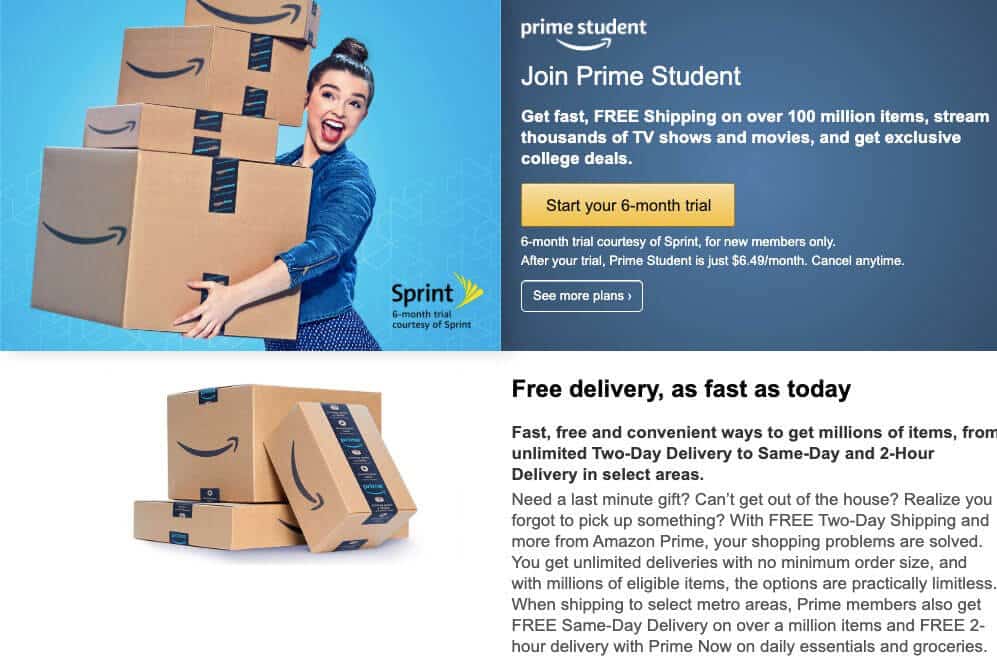
Perhaps the most significant financial feature of Amazon Prime Student is the six-month trial period. Unlike the standard 30-day trial offered to the general public, the six-month window allows a student to bypass shipping costs and access digital perks for an entire academic semester without any capital outlay. Strategically, initiating this trial at the start of a freshman year or a particularly resource-heavy semester provides an immediate boost to a student’s purchasing power, effectively allowing them to redirect those “saved” membership fees toward essential supplies or emergency funds.
2. Maximizing Student Budgeting Through Prime Benefits
The true cost of a subscription is not just the price paid, but the value extracted. In the realm of personal finance, Amazon Prime Student functions less as a luxury and more as a financial tool designed to reduce “lifestyle friction” and logistical costs.
Strategic Savings on Textbooks and Supplies
Textbooks remain one of the most volatile expenses in higher education. By utilizing Prime Student, members gain access to specialized pricing on rentals and used books, often significantly lower than campus bookstore rates. When combined with free two-day or one-day shipping, the financial benefit is twofold: a reduction in the purchase price and the elimination of the “convenience tax”—the premium students often pay at local shops because they need an item immediately. By planning purchases and utilizing Prime’s logistics, a student can save hundreds of dollars per semester on physical assets.
Logistics and Efficiency: The Financial Value of Rapid Shipping
Time is a currency, especially for students balancing academics with part-time employment or internships. The “free shipping” component of Prime Student is a direct subsidy on a student’s logistics. Without Prime, a student might spend $5 to $15 per order on shipping or spend valuable time and fuel commuting to a retail location. Over the course of a year, if a student makes 20 orders, the membership has effectively paid for itself solely through the avoidance of shipping fees. This is a classic example of “spending to save,” where a small fixed cost eliminates a larger variable cost.
3. Digital Perks as Financial Substitutes
In a modern budget, “leakage” often occurs through multiple small subscriptions—Netflix, Spotify, DoorDash, and cloud storage. A sophisticated financial approach involves consolidating these services. Amazon Prime Student acts as a “bundle” that can replace several other line items in a student’s budget.
Consolidating Entertainment Subscriptions
Prime Video and Prime Music (included in the membership) offer robust alternatives to more expensive standalone streaming services. A standard Netflix subscription can cost upwards of $15.49 per month, and a standalone music streaming service adds another $10.99. By utilizing the digital libraries included with Prime Student, a student can potentially eliminate $20 to $30 of monthly subscription “drain.” Over a four-year degree, this consolidation can result in over $1,000 in saved capital, which could be better served in a high-yield savings account or a Roth IRA.
Leveraging Grubhub+ and Travel Discounts
Amazon has strategically expanded its student offering to include a one-year trial of Grubhub+ (normally $9.99/month). For the student who occasionally relies on food delivery during late-night study sessions, the elimination of delivery fees is a tangible financial win. Furthermore, Prime Student often partners with travel platforms like StudentUniverse to offer discounts on flights and hotels. For out-of-state students or those studying abroad, these targeted discounts represent significant “lumpy” savings that can protect their overall financial health during peak travel seasons.
4. Long-term Financial Planning and Subscription Management
While the $7.49 monthly fee is manageable, professional financial management requires looking at the “exit strategy” and the long-term impact of recurring payments.
Managing Renewal Cycles and Avoiding Autopay Debt
One of the pitfalls of modern consumerism is “subscription creep,” where forgotten memberships silently erode a bank balance. To maintain financial integrity, students should treat their Prime membership as a line item in their monthly budget. It is advisable to set calendar reminders for the end of the six-month trial and for the annual renewal date. This ensures that the transition from the free trial to the paid tier is a conscious financial decision rather than an accidental deduction.
The Transition to Standard Prime: Post-Graduation Budgeting
The Prime Student discount is not permanent; it typically lasts for four years or until graduation. A forward-thinking student should account for the eventual price hike in their post-graduation financial plan. Transitioning from a $69 annual fee to a $139 annual fee represents a 100% increase in that specific expense. By understanding this timeline, graduates can reassess whether the service still fits their “young professional” budget or if those funds should be reallocated toward student loan repayments or housing costs.

Conclusion: The Strategic Value of Amazon Prime Student
When asking “how much is student prime amazon,” the answer is far more complex than a simple dollar amount. Financially, it is a $7.49 monthly investment that, if managed correctly, yields a high return through consolidated services, reduced logistics costs, and specialized discounts.
For the student who views their finances through a professional lens, Amazon Prime Student is more than an e-commerce membership—it is a tactical tool for budget optimization. By leveraging the six-month trial, consolidating digital entertainment, and utilizing the membership for high-cost items like textbooks, a student can significantly lower their monthly “burn rate.” In the grand scheme of personal finance, mastering these small-scale efficiencies is the first step toward large-scale financial independence. Whether the $69 annual fee is worth it depends entirely on the user’s ability to maximize the platform’s utility, turning a simple subscription into a pillar of their academic financial strategy.
aViewFromTheCave is a participant in the Amazon Services LLC Associates Program, an affiliate advertising program designed to provide a means for sites to earn advertising fees by advertising and linking to Amazon.com. Amazon, the Amazon logo, AmazonSupply, and the AmazonSupply logo are trademarks of Amazon.com, Inc. or its affiliates. As an Amazon Associate we earn affiliate commissions from qualifying purchases.