
Determining the value of a single share of Tesla (NASDAQ: TSLA) is a task that involves far more than checking a ticker symbol on a mobile app. While the nominal price of a share fluctuates by the second during market hours, the true “cost” of Tesla stock is a composite of market sentiment, technological speculation, and fundamental financial performance. For the modern investor, understanding how much stock in Tesla costs requires a deep dive into the company’s valuation metrics, its historical price action, and the macroeconomic factors that drive its volatility.

Tesla has transitioned from a niche electric vehicle (EV) startup into a global titan that influences entire indices like the S&P 500 and the Nasdaq-100. Consequently, its stock price is one of the most scrutinized figures in the financial world. Whether you are looking to purchase your first fractional share or manage a significant position, understanding the mechanics behind the price is essential for any disciplined approach to personal finance and investing.
The Mechanics of Tesla’s Share Price and Market Capitalization
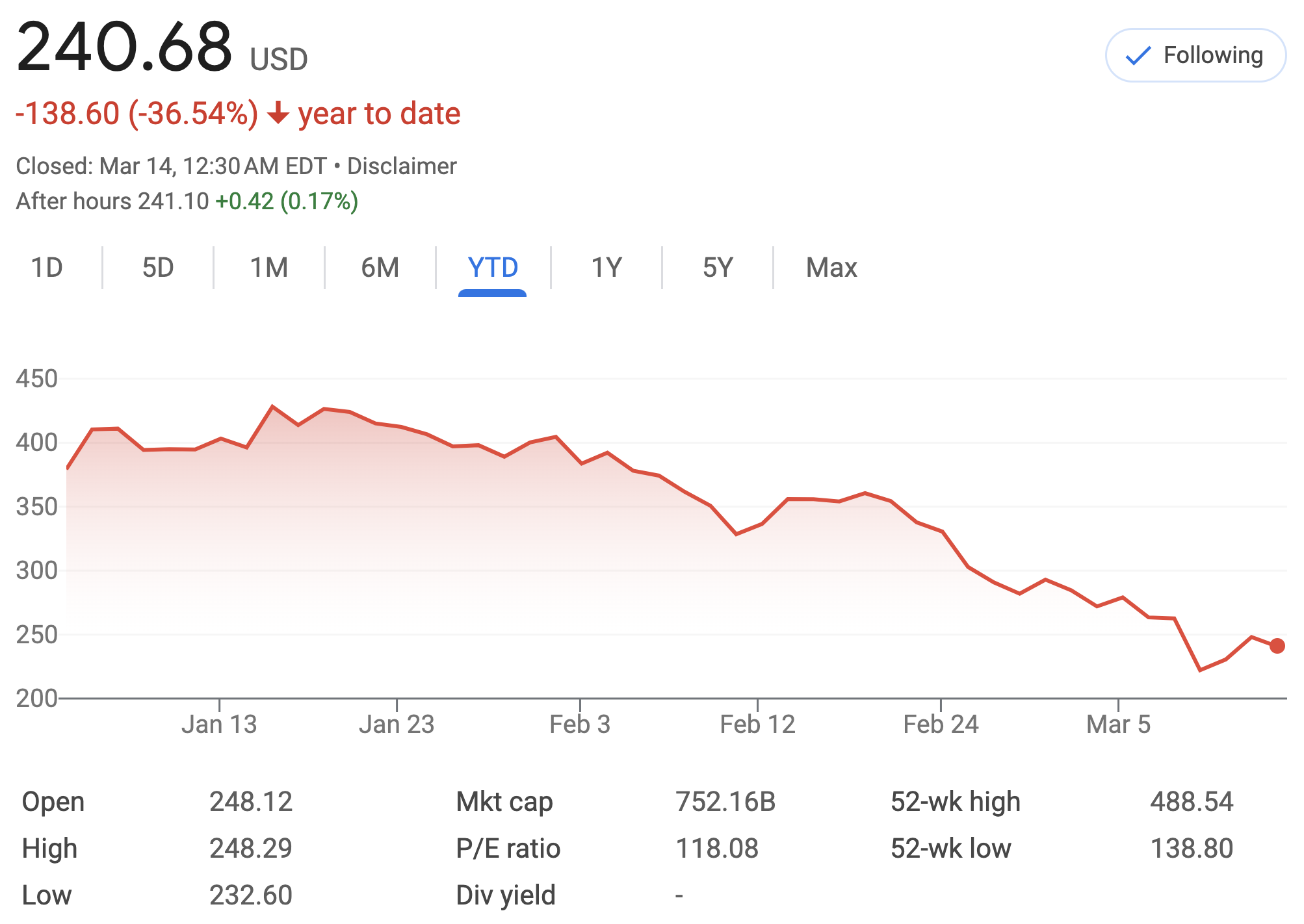
When an investor asks “how much” Tesla stock is, they are usually referring to the spot price—the amount required to buy one share at the current moment. However, in the realm of professional finance, the price of a single share is less important than the market capitalization. Market cap is calculated by multiplying the current share price by the total number of outstanding shares. This figure represents the total market value of the company.
Tesla’s market capitalization has historically defied traditional automotive logic. While legacy automakers like Ford or General Motors are often valued based on their annual production and revenue multiples, Tesla is frequently valued as a high-growth technology company. This distinction is the primary reason why Tesla’s stock price can often seem “expensive” relative to its earnings.
Historical Price Action and Stock Splits
To understand the current price, one must look at Tesla’s history of stock splits. Tesla has executed multiple splits—most notably a 5-for-1 split in August 2020 and a 3-for-1 split in August 2022. These maneuvers do not change the fundamental value of the company, but they do lower the price of an individual share, making it more accessible to retail investors. Without these splits, a single share of Tesla would be trading in the thousands of dollars, potentially pricing out smaller investors who do not have access to fractional share trading.
Volatility as a Constant
Tesla is notoriously volatile. It is not uncommon for the stock to see double-digit percentage swings within a single week based on a delivery report, a social media post from CEO Elon Musk, or a shift in Federal Reserve interest rate policy. For the investor, this means the “cost” of entry is highly dependent on timing and the ability to stomach short-term paper losses in exchange for long-term growth potential.
Fundamental Drivers: What Influences the Value of TSLA?
The price of Tesla stock is not an arbitrary number; it is a reflection of the market’s consensus on the company’s future cash flows. Several key pillars support the current valuation and dictate whether the stock moves up or down in any given quarter.
Vehicle Delivery and Production Margins
At its core, Tesla is currently a volume manufacturer. Every quarter, the financial world waits for the “delivery beat” or “miss.” If Tesla delivers more cars than analysts expected, the stock typically rallies. However, smart money also looks at the margins. As Tesla has entered price wars to maintain market share against competitors like BYD and Rivian, its profit margins have come under pressure. A lower margin per vehicle often leads to a contraction in the stock price, even if delivery numbers remain high.
The Ecosystem of Energy and Software
Investors who value Tesla at a premium do so because they see it as more than an auto company. Tesla’s energy division—encompassing Solar Roof and Powerwall products—is a growing segment of the business. Furthermore, the Full Self-Driving (FSD) software represents a high-margin recurring revenue stream. If Tesla can successfully transition to a Software-as-a-Service (SaaS) model through autonomous driving subscriptions, the “value” of the stock could theoretically be much higher than it is today.
Regulatory Credits and Incentives
A unique aspect of Tesla’s financial health is its sale of regulatory credits to other automakers who fail to meet environmental standards. These credits are pure profit and have often been the difference between a profitable quarter and a loss. Changes in government policy or the expiration of EV tax credits (such as those under the Inflation Reduction Act in the United States) can significantly impact the perceived value of the stock.
Valuation Metrics: Is Tesla Overvalued or Undervalued?
Deciding how much to pay for Tesla stock requires an analysis of valuation multiples. This is where the debate between “bulls” and “bears” is most heated.
The Price-to-Earnings (P/E) Ratio
The P/E ratio is the most common metric used to determine if a stock is priced fairly. It compares the share price to the company’s earnings per share (EPS). Historically, Tesla’s P/E ratio has been astronomical—sometimes exceeding 1,000x—during its early growth phases. As the company matured and became consistently profitable, this ratio compressed into more reasonable, albeit still high, double or triple digits.
Comparing Tesla’s P/E to a company like Toyota (which might trade at 10x earnings) makes Tesla look incredibly expensive. However, comparing it to a high-growth tech firm like Nvidia might make it look more aligned with market trends. The question for the investor is whether Tesla’s future growth justifies a higher multiple than a standard industrial company.
Discounted Cash Flow (DCF) Analysis
Professional analysts use DCF models to estimate the value of an investment today based on projections of how much money it will generate in the future. Because Tesla is reinvesting heavily in new factories (Gigafactories) and R&D for humanoid robots (Optimus) and AI (Dojo), current earnings might not tell the whole story. A DCF analysis often yields a higher “intrinsic value” for Tesla if the investor believes in the company’s long-term technological dominance.
Strategic Considerations for Purchasing Tesla Stock
If you have determined that the current price of Tesla aligns with your investment goals, the next step is the “how” and “when” of the purchase. Investing in a high-beta stock like TSLA requires a different psychological and strategic approach than buying a stable dividend-paying stock.
Dollar-Cost Averaging (DCA)
Because Tesla’s price fluctuates significantly, many financial advisors recommend dollar-cost averaging. Instead of buying a large lump sum at one price, an investor commits to buying a set dollar amount of Tesla stock at regular intervals (e.g., $200 every month). This strategy mitigates the risk of buying at a temporary peak and lowers the average cost basis over time.
The Role of Fractional Shares
Most modern brokerages now offer fractional shares. This means if Tesla is trading at $250 but you only have $50 to invest, you can own 0.2 shares. This has democratized access to the stock, allowing retail investors to build a position in Tesla without needing a large amount of upfront capital.
Risk Management and Diversification
No matter how much you believe in the future of sustainable energy or autonomous driving, putting all your capital into a single stock like Tesla is high-risk. In a balanced portfolio, Tesla often serves as the “growth” engine, balanced by more conservative assets like index funds or bonds. Given its volatility, a common rule of thumb is to limit any single stock position to a manageable percentage of your total net worth.

The Future Outlook: What Will Tesla Stock Be Worth?
The ultimate question of “how much” Tesla stock is worth today is inextricably linked to what it will be worth five or ten years from now. The investment thesis for Tesla generally falls into two camps.
The “Bull Case” suggests that Tesla will eventually solve Level 5 autonomy, launch a global fleet of robotaxis, and become the primary provider of home and grid-scale energy storage. In this scenario, the current stock price may eventually be seen as a bargain. The “Bear Case” posits that as legacy automakers catch up in EV technology and as competition from China intensifies, Tesla will lose its first-mover advantage and its margins will normalize to match the rest of the auto industry, leading to a significant correction in its valuation.
Investing in Tesla is as much a bet on the future of global infrastructure as it is a purchase of a corporate equity. By monitoring the delivery data, understanding the implications of P/E compression, and utilizing disciplined entry strategies like dollar-cost averaging, investors can navigate the complexities of Tesla’s price. Whether the stock is “cheap” or “expensive” depends entirely on your time horizon and your confidence in the company’s ability to execute its ambitious roadmap. In the world of personal finance, knowledge of these underlying factors is the most valuable asset an investor can hold.
aViewFromTheCave is a participant in the Amazon Services LLC Associates Program, an affiliate advertising program designed to provide a means for sites to earn advertising fees by advertising and linking to Amazon.com. Amazon, the Amazon logo, AmazonSupply, and the AmazonSupply logo are trademarks of Amazon.com, Inc. or its affiliates. As an Amazon Associate we earn affiliate commissions from qualifying purchases.