
Social Security represents a cornerstone of financial security for millions of Americans, providing retirement, disability, and survivor benefits. For many, understanding their potential monthly payout is crucial for effective retirement planning. However, there isn’t a single, universal answer to “how much is Social Security a month.” The amount you receive is highly individualized, shaped by a complex interplay of your earning history, age at which you claim benefits, and evolving economic conditions.
Understanding the Basics of Social Security Benefits
Before delving into the specific figures, it’s essential to grasp the fundamental mechanics of the Social Security system. It’s not a personal savings account where your contributions directly accumulate for your future use. Instead, it operates as a pay-as-you-go system, with current workers’ payroll taxes funding the benefits of today’s retirees and beneficiaries.
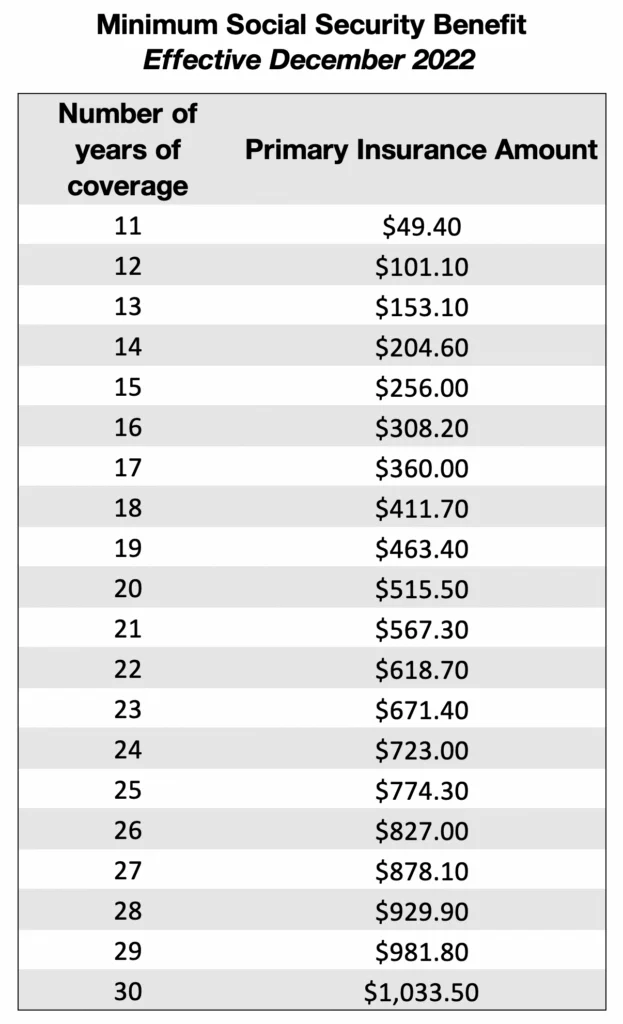
What is Social Security?
Established in 1935, Social Security was designed to provide a safety net for workers and their families. It encompasses several key programs:
- Retirement Benefits: The most common form, providing monthly income to eligible retired workers and their spouses.
- Disability Benefits: Payments to workers who are unable to work due to a severe medical condition.
- Survivors Benefits: Financial support for the family members (spouse, children, dependent parents) of a deceased worker.
- Medicare: While separate, Medicare Part A (hospital insurance) is also funded through Social Security payroll taxes.
The system is funded primarily through dedicated payroll taxes, known as FICA (Federal Insurance Contributions Act) taxes, which are deducted from most workers’ wages. Employers and employees each contribute 6.2% for Social Security up to an annual wage cap, plus 1.45% for Medicare.
Who is Eligible for Benefits?
Eligibility for Social Security benefits is determined by earning “credits” through covered work. In 2024, you earn one credit for every $1,730 in earnings, up to a maximum of four credits per year. To qualify for most types of retirement or disability benefits, you typically need 40 credits, which translates to about 10 years of working and paying Social Security taxes. Younger workers may qualify for disability or survivor benefits with fewer credits.
Once eligible, the specific benefit amount depends on a series of factors designed to reflect your lifetime contributions and personal circumstances.
Factors Determining Your Monthly Benefit Amount
The Social Security Administration (SSA) uses a precise formula to calculate your Primary Insurance Amount (PIA), which is your full benefit at your Full Retirement Age (FRA). Several key factors influence this calculation:
Your Earnings History
The SSA considers your highest 35 years of earnings when calculating your benefits. These earnings are “indexed” to account for changes in average wages over time, ensuring that earlier earnings reflect their relative value today. If you have fewer than 35 years of earnings, the missing years are counted as zeros in the calculation, which can significantly reduce your average. This emphasizes the importance of a consistent and high-earning work history. Working longer can replace lower-earning years with higher-earning ones, thereby increasing your average.
Your Full Retirement Age (FRA)
Your FRA is the age at which you are entitled to receive 100% of your PIA. This age varies depending on your birth year:
- Born 1943-1954: FRA is 66
- Born 1955: FRA is 66 and 2 months
- Born 1956: FRA is 66 and 4 months
- Born 1957: FRA is 66 and 6 months
- Born 1958: FRA is 66 and 8 months
- Born 1959: FRA is 66 and 10 months
- Born 1960 or later: FRA is 67
Knowing your FRA is critical because it’s the benchmark against which early or delayed claiming decisions are measured.
When You Decide to Claim Benefits
This is one of the most significant personal choices influencing your monthly benefit amount.
- Claiming Early (as early as age 62): You can start receiving benefits as early as age 62, but your monthly payment will be permanently reduced. For those with an FRA of 67, claiming at 62 results in a permanent 30% reduction. The reduction is slightly less for those with a lower FRA.
- Claiming at Full Retirement Age (FRA): You receive 100% of your PIA.
- Delaying Benefits (up to age 70): For each month you delay claiming past your FRA, up to age 70, you earn “delayed retirement credits.” These credits increase your monthly benefit by approximately 8% per year (or 2/3 of 1% per month). This means delaying from FRA 67 to age 70 can boost your monthly payment by 24%. No further credits are earned after age 70.
This decision involves weighing factors like current health, need for income, and other retirement resources.
Cost-of-Living Adjustments (COLAs)
Social Security benefits are subject to annual Cost-of-Living Adjustments (COLAs). These adjustments are designed to help maintain the purchasing power of benefits in the face of inflation. COLAs are typically announced in October and apply to benefits paid starting in January of the following year. They are based on the Consumer Price Index for Urban Wage Earners and Clerical Workers (CPI-W). While COLAs protect against inflation, they are not guaranteed to be substantial every year and can sometimes be very small or even zero.
Average Social Security Payments Today
While individual circumstances vary widely, looking at current averages can provide a general idea of what beneficiaries receive. It’s important to remember these are national averages and your personal benefit could be significantly higher or lower.
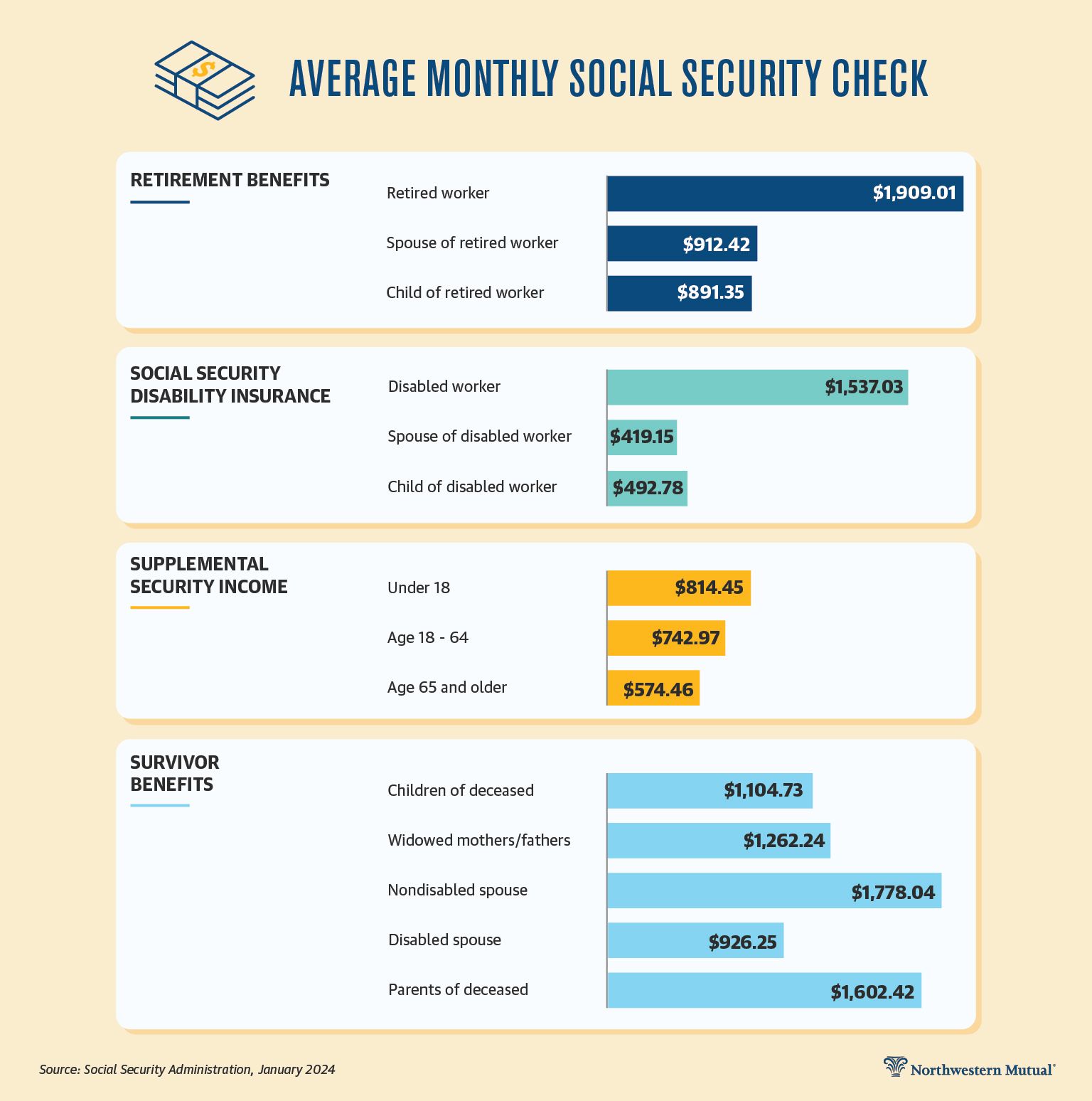
(Note: These figures are based on recent SSA data for early 2024 and are subject to change.)
Averages for Retired Workers
The average monthly Social Security benefit for all retired workers is approximately $1,900 to $2,000. This average includes a wide range of individual benefits, from those who only worked part-time for a few years to those who earned the maximum for their entire careers. The maximum possible Social Security benefit for someone retiring at FRA in 2024 is around $3,822 per month. However, to achieve this, a person would need to have consistently earned the maximum taxable amount for at least 35 years and claimed benefits at their FRA.
Averages for Spouses and Survivors
Social Security also provides crucial benefits for family members.
- Spousal Benefits: An eligible spouse can receive up to 50% of their retired spouse’s PIA. The average benefit for a spouse of a retired worker is approximately $900 to $950.
- Survivor Benefits: A widow or widower can typically receive 100% of the deceased worker’s benefit if they claim at their own FRA. The average benefit for a widowed mother or father caring for children is around $1,400 to $1,500, while a non-disabled widow(er) can average about $1,750 to $1,850.
Averages for Disabled Workers
For individuals unable to work due to a severe disability, Social Security Disability Insurance (SSDI) offers financial support. The average monthly benefit for a disabled worker is approximately $1,500 to $1,600. Similar to retirement benefits, the amount depends on the worker’s earning history.
Strategies to Maximize Your Social Security Payouts
Understanding the factors that influence your benefits allows for strategic planning. Here are some key approaches to potentially increase your monthly Social Security check:
Work Longer and Earn More
Since your benefit is based on your highest 35 years of earnings, extending your career, especially if you’re earning more than in earlier years, can significantly boost your average indexed monthly earnings (AIME). This is particularly true if you have years with low or zero earnings in your record, as working longer will replace those low-earning years with higher ones.
Delay Claiming Benefits
As highlighted earlier, delaying your claim past your Full Retirement Age (FRA) up to age 70 is often the most impactful strategy for maximizing your monthly benefit. Each year you delay adds approximately 8% to your annual payout, creating a substantial increase in your lifetime benefits, especially if you have a long life expectancy. Consider this a guaranteed, risk-free return on your decision.
Coordinate Spousal and Survivor Benefits
For married couples, strategic claiming decisions can optimize total household benefits. For instance, the higher-earning spouse might delay claiming to maximize their own benefit (which will also become the basis for survivor benefits), while the lower-earning spouse might claim earlier to provide some income. When one spouse passes away, the surviving spouse can claim the higher of their own benefit or the deceased spouse’s benefit. Understanding these coordination rules, possibly with professional advice, can lead to thousands of extra dollars over a couple’s lifetime.
Understand Taxation of Benefits
While not directly increasing your benefit amount, understanding how Social Security benefits are taxed can increase your net take-home pay. Depending on your “provisional income” (which includes your adjusted gross income, tax-exempt interest, and 50% of your Social Security benefits), up to 50% or even 85% of your Social Security benefits may be subject to federal income tax. Some states also tax Social Security benefits. Planning your other retirement income streams to minimize provisional income can reduce your tax liability.
How to Estimate Your Future Benefits
While current averages provide a snapshot, the most accurate way to understand your personal Social Security outlook is to access your own specific data.
Using Your Social Security Statement
The Social Security Administration provides a personalized Social Security Statement that details your earnings history and provides estimated benefits at various claiming ages (age 62, Full Retirement Age, and age 70). You can access your statement online by creating a secure mySocialSecurity account at the SSA website (ssa.gov). This statement is an invaluable tool for retirement planning, showing you exactly how your past work history translates into future benefits.

Online Calculators
Beyond your personal statement, the SSA website also offers several online calculators. These tools allow you to model different scenarios, such as the impact of working a few more years, claiming benefits at different ages, or the effect of future earnings. Reputable third-party financial planning tools also often integrate Social Security benefit estimators, allowing you to incorporate these estimates into a broader retirement plan.
Planning for retirement involves many variables, and your Social Security benefit is a significant piece of that puzzle. By understanding the factors that determine your monthly payment and exploring strategies to maximize it, you can make informed decisions that contribute to a more secure financial future.
aViewFromTheCave is a participant in the Amazon Services LLC Associates Program, an affiliate advertising program designed to provide a means for sites to earn advertising fees by advertising and linking to Amazon.com. Amazon, the Amazon logo, AmazonSupply, and the AmazonSupply logo are trademarks of Amazon.com, Inc. or its affiliates. As an Amazon Associate we earn affiliate commissions from qualifying purchases.