
For many Americans, purchasing a vehicle is the second-largest financial commitment they will make, trailing only the purchase of a home. As vehicle prices have climbed, the $30,000 price point has become a common benchmark for both well-equipped mid-sized sedans and entry-level SUVs. When faced with this price tag, many buyers look toward a 72-month (six-year) loan term to keep their monthly obligations manageable.
However, understanding the true cost of a $30,000 car payment for 72 months requires looking beyond the monthly sticker price. It involves an analysis of interest rates, total interest paid, depreciation cycles, and the long-term impact on your personal net worth.

Calculating the Monthly Payment: The Role of Interest Rates and Amortization
The monthly payment on a $30,000 loan is not a static number; it is a variable determined primarily by the Annual Percentage Rate (APR) for which you qualify. Because a 72-month term is considered a “long-term” loan, interest rates are typically higher than they would be for a 36 or 48-month term, as lenders take on more risk over a longer horizon.
The Impact of Interest Rates on Your $30,000 Loan
Your credit score is the primary driver of your interest rate. In the current economic climate, “prime” borrowers might see rates between 5% and 7%, while “subprime” borrowers could face rates of 12% to 18% or higher. On a 72-month term, even a 2% difference in APR can result in thousands of dollars of extra cost over the life of the loan.
Monthly Payment Estimates at Common Interest Rates
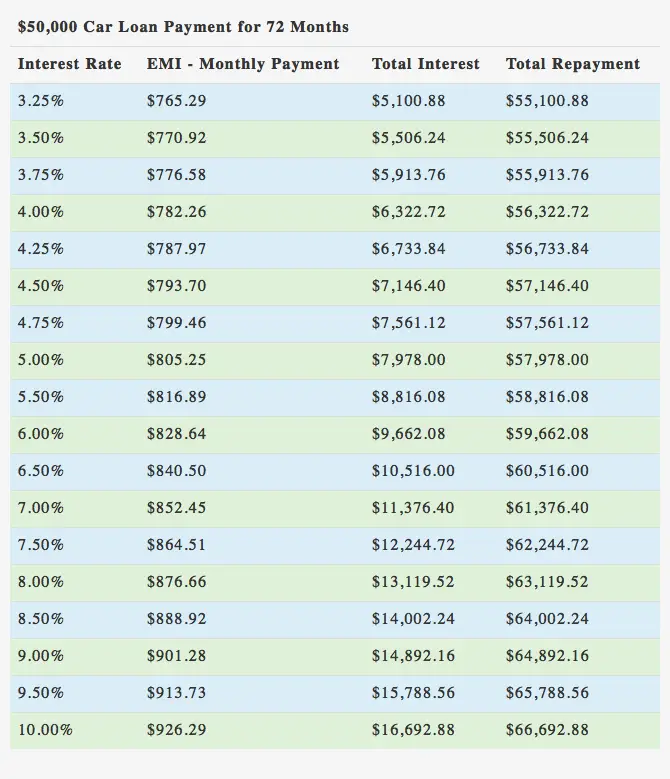
To provide a clear picture, let’s look at the estimated monthly payments for a $30,000 loan amount (assuming no down payment or taxes are included in the principal) over 72 months:
- 4% APR (Excellent Credit): Approximately $469 per month.
- 7% APR (Good Credit): Approximately $511 per month.
- 10% APR (Average Credit): Approximately $555 per month.
- 15% APR (Poor Credit): Approximately $632 per month.
As demonstrated, a buyer with poor credit pays nearly $163 more every single month for the exact same vehicle compared to a buyer with excellent credit. Over 72 months, that difference totals $11,736 in additional interest.
The Hidden Costs of a 72-Month Loan Term
While the primary appeal of a 72-month loan is a lower monthly payment, this convenience comes at a significant financial cost. From a wealth-building perspective, long-term auto loans are often viewed as “wealth-killers” because they keep the consumer in a cycle of debt while the underlying asset rapidly loses value.
Total Interest Paid Over Six Years
The most immediate hidden cost is the total interest expense. When you stretch a loan to 72 months, you are paying interest on the principal for a much longer period. For example, at a 7% interest rate, a $30,000 loan will cost you roughly $6,792 in interest alone. If you had opted for a 48-month loan at the same rate, the interest would be approximately $4,480. By choosing the longer term, you are essentially paying an extra $2,312 for the privilege of lower monthly payments.
Depreciation vs. Loan Balance: The Risk of Negative Equity
Vehicles are depreciating assets. A new car can lose 20% of its value in the first year and up to 60% by the end of five years. Because a 72-month loan pays down the principal balance very slowly in the early years, there is a high probability that you will become “upside down” or “underwater” on the loan.
Being underwater means you owe the bank more than the car is worth. This creates a financial crisis if the car is totaled in an accident or if you need to sell it unexpectedly. If the car is worth $15,000 but your loan balance is $19,000, you would have to pay the lender $4,000 out of pocket just to get rid of the vehicle.
Factors That Influence Your Final Car Payment

It is a common mistake to assume that a $30,000 MSRP (Manufacturer’s Suggested Retail Price) results in a $30,000 loan. Several external factors can swell the principal balance, thereby increasing the monthly payment significantly.
Down Payments and Trade-Ins
The most effective way to lower a $30,000 car payment is to reduce the amount borrowed. A down payment acts as immediate equity. If you put $5,000 down on a $30,000 car, your loan principal drops to $25,000. At a 7% interest rate for 72 months, this reduces your payment from $511 to roughly $426. Similarly, trading in a used vehicle can provide a “tax shield” in many states, where you only pay sales tax on the difference between the new car price and the trade-in value.
Sales Tax, Fees, and Optional Add-ons
When you sit down in the “F&I” (Finance and Insurance) office at a dealership, the $30,000 price tag often grows. Sales tax (which can range from 5% to 10% depending on your location), documentation fees, registration costs, and dealer prep fees can easily add $3,000 to the total.
Furthermore, many buyers are talked into “back-end” products such as extended warranties, GAP insurance, or tire and wheel protection. If these items add $4,000 to your loan, your $30,000 car suddenly requires a $34,000 loan. Over 72 months at 7%, this increases your monthly payment by nearly $70 and your total interest by nearly $1,000.
Strategic Alternatives: Is 72 Months Right for Your Budget?
Financial experts often debate the wisdom of long-term auto financing. While it makes vehicles accessible, it can also lead to “lifestyle creep” where consumers buy more car than they can actually afford.
The 20/4/10 Rule of Thumb
To maintain a healthy financial profile, many advisors suggest the 20/4/10 rule:
- 20% Down: Put at least 20% down to avoid going underwater.
- 4 Years: Finance the vehicle for no more than four years (48 months).
- 10% of Income: Total transportation costs (payment, insurance, fuel) should not exceed 10% of your gross monthly income.
If a $30,000 car requires a 72-month loan to fit into your budget, the 20/4/10 rule would suggest that the car is too expensive for your current income level.
Comparing 48, 60, and 72-Month Terms
Before signing a 72-month contract, compare the numbers. Using a 7% APR on a $30,000 loan:
- 48 Months: $718/month ($4,480 total interest)
- 60 Months: $594/month ($5,642 total interest)
- 72 Months: $511/month ($6,792 total interest)
While the 72-month payment is $207 cheaper per month than the 48-month payment, the shorter term saves you over $2,300 in interest and ensures you own the vehicle outright much sooner, allowing you to redirect those monthly payments toward investments or savings.
How to Secure the Best Financing for Your $30,000 Purchase
If you decide that a $30,000 loan for 72 months is the best path for your specific situation, it is imperative to optimize the terms to minimize the “money cost” of the debt.
Improving Your Credit Score Before Applying
Since the interest rate is the biggest variable in your payment, improving your credit score by even 30 or 40 points before shopping can save you thousands. Ensure you pay down high credit card balances to lower your credit utilization ratio and check your credit report for errors that might be dragging your score down. A jump from a “Fair” to “Good” credit tier could lower your APR by 3-5%.
Shopping Around for the Best Rates
Never rely solely on dealership financing. Dealerships often add a “markup” to the interest rate offered by the lender as a way to increase their profit. Instead, visit a local credit union or an online bank to get a pre-approval letter. Credit unions, in particular, often offer lower rates on 72-month terms than national banks or captive manufacturer lenders. With a pre-approval in hand, you can force the dealership to meet or beat your existing rate, ensuring you get the most competitive deal possible.
The Importance of GAP Insurance
If you proceed with a 72-month loan on a $30,000 vehicle with little money down, purchasing Guaranteed Asset Protection (GAP) insurance is highly recommended. Because of the slow amortization mentioned earlier, your car’s value will likely drop faster than your loan balance. If the car is totaled in year two or three, your standard insurance will only pay the market value, leaving you responsible for the “gap” between that value and your loan balance. GAP insurance covers this difference, preventing a total loss from becoming a financial catastrophe.
In conclusion, a $30,000 car payment for 72 months typically ranges from $470 to $560 for those with decent credit. While the monthly affordability is tempting, the long-term implications—including higher interest costs and the risk of negative equity—require careful consideration. By understanding the mechanics of your loan and looking for ways to reduce the principal or interest rate, you can turn a major purchase into a manageable part of your broader financial strategy.
aViewFromTheCave is a participant in the Amazon Services LLC Associates Program, an affiliate advertising program designed to provide a means for sites to earn advertising fees by advertising and linking to Amazon.com. Amazon, the Amazon logo, AmazonSupply, and the AmazonSupply logo are trademarks of Amazon.com, Inc. or its affiliates. As an Amazon Associate we earn affiliate commissions from qualifying purchases.