
Purchasing a car, especially one in the $30,000 range, is a significant financial decision for many individuals and families. While the sticker price provides an initial benchmark, understanding your actual monthly car payment involves far more than simply dividing $30,000 by a set number of months. A multitude of factors, from interest rates and loan terms to down payments and credit scores, conspire to determine the real cost of putting that new or pre-owned vehicle in your driveway. This article aims to demystify the process, breaking down the components that influence your payment, providing practical calculation methods, and offering strategies to make a $30,000 car a manageable and affordable reality for your budget. We’ll explore the financial landscape of car ownership, moving beyond the sticker price to unveil the true cost and equip you with the knowledge to make an informed decision.

Deconstructing the $30,000 Car Loan: The Core Variables
Before diving into complex calculations, it’s crucial to understand the fundamental elements that dictate the size of your monthly car payment for a $30,000 vehicle. These core variables work in tandem, each playing a significant role in your overall financial commitment.
The Principal: What $30,000 Truly Represents
At its simplest, the principal is the amount of money you borrow to purchase the car. While the car’s price might be $30,000, your principal loan amount could be less if you make a down payment or more if you roll over negative equity from a trade-in. This base figure is the foundation upon which all other costs are built, as interest is calculated directly from the outstanding principal balance. Understanding that the principal isn’t always identical to the car’s selling price is the first step in accurate financial planning.
Interest Rates: The Cost of Borrowing
Interest is essentially the fee you pay the lender for the privilege of borrowing money. Expressed as an Annual Percentage Rate (APR), the interest rate significantly impacts your monthly payment and the total cost of the loan over its lifetime. A higher APR means you’ll pay more for the same principal amount, while a lower APR reduces both your monthly outlay and the overall expense. Your credit score is the primary determinant of the interest rate you’ll qualify for, with excellent credit typically securing the lowest rates, and poor credit leading to much higher, sometimes punitive, rates. Market conditions and the lender’s policies also play a role.
Loan Term: The Duration of Your Obligation
The loan term, or the length of time you have to repay the loan, is another critical factor. Common loan terms range from 36 months (3 years) to 84 months (7 years), with 60 or 72 months being very popular. A longer loan term will result in lower monthly payments because the principal is spread out over more months. However, this convenience comes at a cost: you’ll pay more in total interest over the life of the loan. Conversely, a shorter loan term means higher monthly payments but significantly less total interest paid, saving you money in the long run and allowing you to own the car outright sooner.
The Power of a Down Payment
A down payment is the initial amount of money you pay upfront toward the purchase of the car, reducing the amount you need to borrow. Even a modest down payment can have a substantial impact on your monthly payment and the total interest you’ll pay. For a $30,000 car, putting down $3,000 (10%) means you’re only borrowing $27,000. This not only lowers your principal but also often makes you a more attractive borrower to lenders, potentially qualifying you for a better interest rate. A larger down payment can also help avoid being “upside down” on your loan, where you owe more than the car is worth, especially in the early years of ownership.
Calculating Your Estimated Monthly Payment: A Practical Guide
Once you understand the core variables, you can begin to estimate what your monthly payment for a $30,000 car might look like. While an exact figure requires a formal loan offer, approximations are invaluable for budgeting.
The Basic Loan Payment Formula Explained
The formula used by lenders to calculate monthly loan payments (for a fixed-rate, amortizing loan) is:
M = P [ i(1 + i)^n ] / [ (1 + i)^n – 1]
Where:
-
M = Monthly Payment
-
P = Principal Loan Amount (e.g., $30,000 minus your down payment)
-
i = Monthly Interest Rate (Annual Rate / 12)
-
n = Total Number of Payments (Loan Term in years * 12)
While daunting to calculate by hand, understanding the components helps in interpreting the results from online tools. The key takeaway is how sensitive ‘M’ is to changes in ‘i’ and ‘n’.
Illustrative Scenarios: Different Rates and Terms
Let’s consider a $30,000 car with a $5,000 down payment, meaning a principal loan amount of $25,000.
Scenario 1: Excellent Credit (3% APR)
-
60 Months (5 years): Approx. $449 per month
-
72 Months (6 years): Approx. $389 per month
Scenario 2: Good Credit (6% APR)
-
60 Months (5 years): Approx. $483 per month
-
72 Months (6 years): Approx. $415 per month
Scenario 3: Average Credit (9% APR)
-
60 Months (5 years): Approx. $518 per month
-
72 Months (6 years): Approx. $441 per month
As these scenarios demonstrate, both the interest rate and the loan term significantly impact the monthly payment. A mere 3% difference in APR can translate to tens of dollars saved or spent each month, accumulating to thousands over the life of the loan.

Online Calculators: Your First Stop for Estimates
Fortunately, you don’t need to be a math whiz to calculate your potential car payment. Almost every lender, financial institution, and automotive website offers user-friendly online car payment calculators. These tools allow you to input your desired loan amount (principal), estimated interest rate, and loan term, and instantly see a projected monthly payment. They are excellent for experimenting with different scenarios, such as how a larger down payment or a longer term might affect affordability, and are an indispensable resource in the early stages of car shopping.
Unveiling the True Cost: Beyond the Monthly Installment
While the monthly car payment is the most visible cost, it represents only a fraction of what you’ll actually spend on a $30,000 car. Overlooking these additional expenses can lead to budget strain and financial surprises down the road.
Insurance: A Non-Negotiable Expense
Car insurance is mandatory in most places and is a significant ongoing cost. For a $30,000 car, especially if it’s new, you’ll likely need comprehensive coverage to protect your investment and satisfy lender requirements. The cost of insurance varies widely based on factors like your age, driving record, location, the specific vehicle model, and your chosen deductible. Budgeting for several hundred dollars per month for car insurance is not uncommon, especially for younger drivers or those with a less-than-perfect driving history. It’s crucial to get insurance quotes before finalizing your car purchase to integrate this cost into your overall budget.
Registration, Taxes, and Fees
The upfront costs don’t end with the car’s price. When you purchase a vehicle, you’ll encounter a variety of fees:
-
Sales Tax: Most states charge sales tax on vehicle purchases, which can add hundreds or even thousands of dollars to the total cost. For a $30,000 car, a 7% sales tax would be $2,100.
-
Registration Fees: Annual fees for registering your vehicle with the state.
-
Title Fees: Costs associated with transferring the car’s title into your name.
-
Dealer Fees: Various administrative or documentation fees charged by the dealership, which can sometimes be negotiated.
While some of these are one-time costs, registration is typically an annual expense that needs to be factored into your long-term budget.
Fuel, Maintenance, and Repairs
A car needs fuel to run, and the cost of gasoline or charging an EV can add up quickly, depending on your daily commute and the car’s fuel efficiency. Beyond fuel, regular maintenance is essential to keep your $30,000 investment running smoothly and to preserve its value. This includes oil changes, tire rotations, brake inspections, and scheduled servicing. For a new car, you might have a warranty that covers major issues, but routine maintenance is still out-of-pocket. As the car ages, the likelihood of unexpected repairs increases, necessitating an emergency fund specifically for automotive issues. Neglecting maintenance can lead to more expensive repairs down the line.
Depreciation: The Silent Cost of Ownership
Depreciation is the decline in a car’s value over time. While not a direct monthly payment, it is a very real financial cost. A new $30,000 car can lose 20-30% of its value in the first year alone, and continue to depreciate significantly over the next few years. This means that if you need to sell or trade in the car sooner than expected, you might recover much less than you paid. Understanding depreciation is key to assessing the true long-term financial impact of car ownership and can influence decisions like buying new versus used, or the length of your loan term.
Smart Strategies for Managing a $30,000 Car Payment
Making a $30,000 car affordable and integrating it seamlessly into your financial life requires proactive planning and smart strategies. There are several ways to reduce your monthly burden and ensure you’re getting the best possible deal.
Boosting Your Credit Score
Your credit score is arguably the most powerful tool you have in securing a favorable car loan. A higher score signals to lenders that you are a low-risk borrower, enabling you to qualify for lower interest rates. Before applying for a car loan, take steps to improve your credit: pay bills on time, reduce existing debt, and check your credit report for errors. Even a few points increase can translate into significant savings on a $30,000 loan over several years.
Shopping for the Best Loan Rates
Never settle for the first loan offer you receive. Just as you shop for the car itself, shop for the financing. Get pre-approved for a loan from multiple lenders – banks, credit unions, and online lenders – before you even set foot in a dealership. This not only gives you leverage in negotiations with the dealer’s financing department but also provides a clear benchmark for what a competitive interest rate should be for your credit profile. Even a half-point difference in APR can save you hundreds of dollars over the life of the loan.
Considering a Shorter Loan Term (Wisely)
While a longer loan term offers lower monthly payments, a shorter term can save you a substantial amount in total interest. If your budget allows for a higher monthly payment, opting for a 36 or 48-month loan instead of a 60 or 72-month loan for your $30,000 car can result in thousands of dollars in savings. Calculate the difference in total interest paid for various terms before making a decision. Just ensure the higher monthly payment doesn’t strain your budget and leave you vulnerable to other financial pressures.
The Role of Trade-Ins and Larger Down Payments
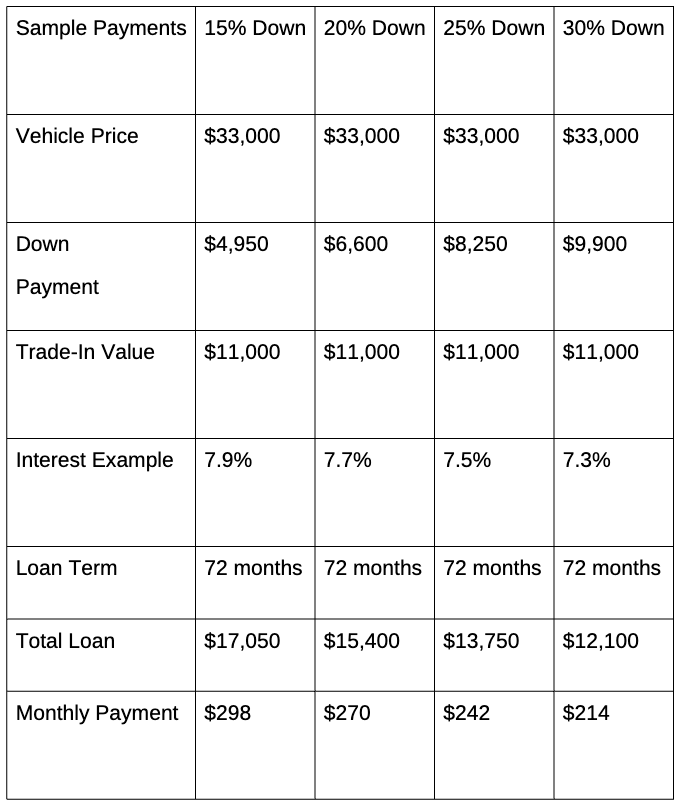
Any amount you can put down upfront, whether through savings or the value of a trade-in vehicle, directly reduces the principal you need to borrow. A larger down payment lessens your monthly payment, decreases the total interest paid, and builds equity in the car faster. Aim for at least 10-20% of the car’s value as a down payment if possible. If you have a trade-in, negotiate its value separately from the purchase price of the new car to ensure you get a fair deal.
Budgeting for Ongoing Car Expenses
Finally, integrate all car-related expenses into your overall personal budget. Don’t just plan for the monthly payment; allocate funds for insurance, fuel, routine maintenance, and an emergency fund for unexpected repairs. Use budgeting apps or spreadsheets to track these expenses. A general rule of thumb is that your total car expenses (payment, insurance, fuel, maintenance) should not exceed 10-15% of your net monthly income. This holistic approach ensures that your $30,000 car remains a source of convenience and enjoyment, rather than a financial burden.
In conclusion, determining “how much is a $30,000 car payment” is a complex equation with many variables. By understanding the interplay of principal, interest, loan term, and down payment, and by carefully considering all the hidden costs of ownership, you can make an informed and financially responsible decision. Strategic planning, diligent research, and smart budgeting are your best tools for transforming that $30,000 car into an affordable asset that serves your needs without compromising your financial well-being.
aViewFromTheCave is a participant in the Amazon Services LLC Associates Program, an affiliate advertising program designed to provide a means for sites to earn advertising fees by advertising and linking to Amazon.com. Amazon, the Amazon logo, AmazonSupply, and the AmazonSupply logo are trademarks of Amazon.com, Inc. or its affiliates. As an Amazon Associate we earn affiliate commissions from qualifying purchases.