
Solar power, once a niche technology, has rapidly evolved into a cornerstone of the global energy transition. As concerns about climate change intensify and the demand for sustainable energy solutions grows, understanding the actual output of solar systems becomes paramount. It’s no longer a question of if solar works, but how effectively it works and how much energy it can reliably deliver. This inquiry delves deep into the technological intricacies, performance metrics, and innovative advancements that define solar energy production today, offering a comprehensive look at the capabilities of this powerful renewable resource. From individual rooftop installations to vast utility-scale farms, solar technology is constantly pushing the boundaries of what’s possible, fundamentally reshaping our energy landscape and offering a tangible pathway to a decarbonized future.
Understanding Solar Power Fundamentals: Beyond the Glare
At its core, solar power production is a marvel of modern physics and engineering. It harnesses the most abundant energy source on Earth – the sun – and converts its photons into usable electricity. This process, while seemingly simple, involves sophisticated technology and a deep understanding of energy conversion principles.
The Photovoltaic Effect: Harnessing Light
The foundational principle behind solar power is the photovoltaic (PV) effect. Discovered in 1839 by Edmond Becquerel, this effect describes the phenomenon where a material generates an electric current when exposed to light. Modern solar panels, or photovoltaic modules, are typically made from semiconductor materials, most commonly silicon. When sunlight (photons) strikes the silicon atoms, it excites electrons, knocking them loose from their atomic orbits. These free electrons are then directed to flow in a specific direction, creating an electric current. This direct current (DC) electricity is the initial output of a solar panel. The efficiency with which a panel converts sunlight into electricity is a critical determinant of its energy production capacity. Early panels had efficiencies in the single digits, whereas today’s commercial panels often exceed 20-22%, with laboratory prototypes demonstrating even higher figures.
Key Components of a Solar Energy System
A complete solar energy system extends beyond just the panels themselves. It’s an integrated network designed to capture, convert, and deliver electricity efficiently.
- Solar Panels (PV Modules): These are the primary collectors, absorbing sunlight and generating DC electricity.
- Inverter: Arguably the most crucial component after the panels, the inverter converts the DC electricity generated by the panels into alternating current (AC) electricity, which is the standard used by homes, businesses, and the electrical grid. There are various types, including string inverters (for an entire array), microinverters (one per panel, optimizing individual panel performance), and hybrid inverters (integrating battery storage).
- Mounting System: This hardware secures the panels to a roof or ground, ensuring optimal tilt and orientation for maximum sun exposure and structural integrity.
- Wiring and Electrical Components: Conductors, junction boxes, and safety disconnects are essential for safe and efficient electricity transmission.
- Monitoring System: Increasingly sophisticated software and hardware allow users to track real-time energy production, consumption, and system performance.
- Battery Storage (Optional): For grid-tied systems, excess energy is typically sent back to the grid. However, for off-grid or hybrid systems, batteries store surplus energy for use during periods of low sunlight or power outages, enhancing energy independence.
Types of Solar Technology: From Rooftop to Utility-Scale
Solar technology manifests in various forms, each tailored for different scales and applications:
- Residential Solar: Typically rooftop installations ranging from 3 kW to 15 kW, designed to offset a household’s electricity consumption.
- Commercial/Industrial Solar: Larger rooftop or ground-mount systems (15 kW to several MW) for businesses, schools, or factories.
- Utility-Scale Solar Farms: Vast ground-mounted arrays spanning acres, often hundreds of megawatts (MW) or even gigawatts (GW) in size, feeding directly into the main power grid. These projects are critical for providing significant baseload or peak-load power.
- Concentrated Solar Power (CSP): While PV directly converts light to electricity, CSP systems use mirrors to concentrate sunlight onto a receiver, heating a fluid to generate steam, which then drives a turbine to produce electricity, similar to a conventional power plant.
- Emerging Technologies: This includes thin-film solar (flexible, lower efficiency but cheaper), transparent solar cells, and advanced materials like perovskites, which promise higher efficiencies and new applications.
Quantifying Solar Output: Factors Influencing Production
Determining precisely how much energy solar power produces isn’t a single, fixed number. It’s a dynamic calculation influenced by a multitude of interconnected factors, both inherent to the technology and external to its environment. Understanding these variables is crucial for accurate forecasting and optimizing system performance.
Irradiance and Insolation: The Sun’s Role
The most fundamental factor is the amount of sunlight available.
- Irradiance refers to the instantaneous power density of sunlight hitting a surface, typically measured in watts per square meter (W/m²). It varies throughout the day and seasonally.
- Insolation, often expressed as Peak Sun Hours (PSH), represents the total amount of solar energy received over a specific period, usually daily or annually. It’s equivalent to the number of hours per day when the solar irradiance averages 1,000 W/m². For instance, a location with 5 PSH receives the same energy as if it had 5 hours of full, 1,000 W/m² sunlight. Locations closer to the equator and with less cloud cover generally have higher insolation levels, leading to greater energy production. For example, parts of Arizona might receive 6-7 PSH annually, while Seattle might only get 3-4 PSH. This directly translates to the potential energy yield of a solar array.
Panel Efficiency and Degradation Rates
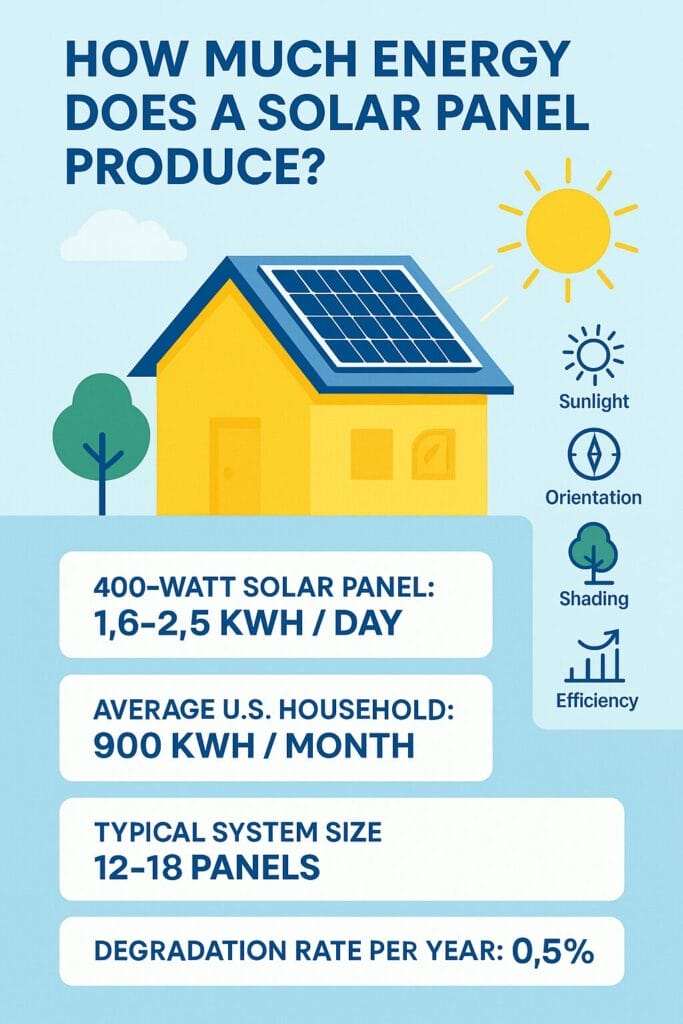
The efficiency of a solar panel determines how much of the incoming sunlight it can convert into electricity. As mentioned, modern panels typically range from 18% to 22%+ efficiency for monocrystalline silicon. A higher efficiency panel can produce more power from a smaller footprint. For example, a 1-meter square panel with 20% efficiency will produce 200 watts under standard test conditions (1000 W/m² irradiance) compared to a 15% efficient panel producing 150 watts.
- Degradation: Solar panels are robust, but their performance naturally declines slightly over time. This is known as the degradation rate, typically around 0.5% to 1% per year. Most manufacturers guarantee that their panels will produce at least 80-85% of their original rated power after 20-25 years. This long-term performance stability is a testament to the durability of the technology.
System Sizing and Installation Quality
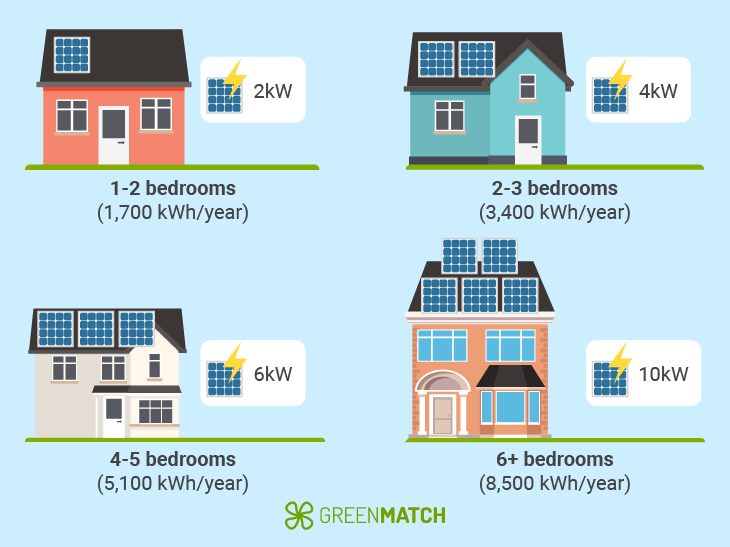
The sheer size of a solar array directly impacts its total energy output. A larger system with more panels will naturally produce more electricity. Residential systems typically range from 3 kW to 10 kW (kilowatts) of nominal power, which can translate to 4,000 to 15,000 kWh (kilowatt-hours) of annual production, depending on location and other factors. A 5 kW system in a sunny location with 5 PSH might produce around 7,000-8,000 kWh per year.
- Installation Quality: Proper installation is critical. This includes correct panel orientation (azimuth) and tilt angle to maximize sun exposure, appropriate wiring, and ensuring optimal inverter sizing for the array. Shading analysis is also crucial; even partial shading on one panel in a string can significantly reduce the output of the entire string if string inverters are used.
Environmental and Climatic Considerations
Beyond pure sunlight, other environmental factors play a role:
- Temperature: While solar panels need sunlight, excessive heat can reduce their efficiency. PV cells perform optimally around 25°C (77°F). For every degree Celsius above this, efficiency can drop by about 0.3-0.5%. This means a very hot day, even if sunny, might result in slightly lower power output than a bright, cooler day.
- Shading: Any obstruction that casts a shadow on the panels – trees, chimneys, adjacent buildings – will reduce energy production. Even partial shading can have a disproportionate impact, making meticulous site assessment vital.
- Soiling: Dust, dirt, pollen, bird droppings, or snow accumulation on the panel surface can block sunlight and decrease output. While rain often provides a natural cleaning, regular maintenance or self-cleaning coatings can mitigate this issue.
- Weather Patterns: Local weather patterns, including cloud cover, fog, and humidity, directly affect the amount of sunlight reaching the panels and thus their output.
Measuring and Monitoring Solar Performance
Accurately measuring and monitoring solar power production is not just about confirming functionality; it’s about optimizing performance, ensuring system health, and realizing the full potential of the investment. Modern solar systems are equipped with sophisticated tools to provide real-time insights into their energy output.
Kilowatt-Hours (kWh): The Standard Metric
The most common and practical unit for measuring solar energy production is the kilowatt-hour (kWh). While kilowatts (kW) denote instantaneous power (how much energy a system can produce at a given moment), kilowatt-hours measure the total energy consumed or produced over a period (e.g., an hour). A 1 kW solar system operating at its full capacity for one hour produces 1 kWh of electricity.
- Typical Production: A single standard solar panel (e.g., 350-watt) might produce between 1.5 to 2.0 kWh per day on average, depending on sunshine hours and efficiency. For an average residential system of 6 kW, annual production can range from 7,000 kWh to 10,000 kWh, enough to power a typical American home. Utility-scale solar farms can produce millions or even billions of kWh annually, feeding significant amounts of clean energy into national grids. For example, a 100 MW solar farm could produce over 200,000 MWh (200 million kWh) per year.
Inverters and Their Role in Conversion and Data
The inverter is the central hub for data collection in most solar systems. It not only converts DC to AC power but also often acts as the primary data logger. Modern inverters continuously monitor the voltage and current from the solar panels, calculate the power output, and record this data.
- Performance Optimization: Advanced inverters, especially microinverters and power optimizers, can track the maximum power point (MPP) for individual panels or strings. This allows them to extract the highest possible power output even if some panels are shaded or performing sub-optimally, thereby enhancing the overall energy production of the array.
Real-time Monitoring Systems and Software
Today’s solar systems come with integrated monitoring solutions that provide granular data to homeowners and operators. These systems typically consist of:
- Hardware Sensors: Integrated into the inverter or dedicated sensors that measure current, voltage, and sometimes even environmental factors like ambient temperature or irradiance.
- Data Loggers: Store the collected data over time.
- Cloud-Based Platforms and Apps: This is where the magic happens for the user. Data is transmitted wirelessly to a cloud server, accessible via web portals or smartphone apps. Users can view:
- Real-time power output (e.g., “currently producing 4.5 kW”)
- Daily, weekly, monthly, and annual energy production (e.g., “25 kWh today,” “500 kWh this month”)
- Historical performance data and trends
- System diagnostics and alerts for issues (e.g., inverter faults, communication errors)
- Often, comparisons to average production or even environmental benefits (e.g., “equivalent to planting X trees”).
These monitoring tools empower users to understand their system’s performance, identify potential issues quickly, and gain insights into their energy consumption patterns.
Understanding Performance Ratios and Capacity Factors
Beyond raw kWh production, two key metrics provide deeper insights into solar system efficiency:
- Performance Ratio (PR): This metric indicates how well a PV system performs compared to its theoretical maximum output under ideal conditions. It accounts for all system losses (inverter efficiency, cabling losses, temperature effects, soiling, etc.) and is expressed as a percentage. A PR of 75-85% is generally considered excellent for a well-designed and maintained system.
- Capacity Factor (CF): For large-scale power plants, the capacity factor measures the actual energy output over a period (usually a year) relative to the maximum possible output if it ran at full rated power continuously. Due to nightfall, weather, and maintenance, solar farms typically have capacity factors ranging from 15% to 30%, depending heavily on location. A solar farm in Arizona might have a CF closer to 25-30%, while one in a less sunny region might be 15-20%. These metrics are crucial for financial modeling and understanding the true operational efficiency of large-scale solar assets.
The Evolving Landscape of Solar Production Technology
The story of solar power is one of relentless innovation. What began as a scientific curiosity has transformed into a sophisticated industrial technology, continuously pushing the boundaries of efficiency, cost-effectiveness, and versatility. The future of solar energy production is being shaped by breakthroughs in materials science, digital integration, and novel application methods.
Advances in Panel Materials and Design
The core of solar production lies in the PV panel, and this is an area of intense research and development.
- Perovskite Solar Cells: These emerging materials are generating significant excitement due to their high efficiency potential (already surpassing silicon in some lab settings) and low manufacturing costs. Perovskites are lightweight, flexible, and can be semi-transparent, opening doors for integration into windows, portable electronics, and architectural elements. While stability and scalability remain challenges, they are poised to revolutionize the PV industry.
- Bifacial Panels: Unlike traditional panels that capture sunlight from one side, bifacial panels absorb light from both the front and the back. Light reflected off the ground or roof surface (albedo effect) can be captured by the rear side, boosting overall energy production by 10-30%. This is particularly effective for ground-mount installations, carports, and flat commercial roofs.
- Heterojunction Technology (HJT) and TOPCon Cells: These are advanced silicon cell architectures that achieve higher efficiencies than conventional monocrystalline cells by reducing energy losses within the cell structure. They represent incremental but significant improvements in current silicon-based technology.
- Thin-Film Technologies (CIGS, CdTe): While generally less efficient than silicon, thin-film panels are flexible, lightweight, and can be produced at lower costs, making them suitable for specialized applications like building-integrated photovoltaics (BIPV) or large-scale, low-cost solar farms.
Integration with Energy Storage Solutions (Batteries)
The intermittency of solar power (no production at night, reduced on cloudy days) has historically been its main limitation. However, the rapid advancement and decreasing cost of battery energy storage systems (BESS) are fundamentally changing this.
- Residential Batteries: Home battery systems (e.g., Tesla Powerwall, LG Chem RESU) store excess solar energy generated during the day for use at night, increasing self-consumption and providing backup power during grid outages. This transforms solar from a “when the sun shines” power source to an “on-demand” one.
- Utility-Scale Storage: Large battery banks integrated with solar farms allow generated electricity to be stored and dispatched to the grid when demand is high or solar output is low, improving grid stability and reliability. This enables solar power to play a much larger role in baseload energy supply.
- Hybrid Inverters: These sophisticated inverters manage both solar production and battery charging/discharging, optimizing energy flow for maximum efficiency and energy independence.
Smart Grids and AI-Powered Optimization
The proliferation of solar power, especially distributed generation from rooftops, necessitates a more intelligent electricity grid.
- Smart Grid Technologies: These enable two-way communication between utilities and consumers, allowing for better management of renewable energy flows. Solar systems can communicate with the grid, providing data on production and potentially responding to grid signals (e.g., to reduce output during oversupply or charge batteries).
- AI and Machine Learning: Artificial intelligence is being applied to forecast solar production with greater accuracy by analyzing weather patterns, satellite imagery, and historical data. AI also optimizes the dispatch of solar-plus-storage systems, predicting demand and pricing to maximize economic and grid benefits. AI-driven systems can identify performance anomalies in solar arrays faster than human operators, predicting maintenance needs before they lead to significant energy losses.
Emerging Solar Applications
Solar technology is expanding beyond traditional rooftop and ground-mount installations, finding innovative niches:
- Floating Solar (Floatovoltaics): Installing solar panels on bodies of water (reservoirs, lakes, hydropower dams) reduces land use, benefits from natural cooling effects (boosting efficiency), and reduces evaporation. This is a growing trend, particularly in land-scarce regions.
- Agrivoltaics (Agro-photovoltaics): This involves co-locating solar panels and agricultural crops on the same land. Panels can provide partial shade beneficial to certain crops, reduce water evaporation, and generate clean electricity simultaneously, optimizing land use and potentially increasing crop yields in some climates.
- Solar Roads and Sidewalks: While still largely experimental, projects exploring embedding PV cells into road surfaces aim to generate power from infrastructure.
- Space Solar Power: Long-term visions include deploying vast solar arrays in Earth orbit to capture sunlight 24/7, transmitting energy wirelessly to Earth, offering a constant, abundant power source.
The Broader Impact and Future Outlook of Solar Energy
The question of “how much energy does solar power produce” extends beyond technical metrics to encompass its profound societal, economic, and environmental implications. Solar’s capabilities are not just about watts and kWh; they are about resilience, sustainability, and global accessibility.
Decarbonization and Grid Resilience
Solar power is a critical tool in the fight against climate change. Every kilowatt-hour produced by solar means one less kilowatt-hour generated from fossil fuels, directly reducing greenhouse gas emissions. The massive scaling of solar, particularly utility-scale projects, is enabling nations to meet ambitious decarbonization targets.
- Grid Resilience: Distributed solar, especially when paired with battery storage, enhances grid resilience by decentralizing power generation. If a centralized power plant goes down or transmission lines are disrupted, localized solar systems can continue to provide power, creating microgrids and improving energy security. This shift reduces vulnerability to large-scale outages.
Accessibility and Global Deployment Trends
The declining cost of solar technology has made it accessible to a wider range of populations and regions. In many parts of the world, solar is now the cheapest form of new electricity generation.
- Developing Nations: Solar mini-grids and off-grid solutions are bringing electricity to remote communities that have never had reliable power, fostering economic development, education, and healthcare. From individual solar lanterns to village-wide solar systems, this technology is bridging the energy access gap.
- Global Growth: Driven by policy support, technological advancements, and economic competitiveness, solar PV is consistently breaking deployment records. It is the fastest-growing renewable energy source and is projected to become the largest source of electricity generation globally within the next few decades, surpassing all other forms of energy.
Research and Development Horizons
The quest for more efficient, durable, and cost-effective solar power continues unabated. Future research focuses on:
- Ultra-High Efficiency Cells: Developing multi-junction cells or tandem cells (e.g., perovskite-on-silicon) that can convert a higher percentage of the solar spectrum into electricity, potentially pushing efficiencies beyond 30-40%.
- Novel Materials and Manufacturing: Exploring new semiconductor materials, quantum dots, and printable solar cells that could further reduce costs and enable flexible, transparent, or spray-on applications.
- Enhanced Durability and Recycling: Improving the lifespan of panels and developing more efficient and economical methods for recycling end-of-life solar modules, creating a truly circular economy for solar technology.
- System Integration and Grid Management: Advancing the intelligence of solar systems within the broader energy ecosystem, utilizing AI and blockchain for optimized energy trading and grid balancing.
In conclusion, the energy produced by solar power is not a static figure but a dynamic and ever-increasing contribution to our global energy supply. From the fundamental physics of the photovoltaic effect to the sophisticated monitoring systems and groundbreaking technological advancements, solar is proving its immense capability. As innovation continues to drive efficiency gains, cost reductions, and versatile applications, solar power’s role in powering our homes, industries, and entire grids will only continue to expand, solidifying its position as a cornerstone of our sustainable future.
aViewFromTheCave is a participant in the Amazon Services LLC Associates Program, an affiliate advertising program designed to provide a means for sites to earn advertising fees by advertising and linking to Amazon.com. Amazon, the Amazon logo, AmazonSupply, and the AmazonSupply logo are trademarks of Amazon.com, Inc. or its affiliates. As an Amazon Associate we earn affiliate commissions from qualifying purchases.