
Understanding the energy output of a solar panel is fundamental to appreciating its role in renewable energy and making informed decisions about its application. While the simple answer might seem elusive due to numerous variables, delving into the core technology and influencing factors reveals a clear picture of how these sophisticated devices convert sunlight into usable electricity. At its heart, a solar panel’s job is to harness photons from the sun and transform them into direct current (DC) electricity, which is then typically converted into alternating current (AC) for household or grid use.
The Core Mechanics of Photovoltaic Conversion
The creation of electricity by a solar panel is a marvel of material science and physics, rooted in the photovoltaic effect. When sunlight, composed of photons, strikes the semiconductor material (most commonly silicon) within a solar cell, it excites electrons, causing them to break free from their atoms. An electric field within the cell then directs these free electrons to flow, creating an electric current. Multiple solar cells are wired together and encapsulated to form a solar panel, or module, generating a larger current and voltage.
Understanding Kilowatt-Hours (kWh)
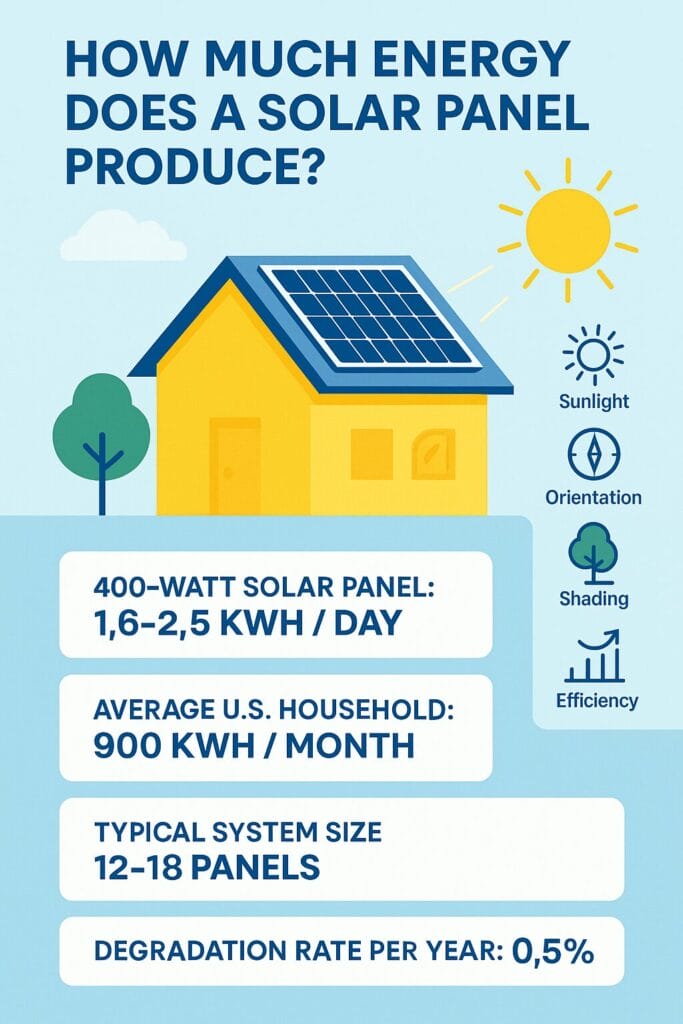
Energy generation is typically measured in kilowatt-hours (kWh), a unit that represents 1,000 watts of power used or generated for one hour. For example, a 1-kilowatt (kW) solar array operating at its peak for one hour would produce 1 kWh of electricity. This unit is crucial for homeowners and businesses to understand their consumption and, consequently, how much energy their solar panels need to produce to offset that consumption. The average solar panel today is rated between 250 and 400 watts (W). This “nameplate capacity” indicates its power output under standard test conditions (STC), which are an irradiance of 1,000 watts per square meter (W/m²), a cell temperature of 25°C, and an air mass (AM) of 1.5. However, real-world conditions rarely perfectly match STC, leading to variations in actual energy output.
The Role of Solar Cell Efficiency
Solar panel efficiency is a critical technological metric, representing the percentage of incident sunlight energy that a panel can convert into electricity. A higher efficiency rating means a panel can produce more power per square foot, which is particularly beneficial when roof space is limited. Current commercially available silicon-based solar panels typically have efficiencies ranging from 17% to 23%. Research and development continue to push these boundaries, with laboratory records for single-junction silicon cells exceeding 26% and multi-junction cells (used in specialized applications like spacecraft) reaching over 47%. The pursuit of higher efficiency involves innovations in cell design, material purity, anti-reflective coatings, and techniques to minimize energy losses.
Key Factors Influencing Solar Panel Output
While the nameplate rating provides a baseline, the actual energy created by a solar panel in any given location and time is a dynamic figure influenced by a multitude of environmental and installation-specific variables. Understanding these factors is crucial for accurate system design and performance prediction.
Sunlight Intensity and Irradiance
The most obvious factor is the amount of sunlight, or solar irradiance, a panel receives. This varies significantly throughout the day, across seasons, and with geographical location. Regions closer to the equator and those with consistently clear skies naturally receive more intense and prolonged sunlight, leading to higher energy generation. For instance, a panel in Arizona will generally produce more kWh annually than the same panel in Seattle, simply due to differences in average solar insolation (the total amount of solar radiation received on a given surface area over a given time). Cloud cover, fog, and atmospheric aerosols can significantly reduce the amount of direct sunlight reaching the panels.
Panel Size and Configuration
The physical dimensions and the total number of panels in an array directly dictate the overall system’s capacity. A larger system with more panels will inherently generate more energy, assuming all other factors are equal. Furthermore, the electrical configuration—whether panels are wired in series or parallel—impacts voltage and current, affecting the inverter’s ability to efficiently convert DC to AC. Proper string sizing and matching to the inverter’s specifications are technical considerations that optimize energy yield.
Temperature Considerations
Despite popular belief, solar panels operate more efficiently in cooler temperatures. As the temperature of the solar cells increases, their voltage output decreases, leading to a reduction in power generation. This means a scorching hot summer day with direct sunlight might actually yield slightly less power than a bright, clear, and cooler day. Manufacturers provide a temperature coefficient for their panels, indicating how much efficiency drops for every degree Celsius above 25°C. Effective ventilation and air circulation around the panels can help mitigate some of this temperature-related loss.
Shading and Obstructions
Even partial shading on a solar panel can disproportionately reduce its output. If just a portion of a single cell or a panel in a string is shaded by a tree branch, chimney, or adjacent building, it can act as a bottleneck, reducing the current flow through the entire series of panels. Modern inverter technologies, such as micro-inverters or power optimizers, are designed to mitigate the impact of shading by optimizing the output of individual panels, rather than the entire string, thereby maximizing overall system performance.
Panel Tilt and Orientation
The angle at which a solar panel is installed (tilt) and the direction it faces (orientation) are critical for maximizing energy capture. In the Northern Hemisphere, panels ideally face due south to receive the most direct sunlight throughout the day. The optimal tilt angle typically corresponds to the latitude of the installation site, allowing for maximum solar exposure throughout the year. However, for specific energy generation profiles (e.g., higher output in the morning or afternoon), a slight deviation from true south or the ideal tilt might be strategically chosen.
Calculating Expected Energy Generation
Estimating the actual energy production of a solar panel system involves more than just its nameplate capacity. It requires incorporating the real-world conditions and system losses.
Peak Sun Hours and System Sizing
“Peak sun hours” refer to the equivalent number of hours per day when solar irradiance averages 1,000 W/m². This is a critical metric for solar system sizing and energy estimation. For example, if a location experiences 5 peak sun hours per day, a 1 kW (1,000 W) solar panel system is expected to produce 1,000 W * 5 hours = 5,000 Wh, or 5 kWh per day. These peak sun hour values vary significantly by geography and season, and readily available solar insolation maps or calculators provide this data for different regions. Using this, one can estimate daily, monthly, and annual energy output.
Performance Ratio and System Losses
The “performance ratio” (PR) is a crucial metric that quantifies the real-world performance of a solar system relative to its theoretical maximum under ideal conditions. It accounts for various system losses, including:
-
Temperature losses: As discussed, panels lose efficiency at higher temperatures.
-
Inverter efficiency: Inverters aren’t 100% efficient at converting DC to AC; typical efficiencies range from 95% to 99%.
-
Wiring losses: Some energy is lost as heat in the electrical wiring.
-
Dust and soiling: Accumulation of dirt, dust, pollen, or bird droppings on the panel surface can block sunlight.
-
Mismatch losses: Slight differences in individual panel performance or shading can cause some panels to underperform.
-
Degradation: Solar panels naturally degrade over time, typically losing about 0.5% to 1% of their output per year.
A typical performance ratio for a well-designed and maintained system might range from 75% to 85%. To calculate expected energy, one multiplies the theoretical output (kW system size * peak sun hours) by the performance ratio.
Real-World Examples and Averaging
Considering a common residential setup: a 6 kW solar panel system in a location with an average of 4.5 peak sun hours per day and an 80% performance ratio.
-
Daily theoretical output: 6 kW * 4.5 hours = 27 kWh
-
Daily actual output: 27 kWh * 0.80 = 21.6 kWh
-
Annual output: 21.6 kWh/day * 365 days = 7,884 kWh per year
This annual production can then be compared to a household’s annual energy consumption to determine the degree of energy offset. It’s important to remember these are averages; actual daily output will fluctuate significantly based on weather and seasonal changes.
Advancements and Future of Solar Technology
The journey of solar panel technology is one of continuous innovation, striving for greater efficiency, durability, and cost-effectiveness. Future developments promise to further enhance the energy creation capabilities of photovoltaic systems.
Bifacial Panels and Perovskite Cells
Bifacial solar panels are a significant technological advancement. Unlike traditional panels that capture sunlight only on their front surface, bifacial panels are designed to absorb light from both sides, increasing their energy yield. This allows them to capture direct sunlight on the front and reflected light (from the ground, snow, or light-colored surfaces) on the rear, potentially boosting total energy production by 5% to 30% depending on the installation environment.
Perovskite solar cells represent a cutting-edge frontier. These cells use a synthetic perovskite material as the light-harvesting active layer, offering several advantages, including high efficiency potential, low manufacturing costs, and flexibility. While still largely in the research and development phase for commercial applications, perovskites have achieved lab efficiencies comparable to silicon and hold promise for a new generation of highly efficient, versatile, and potentially transparent or flexible solar products.
Integrated Smart Technologies and Monitoring
The integration of smart technologies is transforming how solar panels create and manage energy. Advanced monitoring systems collect real-time data on panel performance, identifying inefficiencies, shading issues, or potential faults. This data can be accessed via mobile apps or web portals, allowing system owners to track their energy production and consumption patterns. Artificial intelligence (AI) and machine learning (ML) are being deployed to predict energy output more accurately based on weather forecasts and historical data, and to optimize energy flow within smart grids or home energy management systems. These intelligent integrations improve the overall performance ratio and ensure the system operates at its peak potential.
Energy Storage Integration
While not directly related to creating energy, the ability to store generated solar energy significantly enhances the utility and value of solar panels. Battery energy storage systems (BESS), typically lithium-ion batteries, allow excess electricity produced during peak sunlight hours to be stored and then used later, such as after sunset or during grid outages. This integration transforms solar panels from simply energy generators into components of a self-sufficient energy ecosystem, enabling greater energy independence and resilience. The efficiency of the overall solar-plus-storage system relies not only on the panel’s output but also on the battery’s charge/discharge efficiency and the inverter’s capabilities.
In conclusion, the energy created by a solar panel is a complex interplay of its inherent technological capabilities and a host of environmental and system-specific factors. From the fundamental physics of the photovoltaic effect to advanced materials and smart grid integration, the continuous evolution of solar technology is consistently improving its capacity to reliably and efficiently convert sunlight into the power that drives our modern world.
aViewFromTheCave is a participant in the Amazon Services LLC Associates Program, an affiliate advertising program designed to provide a means for sites to earn advertising fees by advertising and linking to Amazon.com. Amazon, the Amazon logo, AmazonSupply, and the AmazonSupply logo are trademarks of Amazon.com, Inc. or its affiliates. As an Amazon Associate we earn affiliate commissions from qualifying purchases.