
The question “how much energy do solar panels produce?” is fundamental to understanding solar technology and its role in our evolving energy landscape. It’s not a simple, fixed number, but rather a dynamic output governed by a sophisticated interplay of scientific principles, material engineering, environmental factors, and cutting-edge technological advancements. For anyone interested in the practical application and performance metrics of this renewable energy gadget, delving into the intricacies of solar panel energy production reveals a fascinating world of innovation aimed at maximizing photon capture and electricity generation.
At its core, a solar panel is an elegant piece of engineering designed to convert sunlight directly into electricity. This process, known as the photovoltaic (PV) effect, is the bedrock of solar power. However, the actual energy output—measured in kilowatt-hours (kWh) over a period—varies significantly based on numerous technical specifications of the panels themselves, the broader system components, and the conditions under which they operate. Understanding these variables is key to appreciating the true capabilities and potential of solar technology.
The Core Mechanics of Solar Energy Production
Before we quantify energy output, it’s crucial to grasp the foundational technology that makes it all possible. Solar panels are not monolithic units but intricate assemblies of solar cells, each a tiny power generator.
Photovoltaic Effect: The Fundamental Principle
The journey of sunlight to electricity begins with the photovoltaic effect. When photons from sunlight strike the semiconductor material (typically silicon) within a solar cell, they excite electrons, knocking them loose from their atoms. These freed electrons then move towards one side of the cell, creating an electrical current. This current, a flow of electrons, is captured by metallic contacts on the cell and directed into an external circuit, forming usable direct current (DC) electricity. This process requires a p-n junction—a boundary between two different types of silicon (p-type with an excess of “holes” and n-type with an excess of electrons)—to create an electric field that drives the electrons in a specific direction.
Solar Cell Components and Materials
The performance of a solar panel is intrinsically linked to the quality and type of its constituent solar cells. Crystalline silicon, dominating approximately 95% of the market, comes primarily in two forms:
- Monocrystalline Silicon: Made from a single, continuous crystal structure, these cells are characterized by their uniform dark appearance and higher efficiency rates. The single crystal structure allows electrons to move more freely, resulting in better performance.
- Polycrystalline Silicon: Composed of multiple silicon crystals, these cells have a more fragmented, bluish appearance. While slightly less efficient than monocrystalline panels due to imperfections at the crystal boundaries hindering electron flow, they are generally more cost-effective to produce.
Beyond silicon, thin-film technologies (like Cadmium Telluride (CdTe), Copper Indium Gallium Selenide (CIGS), and Amorphous Silicon (a-Si)) utilize ultra-thin layers of photovoltaic material. These are typically less efficient per square foot but are lightweight, flexible, and perform well in low light or high temperatures, making them suitable for specific niche applications. The choice of material directly influences how many photons can be converted into electrons and thus the overall power output.
Panel Design and Configuration
A typical solar panel is an array of multiple solar cells connected electrically, usually in series and parallel, to achieve a desired voltage and current output. These cells are encapsulated between layers of protective material (like EVA film), tempered glass (on the front for durability and light transmission), and a durable back sheet, all framed within an aluminum frame for structural integrity. The specific arrangement and number of cells (e.g., 60-cell, 72-cell, or even 120-half-cut-cell panels) determine the panel’s nominal power rating, typically expressed in watts (W). A higher wattage panel, all else being equal, will produce more energy. Half-cut cell technology, for instance, reduces resistive losses within the cell and improves shade tolerance, leading to incrementally higher overall output for a given panel footprint.
Key Technological Factors Influencing Energy Output
The energy output isn’t solely about the cells; it’s also about how well the entire system manages and converts the generated electricity.
Panel Efficiency Ratings: What They Mean for Production
Efficiency is perhaps the most talked-about technical specification. A panel’s efficiency rating (e.g., 20%) indicates the percentage of incident sunlight energy that it can convert into usable electricity. If a panel has a 20% efficiency, it means 20% of the solar energy hitting its surface is converted into electricity. Higher efficiency panels generate more power from the same footprint, which is critical for installations with limited roof space. Modern residential panels typically range from 17% to 23%, with some premium and lab-based panels exceeding 25%. This rating is measured under Standard Test Conditions (STC), which assume a specific temperature (25°C), irradiance (1000 W/m²), and air mass (AM 1.5). Real-world conditions rarely match STC perfectly, leading to variations in actual output.
Inverter Technology: Optimizing DC to AC Conversion
Solar panels produce DC electricity, but homes and the grid use alternating current (AC). Inverters are the crucial pieces of technology that perform this conversion. Their efficiency and intelligence directly impact the overall energy yield.
- String Inverters: These are common and connect multiple panels in a “string.” If one panel in the string underperforms (due to shade or dirt), it can reduce the output of the entire string.
- Microinverters: Installed on each individual panel, microinverters optimize the output of each panel independently. This means shading on one panel won’t affect the others, leading to higher overall system efficiency and better performance in less-than-ideal conditions. They also offer panel-level monitoring.
- Power Optimizers: A hybrid solution, these devices are attached to individual panels and optimize their DC output before sending it to a central string inverter. Like microinverters, they mitigate the impact of shading and allow for panel-level monitoring. The efficiency of these inverters (typically 95-99%) directly dictates how much of the DC power generated by the panels successfully makes it into your home as AC power.
Degradation Rates and Longevity: Sustaining Output Over Time
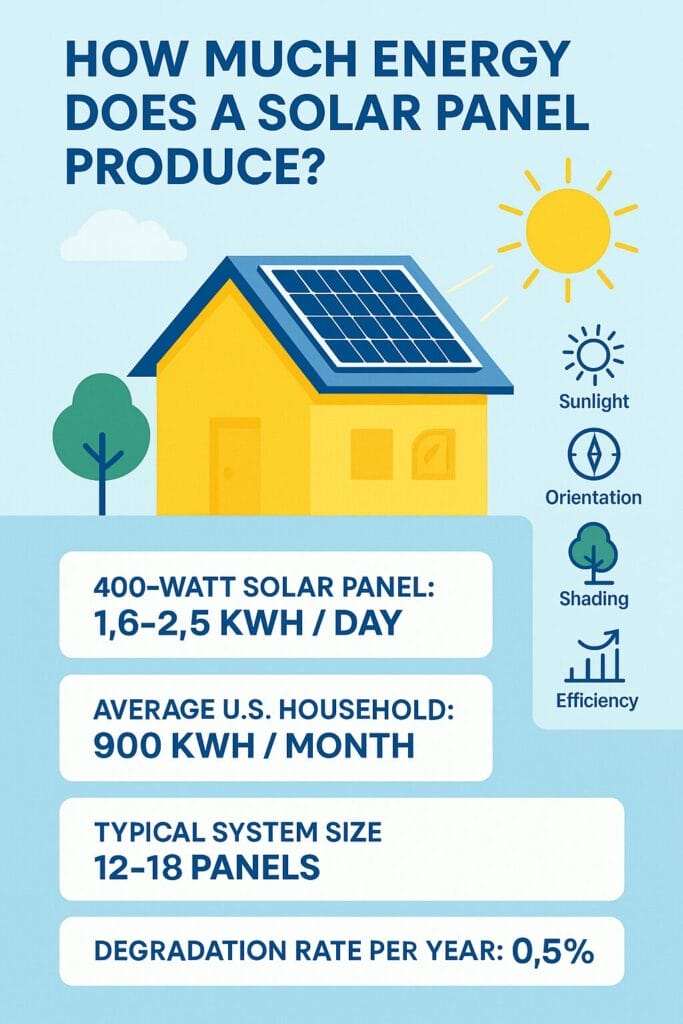
Solar panels are built to last, but like all technology, their performance degrades over time. This degradation rate is a critical factor in long-term energy production calculations. Most manufacturers guarantee that their panels will produce at least 80-85% of their original output after 20-25 years. A typical degradation rate is around 0.5% per year. This means a 400W panel might produce approximately 398W in its second year, 396W in its third, and so on. Understanding this slow, predictable decline is essential for projecting lifetime energy yield and return on investment. Advanced materials and manufacturing processes are constantly working to reduce these degradation rates further.
External Environmental and Installation Considerations
Beyond the inherent technological capabilities of the panels and inverters, a host of external factors significantly influence how much energy a solar system actually produces.
Irradiance and Sunlight Hours: Geographical Impact
The most obvious factor is the amount of sunlight a location receives, known as solar irradiance. Regions closer to the equator or with consistently clear skies (e.g., deserts) will naturally produce more energy than cloudy, high-latitude areas. System designers use solar insolation maps, which plot the average daily peak sun hours for different geographies, to estimate potential energy yield. For example, a system in Arizona will typically produce more energy than an identical system in Seattle, simply due to greater average daily sunlight.
Temperature Coefficients and Performance in Heat
While solar panels need sunlight, they don’t necessarily love extreme heat. Silicon-based panels have a negative temperature coefficient, meaning their efficiency slightly decreases as their temperature rises above the STC benchmark of 25°C (77°F). For every degree Celsius above this, a panel’s output might drop by 0.3% to 0.5%. This is why a sunny, cool day can sometimes yield more power than an equally sunny but scorching hot day. Proper ventilation beneath panels and mounting design can help mitigate some of this heat build-up.
System Sizing and Orientation: Maximizing Capture
The physical installation choices play a monumental role.
- System Sizing: This refers to the total wattage of all panels in an array. A larger system (more panels or higher wattage panels) will, of course, produce more energy. Proper sizing ensures the system meets the energy demands of the property without excessive overproduction or underproduction.
- Orientation and Tilt: For optimal production in the Northern Hemisphere, panels should ideally face true south (or north in the Southern Hemisphere) to maximize exposure to direct sunlight throughout the day. The tilt angle should generally match the latitude of the location, although seasonal adjustments or an angle optimized for year-round production are common. A professionally designed system takes these angles into account to project the most efficient sunlight capture.
Shading and Soiling: Mitigating Production Losses
Even partial shading from trees, chimneys, or adjacent buildings can drastically reduce a system’s output, especially with string inverters, as it can affect an entire string of panels. Modern technologies like microinverters and power optimizers are specifically designed to minimize these losses by allowing each panel to operate independently. Similarly, dirt, dust, pollen, bird droppings, or snow accumulated on the panel surface (known as “soiling”) block sunlight and reduce energy production. While rain can often wash away light debris, periodic cleaning might be necessary in very dusty or low-rainfall areas to maintain peak performance.
Advanced Technologies for Enhanced Solar Production
The quest for higher energy output from solar panels is an ongoing driver of innovation in the tech sector.
Bifacial Solar Panels: Capturing Light from Both Sides
Traditional solar panels capture sunlight only from their front surface. Bifacial panels, however, are designed with transparent back sheets and often frameless construction, allowing them to capture reflected and diffused light from their rear side. When installed over light-colored surfaces (like white roofs or gravel) or elevated from the ground, they can significantly boost energy yield, sometimes by 5-30%, depending on the albedo (reflectivity) of the surface beneath and mounting height. This represents a significant step forward in maximizing energy capture per panel.
PERC and TOPCon Cells: Pushing Efficiency Limits
Technological advancements in solar cell architecture are continually improving efficiency.
- PERC (Passivated Emitter Rear Cell): This technology adds a dielectric passivation layer to the rear of a conventional solar cell, along with localized openings for electrical contact. This layer reflects unabsorbed light back into the silicon, giving photons a “second chance” to create an electron-hole pair, and reduces electron recombination, thereby boosting efficiency. Most high-efficiency monocrystalline panels today incorporate PERC technology.
- TOPCon (Tunnel Oxide Passivated Contact): An evolution beyond PERC, TOPCon cells add a ultra-thin tunnel oxide layer followed by a doped polysilicon layer to the rear of the cell. This design further reduces recombination losses and improves overall efficiency, making it one of the most promising next-generation technologies for mass production, pushing efficiencies above 23-24% in commercial modules.
Solar Tracking Systems: Dynamic Optimization
For ground-mounted systems, solar trackers are mechanical devices that automatically adjust the orientation of the solar panels throughout the day to follow the sun’s path across the sky. Single-axis trackers (tilting east to west) can increase energy yield by 20-30%, while dual-axis trackers (tracking both east-west and north-south) can achieve even higher gains, up to 35-45% over fixed-tilt systems. While they add complexity and cost, and require maintenance, they are highly effective in maximizing direct sunlight capture, especially for large-scale solar farms.
Integrated Smart Monitoring and AI for Performance Analytics
Modern solar systems are increasingly integrated with smart monitoring platforms that provide real-time data on energy production, panel-level performance, and system health. These systems often utilize cloud-based analytics and even AI algorithms to detect anomalies, predict potential issues (like localized shading or inverter faults), and suggest optimizations. This proactive monitoring ensures the system operates at peak efficiency, allowing owners to maximize their energy harvest and quickly address any production shortfalls, making the ‘how much energy’ question a transparent and continuously optimized metric.
Calculating and Understanding Your Solar Panel’s Output Potential
Ultimately, users want to know the tangible output. While the exact figure varies daily, understanding the estimation process helps manage expectations.
The Kilowatt-Hour (kWh): Your Metric for Energy Production
Energy output is measured in kilowatt-hours (kWh). A kilowatt-hour represents the energy consumed by a 1,000-watt appliance running for one hour. For solar panels, if you have a 400W panel that produces power for an average of 5 “peak sun hours” per day, it generates 400W * 5 hours = 2000 Wh, or 2 kWh per day. Multiply this by 365 days, and that single panel could produce around 730 kWh annually. A typical residential system might consist of 15-25 panels, leading to an annual production of anywhere from 8,000 to 15,000 kWh, depending on size, location, and conditions.
Online Tools and Professional Assessments
Estimating real-world energy production is a complex calculation that factors in all the variables discussed. Fortunately, numerous online tools (like PVWatts Calculator from NREL) allow users to input their location, system size, tilt, and azimuth to get a detailed estimate of annual and monthly energy production. For a precise assessment, professional solar installers conduct a thorough site survey, factoring in specific roof dimensions, shading analysis, local weather patterns, and panel specifications to provide a highly accurate projection of expected energy output tailored to your specific installation.
Beyond Production: The Role of Energy Storage (Batteries)
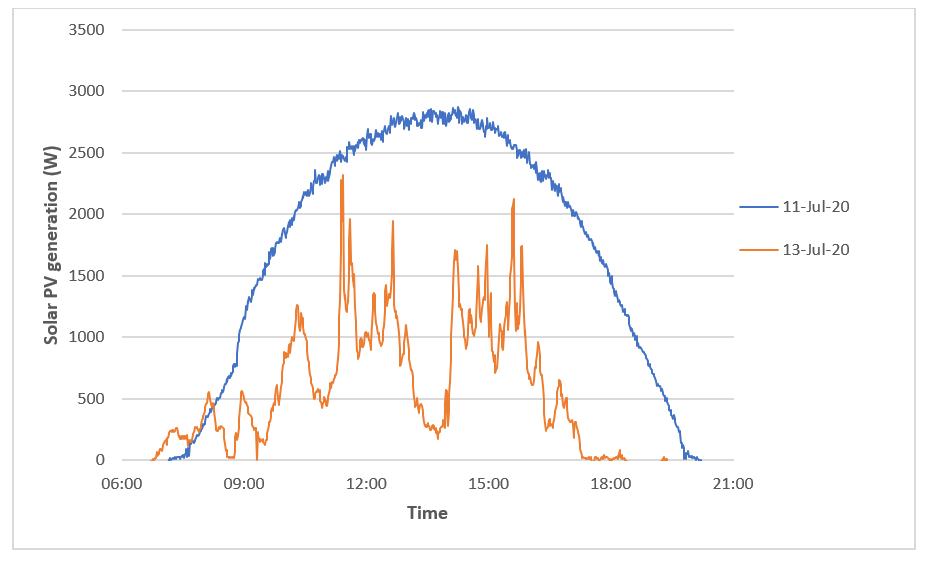
While solar panels produce energy, they do so intermittently (only when the sun shines). To truly maximize the use of this produced energy, especially during peak demand times or at night, energy storage solutions like home battery systems are becoming increasingly vital. These batteries store excess electricity generated by the panels during the day, allowing homeowners to use it later, reduce reliance on the grid, and enhance energy independence. While batteries don’t increase the production of energy by the panels, they drastically improve the usability and value of that produced energy, making the overall solar solution more robust and flexible.
In conclusion, the energy produced by solar panels is a dynamic figure, a testament to intricate engineering and continuous innovation. From the fundamental photovoltaic effect within advanced silicon cells to sophisticated inverters, climate resilience, and smart monitoring systems, every technological facet plays a critical role. As solar technology continues to evolve, pushing the boundaries of efficiency and reliability, the answer to “how much energy do solar panels produce?” will only trend upwards, solidifying its position as a cornerstone of sustainable energy for the future.
aViewFromTheCave is a participant in the Amazon Services LLC Associates Program, an affiliate advertising program designed to provide a means for sites to earn advertising fees by advertising and linking to Amazon.com. Amazon, the Amazon logo, AmazonSupply, and the AmazonSupply logo are trademarks of Amazon.com, Inc. or its affiliates. As an Amazon Associate we earn affiliate commissions from qualifying purchases.