
Social Security is a cornerstone of financial security for millions of Americans, providing a vital safety net for retirees, disabled workers, and survivors. However, the question “how much does Social Security pay per month?” is far from simple, as the answer varies dramatically from person to person. It’s a complex calculation influenced by a multitude of personal factors, making it essential for individuals to understand the underlying mechanics to plan effectively for their future. For many, Social Security isn’t just a government program; it’s a foundational element of their retirement income, making accurate projections and strategic planning indispensable. This article aims to demystify the intricacies of Social Security benefits, guiding you through the factors that determine your monthly payment and how you can estimate and potentially maximize what you receive.
Understanding the Fundamentals of Social Security Benefits
Before diving into the specifics of monthly payments, it’s crucial to grasp the basic principles that underpin the entire Social Security system. This foundational knowledge will help you better understand how your individual circumstances translate into concrete benefit amounts.
What is Social Security?
Social Security is a federal insurance program in the United States, funded through dedicated payroll taxes (FICA taxes) paid by workers and their employers. Its primary purpose is to provide a basic level of income replacement in the event of retirement, disability, or death. While often associated primarily with retirement, Social Security actually encompasses three main types of benefits: retirement benefits, disability benefits, and survivors’ benefits. It acts as a pay-as-you-go system, meaning that current workers’ contributions largely fund the benefits of current beneficiaries.
Who is Eligible for Benefits?
Eligibility for Social Security benefits primarily hinges on your work history and contributions to the system. Most Americans become eligible by working and paying Social Security taxes for a sufficient period. Beyond the primary worker, certain family members may also be eligible for benefits based on the worker’s record, including:
- Spouses: Current or divorced spouses may receive benefits.
- Children: Dependent children (under 18, under 19 if still in high school, or any age if disabled before age 22).
- Survivors: Widows, widowers, or dependent parents of a deceased worker.
Each category has specific eligibility criteria, but the common thread is the link to a worker who has paid into the system.
The Concept of “Credits” and “Years of Work”
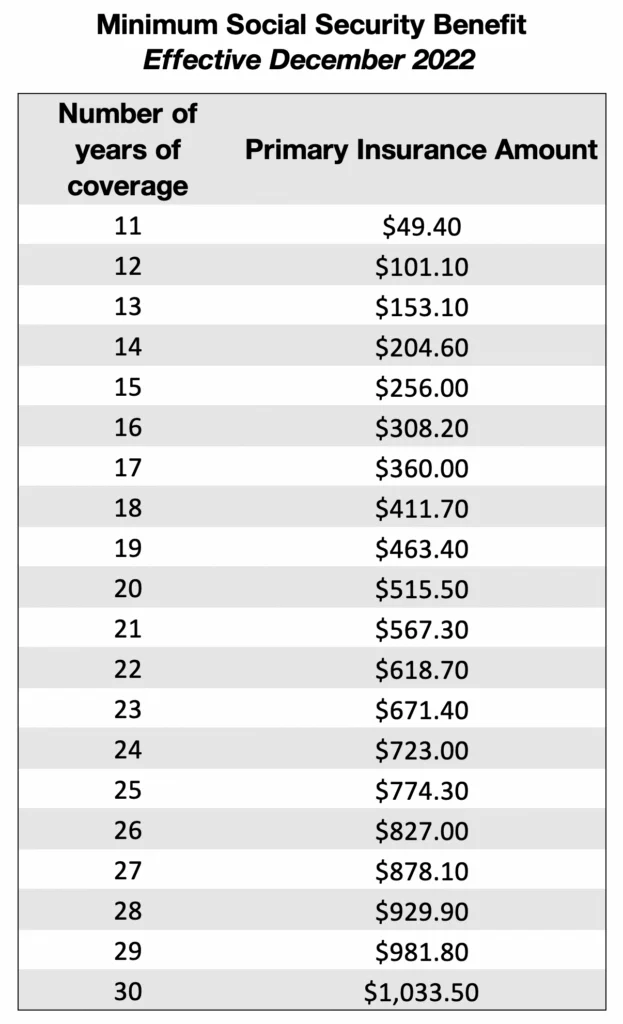
To qualify for Social Security benefits, you must accumulate “credits” through your earnings. In 2024, you earn one Social Security credit for every $1,730 in earnings, up to a maximum of four credits per year. To be eligible for retirement benefits, most people need to earn 40 credits, which typically equates to 10 years of work.
While 40 credits qualify you for benefits, the amount you receive is based on your entire earnings history, not just the minimum 10 years. The Social Security Administration (SSA) focuses on your highest 35 years of indexed earnings when calculating your Average Indexed Monthly Earnings (AIME), which is the primary driver of your benefit amount. If you work fewer than 35 years, the remaining years will be filled in with zeros, significantly reducing your AIME and thus your monthly payment. This highlights the importance of a consistent and substantial work history over many years.
Key Factors Influencing Your Monthly Social Security Payment
Your Social Security benefit isn’t a fixed sum; it’s a highly personalized figure derived from several critical factors. Understanding these elements is essential for estimating your future payments and making informed financial decisions.
Your Average Indexed Monthly Earnings (AIME)
The most significant determinant of your Social Security payment is your Average Indexed Monthly Earnings (AIME). This figure represents your average monthly earnings over your working career, adjusted for inflation. The SSA takes your earnings from each year you worked, indexes (adjusts) them to account for changes in the average wage level since the year the earnings were paid, and then selects your 35 highest-earning years. These indexed earnings are summed up and divided by 420 (the number of months in 35 years) to arrive at your AIME. Higher lifetime earnings directly translate to a higher AIME and, consequently, a larger monthly benefit.
Your Full Retirement Age (FRA)
Your Full Retirement Age (FRA) is the age at which you are entitled to receive 100% of your primary insurance amount (PIA), which is your basic benefit before any adjustments for early or delayed claiming. FRA is not universal; it depends on your birth year:
- Born 1943-1954: FRA is 66
- Born 1955: FRA is 66 and 2 months
- Born 1956: FRA is 66 and 4 months
- Born 1957: FRA is 66 and 6 months
- Born 1958: FRA is 66 and 8 months
- Born 1959: FRA is 66 and 10 months
- Born 1960 or later: FRA is 67
Knowing your FRA is crucial because it serves as the benchmark for calculating adjustments to your benefit if you claim earlier or later.
When You Choose to Start Receiving Benefits
The age at which you begin claiming Social Security benefits has a profound and permanent impact on your monthly payment.
- Claiming Early (as early as age 62): You can start receiving benefits as early as age 62, but doing so will result in a permanent reduction in your monthly payment. The reduction is approximately 5/9 of 1% for each month before your FRA, up to 36 months, and 5/12 of 1% for each month beyond 36 months. For someone with an FRA of 67, claiming at 62 means a reduction of about 30%.
- Claiming at Your Full Retirement Age (FRA): If you wait until your FRA, you will receive 100% of your Primary Insurance Amount (PIA). This is the base amount determined by your AIME.
- Claiming Late (up to age 70): For each month you delay claiming benefits past your FRA, up to age 70, you earn “Delayed Retirement Credits.” These credits permanently increase your monthly benefit by approximately 2/3 of 1% per month, or 8% per year. This means that by waiting until age 70, you could receive 124% to 132% of your PIA, depending on your FRA.
This decision is one of the most critical you’ll make regarding Social Security, as it can significantly affect your total lifetime benefits.
Cost-of-Living Adjustments (COLAs)
Once you start receiving Social Security benefits, your payment is generally adjusted annually to keep pace with inflation. These are known as Cost-of-Living Adjustments (COLAs). COLAs are determined by the Consumer Price Index for Urban Wage Earners and Clerical Workers (CPI-W). If the CPI-W increases from the third quarter of one year to the third quarter of the next, benefits will increase by the same percentage. These adjustments help preserve the purchasing power of your benefits over time, especially crucial during retirement.
Other Factors: Spousal, Survivor, Disability Benefits, and Taxation
While the above factors primarily apply to your own retirement benefit, other circumstances can influence payments:
- Spousal Benefits: A spouse may receive up to 50% of the primary worker’s FRA benefit, even if they have their own, lower benefit.
- Survivor Benefits: Widows, widowers, and other survivors can receive benefits based on the deceased worker’s earnings record.
- Disability Benefits: If you become unable to work due to a severe medical condition, you may qualify for Social Security Disability Insurance (SSDI) benefits, which are calculated similarly to retirement benefits based on your earnings history.
- Earnings Limits (Before FRA): If you claim benefits before your FRA and continue to work, your benefits may be reduced if your earnings exceed certain annual limits. These limits disappear once you reach your FRA.
- Taxation of Benefits: Depending on your combined income (adjusted gross income + non-taxable interest + half of your Social Security benefits), a portion of your Social Security benefits (up to 85%) may be subject to federal income tax.
Calculating Your Potential Social Security Benefit
Estimating your potential Social Security payment is not just a theoretical exercise; it’s a practical step in sound financial planning. Fortunately, the Social Security Administration (SSA) provides excellent tools to help you do just that.
Using the Social Security Administration (SSA) Tools
The most reliable way to estimate your future Social Security benefits is by using the resources provided directly by the SSA:
- My Social Security Account: This is your personalized portal to your Social Security information. By creating an account at ssa.gov/myaccount, you can view your earnings record, see estimated future benefits based on different claiming ages (62, FRA, 70), and review your complete work history. It’s crucial to check your earnings record periodically for accuracy, as errors could impact your future benefits.
- Benefit Estimators: The SSA website also offers various online calculators that allow you to plug in different scenarios (e.g., stopping work earlier, different future earnings) to see how they might affect your benefits. These tools are invaluable for scenario planning.
Understanding Your Social Security Statement
The Social Security Statement is a personalized report that the SSA provides. If you have an online “my Social Security” account, you can access it at any time. If you don’t have an online account, the SSA mails statements to workers aged 60 and older who are not yet receiving benefits and do not have an online account.
Your statement includes:
- Your estimated monthly benefits at various claiming ages (early retirement, full retirement age, and age 70).
- Estimated disability benefits if you become disabled.
- Estimated survivor benefits for your family if you pass away.
- A detailed record of your yearly earnings, indexed for inflation.
- Information about your Social Security credits and how many more you need to be eligible.
Carefully reviewing this statement is critical. It’s your personal window into your Social Security future and allows you to confirm the accuracy of your earnings history, which directly impacts your AIME.
Illustrative Examples of Benefit Ranges
While your exact benefit will depend on your unique earnings history, it’s helpful to understand typical ranges. As of early 2024:
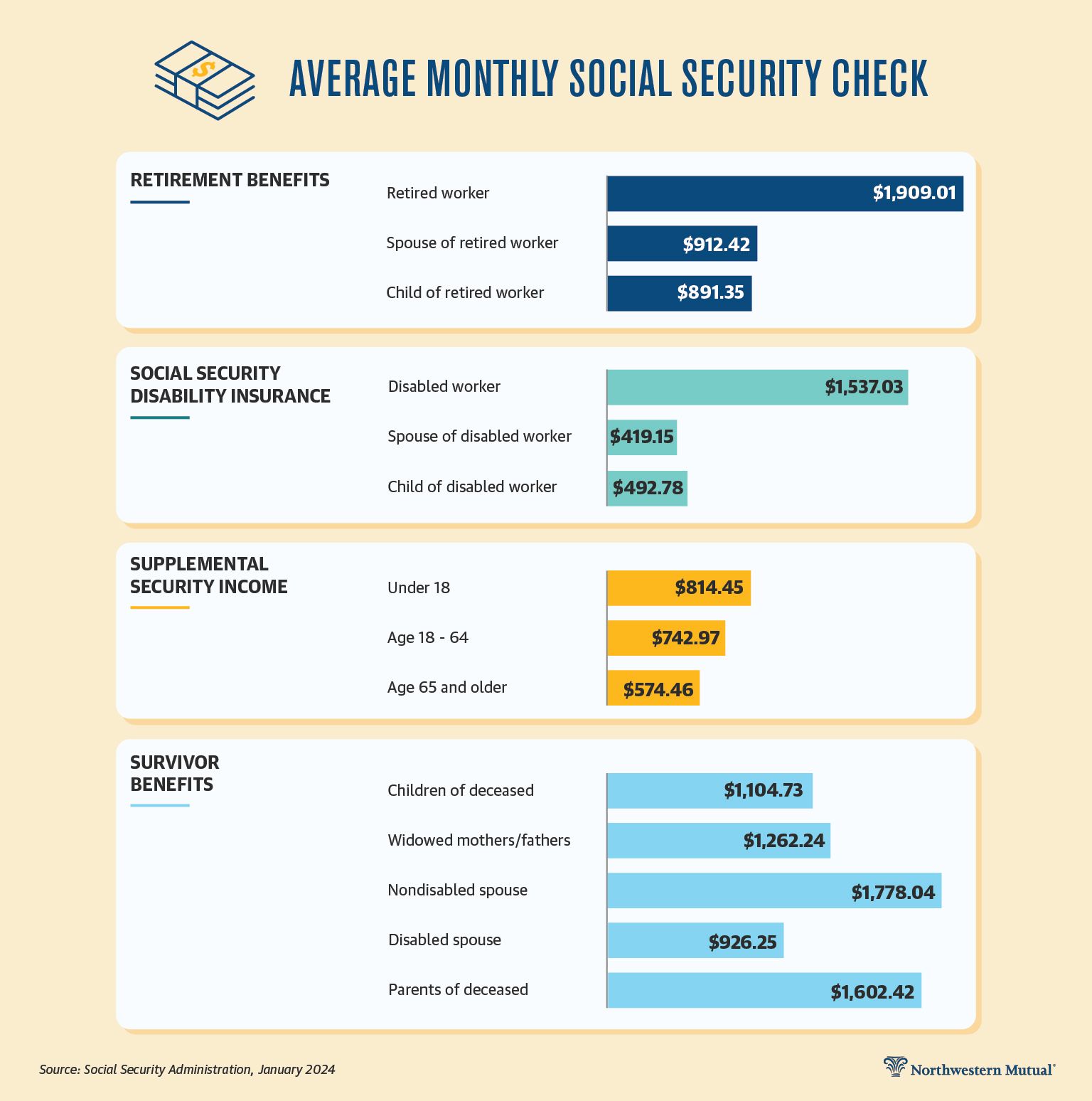
- Average Retirement Benefit: The average monthly Social Security benefit for retired workers is approximately $1,907. This figure reflects a wide range of earnings histories and claiming ages.
- Maximum Benefit at Full Retirement Age: For someone reaching their Full Retirement Age in 2024, the maximum possible monthly benefit is $3,822. To receive this, an individual would need to have consistently earned the maximum taxable amount for Social Security (the “wage base limit”) for at least 35 years.
- Maximum Benefit at Age 70: By delaying benefits until age 70, the maximum possible monthly benefit for someone reaching age 70 in 2024 could be as high as $4,873. This significant increase highlights the power of delayed retirement credits.
It’s important to remember that these are examples. Your personal benefit could be higher or lower depending on your specific circumstances.
Strategic Considerations for Maximizing Your Benefits
Understanding how your Social Security benefits are calculated empowers you to make strategic decisions that could significantly enhance your monthly payment and overall financial security in retirement.
The Power of Delaying Claims
Perhaps the most impactful strategy for increasing your Social Security benefits is delaying when you start claiming them. As discussed, for every year you delay claiming past your Full Retirement Age (up to age 70), your benefit increases by 8% due to Delayed Retirement Credits. This guaranteed 8% annual return is incredibly attractive, especially in today’s low-interest-rate environment, and offers a powerful way to provide longevity insurance against outliving your other assets.
For individuals in good health with other sources of income to bridge the gap, delaying to age 70 can provide a substantially larger monthly income stream that lasts for life and is inflation-adjusted. This strategy is particularly beneficial for the higher-earning spouse in a couple, as it also maximizes potential survivor benefits.
Coordinating with a Spouse
For married couples, Social Security claiming strategies become more nuanced and can yield substantial benefits if coordinated effectively. While the “file and suspend” strategy for spousal benefits has largely been eliminated for those reaching FRA after 2016, careful planning remains critical.
Key strategies for couples often involve:
- Maximizing the higher earner’s benefit: The higher-earning spouse typically benefits most from delaying their claim until age 70, as this maximizes their primary benefit, which then becomes the basis for potential survivor benefits for the lower-earning spouse.
- Timing the lower earner’s claim: The lower-earning spouse might claim their benefits earlier (even at age 62) to provide some income while the higher earner delays. Alternatively, they might wait until their own FRA or later if their own benefit is higher than 50% of their spouse’s.
- Spousal Benefits: One spouse may be able to claim a spousal benefit (up to 50% of the other spouse’s FRA benefit) if it is higher than their own earned benefit. They generally can’t claim a spousal benefit until their spouse has filed for their own benefits.
- Survivor Benefits: Upon the death of a spouse, the surviving spouse can switch to the deceased spouse’s benefit if it is higher than their own. Maximizing the higher earner’s benefit through delayed claiming ensures the surviving spouse will receive the largest possible income.
These decisions are complex and often benefit from a personalized consultation with a financial advisor experienced in Social Security planning.
Working Longer and Higher Earnings
Since your Social Security benefit is based on your highest 35 years of indexed earnings, working longer can often significantly increase your monthly payment. If your current earnings are higher than some of your earlier, lower-earning years (which might be included in your initial 35-year calculation), working an additional year can replace one of those lower-earning years with a higher one, boosting your AIME.
Furthermore, if you haven’t worked for the full 35 years, continuing to work can replace “zero” years in your earnings record, which will have an even more dramatic positive effect on your AIME. Even a few extra years of solid earnings can make a noticeable difference in your retirement check.
Understanding Taxation of Benefits
While not a strategy to increase your benefits, understanding the taxation of Social Security benefits is crucial for effective financial planning. Depending on your “combined income” (your adjusted gross income + any tax-exempt interest + one-half of your Social Security benefits), a portion of your Social Security benefits may be subject to federal income tax.
- Up to 50% of benefits taxable: If your combined income is between $25,000 and $34,000 for an individual, or $32,000 and $44,000 for those filing jointly.
- Up to 85% of benefits taxable: If your combined income is above $34,000 for an individual, or above $44,000 for those filing jointly.
Some states also tax Social Security benefits. Planning your retirement withdrawals from other accounts (e.g., Roth vs. traditional IRAs/401(k)s) can help manage your combined income and potentially reduce the taxable portion of your Social Security benefits.

Conclusion
The question “how much does Social Security pay per month?” opens the door to a multifaceted discussion about personal finance, long-term planning, and understanding a vital government program. While the calculation is rooted in your individual work history and earnings, the choices you make about when to claim benefits can significantly impact your financial well-being in retirement.
Social Security is a foundational pillar of retirement income, but it’s rarely the sole source. By understanding how your benefits are determined, utilizing the invaluable resources provided by the Social Security Administration, and strategically considering factors like claiming age and spousal coordination, you can optimize this crucial component of your financial future. Proactive planning, informed decision-making, and potentially seeking advice from a qualified financial advisor are essential steps to ensure you maximize your Social Security benefits and build a secure retirement.
aViewFromTheCave is a participant in the Amazon Services LLC Associates Program, an affiliate advertising program designed to provide a means for sites to earn advertising fees by advertising and linking to Amazon.com. Amazon, the Amazon logo, AmazonSupply, and the AmazonSupply logo are trademarks of Amazon.com, Inc. or its affiliates. As an Amazon Associate we earn affiliate commissions from qualifying purchases.