
Navigating the landscape of government benefits can often feel like deciphering a complex financial code. For millions of Americans, Supplemental Security Income (SSI) represents a critical lifeline, providing essential financial support to those who are aged, blind, or disabled and have limited income and resources. Understanding how much you can receive from SSI is not just a matter of knowing a number; it involves grasping the program’s intricate rules, eligibility criteria, and the various factors that can influence your monthly benefit. This article aims to demystify SSI, offering a comprehensive guide to its purpose, eligibility, benefit calculation, and how it fits into the broader picture of personal financial well-being.
Understanding Supplemental Security Income (SSI)
Before delving into the specifics of benefit amounts, it’s crucial to establish a foundational understanding of what SSI is and whom it is designed to serve. Often confused with other Social Security programs, SSI stands distinct in its purpose and funding mechanisms.
What is SSI and Who Does it Serve?
Supplemental Security Income (SSI) is a needs-based federal income supplement program funded by general tax revenues, not by Social Security taxes. Its primary objective is to provide cash assistance to individuals in critical need who meet specific criteria related to age, blindness, or disability, coupled with very limited income and resources. This program acts as a safety net, ensuring that the most vulnerable members of society have access to funds for basic necessities like food, clothing, and shelter. Eligibility is strictly evaluated based on financial need, meaning applicants must demonstrate they have minimal other sources of income and assets.
Differentiating SSI from Social Security Disability Insurance (SSDI)
A common point of confusion arises when comparing SSI with Social Security Disability Insurance (SSDI). While both programs are administered by the Social Security Administration (SSA) and provide benefits to disabled individuals, their fundamental structures and eligibility requirements differ significantly.
-
SSI (Supplemental Security Income): This is a means-tested program. Eligibility hinges on financial need (limited income and resources) and meeting the SSA’s definition of disability, blindness, or being age 65 or older. It is not tied to an individual’s work history or contributions to the Social Security system.
-
SSDI (Social Security Disability Insurance): This is an entitlement program. Eligibility is based on an individual’s work history and the Social Security taxes they’ve paid. To qualify, you must have worked long enough and recently enough under Social Security to have accumulated sufficient “work credits,” and then meet the SSA’s definition of disability.
In essence, SSI is for those with limited financial means, while SSDI is for those who have paid into the system through their employment. It is possible, however, for an individual to qualify for both SSI and SSDI, particularly if their SSDI benefit is very low due to a limited work history. In such cases, SSI can supplement the SSDI payment to bring the total benefit up to a certain threshold.
Navigating SSI Eligibility Requirements
The question of “how much” you can get from SSI is intrinsically linked to “if” you can get it at all. Eligibility for SSI is stringent and involves a detailed evaluation of several key criteria. Understanding these requirements is the first step in determining your potential benefit.
The Income and Resource Limits
The cornerstone of SSI eligibility is financial need, which is assessed through strict income and resource limits. These limits are subject to change annually and vary based on your living arrangements.
-
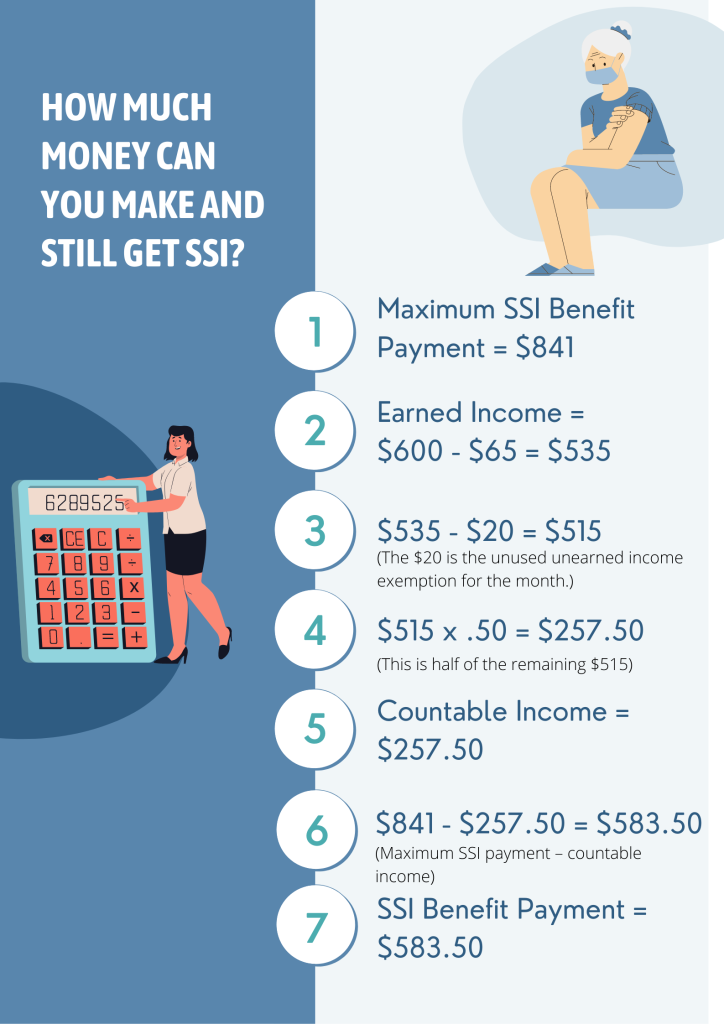
Income Limit: The SSA considers almost all types of income, earned and unearned, when determining eligibility. However, not all income counts equally. Certain amounts of earned income (money from work) are disregarded, encouraging recipients to work if they are able. For example, the first $65 of earned income per month, plus one-half of the remainder, is typically not counted. For unearned income (like pensions, interest, or other benefits), the first $20 per month is generally disregarded. The maximum countable income generally cannot exceed the Federal Benefit Rate (FBR), which is the maximum monthly SSI payment an individual can receive.
-
Resource Limit: Resources are assets you own that could be converted to cash and used for your support. This includes bank accounts, cash, stocks, bonds, and some real estate. For an individual, the resource limit is typically $2,000, and for a couple, it’s $3,000. Not all assets count towards this limit; for instance, your home (if you live in it), one vehicle, and essential household goods are usually exempt. It’s vital to meticulously document all assets during the application process to avoid misunderstandings or disqualification.
Disability or Age Criteria
Beyond financial need, applicants must meet specific non-financial criteria related to age, blindness, or disability.
-
Age: You must be 65 years or older.
-
Blindness: You must meet the SSA’s definition of statutory blindness. This means your vision cannot be better than 20/200 in your better eye with the use of a correcting lens, or your visual field must be 20 degrees or less.
-
Disability: For individuals under 65, you must meet the SSA’s strict definition of disability. This means you must have a medically determinable physical or mental impairment that is expected to last for a continuous period of not less than 12 months or result in death, and which prevents you from performing substantial gainful activity (SGA). The SSA uses a five-step sequential evaluation process to determine disability, considering medical evidence, functional limitations, and ability to work.
Citizenship and Residency Requirements
To be eligible for SSI, you must also be a U.S. citizen or national, or in certain cases, a lawfully admitted alien. Generally, non-citizens must meet specific conditions, such as being a qualified alien and meeting certain exceptions to the general bar on SSI for non-citizens. Furthermore, you must be a resident of one of the 50 states, the District of Columbia, or the Northern Mariana Islands.
Deciphering Your Potential SSI Benefit Amount
The core question remains: how much can you actually get? The amount of SSI you can receive is not a fixed sum for everyone. It’s a dynamic figure influenced by federal standards, state provisions, and individual circumstances.
The Federal Benefit Rate (FBR) Explained

The starting point for calculating your SSI benefit is the Federal Benefit Rate (FBR). This is the maximum federal SSI payment an eligible individual can receive. Congress sets the FBR, and it is usually adjusted annually based on the cost-of-living increase (COLA) that applies to Social Security benefits. For 2024, the FBR is $943 per month for an eligible individual and $1,415 per month for an eligible couple.
It’s crucial to understand that the FBR represents the maximum federal portion. Many recipients will receive less than the FBR due to countable income and various other reductions.
The Role of State Supplements
Many states recognize that the FBR alone may not be sufficient to meet the basic needs of their residents. Consequently, many states supplement the federal SSI payment with an additional amount, known as a State Supplementary Payment (SSP). The amount of these state supplements varies significantly from state to state, and some states do not provide a supplement at all.
These state supplements can be administered either by the SSA (federal administration) or directly by the state (state administration). If your state provides an SSP, your total SSI benefit will be the FBR plus the state’s supplement, minus any countable income. This is a significant factor, as a strong state supplement can substantially increase your overall monthly income.
Factors That Can Reduce Your Benefit
While the FBR and state supplements set the potential maximum, several factors can reduce your actual monthly SSI payment:
-
Countable Income: As discussed in eligibility, any countable income you have (earned or unearned) will reduce your SSI payment dollar for dollar after certain exclusions. Your SSI benefit is essentially the FBR (plus any state supplement) minus your countable income.
-
Living Arrangements: Your living situation can significantly impact your benefit. If you live in someone else’s household and do not pay your fair share of food and shelter costs, the SSA may apply an “in-kind support and maintenance” reduction. This often results in a one-third reduction of the FBR. Living in certain institutions (like hospitals or nursing homes where Medicaid pays for over 50% of the cost) can also lead to a reduced benefit, often to a minimal personal needs allowance.
-
Absence from the U.S.: If you leave the U.S. for 30 consecutive days or more, your SSI benefits will generally be suspended.
-
Failure to Report Changes: Not reporting changes in income, resources, living arrangements, or marital status promptly can lead to overpayments that must be repaid, or even temporary benefit suspension.
Maximizing Your Entitlement
To ensure you receive the maximum benefit you’re entitled to, it’s vital to:
-
Understand Countable Income Rules: Work with the SSA to understand exactly what income is counted and what is disregarded.
-
Report Changes Promptly: Always inform the SSA immediately about any changes in your financial situation, living arrangements, or marital status.
-
Explore State Supplements: Research if your state provides an SSP and how it is administered.
-
Seek Assistance: Don’t hesitate to consult with an SSA representative or a benefits counselor if you have complex questions.
Beyond the Monthly Check: Managing Life on SSI
Receiving SSI benefits is often just one component of a broader financial and support system. Understanding how SSI interacts with other programs and how to manage your finances effectively can significantly enhance your quality of life.
SSI and Other Government Benefits (Medicaid, SNAP)
One of the most valuable aspects of receiving SSI is that it often automatically qualifies you for other essential government assistance programs.
-
Medicaid: In most states, SSI recipients are automatically eligible for Medicaid, which provides comprehensive health insurance coverage. This is a crucial benefit, as healthcare costs can be prohibitive for individuals with disabilities or limited income.
-
SNAP (Supplemental Nutrition Assistance Program): Many SSI recipients also qualify for SNAP benefits (formerly known as food stamps), which help low-income individuals and families purchase nutritious food.
-
Housing Assistance: While not automatic, SSI recipients often meet the income requirements for various federal and state housing assistance programs, such as Section 8 housing vouchers.
These additional benefits can collectively provide a substantial boost to your overall financial stability and well-being, far exceeding the monetary value of the SSI check alone.
Work Incentives and Returning to Employment
The Social Security Administration has designed a range of “work incentives” to encourage SSI recipients to attempt to work without immediately losing their vital benefits. These programs aim to help individuals with disabilities transition towards greater financial independence.
-
Earned Income Exclusion: As mentioned, a significant portion of earned income is not counted towards your SSI payment, allowing you to earn more without losing all your benefits.
-
Blind Work Expenses (BWE): If you are blind, certain work-related expenses (even those not directly related to earning income) can be excluded from your countable income.
-
Impairment-Related Work Expenses (IRWE): For disabled individuals, the cost of certain items or services needed to work due to your impairment (e.g., attendant care, specialized transportation) can be deducted from your earned income.
-
Plan to Achieve Self-Support (PASS): A PASS allows you to set aside money and resources for a specific work goal (e.g., education, vocational training, starting a business) without those assets affecting your SSI eligibility or payment.
These work incentives are powerful tools that can allow you to test your ability to work, gain valuable experience, and increase your total income without fear of immediate benefit termination.
Financial Planning and Budgeting for SSI Recipients
Living on a limited income, even with SSI, requires careful financial management. Effective budgeting and financial planning are essential to make your benefits stretch as far as possible.
-
Create a Detailed Budget: Track all your income and expenses. Understand where every dollar goes and identify areas where you can cut back.
-
Emergency Fund: Even a small emergency fund can provide a buffer against unexpected costs. Consider setting aside a modest amount each month if possible.
-
Utilize Other Benefits: Make sure you are receiving all the additional benefits you are eligible for, such as Medicaid, SNAP, and energy assistance programs.
-
Avoid Debt: High-interest debt can quickly become unmanageable on a fixed income. Prioritize paying off existing debts and avoid taking on new ones if possible.
-
Seek Financial Counseling: Non-profit organizations often offer free or low-cost financial counseling services that can help you develop a personalized financial plan.
In conclusion, the question of “how much can you get from SSI?” is multifaceted. While the Federal Benefit Rate provides a baseline, your actual payment is a personalized figure shaped by your income, resources, living arrangements, and the state you reside in. SSI is a crucial program that provides a safety net, and by understanding its intricacies and leveraging associated benefits and work incentives, recipients can navigate their financial journey with greater clarity and stability.
aViewFromTheCave is a participant in the Amazon Services LLC Associates Program, an affiliate advertising program designed to provide a means for sites to earn advertising fees by advertising and linking to Amazon.com. Amazon, the Amazon logo, AmazonSupply, and the AmazonSupply logo are trademarks of Amazon.com, Inc. or its affiliates. As an Amazon Associate we earn affiliate commissions from qualifying purchases.