
Purchasing a vehicle is one of the most significant financial commitments the average consumer will make. When eyeing a car with a sticker price of $20,000, the immediate question is rarely about the total cost, but rather: “How much will this cost me every month?” In the world of personal finance, the monthly payment is the figure that dictates lifestyle and dictates whether a budget remains solvent or drifts into the red.
However, a $20,000 car does not result in a universal payment. The monthly obligation is a fluid number, sculpted by interest rates, loan durations, down payments, and the borrower’s underlying credit health. To truly understand the cost of a $20,000 vehicle, one must look past the sticker price and analyze the structural components of an auto loan.

The Mathematical Foundation: Interest, Terms, and Principal
The monthly payment on any installment loan is determined by three primary factors: the principal amount, the interest rate (APR), and the loan term. While $20,000 serves as our baseline principal, the “out-the-door” price often fluctuates due to taxes, registration fees, and dealer documentation charges.
The Role of the Annual Percentage Rate (APR)
The APR is perhaps the most critical variable in the financing equation. It represents the cost of borrowing money, expressed as a yearly percentage. For a $20,000 loan, a difference of just a few percentage points can result in thousands of dollars in extra interest over the life of the loan.
Interest rates are largely dictated by the Federal Reserve’s benchmark rates and the borrower’s credit score. In a high-rate environment, even borrowers with excellent credit may see APRs between 5% and 7%. For those with subprime credit, these rates can soar to 15% or even 20%. When calculating a payment, moving from a 5% APR to a 15% APR on a five-year $20,000 loan increases the monthly payment by approximately $100 and adds nearly $6,000 in total interest costs.
Loan Term Length: The Balancing Act
The term length is the duration over which the borrower agrees to repay the loan. Traditional terms have historically been 36, 48, or 60 months. However, as car prices have risen, 72-month and even 84-month loans have become commonplace.
While a longer term reduces the monthly payment—making a $20,000 car seem more affordable—it increases the total interest paid. Furthermore, long-term loans increase the risk of “negative equity,” a state where the borrower owes more on the car than it is worth. Because vehicles are depreciating assets, a 72-month loan often results in the borrower being “upside down” for several years, which can be a significant financial liability if the car needs to be sold or is totaled in an accident.
The Power of the Down Payment
The down payment is the most effective tool a buyer has to control their monthly payment. Every $1,000 put down typically reduces the monthly payment by roughly $15 to $20, depending on the interest rate. More importantly, a substantial down payment reduces the principal balance, which in turn reduces the total interest accrued over time. For a $20,000 car, a 20% down payment ($4,000) brings the financed amount to $16,000, significantly lowering the monthly financial burden and providing an immediate equity cushion.
Comparative Payment Tiers Based on Credit Profiles
To understand what a $20,000 car payment looks like in reality, we must examine different credit scenarios. Credit scores are the gatekeepers of interest rates, and they create a tiered reality for consumers.
The Prime Borrower (Score 720+)
A borrower with excellent credit is often eligible for the most competitive rates. If we assume a $20,000 loan with no down payment (excluding taxes and fees for simplicity) at a 5% APR:
-
48 Months: ~$461 per month
-
60 Months: ~$377 per month
-
72 Months: ~$322 per month
In this scenario, the prime borrower pays relatively little for the privilege of borrowing. Over a 60-month term, they will pay roughly $2,645 in total interest.
The Non-Prime Borrower (Score 620–680)
Borrowers in the middle tier may see interest rates in the 8% to 10% range. Using an 9% APR as a benchmark for a $20,000 loan:
-
48 Months: ~$498 per month
-
60 Months: ~$415 per month
-
72 Months: ~$361 per month
The monthly payment increases by about $38 compared to the prime borrower on a five-year term. However, the total interest paid jumps to approximately $4,900, nearly doubling the cost of borrowing compared to the prime tier.
The Subprime Borrower (Score Under 600)
Subprime lending is a high-cost environment. Rates of 16% or higher are not uncommon. At a 16% APR for a $20,000 loan:
-
48 Months: ~$567 per month
-
60 Months: ~$486 per month
-
72 Months: ~$434 per month
For the subprime borrower, the monthly payment on a 60-month loan is over $100 higher than the prime borrower’s payment. More shockingly, the total interest paid over five years exceeds $9,100. In this case, the $20,000 car actually costs nearly $30,000 by the time the final payment is made.
The Stealth Costs: Why Your Payment Is Only the Beginning
A mistake many car buyers make is equate the “loan payment” with the “cost of ownership.” When budgeting for a $20,000 vehicle, the monthly payment is merely the entry fee. To maintain financial health, one must account for the ancillary costs that accompany vehicle ownership.
Insurance Premiums
Financed vehicles require “full coverage” insurance, which includes collision and comprehensive insurance in addition to liability. Depending on the driver’s age, location, and driving record, insurance for a $20,000 car can range from $100 to $250 per month. This cost must be added to the loan payment to find the true monthly impact on a budget.
Maintenance and Repairs
Even a reliable $20,000 vehicle—which, in today’s market, is often a high-quality used car—will require maintenance. Tires, brakes, oil changes, and unexpected mechanical failures are inevitable. A prudent financial plan allocates at least $50 to $100 per month into a “sinking fund” for vehicle maintenance. Ignoring this reality often leads to high-interest credit card debt when a repair is suddenly required.
Fuel and Registration
Fuel costs are a volatile variable. Depending on the vehicle’s efficiency and the driver’s mileage, fuel can easily add $150 per month to the cost of operation. Furthermore, annual registration fees and property taxes (in certain states) can add several hundred dollars a year to the total cost, which should be pro-rated into a monthly budget.
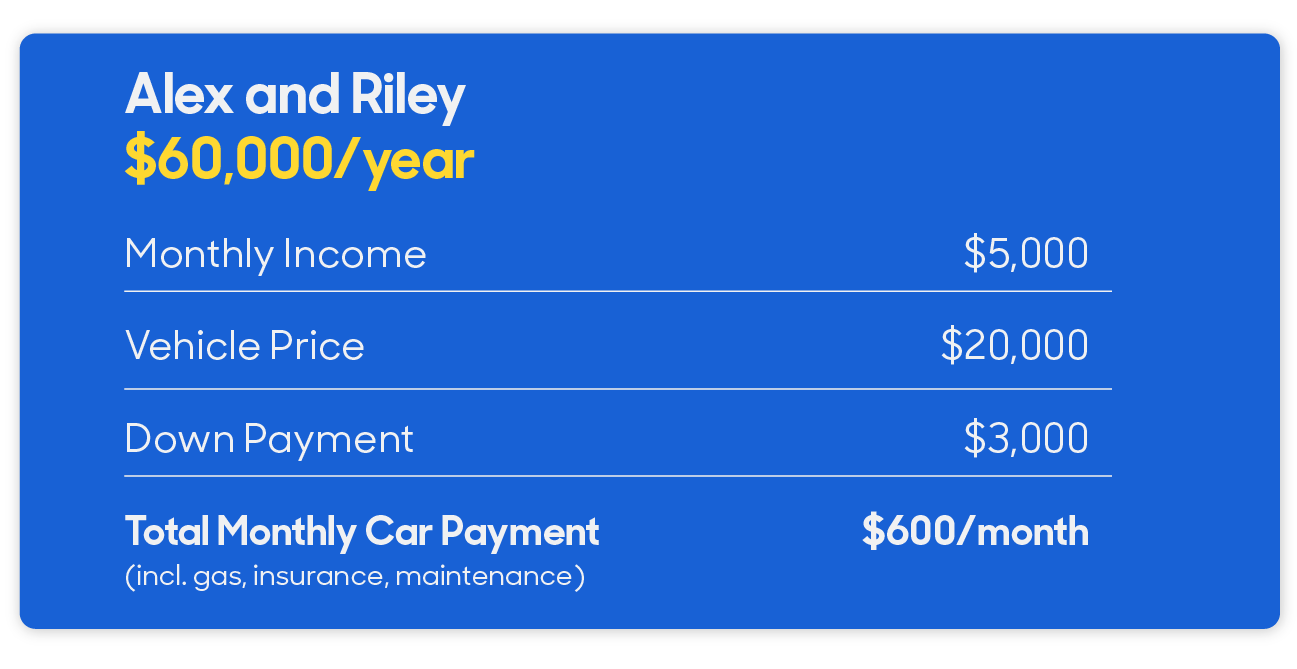
When all these factors are combined, a $400 loan payment on a $20,000 car can easily transform into a $750 or $800 total monthly operating cost. This is the figure that truly matters for personal cash flow management.
Strategic Financial Moves to Minimize Your Interest Expense
If you are planning to purchase a $20,000 car, there are several strategic moves you can make to ensure the loan does not become a financial burden.
Get Pre-Approved
Before stepping foot on a dealership lot, seek pre-approval from a credit union or a local bank. Dealerships often add “points” to the interest rate offered by lenders—a practice known as dealer reserve—to increase their profit. By walking in with a pre-approved rate of 6%, you prevent the dealer from “selling” you an 8% rate.
The 20/4/10 Rule
A classic rule of thumb in personal finance is the 20/4/10 rule:
-
Put at least 20% down.
-
Limit the loan term to no more than 4 years (48 months).
-
Keep the total cost of transportation (payment, insurance, fuel) under 10% of your gross monthly income.
Following this rule ensures that you stay ahead of the depreciation curve and that your car does not “crowd out” other financial goals, such as retirement savings or emergency fund contributions.
Consider the Impact of Refinancing
If you are forced to take a high-interest loan due to a poor credit score, you are not necessarily stuck with that rate for the life of the loan. After 6 to 12 months of on-time payments, your credit score may improve. At that point, you can look into refinancing the loan with a different lender at a lower APR. On a $20,000 loan, dropping your rate by 5% can save you significant money in the long run.

Factor in the “Out-the-Door” Price
Always negotiate the “out-the-door” price rather than the monthly payment. Shrewd salespeople often focus on the monthly payment because they can hide the true cost of the car by extending the loan term. If you tell a dealer you can afford $350 a month, they might sell you a $20,000 car on a 72-month loan at a high interest rate, when you could have afforded a much better deal. Focus on the price of the asset first, then the terms of the debt.
The monthly payment on a $20,000 car is a variable that is largely within the buyer’s control. By understanding the interplay between credit scores, interest rates, and loan terms, a consumer can transform a potentially predatory financial arrangement into a manageable, strategic investment in their mobility. Financing is a tool; when used with precision and an eye on the total cost of ownership, it allows for the acquisition of a necessary asset without compromising long-term financial stability.
aViewFromTheCave is a participant in the Amazon Services LLC Associates Program, an affiliate advertising program designed to provide a means for sites to earn advertising fees by advertising and linking to Amazon.com. Amazon, the Amazon logo, AmazonSupply, and the AmazonSupply logo are trademarks of Amazon.com, Inc. or its affiliates. As an Amazon Associate we earn affiliate commissions from qualifying purchases.