
Investing in a solar energy system is no longer just an environmental statement; it is one of the most sophisticated personal finance moves a homeowner or business owner can make in the 21st century. As utility rates continue to climb—often outpacing general inflation—transitioning to self-generated power represents a hedge against rising living costs. However, the most critical question in this financial transition isn’t just “should I go solar,” but rather “exactly how many watts of solar do I need to maximize my return on investment (ROI)?”
Sizing a system incorrectly is a costly mistake. Under-sizing your system leaves you vulnerable to the very utility hikes you are trying to avoid, while over-sizing can lead to a “diminishing returns” scenario where the excess energy produced is sold back to the grid at a fraction of its cost, extending your payback period. To find the financial “sweet spot,” you must treat your solar array as a capital asset and calculate its capacity based on rigorous data.
The Core Financial Metrics: Translating Wattage into ROI
To determine the wattage required, we must first distinguish between the power capacity of a system (measured in Watts) and the energy produced over time (measured in Kilowatt-hours, or kWh). From a financial perspective, you are purchasing a system in Watts to eliminate a liability measured in kWh.
Understanding the Conversion
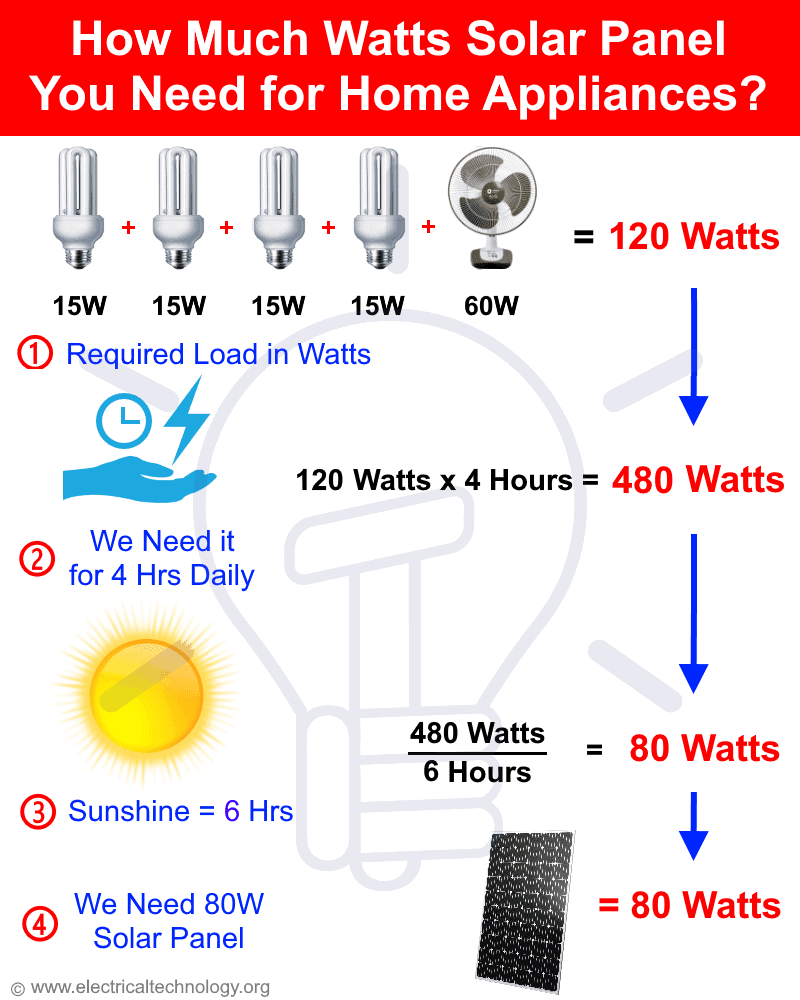
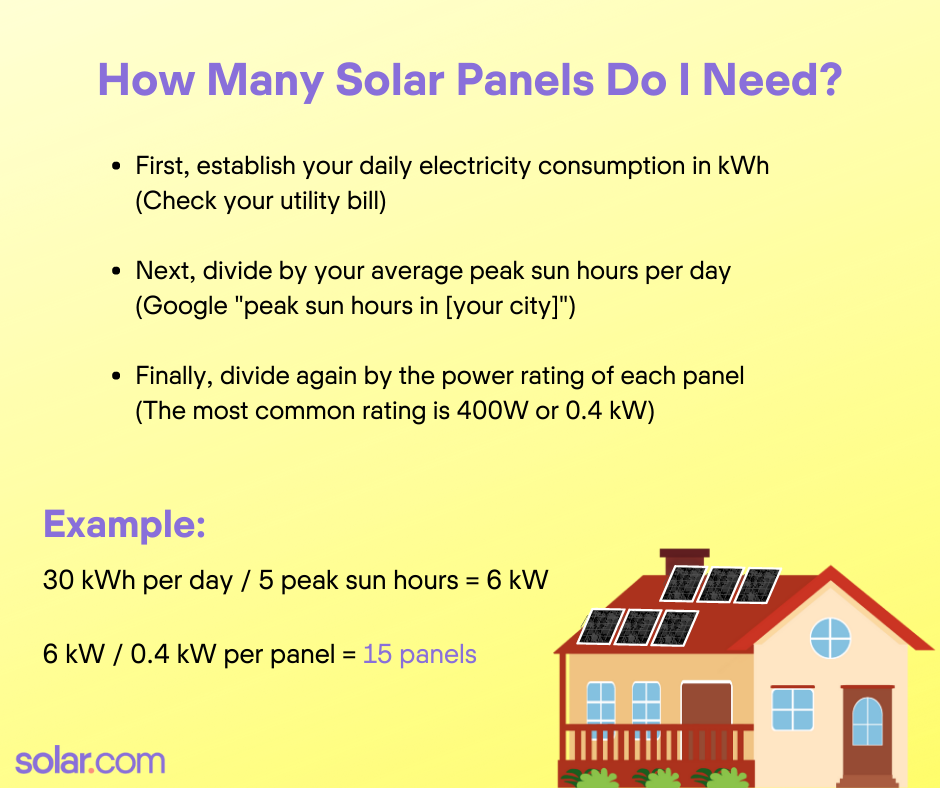
Most residential solar panels are rated between 350 and 450 watts. However, a 400-watt panel does not produce 400 watts 24 hours a day. Its output is contingent on “Peak Sun Hours”—a financial variable that differs by geography. For instance, a homeowner in Arizona will require significantly fewer total watts to achieve the same financial offset as a homeowner in Massachusetts.
The basic formula for your financial audit is:
Total Annual kWh Usage / (Peak Sun Hours × 365) = System Size in kW.
The Impact of Local Utility Rates
The financial viability of your system’s wattage depends heavily on your local utility’s rate structure. If your utility employs “Time-of-Use” (TOU) pricing, the value of the watts you produce in the afternoon is higher than those produced in the morning. When calculating your needs, you aren’t just looking to cover total usage; you are looking to cover your most expensive usage. This may shift your strategy from a simple wattage target to a more complex layout involving western-facing panels to capture high-value afternoon sun, even if the total wattage output is slightly lower than a south-facing array.
Calculating Your Load: The Foundation of Your Energy Investment
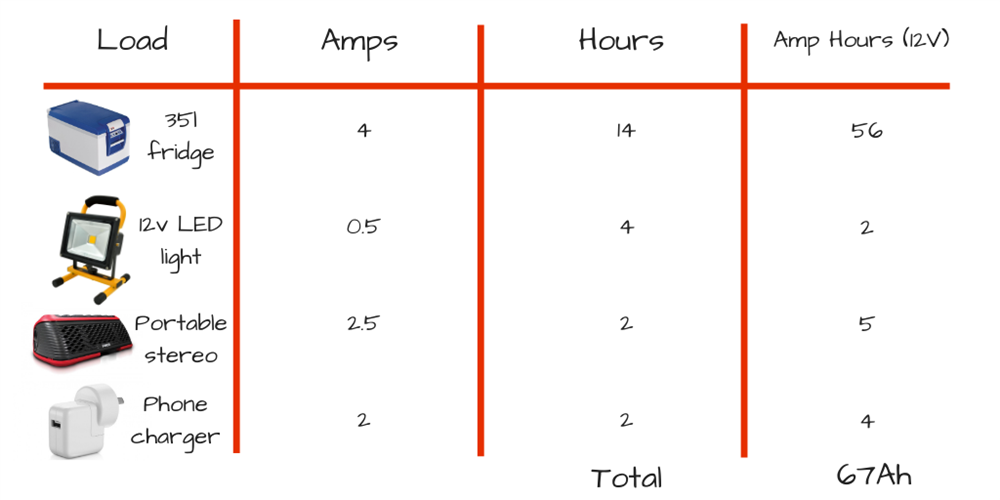
Before committing capital to hardware, you must perform a deep dive into your historical energy consumption. This is the “due diligence” phase of your investment.
Analyzing Historical Utility Bills
A single month’s bill is insufficient for financial planning. Seasonal fluctuations in HVAC usage can cause energy consumption to swing by 300% or more between spring and summer. To find your ideal wattage, aggregate twelve months of utility statements to find your total annual kWh consumption.
A typical American home consumes approximately 10,600 kWh per year. To offset this entirely in a region with 4.5 peak sun hours per day, a homeowner would need roughly an 8,000-watt (8 kW) system. However, the goal of a financial strategy is not always 100% offset.
The Role of Efficiency and Derate Factors
In a financial model, we must account for “derate factors”—system losses due to inverter inefficiency, wiring resistance, and soiling. Professionals typically apply a 0.77 to 0.85 efficiency factor. When calculating how many watts you need, you should always over-size your theoretical need by roughly 20% to ensure that your real-world financial savings match your projections. If your math suggests you need 7,000 watts to cover your bill, purchasing an 8,400-watt system is often the more sound financial move to ensure the “net-zero” goal is actually met.
Offsetting 100% vs. Partial Coverage: A Cost-Benefit Analysis
In some jurisdictions, the utility will not pay you for excess generation, or they will pay you a “wholesale” rate that is significantly lower than the “retail” rate you pay them. In these scenarios, sizing a system to 110% of your needs is a poor investment. Instead, sizing for 80% to 90% of your needs ensures that every single watt produced is “worth” the full retail price of electricity, thereby accelerating your payback period and increasing your Internal Rate of Return (IRR).
Strategic Sizing to Maximize Tax Credits and Incentives
The “cost” of the watts you install is significantly mitigated by government intervention. Understanding the interaction between system size and tax policy is essential for personal finance optimization.
The Federal Solar Investment Tax Credit (ITC)
Under current U.S. law, the Residential Clean Energy Credit allows taxpayers to deduct 30% of the cost of a solar system from their federal income taxes. This is a dollar-for-dollar credit, not a deduction. This incentive changes the math on system sizing: because the government is effectively subsidizing 30% of every watt you add, it often makes financial sense to “bulk up” the system size now rather than adding panels later, which would incur secondary labor and permitting costs.
Net Metering Policies and Their Influence on System Scale
Net Energy Metering (NEM) is the financial engine of solar. It allows you to “store” the value of your excess daytime wattage on the grid and pull it back at night for free. However, many states are transitioning to NEM 3.0 or similar structures that reduce the value of exported energy.
If you live in an area with unfavorable net metering, the “how many watts” question changes. Instead of a massive roof-mounted array, your best financial move might be a smaller wattage array paired with a battery storage system. This allows you to engage in “load shifting”—storing your own watts to avoid buying expensive energy during peak evening hours, rather than selling watts back to the grid for pennies.
SREC Markets and Passive Income Generation
In certain states (like New Jersey, Pennsylvania, or Maryland), every 1,000 kWh your system produces generates a Solar Renewable Energy Certificate (SREC). These can be sold on an open market, providing a stream of passive income. If you live in a high-value SREC market, over-sizing your system wattage becomes a proactive business strategy. You aren’t just saving money on your bill; you are building a small-scale power plant that generates a monthly commodity for sale.
Long-Term Financial Projections: The Cost of Under-Sizing vs. Over-Sizing
The lifespan of a modern solar system is 25 to 30 years. When deciding how many watts to install, you must look at your financial life three decades into the future.
The Diminishing Returns of Excess Wattage
There is a point where adding more panels does not make sense. If your roof is already covered and you begin looking at expensive ground-mount solutions or clearing trees, the “soft costs” of those additional watts can skyrocket. A smart investor monitors the “Levelized Cost of Energy” (LCOE). If the cost of the next 1,000 watts exceeds the projected cost of buying that same energy from the grid over 20 years, you have reached the limit of your investment’s efficiency.
Future-Proofing: EVs and Heat Pumps
Your current energy bill reflects your past behavior, but a solar investment should reflect your future. If you plan to trade a combustion-engine vehicle for an Electric Vehicle (EV) in the next three years, your energy needs will spike. A typical EV requires about 3,000 to 4,000 kWh per year for average driving.
Financially, it is much cheaper to include those extra 3,000 watts in your initial installation than to call a contractor back three years later. Adding capacity to an existing system involves new permits, new CAD drawings, and another round of labor fees, which can cost 50% more per watt than if those panels had been included in the original build.
Impact on Property Value and Resale Premium
Studies from the Lawrence Berkeley National Laboratory have shown that solar panels increase a home’s value by an average of $4 per watt installed. An 8,000-watt system could potentially add $32,000 to your home’s resale value. Unlike other home renovations, solar is one of the few that provides a measurable, functional increase in the underlying asset’s value while simultaneously providing a monthly cash-flow benefit.
When determining your wattage, consider your exit strategy. If you plan to sell the home in five years, sizing the system to completely eliminate the electric bill makes the property significantly more attractive to buyers who are increasingly wary of high utility costs.
Conclusion: The Final Calculation
Determining how many watts of solar you need is ultimately a balance of three factors: your historical consumption, your future lifestyle changes, and the regulatory environment of your local utility. By approaching this as a financial exercise rather than a purely technical one, you can ensure that your capital is deployed effectively.
To find your number, start with your annual kWh usage, adjust for a 20% efficiency loss, factor in upcoming loads like EVs, and then cross-reference that total against your local net metering policies. Whether the answer is 5,000 watts or 15,000 watts, the goal remains the same: transforming a variable monthly expense into a fixed, depreciating asset that yields a tax-free return for decades to come. Solar is not just about power; it is about the power of smart capital allocation.
aViewFromTheCave is a participant in the Amazon Services LLC Associates Program, an affiliate advertising program designed to provide a means for sites to earn advertising fees by advertising and linking to Amazon.com. Amazon, the Amazon logo, AmazonSupply, and the AmazonSupply logo are trademarks of Amazon.com, Inc. or its affiliates. As an Amazon Associate we earn affiliate commissions from qualifying purchases.