
Tesla, Inc. (TSLA) has become one of the most talked-about and dynamic stocks of the 21st century. Its journey from a niche electric vehicle manufacturer to a global behemoth in clean energy, AI, and autonomous technology has captivated investors worldwide. Accompanying its meteoric rise in market valuation, Tesla’s stock has undergone several strategic adjustments designed to make its shares more accessible and appealing to a broader range of investors: stock splits. For many, understanding these corporate actions is crucial for grasping the stock’s historical performance and its future trajectory within an investment portfolio. This article will delve into Tesla’s stock split history, explain the mechanics behind such decisions, and offer insights into their implications for investors, all strictly from a financial perspective.
Understanding Stock Splits: The Mechanics and Rationale
A stock split is a corporate action in which a company divides its existing shares into multiple new shares. While this might sound like a significant change, it’s essentially a cosmetic adjustment that does not alter the fundamental value or market capitalization of the company. It’s akin to exchanging a ten-dollar bill for two five-dollar bills; you still have the same total value, just in smaller denominations.
What is a Stock Split?
When a company announces a stock split, it specifies a ratio. For instance, a 2-for-1 split means that for every one share an investor owns, they will now own two shares, and the price per share will be halved. If a stock was trading at $100 per share, after a 2-for-1 split, an investor who held 10 shares worth $1,000 would now hold 20 shares, each priced at $50, with their total investment value remaining $1,000. The total number of outstanding shares increases, and the price per share decreases proportionally. This process is purely an accounting adjustment that affects the number of shares and their nominal price, but not the company’s enterprise value or an investor’s total equity stake.
Why Do Companies Split Their Stock?
Companies typically execute stock splits for several strategic reasons, primarily aimed at increasing the stock’s liquidity and making it more attractive to a wider pool of investors:
- Increased Accessibility: When a stock’s price rises significantly, it can become prohibitively expensive for individual retail investors to purchase a meaningful number of shares, or even a single share in some cases. A stock split brings the share price down to a more “comfortable” range, making it more accessible and affordable for smaller investors. This lower entry point can democratize ownership and broaden the shareholder base.
- Enhanced Liquidity: A lower share price often leads to increased trading volume. More shares outstanding at a lower price means more opportunities for buying and selling, which generally translates to greater liquidity in the market. Higher liquidity can make it easier for investors to enter and exit positions without significantly impacting the stock’s price, benefiting both buyers and sellers.
- Psychological Appeal: There’s a widely acknowledged psychological effect where investors perceive a lower-priced stock as “cheaper” and therefore more appealing, even if the underlying company’s valuation remains the same. This perception can generate renewed interest and buying pressure, sometimes leading to short-term price appreciation following a split announcement.
- Inclusion in Indices: For some indices, a very high share price might make it difficult to maintain appropriate weighting, or it could prevent a company from being included in certain price-weighted indices. While less common in modern market-cap-weighted indices, it can be a consideration.
The Impact on Shareholder Value
It is critical for investors to understand that a stock split, by itself, does not create or destroy shareholder value. The underlying fundamentals of the company – its earnings, assets, liabilities, and future prospects – remain unchanged. Your percentage ownership of the company also stays the same. For example, if you owned 0.0001% of a company before a 5-for-1 split, you would still own 0.0001% after the split, just represented by five times as many shares, each worth one-fifth of its original price. Any market reaction to a stock split is usually due to the positive sentiment it generates, signaling confidence from management and anticipation of increased investor interest, rather than any change in intrinsic value.
Tesla’s Stock Split History: A Timeline of Key Events
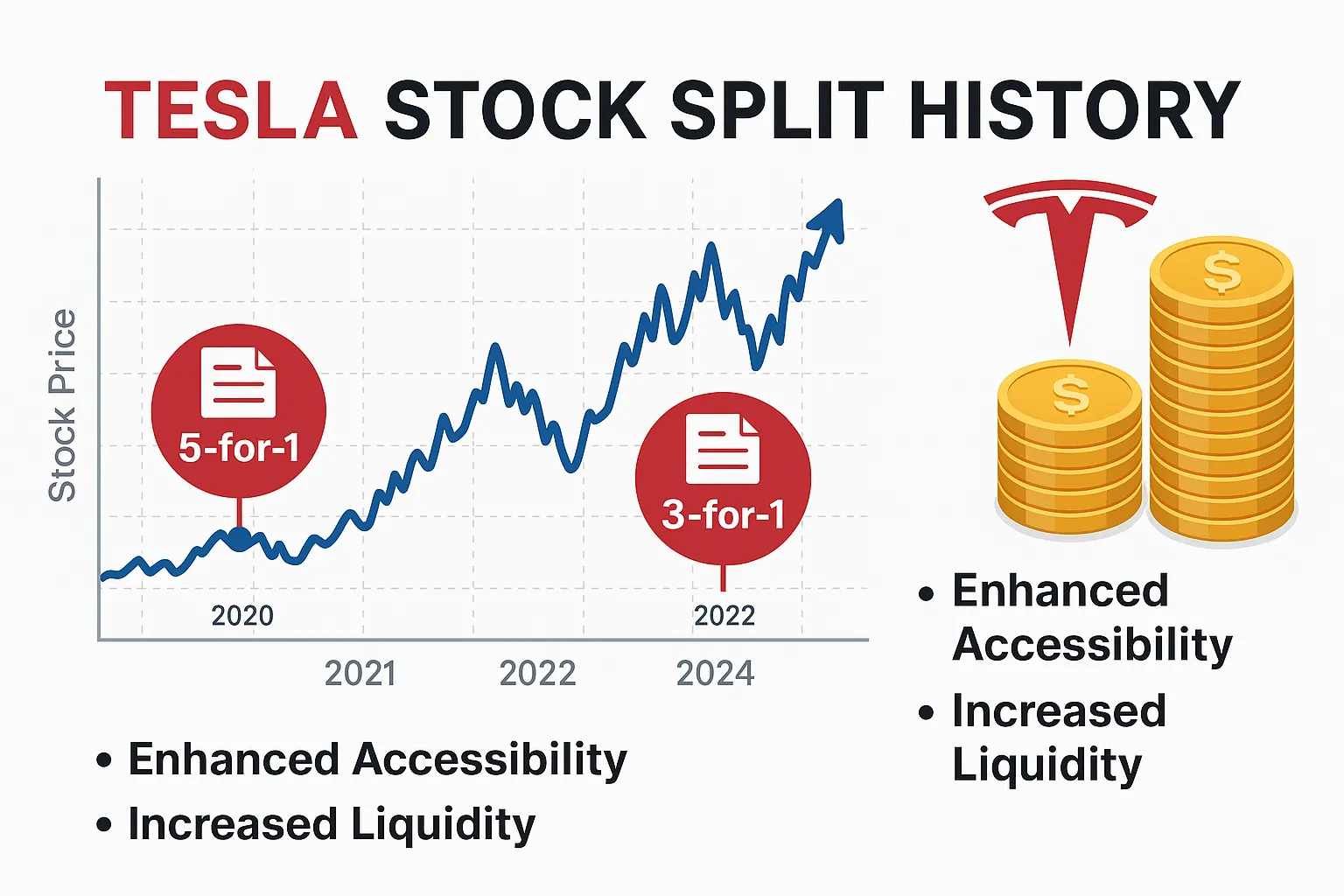
Tesla has undertaken two significant stock splits in its history, both occurring during periods of substantial growth and investor excitement. These splits were pivotal moments that reflected the company’s success and strategic intent to broaden its appeal.
The First Split: August 2020 (5-for-1 Split)
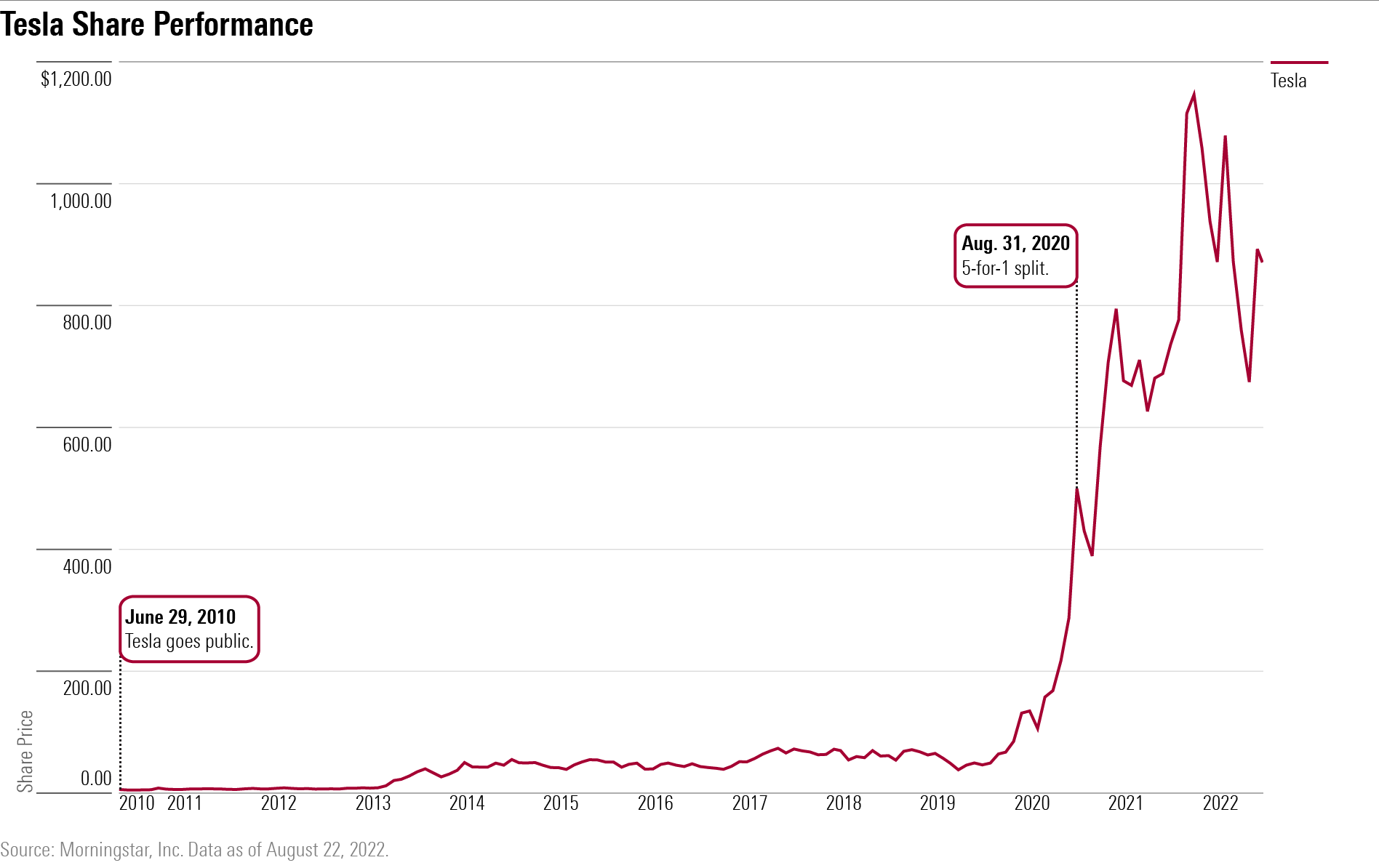
Tesla executed its first stock split on August 31, 2020. This was a 5-for-1 forward stock split, meaning that for every share of TSLA stock an investor owned, they received four additional shares, totaling five shares. The stock price was simultaneously adjusted to one-fifth of its pre-split value.
Leading up to this split, Tesla’s stock had experienced an extraordinary surge. From its IPO price of $17 in 2010, the stock had climbed past $1,300 (pre-split) by mid-2020, becoming one of the most expensive individual stocks on major U.S. exchanges. The decision to split was announced on August 11, 2020, and was widely seen as a move to make the stock more affordable for individual investors and potentially facilitate its inclusion in the S&P 500 index, which indeed happened later that year. The market reacted positively to the news, with the stock seeing a significant run-up between the announcement and the split date, indicative of the strong retail investor interest in TSLA.
The Second Split: August 2022 (3-for-1 Split)
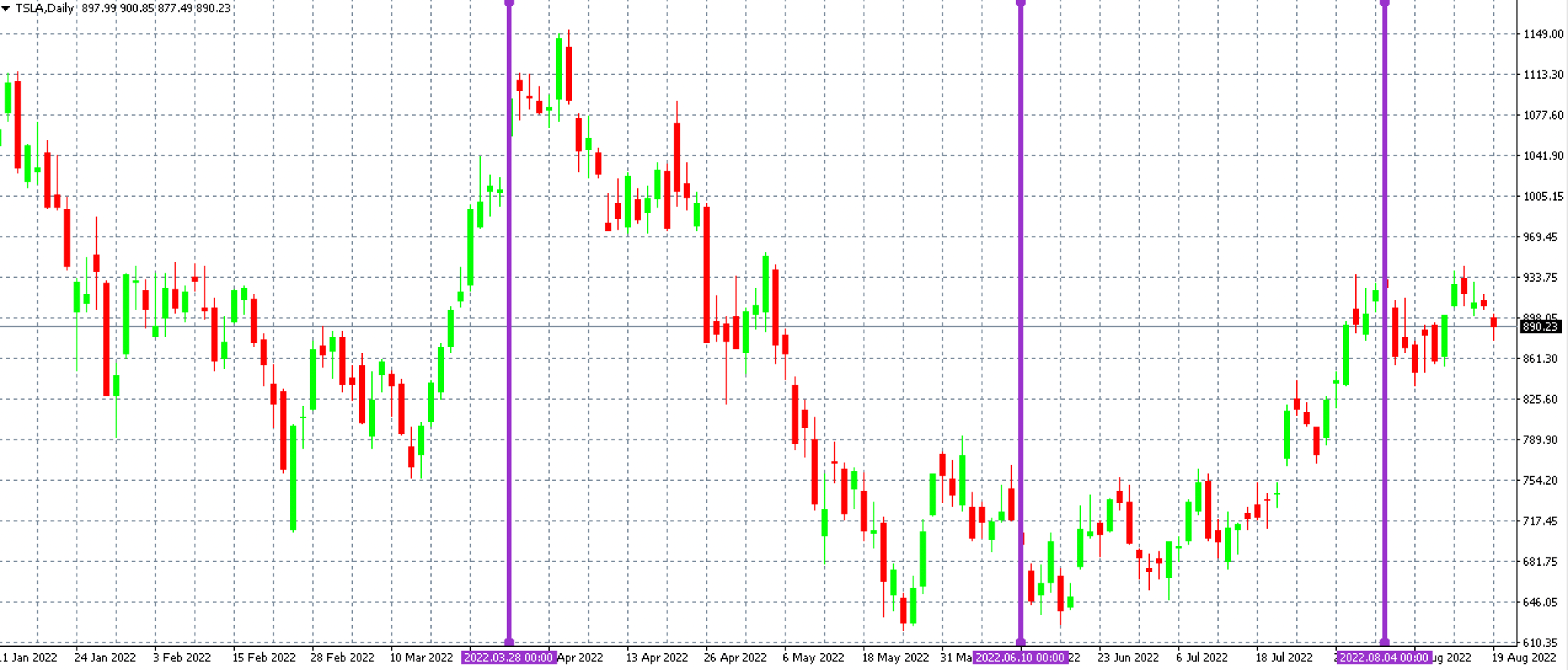
Two years after its first split, Tesla announced its second stock split, a 3-for-1 forward split, which took effect on August 25, 2022. Similar to the first, this action meant that each existing share was replaced with three shares, with the price per share being reduced to one-third of its pre-split value.
By mid-2022, Tesla’s stock had again reached a high trading range, following continued strong performance in vehicle deliveries, expansion of its manufacturing capabilities, and burgeoning interest in its ancillary businesses like energy storage and AI. The company stated its intention to “make stock ownership more accessible to employees and investors,” echoing the rationale behind its first split. This split, like its predecessor, was met with a generally favorable market response, reflecting persistent demand and optimism surrounding Tesla’s future growth prospects. It allowed for a renewed wave of retail investor participation and continued to cement Tesla’s status as a favored stock among a broad demographic of investors.
Analyzing the Pre-Split and Post-Split Performance
In both instances, the periods leading up to Tesla’s stock split announcements were characterized by robust stock performance. This trend suggests that management often chooses to split stock when the company is performing well and its share price has appreciated significantly. The anticipation of a split itself often generates positive sentiment, leading to further price increases between the announcement date and the effective date.
Post-split, while the initial trading days might see some volatility, the underlying growth narrative and fundamental strength of Tesla have historically driven the stock’s long-term performance. The splits successfully lowered the per-share price, enhancing liquidity and retail accessibility. This strategy has played a role in maintaining strong investor engagement and potentially contributing to its continued upward trajectory, even through broader market fluctuations. It’s important to differentiate between the purely cosmetic adjustment of the split and the genuine growth drivers that underpin Tesla’s valuation.
Beyond the Split: What Drives Tesla’s Valuation?
While stock splits are interesting financial events, they are merely indicators of a company’s success, not the cause of it. Tesla’s valuation and its appeal to investors are driven by a complex interplay of innovation, market dynamics, financial performance, and powerful brand identity. Understanding these deeper drivers is essential for any investor considering TSLA.
Innovation and Market Dominance
Tesla’s core strength lies in its relentless pursuit of innovation and its pioneering role in the electric vehicle (EV) market. It was not merely an early entrant but a disruptor that forced traditional automakers to accelerate their EV strategies. Key innovations include:
- Battery Technology: Tesla’s advancements in battery design, production, and energy density have been critical to its range and performance advantages.
- Software and AI: Its lead in autonomous driving technology (Full Self-Driving, FSD), in-car infotainment, and over-the-air software updates provides a significant competitive edge, turning vehicles into continuously improving software platforms.
- Gigafactories and Manufacturing: Tesla’s focus on innovative manufacturing processes, particularly through its Gigafactories, aims to reduce costs and increase production scale more efficiently than competitors.
- Energy Storage and Solar: Beyond vehicles, Tesla’s Powerwall, Megapack, and solar energy solutions position it as a comprehensive clean energy company, diversifying its revenue streams and market opportunities.
These technological leadership aspects, coupled with a dominant market share in premium EVs, are fundamental to Tesla’s high valuation.
Financial Performance and Growth Prospects
Robust financial performance and compelling growth prospects are paramount for any company with a high valuation, and Tesla is no exception. Investors scrutinize:
- Revenue Growth: Tesla has consistently demonstrated impressive revenue growth rates driven by increasing vehicle deliveries and expansion into new markets and product lines.
- Profitability: The company has transitioned from being primarily a growth story to showing consistent profitability, with improving margins from vehicle sales and increasing contributions from its software and energy divisions.
- Cash Flow: Strong free cash flow generation is a critical indicator of a company’s financial health and its ability to fund future investments without relying excessively on external financing.
- Future Projections: Tesla’s ambitious targets for production expansion, new vehicle models (like Cybertruck or a more affordable EV), and further development of FSD and AI capabilities paint a picture of significant future growth potential, justifying its premium valuation in the eyes of many investors.
Brand Strength and Investor Sentiment
Tesla possesses an exceptionally strong brand, largely intertwined with the charismatic and often controversial persona of its CEO, Elon Musk. This brand strength translates into:
- Customer Loyalty: Tesla owners often exhibit strong brand loyalty and advocacy.
- Market Hype and Media Attention: The company consistently generates significant media attention, keeping it in the public eye and driving investor interest.
- Retail Investor Enthusiasm: Tesla has cultivated a massive base of enthusiastic retail investors who often hold the stock due to a belief in its mission and future potential, beyond traditional financial metrics. This strong retail support can contribute to price stability and upward momentum.
The combination of a powerful brand narrative, innovative products, and future-looking vision fosters a unique investor sentiment that often distinguishes Tesla from its peers.
Implications for Investors: Strategy and Perspective
For investors, understanding stock splits and the underlying drivers of Tesla’s valuation is crucial for informed decision-making. Stock splits, while exciting, should not be the sole reason to invest or divest.
The Illusion of “Cheaper” Stock
The most important takeaway for investors regarding stock splits is to recognize that a lower share price post-split does not equate to a “cheaper” stock in terms of valuation. The company’s total market capitalization remains the same. An investor purchasing 10 shares at $100 before a 2-for-1 split is in the exact same financial position as an investor purchasing 20 shares at $50 after the split. The perceived “affordability” might make it easier to buy a whole number of shares, but it does not change the fundamental value or the investment’s risk profile. Investors should always focus on the company’s fundamentals, growth prospects, and valuation metrics (like P/E ratios, revenue multiples) relative to its peers and historical averages, rather than just the nominal share price.
Long-Term vs. Short-Term Trading
For long-term investors, stock splits are typically non-events in terms of their investment strategy. They simply represent an adjustment to the share count and price in their brokerage accounts. The long-term thesis for investing in Tesla, if one exists, should be based on its technological leadership, market position, financial performance, and future potential, not on the temporary excitement surrounding a split.
Short-term traders, however, might attempt to capitalize on the “split rally” – the tendency for a stock to appreciate between the announcement and the effective date of a split due to increased speculative interest. While this can be a real phenomenon, it is inherently risky and requires careful timing and market analysis. It’s not a reliable strategy for consistent returns and can lead to losses if market sentiment shifts.
Diversification and Risk Management
Investing in high-growth, high-volatility stocks like Tesla, regardless of stock splits, carries inherent risks. While Tesla has delivered exceptional returns for many, its stock price can be subject to significant fluctuations based on company news, technological breakthroughs, competitive pressures, regulatory changes, and broader market sentiment.
For any investor, especially those drawn to dynamic stocks like TSLA, it is prudent to:
- Conduct Thorough Due Diligence: Understand the business, its competitive landscape, and financial health.
- Diversify Your Portfolio: Avoid putting all your capital into a single stock, no matter how promising it seems. Diversification across different asset classes, industries, and geographies helps mitigate risk.
- Invest with a Long-Term Horizon: Attempting to time the market, especially with volatile stocks, is exceedingly difficult. A long-term perspective allows investments to ride out short-term fluctuations and benefit from compounding growth.
- Understand Your Risk Tolerance: Only invest capital that you are comfortable potentially losing, especially in higher-risk assets.
In conclusion, Tesla has executed two stock splits in its history – a 5-for-1 split in August 2020 and a 3-for-1 split in August 2022. These actions were strategic moves to make the stock more accessible and liquid for a broader base of investors. While fascinating financial events, stock splits are ultimately cosmetic adjustments that do not alter the intrinsic value of the company or an investor’s total holding. For investors, the focus should always remain on the fundamental drivers of Tesla’s business – its innovation, financial performance, and market leadership – rather than the mechanics of its share structure. A sound investment strategy will always prioritize thorough research, diversification, and a long-term perspective.
aViewFromTheCave is a participant in the Amazon Services LLC Associates Program, an affiliate advertising program designed to provide a means for sites to earn advertising fees by advertising and linking to Amazon.com. Amazon, the Amazon logo, AmazonSupply, and the AmazonSupply logo are trademarks of Amazon.com, Inc. or its affiliates. As an Amazon Associate we earn affiliate commissions from qualifying purchases.