
Amazon.com, Inc. (AMZN) stands as a titan in the global economy, a company whose journey from an online bookseller to a diversified technology and e-commerce behemoth has captivated investors worldwide. For anyone tracking its remarkable ascent, understanding the mechanics of its stock, particularly its history of stock splits, is crucial. A stock split, while seemingly a simple administrative adjustment, can profoundly influence investor perception, market accessibility, and the psychological dynamics of stock ownership. In the case of Amazon, its infrequent yet impactful splits offer a fascinating case study in corporate finance and investor relations.
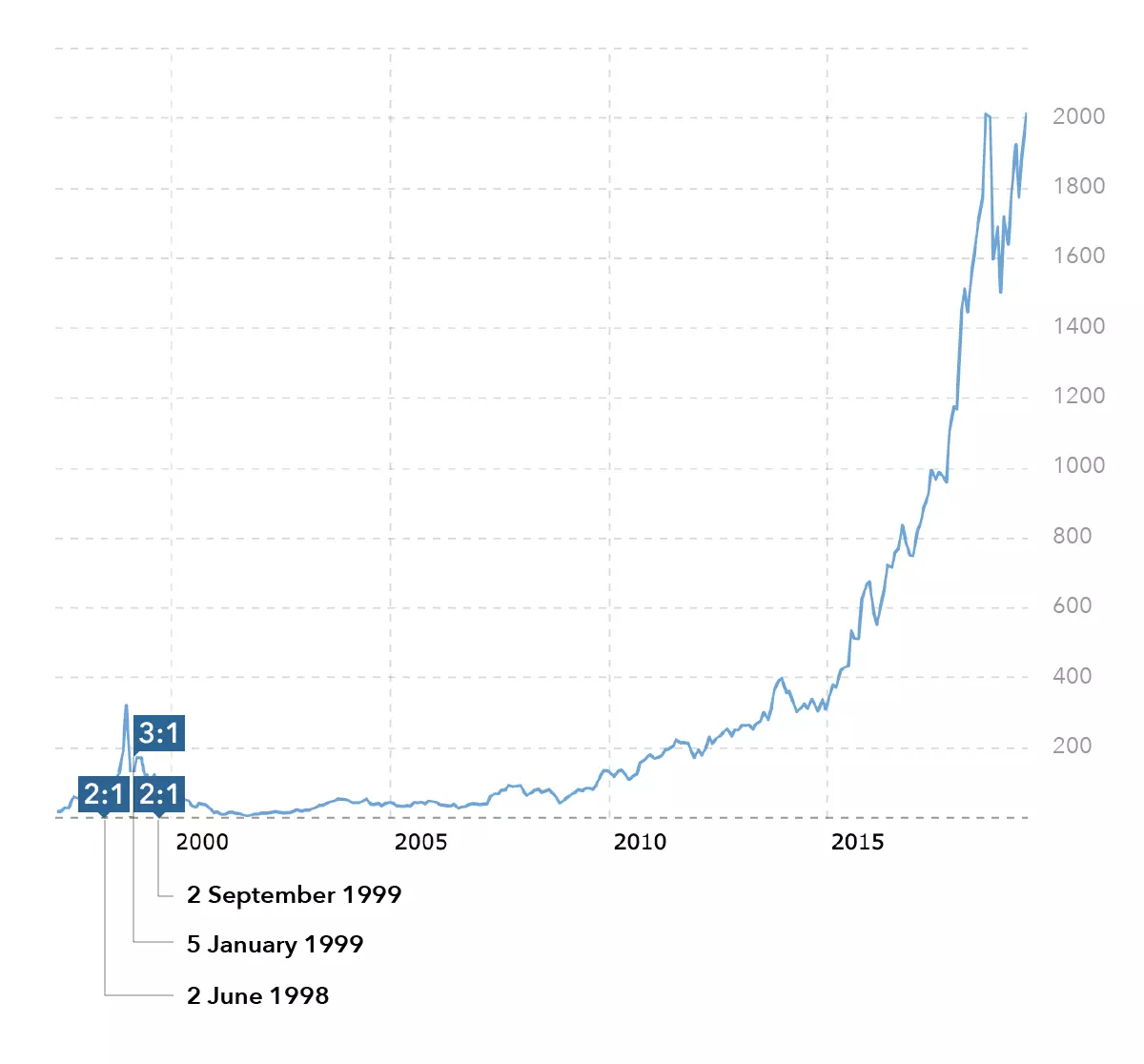
Amazon has conducted a stock split four times in its history: three times in its early years during the dot-com boom, and once much more recently, in 2022, following a prolonged period of extraordinary growth. These events reflect different eras of the company’s development and distinct strategic considerations regarding its share price and market presence.
Understanding the Amazon Stock Journey: A Historical Perspective
Amazon’s trajectory has been nothing short of extraordinary, marked by relentless innovation, aggressive expansion, and a steadfast focus on customer experience. This relentless growth has, understandably, translated into a stock performance that has handsomely rewarded long-term shareholders.
Amazon’s Meteoric Rise and Early Public Offerings
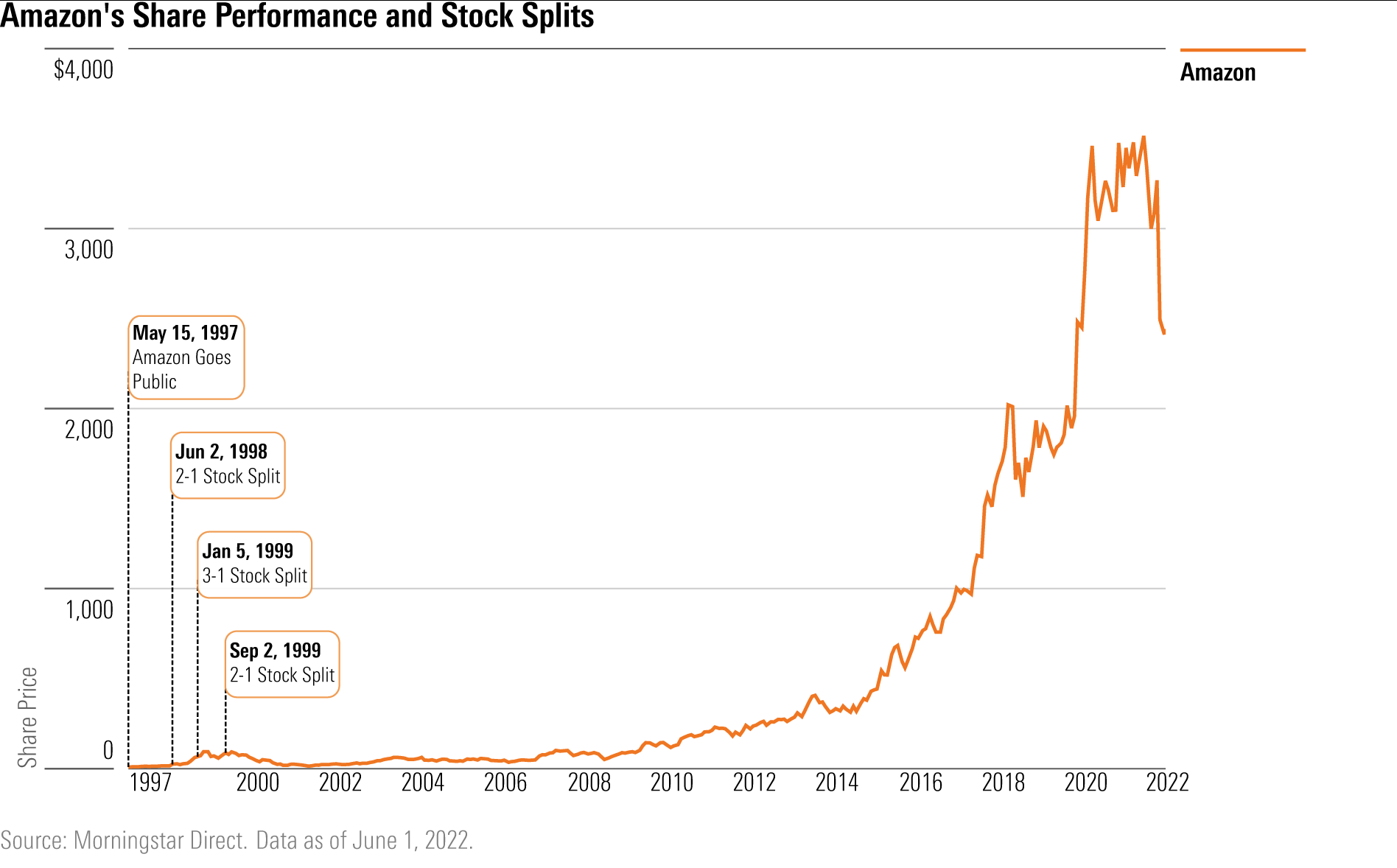
Founded by Jeff Bezos in 1994, Amazon started as an online bookstore operating out of a garage. Its initial public offering (IPO) occurred on May 15, 1997, at a price of $18.00 per share. From these humble beginnings, Amazon rapidly expanded its product offerings, moving into music, videos, electronics, and beyond, quickly becoming a symbol of the burgeoning e-commerce revolution. Early investors who held onto their shares witnessed an unparalleled appreciation in value, a testament to Amazon’s visionary leadership and its ability to consistently disrupt industries. This incredible growth meant that by the late 1990s, the nominal share price had become quite high, setting the stage for the company’s initial stock splits.
The Rationale Behind Stock Splits
Before delving into Amazon’s specific split history, it’s essential to grasp the fundamental concept of a stock split and why companies undertake such actions. A stock split is a corporate action in which a company increases the number of its outstanding shares by dividing each existing share into multiple shares. For example, in a 2-for-1 split, each shareholder receives two shares for every one share they previously owned. Crucially, the total market capitalization of the company remains unchanged. It’s akin to taking a pizza and cutting it into more slices; while you have more slices, the total amount of pizza remains the same.
Companies typically split their stock for several key reasons:
-
Increased Accessibility and Liquidity: A high share price can deter smaller retail investors who might find it difficult to purchase even a single share. By lowering the per-share price, a split makes the stock more affordable and accessible, potentially broadening the investor base. This increased accessibility often leads to higher trading volumes, or liquidity, which can make it easier for investors to buy and sell shares.
-
Psychological Effect: A “cheaper” per-share price can create a psychological perception of affordability, making the stock appear more attractive to new investors, even though the company’s underlying value hasn’t changed.
-
Optimal Trading Range: Companies often aim to keep their stock price within a certain range that they believe is optimal for trading activity. If the price climbs too high, it might signal an appropriate time for a split.
-
Employee Compensation: For companies that issue stock options or grants to employees, a lower share price can make these compensation packages more manageable and appealing, especially for junior employees.
A Detailed Look at Amazon’s Stock Split History
Amazon’s history of stock splits is divided into two distinct periods: the late 1990s dot-com fervor and the post-pandemic retail investing surge.
The Early Splits: Making Shares Accessible in the Dot-Com Era (1998-1999)
Amazon conducted its first three stock splits in rapid succession during the height of the dot-com boom, a period characterized by explosive growth in technology stocks and high investor enthusiasm.
-
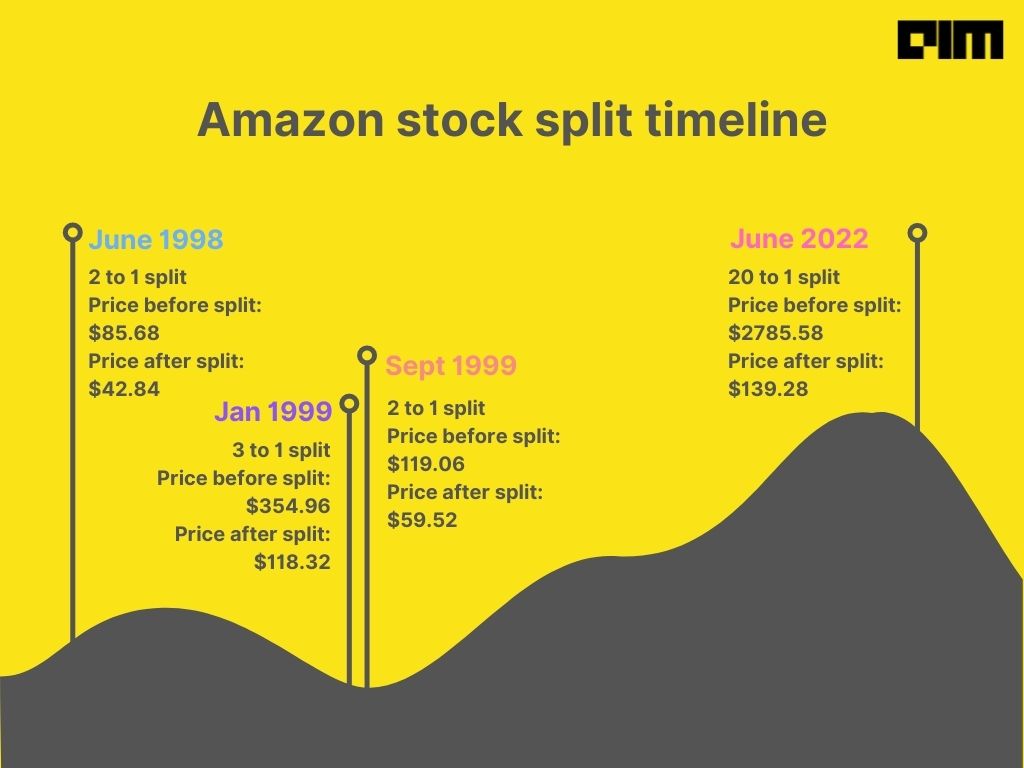
June 2, 1998 (2-for-1 split): Just over a year after its IPO, Amazon executed its first 2-for-1 stock split. At this point, the stock had already soared considerably from its initial offering price. This split doubled the number of outstanding shares and halved the price per share.
-
January 5, 1999 (3-for-1 split): Less than seven months later, Amazon implemented a 3-for-1 split. This more aggressive split further significantly reduced the per-share price, making it even more accessible as the company continued its rapid expansion.
-
September 1, 1999 (2-for-1 split): The company followed up with another 2-for-1 split just eight months after the previous one. This third split within a 15-month period underscored the phenomenal growth Amazon was experiencing and its management’s desire to keep the share price in an accessible range for a broad base of investors during a time of intense market speculation in tech companies.
These early splits collectively transformed a single original share purchased at $18.00 into 12 shares (1 share * 2 * 3 * 2 = 12 shares). For an investor holding 100 shares pre-splits, they would have ended up with 1,200 shares.
The Long Hiatus: Two Decades Without a Split
Following the three splits in the late 1990s, Amazon entered a remarkably long period—over 22 years—without another stock split. During this time, Amazon’s stock price surged from around $76 per share (post-1999 splits) to over $3,000 per share before its next split.
Several factors likely contributed to this prolonged hiatus:
-
Focus on Long-Term Investors: Jeff Bezos, Amazon’s founder and CEO for most of this period, often emphasized long-term thinking and attracting investors who shared that philosophy. A high share price naturally tends to attract more serious, long-term institutional investors rather than short-term speculators.
-
Institutional Investor Dominance: For a significant portion of this period, institutional investors (pension funds, mutual funds, hedge funds) dominated trading in large-cap stocks like Amazon. For these entities, the nominal price per share is less relevant than the total market value and the company’s fundamentals, as they trade in large blocks.
-
No Pressure: Despite the rising share price, there wasn’t a strong perceived need to split, as the company continued to attract significant investment and maintain its growth trajectory. The “barrier to entry” for retail investors was increasingly mitigated by fractional share ownership options offered by many brokerages.
The Recent Split: Addressing Modern Market Dynamics (2022)
After more than two decades, Amazon finally announced its fourth stock split in March 2022, which took effect on June 6, 2022. This was a substantial 20-for-1 forward stock split. This split reduced the per-share price from around $2,400 to approximately $120 (pre-market fluctuations).
The reasons cited by Amazon for this split aligned with the traditional rationale:
-
Increased Accessibility: To make the stock more affordable for individual investors and Amazon employees.
-
Broader Investor Base: To attract a wider range of investors, especially retail investors who had become a more prominent force in the market following the COVID-19 pandemic and the rise of commission-free trading.
-
Potential for Index Inclusion: While not explicitly stated, a lower share price could potentially make Amazon eligible for inclusion in price-weighted indices like the Dow Jones Industrial Average (though Amazon has historically not been part of it, it’s a general benefit of splits for other companies).
This 2022 split means that a single share bought before any splits (at $18) would now represent 240 shares (1 share * 2 * 3 * 2 * 20 = 240 shares). This dramatic increase illustrates the power of both long-term holding and stock splits in magnifying the number of shares held.
The Impact of Stock Splits on Investors
While a stock split does not alter the fundamental value of a company, it can have several tangible and psychological effects on investors.
Advantages for Retail Investors
For individual retail investors, a stock split, particularly one as large as Amazon’s 2022 split, brings immediate benefits:
-
Lower Entry Price: The most direct impact is a significantly reduced per-share price, making it easier for investors with smaller capital to purchase full shares of the company. This eliminates the need for fractional share purchases for those who prefer full share ownership.
-
Psychological Comfort: A stock priced at $120 often feels more “affordable” or “manageable” than one priced at $2,400, even if the underlying investment value is identical. This psychological factor can encourage new investors.
-
Increased Liquidity: With more shares outstanding and a lower price, the stock generally experiences higher trading volume, making it easier for investors to enter or exit positions.
Implications for Institutional Investors and Index Funds
For large institutional investors, the direct impact of a stock split is less pronounced. They typically trade in large block orders, and the nominal share price is less of a concern than the company’s market capitalization, financial health, and future growth prospects. However, increased liquidity can still be beneficial for institutional trading strategies. For index funds, especially those tracking price-weighted indices, a split can increase a company’s weighting if its new, lower price makes it eligible for inclusion or if it was previously considered “too expensive” for certain index methodologies.
Stock Splits and Valuation: The Illusion vs. Reality
It’s paramount for investors to understand that a stock split is a purely cosmetic change. It does not alter the company’s market capitalization, its earnings per share (though the number is adjusted to reflect the increased share count), its revenue, or its fundamental business operations. The “pizza” analogy holds true: you have more slices, but the overall pizza remains the same size. True valuation depends on the company’s financial performance, competitive advantages, industry position, and future growth potential, not on its share price or the number of shares outstanding. Savvy investors look beyond the split to these underlying metrics.
Navigating Investment Decisions Post-Split
For investors holding Amazon shares before a split, or those considering buying afterward, understanding the post-split landscape is key to effective portfolio management.
Adjusting Cost Basis and Portfolio Tracking
If you owned Amazon shares before a split, your brokerage account automatically adjusts the number of shares and your cost basis per share. For example, if you bought 10 shares at $2,000 each (total $20,000) before a 20-for-1 split, you would now own 200 shares (10 * 20) with a new cost basis of $100 per share ($2,000 / 20). Your total investment value remains the same, but the per-share metrics change. It’s crucial for tax purposes and portfolio performance tracking to ensure these adjustments are correctly reflected. Most modern brokerage platforms handle this seamlessly.
Understanding Dividends (if applicable)
Amazon has historically not paid a dividend, choosing instead to reinvest its profits back into the business for growth. However, for companies that do pay dividends, a stock split would proportionally reduce the dividend per share. For example, in a 2-for-1 split, the dividend per share would typically be halved, so the total dividend income received by a shareholder would remain unchanged.
Beyond the Split: What Really Matters for Long-Term Investors
While a split can offer psychological benefits and improve accessibility, it’s merely a financial engineering tactic. What truly drives long-term investment success in a company like Amazon are its core business fundamentals:
-
Financial Performance: Consistent revenue growth, profitability, and strong cash flow.
-
Innovation: Amazon’s ability to constantly innovate across its diverse segments, from AWS cloud computing to Prime services, e-commerce, advertising, and logistics.
-
Market Leadership: Its dominant position in multiple industries and its strong competitive moats.
-
Management Quality: The effectiveness of its leadership team in navigating complex markets and executing strategic vision.
Investing based solely on a stock split or a lower share price is a common pitfall. A robust investment strategy emphasizes due diligence and a focus on the intrinsic value of the underlying business.
Future Considerations and Amazon’s Continued Evolution
Amazon remains a dynamic company, constantly evolving and expanding its reach. Its past stock splits provide insight into its approach to market accessibility and investor relations.
Will Amazon Split Its Stock Again?
Whether Amazon will split its stock again in the future depends on several factors:
-
Share Price Growth: If the stock price continues its upward trajectory and once again reaches a level considered “too high” by management or for optimal retail accessibility.
-
Market Conditions: The prevailing sentiment in the retail investment landscape and whether there’s a renewed drive to make shares of large tech companies more affordable.
-
Management Philosophy: The current leadership’s views on share price range and investor demographics.
Given Amazon’s history, it’s plausible that future splits could occur if its stock price climbs significantly again, especially considering the success and rationale behind the 2022 split.
Amazon’s Place in the Global Economy and Investor Portfolios
Amazon’s diversified empire, encompassing its flagship e-commerce platform, the highly profitable Amazon Web Services (AWS), a burgeoning advertising business, logistics networks, and entertainment ventures through Prime Video and MGM, cements its position as a critical component of the global economy. For investors, Amazon represents exposure to multiple high-growth sectors. Its continued focus on innovation, customer-centricity, and operational efficiency suggests that it will likely remain a significant player and a compelling consideration for many investment portfolios for years to come.
In conclusion, Amazon has executed four stock splits: three in 1998-1999 and one in 2022. These events, while changing the number of shares and their per-share price, fundamentally leave the company’s value untouched. For investors, understanding these mechanics is important for portfolio management, but the ultimate success of an investment in Amazon, or any company, hinges on its underlying business performance and long-term strategic vision.
aViewFromTheCave is a participant in the Amazon Services LLC Associates Program, an affiliate advertising program designed to provide a means for sites to earn advertising fees by advertising and linking to Amazon.com. Amazon, the Amazon logo, AmazonSupply, and the AmazonSupply logo are trademarks of Amazon.com, Inc. or its affiliates. As an Amazon Associate we earn affiliate commissions from qualifying purchases.