
The question “how many stocks are in the S&P 500” might seem straightforward, implying a fixed and immutable count. However, the reality of this prominent stock market index is far more dynamic and nuanced than a simple numerical answer suggests. While its name strongly implies “500” stocks, the S&P 500 is a meticulously curated index designed to serve as a bellwether for the U.S. equity market, and its exact constituent count can fluctuate. Understanding this index is crucial for anyone engaging with personal finance, investing, or business finance, as it represents approximately 80% of the total value of the U.S. stock market.
Deconstructing the S&P 500: More Than Just a Number
To truly grasp the composition of the S&P 500, it’s essential to understand its fundamental purpose and how it operates. It’s not merely a list of 500 companies; it’s a carefully constructed economic indicator.
What is the S&P 500?
The S&P 500, or the Standard & Poor’s 500, is a stock market index that represents 500 of the largest publicly traded companies in the United States. It is a market-capitalization-weighted index, meaning that companies with larger market values have a greater impact on the index’s performance. Launched in its current form in 1957, it is widely regarded as one of the best gauges of large-cap U.S. equities and a strong indicator of the overall health of the U.S. economy. Investors, analysts, and economists alike routinely reference the S&P 500 for insights into market trends, corporate earnings, and economic sentiment.
The “500” Misconception
While the name “S&P 500” strongly suggests an exact count of 500 companies, this is more of an aspiration or a general target rather than a strict, unyielding rule. In practice, the index frequently includes slightly more or slightly fewer than 500 common stocks. This slight variance is due to several factors, including the timing of rebalancing, corporate actions like mergers and acquisitions, and the precise methodology used by the S&P Dow Jones Indices committee. For example, some companies may have multiple share classes listed, each counted as a separate constituent, or temporary adjustments might be made. Thus, while the spirit of “500” remains, the exact tally can be 501, 503, or even 499 at any given moment.
Eligibility and Selection Criteria
Inclusion in the S&P 500 is a coveted status, signaling a company’s robust market presence and financial health. The S&P Dow Jones Indices committee, which maintains the index, uses a set of rigorous criteria to select and maintain its constituents:
- Market Capitalization: A company must have an unadjusted market capitalization of at least $14.5 billion (this threshold changes periodically). This ensures that only large-cap companies are included.
- Liquidity: The stock must be highly liquid, meaning it can be easily bought and sold without significantly impacting its price. Specifically, a sufficient public float (shares available to trade) and robust trading volume are required.
- Public Float: At least 50% of the company’s shares must be publicly available for trading.
- U.S. Company: The company must be a U.S. company, defined by factors such as its primary listing, headquarters, and operational base.
- Profitability: The sum of the most recent four consecutive quarters’ GAAP earnings must be positive, and the most recent quarter’s GAAP earnings must also be positive. This ensures financial stability.
- Sector Representation: While not a strict quota, the committee aims for balanced representation across various GICS (Global Industry Classification Standard) sectors of the U.S. economy. This ensures the index accurately reflects the broader market’s composition.
- Exchange Listing: The company must be listed on a major U.S. exchange, such as the New York Stock Exchange (NYSE) or Nasdaq.
These criteria are applied judiciously, ensuring that the S&P 500 remains a relevant and reliable benchmark for institutional and individual investors alike.
The Dynamic Nature of the Index
The S&P 500 is not a static entity; it is a living, breathing representation of the U.S. economy, constantly adapting to changes in the corporate landscape. This dynamic nature is fundamental to its continued relevance.
Additions and Deletions
Companies are regularly added to and removed from the S&P 500, a process that ensures the index continues to reflect the largest and most representative U.S. companies. Additions typically occur when a company’s market capitalization grows significantly, it meets all other eligibility criteria, and the committee determines its inclusion will improve the index’s overall representation. Conversely, companies are removed for various reasons:
- Declining Market Cap: If a company’s market value shrinks significantly below the eligibility threshold.
- Mergers and Acquisitions: When a constituent company is acquired by another entity, especially if it’s already in the S&P 500 or is a private company, the acquired company is removed.
- Bankruptcies or Delistings: Companies facing severe financial distress or delisting from major exchanges are removed.
- Restructuring: Major corporate restructuring that significantly alters the company’s profile.
These changes are not arbitrary; they are the result of the S&P Dow Jones Indices committee’s ongoing evaluation, typically announced quarterly or as needed. The committee strives to minimize turnover to maintain stability but will make adjustments to uphold the index’s integrity and accuracy.
Maintaining Representation
The committee’s role extends beyond simply applying a checklist. It involves a qualitative assessment to ensure the S&P 500 remains a robust barometer of the U.S. economy. This means not just focusing on size, but also on industry balance and the capacity of the index to capture broad market movements. For instance, if a particular sector like technology experiences rapid growth, the committee will ensure that the index’s composition evolves to reflect this shift, bringing in new innovators while older, less relevant companies may be phased out. This proactive management helps prevent the index from becoming outdated or overly concentrated in declining industries.
Impact of M&A and Bankruptcies
Mergers and acquisitions are particularly common drivers of change within the S&P 500. When one S&P 500 company acquires another, the acquired company’s stock is often removed, and its value is subsumed by the acquirer. If a non-S&P 500 company acquires an S&P 500 constituent, the acquired company is simply removed, opening a spot for a new entrant. Bankruptcies, while less frequent among large-cap companies, also necessitate removal, as the company no longer meets listing and profitability requirements. These corporate actions are natural parts of a dynamic capitalist system and the index reflects these ongoing transformations.
Why the Number Matters (and Why It Doesn’t)

The precise number of stocks within the S&P 500 is less important than what that collection of companies represents and how it functions as an investment tool.
A Barometer of the US Economy
The S&P 500 is arguably the most widely cited barometer of the U.S. stock market and, by extension, the U.S. economy. Its performance is seen as a proxy for the financial health of the nation’s largest companies, which collectively employ millions of people and contribute significantly to GDP. When the S&P 500 rises, it often signals investor confidence, robust corporate earnings, and economic growth. Conversely, a decline can indicate recessionary fears or other economic headwinds. Therefore, while the exact count of 500+/- stocks might vary, the consistent representation of large-cap U.S. companies ensures its validity as a key economic indicator.
Diversification Through the Index
For individual investors, the S&P 500 offers a straightforward path to significant diversification. By investing in an S&P 500 index fund or ETF, an investor gains exposure to hundreds of large companies across numerous sectors without having to buy individual stocks. This broad exposure helps mitigate the risk associated with investing in single companies, as the underperformance of one or a few stocks is typically offset by the performance of others within the index. It’s a fundamental principle of modern portfolio theory, allowing investors to capture market returns with reduced idiosyncratic risk.
Beyond the Count: Market Capitalization Weighting
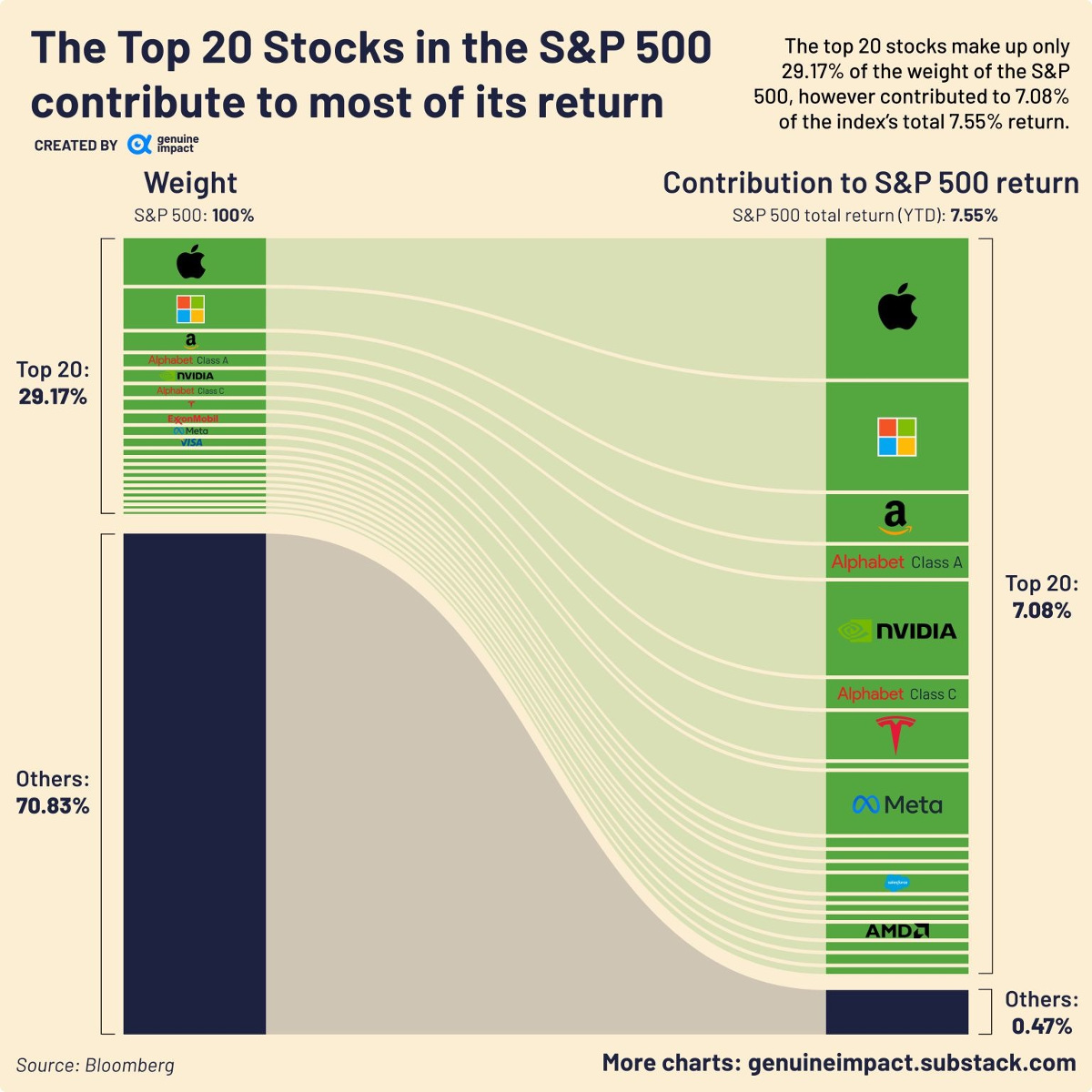
Crucially, the S&P 500 is market-capitalization-weighted. This means that the influence a company has on the index’s overall performance is proportional to its market value. A company like Apple or Microsoft, with market caps in the trillions, will exert significantly more influence on the index’s daily movement than a company with a market cap of “only” $20 billion, even though both are “one stock” in the index. Therefore, simply counting the number of stocks doesn’t fully explain the index’s behavior; understanding the weighting methodology is far more insightful for investors. It means that the largest companies effectively drive the index’s direction, often leading to a concentration of returns from a relatively small number of mega-cap stocks.
Investing in the S&P 500
For most individual investors, directly buying all 500+ stocks in the S&P 500 is impractical due to high transaction costs and the sheer volume of management required. Fortunately, there are highly efficient ways to gain exposure.
Index Funds and ETFs
The most common and efficient way to invest in the S&P 500 is through S&P 500 index funds or Exchange Traded Funds (ETFs). These financial products passively track the performance of the S&P 500 index.
- Index Funds: Typically offered by mutual fund companies, these funds hold all the stocks in the index in the same proportions as the index itself.
- ETFs: Similar to index funds but trade like individual stocks on an exchange throughout the day. They offer intra-day liquidity and generally have very low expense ratios.
Both options provide broad diversification, professional management, and often lower fees compared to actively managed funds.
Benefits of S&P 500 Investing
Investing in the S&P 500 offers several compelling advantages:
- Broad Diversification: Immediate exposure to a wide array of sectors and industries.
- Low Costs: Passive index funds and ETFs typically have very low expense ratios, maximizing investor returns.
- Long-Term Growth Potential: Historically, the S&P 500 has delivered robust long-term returns, reflecting the growth of the U.S. economy.
- Simplicity: It’s a straightforward investment strategy that doesn’t require complex stock picking or market timing.
Considerations and Risks
While generally considered a sound long-term investment, S&P 500 investing isn’t without its considerations:
- Market Risk: As a stock market index, it is subject to market fluctuations and potential downturns. There are no guaranteed returns.
- Concentration in Large Caps: While diversified across many companies, it is exclusively focused on large-capitalization companies and may not capture the growth potential of smaller companies.
- U.S. Focus: It provides no direct exposure to international markets, so investors seeking global diversification would need additional investments.
- No Active Management Upside: By definition, it aims to match the market’s return, not beat it.
The Broader Context: Beyond the “S”
It’s important to remember that the S&P 500, while dominant, is just one component of a much larger universe of investable assets.
Other Major Indices
The S&P 500 is often discussed alongside other prominent indices, each serving a different purpose:
- Dow Jones Industrial Average (DJIA): Tracks 30 large, established U.S. companies. It’s price-weighted, meaning higher-priced stocks have more influence, and it covers fewer companies than the S&P 500.
- Nasdaq Composite: Includes over 3,000 stocks listed on the Nasdaq exchange, heavily weighted towards technology and growth companies.
- Russell 2000: Focuses on small-cap U.S. companies, offering exposure to a different segment of the market.
Each index provides a unique lens through which to view different segments of the economy, and their respective “stock counts” vary widely based on their design and objectives.
The Total US Stock Market
Beyond the roughly 500 companies in the S&P 500, thousands of other publicly traded companies exist in the U.S. economy. These range from mid-cap to small-cap to micro-cap companies, often offering different risk/reward profiles. Investing in a “total stock market” index fund would provide exposure to a much larger universe of U.S. equities, encompassing the S&P 500 companies plus thousands of smaller firms.
In conclusion, while the S&P 500 is generally understood to comprise “500” stocks, its true value lies not in that precise numerical count but in its rigorous methodology, its dynamic nature, and its unparalleled role as a comprehensive benchmark for the U.S. large-cap equity market. For investors, it remains a cornerstone for achieving diversified, long-term wealth accumulation within the money management landscape.
aViewFromTheCave is a participant in the Amazon Services LLC Associates Program, an affiliate advertising program designed to provide a means for sites to earn advertising fees by advertising and linking to Amazon.com. Amazon, the Amazon logo, AmazonSupply, and the AmazonSupply logo are trademarks of Amazon.com, Inc. or its affiliates. As an Amazon Associate we earn affiliate commissions from qualifying purchases.