
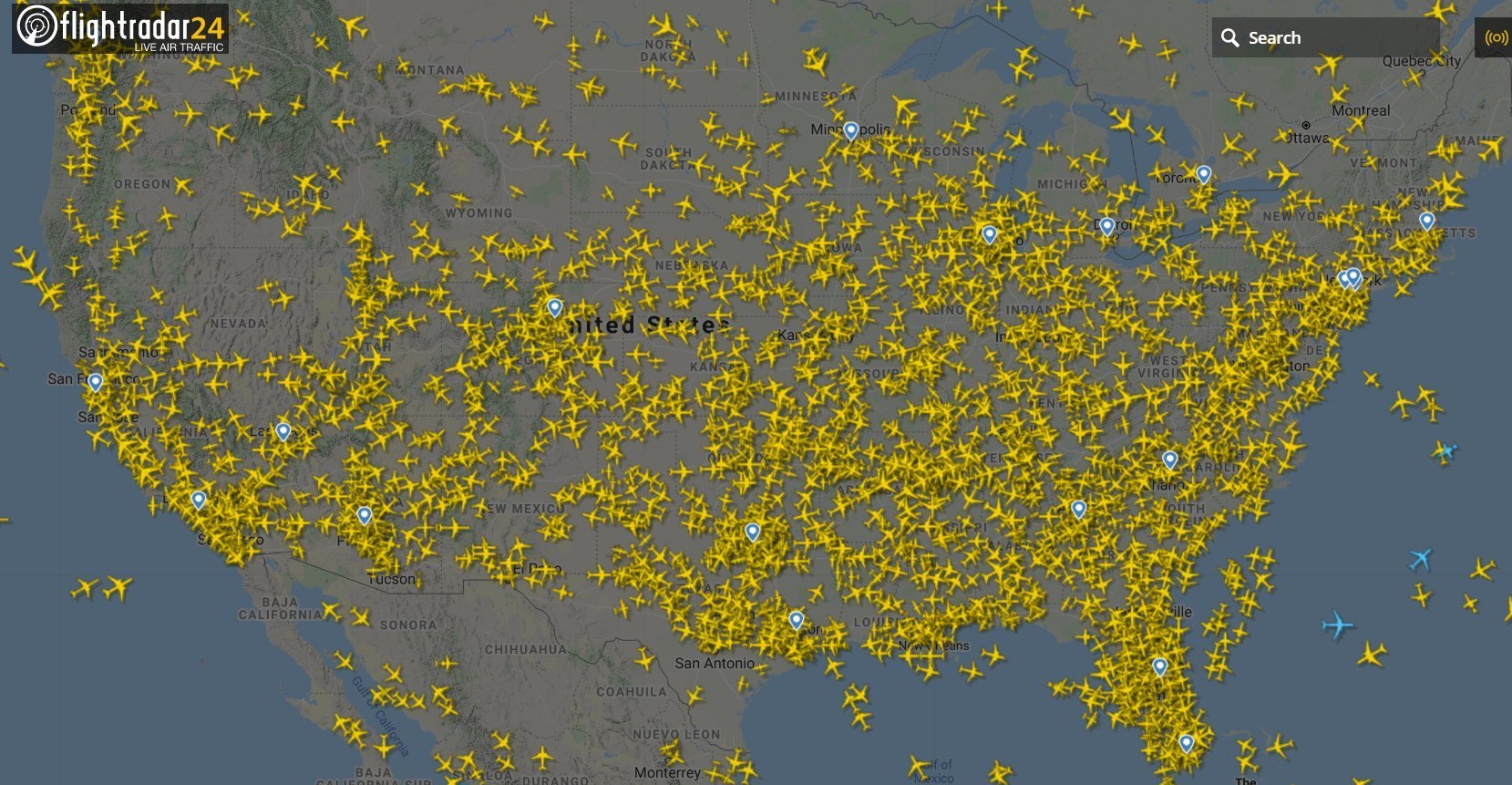
On any given day, the sky above the United States is a masterpiece of synchronized movement. While a casual glance upward might reveal a lone contrail, the digital reality is far more crowded. According to the Federal Aviation Administration (FAA), the Air Traffic Organization (ATO) services approximately 45,000 flights and manages 2.9 million airline passengers across more than 29 million square miles of airspace every single day.
To the average traveler, these numbers represent a logistical miracle. To a technologist, they represent one of the most complex, distributed, and high-stakes software and hardware environments ever conceived. Managing this volume of traffic requires more than just skilled pilots and controllers; it requires an intricate web of satellite navigation, predictive AI, and robust cybersecurity protocols. This article explores the technological infrastructure that makes such a staggering daily flight count possible.

The Data Behind the Numbers: Quantifying the US Airspace
When we ask how many flights are in the US per day, we are really asking about the capacity of the National Airspace System (NAS). This system is a network of air navigation facilities, airports, and technology-driven services. On a peak day, there are often more than 5,000 aircraft in the sky simultaneously. Managing this “big data” problem in real-time is the primary challenge of modern aviation technology.
Commercial vs. Private: The Complexity of Shared Airspace
The 45,000 daily flights are not a monolith. They are a mixture of commercial airliners, cargo carriers, private jets, and military sorties. From a technological standpoint, this diversity adds layers of complexity. Each category of flight operates on different performance characteristics and priorities.
Commercial flights rely on sophisticated Global Distribution Systems (GDS) to sync their schedules with the FAA’s traffic management systems. Meanwhile, General Aviation (GA)—which accounts for a significant portion of the daily flight count—requires onboard avionics that can communicate seamlessly with commercial-grade radar. The tech stack must be inclusive enough to monitor a single-engine Cessna while simultaneously guiding a Boeing 787 through a complex approach into JFK.
Real-Time Tracking: How Software Manages Thousands of Vectors
To prevent mid-air collisions and optimize fuel efficiency, the FAA utilizes the Traffic Flow Management System (TFMS). This is a massive software suite that predicts traffic surges and suggests rerouting. By analyzing historical data and real-time inputs, the system can identify “bottlenecks” in the sky before they happen.
Every flight generates a constant stream of data points—latitude, longitude, altitude, and airspeed. Modern Air Traffic Control (ATC) centers use advanced visualization software to turn these raw data streams into actionable graphics. This allows controllers to manage “vectors” (the direction and speed of a plane) with precision that was unimaginable thirty years ago.
NextGen: Modernizing the National Airspace System
For decades, aviation relied on ground-based radar technology—a system with roots in World War II. However, as the number of daily flights grew, radar reached its limits. To accommodate 45,000 flights a day, the US transitioned to “NextGen,” a multi-billion dollar technological overhaul that shifted the foundation of flight from ground-based systems to satellite-based navigation.
ADS-B Technology: The Backbone of Modern Navigation
The most significant tech shift in NextGen is Automatic Dependent Surveillance-Broadcast (ADS-B). Unlike radar, which “bounces” a signal off a plane to find it, ADS-B allows aircraft to determine their position via GPS and “broadcast” that information to controllers and other aircraft every second.
This technology has revolutionized the capacity of US airspace. Because satellite tracking is far more accurate than radar, planes can fly closer together safely. This increased precision is the only reason the US can handle the current volume of daily flights. ADS-B also provides pilots with “cockpit displays of traffic information,” giving them the same view as the controllers, effectively creating a decentralized safety net.
Data Comm: Streamlining Pilot-Controller Communications
Traditionally, pilots and controllers communicated via voice radio. During peak hours at hubs like Atlanta Hartsfield-Jackson, radio frequencies can become dangerously congested. To solve this, the FAA implemented “Data Comm.”
Data Comm is essentially an encrypted text-messaging system for flight decks. It allows controllers to send complex departure clearances and rerouting instructions directly to the aircraft’s Flight Management System (FMS). This reduces the risk of miscommunication and significantly speeds up the time it takes to get 45,000 flights off the ground and into their cruising altitudes.

AI and Predictive Analytics in Flight Management
Handling 45,000 flights a day isn’t just about avoiding collisions; it’s about managing the chaos of weather, mechanical failures, and human error. This is where Artificial Intelligence (AI) and machine learning (ML) have become indispensable tools for both airlines and the FAA.
Optimizing Routes with Machine Learning
Weather is the leading cause of delays in the US. When a massive storm front hits the Midwest, hundreds of flight paths must be recalculated instantly. Modern AI algorithms can process weather patterns and historical flight data to suggest the most fuel-efficient “reroutes” in seconds.
Airlines use AI-driven software to perform “trajectory-based operations.” Instead of flying in straight lines from one ground-based beacon to another, AI calculates the optimal curve of the flight path based on wind speeds and air density. For a fleet operating thousands of flights daily, these marginal tech-driven gains result in millions of dollars in fuel savings and a significant reduction in carbon emissions.
Predictive Maintenance: Keeping the Fleet Airborne
The number of flights per day is heavily dependent on aircraft availability. If a plane is grounded for an unscheduled repair, it creates a ripple effect across the network. To combat this, modern jet engines are equipped with thousands of sensors that stream “health data” back to the airline’s tech hub in real-time.
Using “Digital Twin” technology—a virtual replica of the physical aircraft—engineers can use machine learning to predict when a component is likely to fail before it actually does. By performing “predictive maintenance,” airlines can ensure that their portion of the 45,000 daily flights remains on schedule, keeping the entire national system fluid.
Cybersecurity in the Clouds: Protecting Global Aviation Networks
As aviation becomes increasingly digitized, the “Internet of Planes” has become a reality. However, with connectivity comes vulnerability. Protecting the technology that manages 45,000 daily flights is a matter of national security and digital integrity.
Securing In-Flight Connectivity
Modern aircraft are flying data centers. From the Wi-Fi used by passengers to the critical avionics used by the flight crew, data is constantly moving on and off the plane. The tech industry has had to develop specialized firewalls and encryption standards to ensure that cabin entertainment systems are “air-gapped” from the flight control systems.
The integrity of the GPS signal is another tech priority. “Spoofing” or jamming GPS signals could theoretically disrupt the ADS-B system. Consequently, the latest generation of aviation hardware includes “anti-spoofing” tech and multi-constellation GNSS (Global Navigation Satellite System) receivers that can cross-reference multiple satellite networks to ensure position accuracy.
Preventing Systemic Disruption in Distributed Networks
The FAA’s infrastructure is a distributed network. If one node fails, the system must be able to “failover” to another without dropping a single flight from the radar screen. The 2023 NOTAM (Notice to Air Missions) system outage served as a stark reminder of how dependent the daily flight count is on database stability.
Since then, there has been a massive push toward cloud-native architectures for aviation data. By moving legacy databases to secure, redundant cloud environments, the FAA aims to ensure that even if a localized hardware failure occurs, the software that tracks 45,000 daily flights remains online.
The Future of the US Flight Count: Automation and Beyond
As we look toward the future, the number of daily flights in the US is expected to grow, particularly with the introduction of Unmanned Aircraft Systems (UAS) and Advanced Air Mobility (AAM)—essentially delivery drones and air taxis.
The technology required to scale from 45,000 flights to 100,000 or more will rely on “Autonomous Traffic Management.” This will involve systems where aircraft negotiate their own spacing and routing via machine-to-machine communication, with human controllers stepping in only for exceptions.
The 45,000 flights we see today are a testament to the power of modern technology. From the code that runs the ADS-B transponders to the AI that predicts a thunderstorm over Chicago, tech is the invisible pilot guiding every journey. As these systems continue to evolve, the “miracle” of the US sky will only become more automated, more efficient, and more interconnected.
aViewFromTheCave is a participant in the Amazon Services LLC Associates Program, an affiliate advertising program designed to provide a means for sites to earn advertising fees by advertising and linking to Amazon.com. Amazon, the Amazon logo, AmazonSupply, and the AmazonSupply logo are trademarks of Amazon.com, Inc. or its affiliates. As an Amazon Associate we earn affiliate commissions from qualifying purchases.