
The Dow Jones Industrial Average (DJIA), often referred to simply as “the Dow,” is arguably the most recognizable financial ticker in the world. When news anchors report that “the market is up,” they are frequently referencing the movement of this specific index. For the modern investor, understanding the composition of the Dow is essential for grasping the broader movements of the U.S. economy. While there are thousands of publicly traded companies in the United States, the Dow Jones is famously composed of just 30 large, “blue-chip” companies.
This narrow focus on 30 companies is both the index’s greatest strength and its most frequent point of criticism. By selecting a small group of industry leaders, the Dow aims to provide a snapshot of the health of the American corporate landscape. To truly understand how these 30 companies influence global finance, one must look at the history, the selection criteria, and the unique mathematical weighting that sets the Dow apart from other major indices like the S&P 500 or the Nasdaq Composite.

The Evolution of the Dow 30
The Dow Jones Industrial Average was created by Charles Dow and Edward Jones in 1896. At its inception, the index looked significantly different than it does today. Initially, it consisted of only 12 companies, almost all of which were involved in heavy industry—sugar, oil, rubber, and railroads. Of those original 12 companies, which included names like General Electric and American Cotton Oil, none remain in the index today in their original form.
From 12 to 30: The Expansion of the Index
As the American economy grew and diversified, the index needed to expand to maintain its relevance as a representative barometer. In 1916, the index grew to 20 companies, and finally, in 1928, it expanded to the 30 companies we see today. This number has remained constant for nearly a century, even as the names within the list have rotated frequently.
The decision to cap the index at 30 companies was a deliberate choice to focus on “quality over quantity.” Unlike the S&P 500, which seeks to track the broad market by including 500 different stocks, the Dow aims to represent the “elite” of the business world. These are companies that are leaders in their respective sectors, possess a long history of sustainable growth, and are of significant interest to a wide range of investors.
The Shift from “Industrial” to “Information”
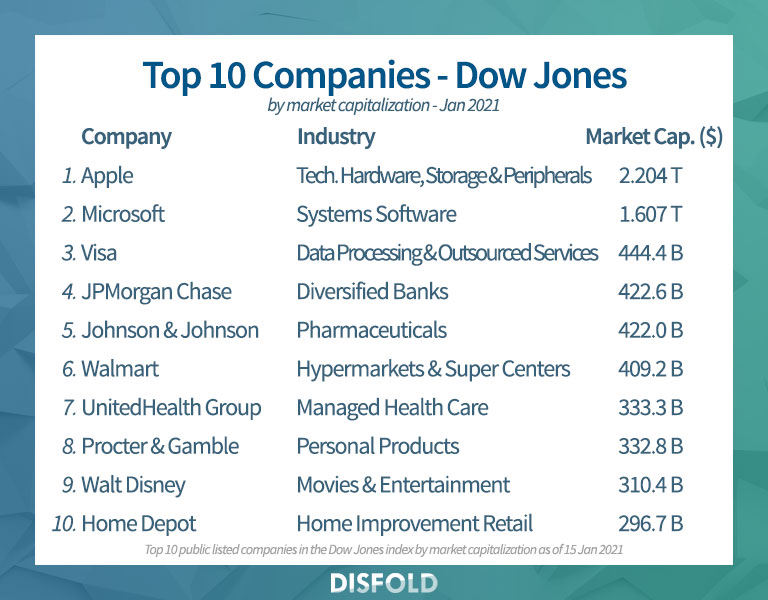
The name “Industrial Average” is largely a historical artifact. In the early 20th century, the U.S. economy was driven by manufacturing and manual labor. Today, the composition of the 30 companies reflects the shift toward a service- and technology-oriented economy. The modern Dow includes titans of technology like Microsoft and Apple, healthcare giants like UnitedHealth Group, and financial powerhouses like Goldman Sachs. While “Industrial” remains in the title, the index now covers everything from retail and entertainment to cloud computing and biotechnology.
The Selection Process: How the Elite 30 Are Chosen
One of the most common misconceptions about the Dow Jones is that it is a purely rules-based index. Unlike the S&P 500, which has strict quantitative requirements for market capitalization and liquidity, the Dow is managed by a selection committee. This committee, known as the Averages Committee, is composed of representatives from S&P Dow Jones Indices and The Wall Street Journal.
Qualitative vs. Quantitative Standards
There is no “secret formula” for getting a company into the Dow. Instead, the committee looks for companies that meet a set of broad, qualitative standards. A company must have an excellent reputation, demonstrate sustained growth, and be a leader in its industry. Most importantly, the company must be incorporated and headquartered in the United States.
The committee also strives to ensure that the index reflects the current state of the U.S. economy. If a specific sector—such as technology or healthcare—becomes a larger part of the Gross Domestic Product (GDP), the committee may remove a company from a declining sector (like traditional energy or manufacturing) and replace it with a leader from the growing sector.
The Process of Removal and Replacement
Membership in the Dow is not permanent. In fact, the “Dow 30” is a rotating door that reflects the survival of the fittest in the corporate world. When a company is removed, it is often because its influence on the economy has waned or it has been surpassed by a more relevant competitor.
For example, the removal of ExxonMobil in 2020 after nearly a century in the index was a landmark moment, signaling the declining dominance of big oil in favor of software and services. The inclusion of companies like Salesforce or Amazon highlights the index’s commitment to staying current with the digital transformation of the global marketplace.
Price-Weighting and the Mathematics of the Dow
To understand the 30 companies of the Dow, one must understand how they are weighted. Most major stock indices are “market-cap weighted,” meaning that the larger the company’s total value, the more it moves the index. The Dow, however, is “price-weighted.”

The Significance of the Share Price
In a price-weighted index, the companies with the highest stock price per share have the most influence on the index’s daily movement, regardless of their actual company size. This means that a $1 movement in a $300 stock has the same impact on the Dow as a $1 movement in a $30 stock. Consequently, a company like UnitedHealth Group, which often carries a high share price, can have a much larger impact on the Dow than a company with a massive market cap but a lower share price.
This unique structure creates a specific dynamic. Companies in the Dow are often hesitant to perform stock splits, as a lower share price would reduce their influence within the index. Conversely, if a stock’s price becomes too high, it might exert too much control over the index, prompting the committee to look for a replacement or encouraging the company to split its shares.
The Dow Divisor
Because of stock splits, spin-offs, and other corporate actions, the Dow cannot simply be the sum of the 30 stock prices divided by 30. If it were, a stock split would cause the index to “crash” artificially. To solve this, the index uses the “Dow Divisor.”
The Divisor is a continuously adjusted mathematical constant. When a company in the index splits its stock or pays a special dividend, the Divisor is adjusted so that the value of the index remains the same. As of recent years, the divisor is a small fraction (less than 1). This means that a $1 change in any of the 30 stocks actually results in a much larger point move in the Dow Jones Industrial Average.
The Dow as a Global Financial Barometer
Despite its small size of only 30 companies, the Dow Jones remains one of the most cited figures in the financial world. It serves as a psychological anchor for both institutional and retail investors. When the Dow hits a new “round number” milestone—such as 30,000 or 40,000—it generates headlines that can shift consumer sentiment and investment behavior.
A Reflection of Blue-Chip Stability
Investors often look to the Dow as a measure of “safe” or “stable” investing. Because the 30 companies are required to be established leaders with proven track records, the index is often less volatile than the tech-heavy Nasdaq or the broader S&P 500. For many, the Dow represents the “old guard” of the economy—the reliable companies that pay dividends and survive economic downturns.
However, the narrow focus of 30 companies means that the Dow can sometimes miss emerging trends. It does not capture the explosive growth of mid-cap or small-cap companies, nor does it provide a comprehensive view of the thousands of stocks that make up the total market. For this reason, professional portfolio managers often use the Dow in conjunction with other indices to get a full picture of market health.
Sector Diversity Within the 30
While the number 30 is small, the committee ensures a wide spread across sectors. The current composition includes:
-
Information Technology: Driving growth through software and hardware.
-
Healthcare: Reflecting the aging population and medical innovation.
-
Financials: Representing the backbone of the global credit and banking system.
-
Consumer Discretionary: Tracking the spending habits of the American public.
-
Industrials: Keeping a link to the country’s manufacturing and logistics roots.
By balancing these sectors within a 30-company limit, the Dow provides a concentrated dose of the American economic engine.
Strategic Considerations for Individual Investors
For the individual investor, the Dow Jones offers a unique way to participate in the growth of the U.S. economy. While you cannot “buy” the index directly, there are numerous financial tools designed to track the 30 companies of the Dow.
Investing via ETFs and Index Funds
The most popular way to invest in the Dow is through Exchange-Traded Funds (ETFs), such as the SPDR Dow Jones Industrial Average ETF Trust (commonly known by its ticker, DIA, or “Diamonds”). This fund holds all 30 stocks in the same weights as the index, allowing investors to gain exposure to the elite 30 with a single transaction.
This strategy is often favored by those looking for a “defensive” equity position. Since the Dow companies are typically large and profitable, they are often seen as a hedge against the volatility found in speculative growth stocks. Furthermore, many of the 30 companies are famous for their consistent dividend payments, making the Dow a popular focus for income-oriented investors.
The Limitations of the 30-Company Model
While the Dow is a prestigious list, investors should be aware of its limitations. Because it only tracks 30 companies, it can be skewed by the poor performance of just one or two members. If a high-priced stock in the index has a bad quarter, it can drag down the entire average, even if the other 29 companies are performing well.
Additionally, the price-weighting system means the index does not reflect the “true” economic weight of a company. A massive company like Apple might have less influence on the Dow than a smaller company with a higher share price. This “mathematical quirk” is why many financial professionals prefer the S&P 500 for benchmarking their performance.
Ultimately, the 30 companies that make up the Dow Jones Industrial Average are more than just a list of stocks. they are a curated selection of the most influential corporate entities in the world. Whether the index is rising or falling, the movement of these 30 companies provides a vital narrative about where the economy has been and where it is headed next. For any serious participant in the world of finance, keeping an eye on these 30 giants is not just an option—it is a necessity.
aViewFromTheCave is a participant in the Amazon Services LLC Associates Program, an affiliate advertising program designed to provide a means for sites to earn advertising fees by advertising and linking to Amazon.com. Amazon, the Amazon logo, AmazonSupply, and the AmazonSupply logo are trademarks of Amazon.com, Inc. or its affiliates. As an Amazon Associate we earn affiliate commissions from qualifying purchases.