
The Definitive Count: More Than Just a Number
The question of “how many companies in the S&P 500” seems straightforward, yet its answer holds nuances crucial for understanding one of the world’s most vital financial benchmarks. At its core, the S&P 500 is designed to track 500 of the largest U.S. publicly traded companies by market capitalization. This benchmark, managed by S&P Dow Jones Indices, serves as a proxy for the broader U.S. equity market and is a cornerstone for passive and active investment strategies alike. While the name explicitly states “500,” the actual number of constituents can, at times, deviate slightly due to corporate actions or the administrative processes involved in index management.
Unpacking the “500” Misconception
It’s common for investors and the public to assume the S&P 500 always contains precisely 500 companies. While the index aims for 500, the count can fluctuate marginally. For instance, a company might have different classes of shares (e.g., voting and non-voting shares) that are both listed, potentially increasing the technical count of listed securities without increasing the number of distinct companies. More commonly, the index undergoes periodic rebalancing and ad-hoc changes as companies are added or removed. During the interim period between an announcement of a change and its effective date, or due to a merger, acquisition, or delisting, the exact count might momentarily stray from 500. These fluctuations are typically minor and temporary, as S&P Dow Jones Indices consistently works to maintain the 500-company target, ensuring the index remains a true representation of its intended market segment.
The Role of S&P Dow Jones Indices
S&P Dow Jones Indices is the entity responsible for constructing and maintaining the S&P 500. Their role extends far beyond simply counting 500 companies. They establish and enforce rigorous criteria for inclusion, manage the ongoing rebalancing, and ensure the index accurately reflects the market it aims to represent. This meticulous oversight is critical because the S&P 500 isn’t just a list; it’s a dynamic financial tool that influences trillions of dollars in investment portfolios worldwide. Their methodology is designed to minimize turnover while ensuring the index remains relevant and reflective of the leading U.S. large-cap firms.
Criteria for Inclusion: The Gates to Elite Status
Gaining entry into the S&P 500 is a significant achievement for any company, often leading to increased investor visibility and demand for its stock, particularly from index funds. The S&P Dow Jones Index Committee employs a set of stringent, objective criteria to select companies, aiming to ensure the index is representative, investable, and maintains the quality investors expect. These criteria are reviewed periodically and are crucial for understanding the composition and nature of the S&P 500.
Market Capitalization Thresholds
One of the primary requirements for inclusion is a substantial market capitalization. While the specific threshold changes with market dynamics, it typically requires companies to be “large-cap.” This ensures that the index reflects the largest and most influential companies in the U.S. equity market. The S&P 500 is a market-cap-weighted index, meaning companies with larger market caps have a greater influence on the index’s performance. Therefore, a significant market cap is essential for a company to be considered for this elite group.
Liquidity and Public Float Requirements
Beyond size, liquidity is paramount. A company must have sufficient liquidity, meaning a large enough volume of its shares trade regularly, to allow for efficient buying and selling without drastically impacting its stock price. This is crucial for index funds and other institutional investors who need to buy and sell large blocks of shares to track the index. Furthermore, a substantial percentage of a company’s shares must be publicly available for trading (free float). Companies with tightly held ownership structures, where a large portion of shares is not actively traded, are generally excluded to ensure investability for a broad range of investors.
Profitability and U.S. Domicile
Profitability is another key criterion. Companies must demonstrate a track record of positive earnings, specifically in the most recent quarter and over the preceding four consecutive quarters on an aggregate basis. This ensures that the index is composed of financially sound and viable businesses. Additionally, companies must be U.S. companies, meaning they are domiciled in the United States. This geographical restriction underpins the S&P 500’s role as a benchmark for the U.S. equity market, distinguishing it from global or international indices.
Sector and Industry Representation
While not a rigid quota system, the S&P Dow Jones Index Committee also considers the overall sector balance of the S&P 500. They strive to ensure that the index broadly represents the sector composition of the U.S. economy. This avoids an overconcentration in a single industry and ensures the index offers a diversified view across various economic segments. This consideration ensures the S&P 500 remains a robust economic barometer, encompassing the breadth of leading American industries from technology and healthcare to financial services and consumer staples.
The S&P 500’s Weight and Impact on Investing
The S&P 500 is more than just a collection of 500 companies; it is arguably the most referenced stock market index globally, playing a colossal role in the financial landscape. Its composition, performance, and the very act of tracking it have profound implications for financial markets, investors, and economic analysis.
A Bellwether for the U.S. Economy
Often dubbed a “bellwether” for the U.S. economy, the S&P 500 provides a broad snapshot of the health and direction of American corporations. Its constituents represent a significant portion of the U.S. stock market’s total value and generate a substantial share of the nation’s economic output and employment. When the S&P 500 is performing well, it often signals a robust corporate earnings environment and broader economic expansion. Conversely, downturns in the index can reflect economic headwinds, decreased consumer spending, or investor uncertainty. Economists and policymakers frequently monitor its movements as an indicator of financial stability and economic sentiment.
The Foundation of Index Investing
Perhaps the most significant impact of the S&P 500 lies in its role as the foundation for index investing. Trillions of dollars are managed in investment products—such as exchange-traded funds (ETFs) and mutual funds—that passively track the S&P 500. These funds aim to replicate the index’s performance by holding the same stocks in the same proportions as the S&P 500. For individual investors, this offers a diversified, low-cost way to gain exposure to a broad swath of the U.S. stock market without needing to pick individual stocks. This passive investment strategy has democratized access to market returns and profoundly reshaped the asset management industry, emphasizing diversification and long-term growth.
Sector Diversification and Portfolio Implications
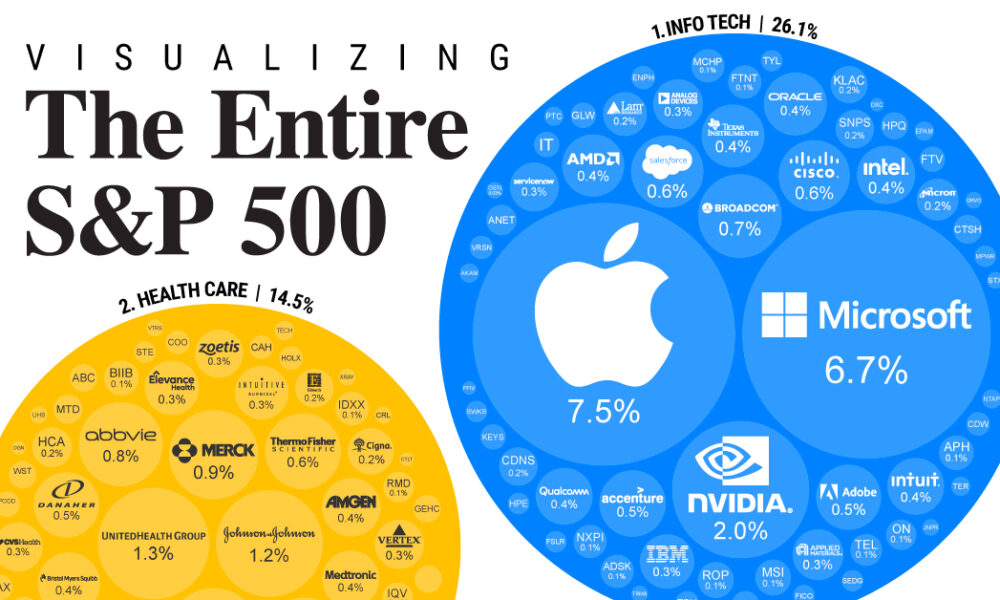
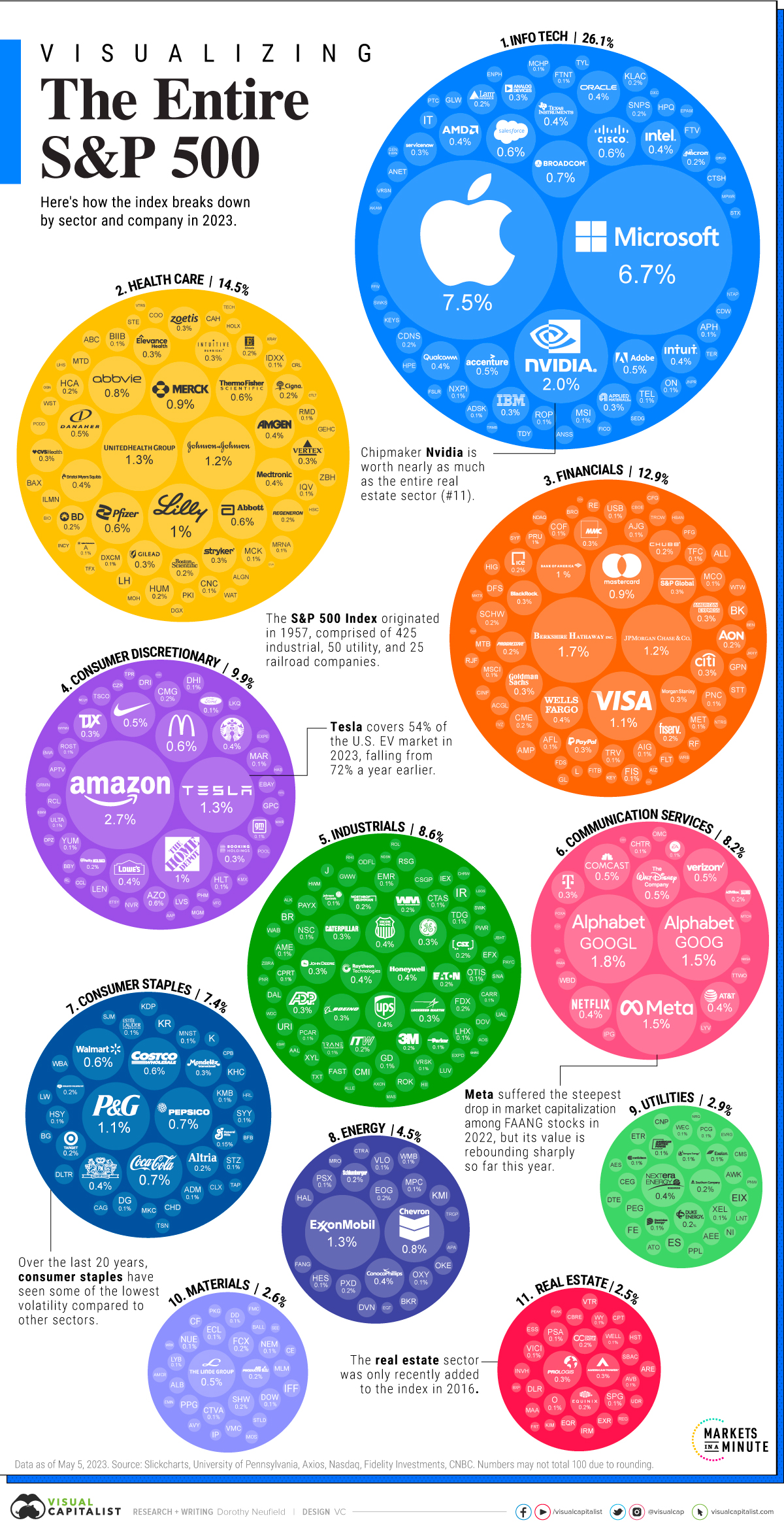
The S&P 500 provides inherent sector diversification, encompassing companies from all major economic sectors. This diversified exposure is critical for portfolio construction, allowing investors to spread risk across different industries. While the specific weight of each sector fluctuates with market dynamics and the performance of individual companies, the index generally includes significant representation from technology, healthcare, financials, consumer discretionary, consumer staples, industrials, communication services, utilities, energy, and real estate. Understanding these sector weightings is vital for investors to assess their overall market exposure and identify any potential biases in their portfolios relative to the broader market. For instance, a heavy concentration in technology stocks within the S&P 500 can drive overall index performance but also expose investors to sector-specific risks.
Dynamics of the Index: Additions and Deletions
The S&P 500 is not static; it is a living index that evolves with the market. Companies are periodically added and removed, a dynamic process managed by the S&P Dow Jones Index Committee. These changes are critical events for the companies involved and have ripple effects across the investment landscape.
Quarterly Rebalancing and Ad Hoc Changes
The Index Committee meets regularly, typically on a quarterly basis, to review the index’s composition and make necessary adjustments. During these reviews, they assess companies against the inclusion criteria, considering factors like market cap changes, liquidity, and profitability. Companies that no longer meet the criteria, or are significantly underperforming, may be considered for removal. Conversely, rising stars that meet all requirements could be added. Beyond the scheduled quarterly reviews, ad hoc changes can occur at any time. These often result from corporate events such as mergers, acquisitions, bankruptcies, or significant delistings. When a company is acquired, for example, it is typically removed, and a new company is selected to maintain the 500-constituent count.
Implications for Fund Managers and Investors
Additions and deletions to the S&P 500 have immediate and significant implications. When a company is announced for inclusion, index funds and other passively managed funds that track the S&P 500 are compelled to buy shares of that company to match the index’s new composition. This often leads to a surge in demand and a temporary boost in the stock price of the newly added company. Conversely, a company’s removal from the index often triggers widespread selling by these same funds, which can put downward pressure on its stock price. Active fund managers also pay close attention to these changes, as they can indicate shifts in market leadership or provide arbitrage opportunities. For individual investors, understanding these dynamics reinforces the importance of diversification and long-term perspective, rather than attempting to profit from short-term index rebalancing events.
Beyond the Count: What the S&P 500 Represents
While the initial question centers on a simple count, the true value and insight derived from the S&P 500 extend far beyond the number of its constituents. It embodies the collective performance and economic narrative of America’s leading enterprises.
Economic Barometer and Future Outlook
The S&P 500 acts as a powerful economic barometer, reflecting not just current corporate health but also investor expectations for future economic conditions. Movements in the index can signal investor confidence (or lack thereof) regarding interest rates, inflation, consumer spending, and geopolitical events. A rising S&P 500 often suggests optimism for future earnings growth and economic expansion, while declines can point to anticipated economic contractions or increased risk. Its forward-looking nature makes it an invaluable tool for analysts, economists, and investors seeking to gauge the trajectory of the U.S. economy and corporate profitability.

The Power of Large-Cap Performance
The S&P 500 represents the large-cap segment of the U.S. equity market. These large companies typically possess significant market share, robust balance sheets, and often, global operations. Their performance can influence smaller companies within their supply chains and broader economic sectors. Investing in the S&P 500, therefore, means investing in the established leaders and innovators that drive much of the American economic engine. It offers exposure to businesses that have demonstrated resilience, adapted to changing market conditions, and have the scale to continue generating substantial revenue and profit. Understanding that the “500” represents this specific, influential segment of the market is key to appreciating its enduring relevance and impact on financial planning and investment strategy.
aViewFromTheCave is a participant in the Amazon Services LLC Associates Program, an affiliate advertising program designed to provide a means for sites to earn advertising fees by advertising and linking to Amazon.com. Amazon, the Amazon logo, AmazonSupply, and the AmazonSupply logo are trademarks of Amazon.com, Inc. or its affiliates. As an Amazon Associate we earn affiliate commissions from qualifying purchases.