
The Dow Jones Industrial Average (DJIA), often simply referred to as “the Dow,” is one of the most widely recognized and frequently cited stock market indices in the world. For investors, financial commentators, and the general public alike, the question of its composition – specifically, how many companies it includes – is fundamental to understanding its nature and impact. The answer is straightforward: the Dow Jones Industrial Average is comprised of 30 large, publicly-owned companies based in the United States. This seemingly small number holds significant weight, as these 30 companies are often seen as bellwethers for the broader U.S. economy and specific industrial sectors. This article delves into the intricacies of the DJIA, exploring its history, selection criteria, influence, and its role in the modern financial landscape, all within the framework of its 30 distinguished constituents.

The Dow Jones Industrial Average: An Enduring Benchmark
Established in the late 19th century, the Dow has evolved from a simple measure of industrial stocks to a symbol of American corporate strength and economic health. Its long history gives it a unique place among financial indices.
What is the DJIA? A Brief History
The Dow Jones Industrial Average was first calculated by Charles Dow, editor of The Wall Street Journal and co-founder of Dow Jones & Company, on May 26, 1896. Initially, it comprised just 12 companies, predominantly from heavy industries such as railroads, cotton, sugar, tobacco, and oil. The index was designed to provide a clear and concise snapshot of the overall health of the U.S. industrial sector. Over the decades, as the American economy diversified and grew, so too did the components of the Dow, expanding to 20 stocks in 1916 and finally to its current 30 stocks in 1928.
Unlike some other market indices, the DJIA is not an arithmetic average of its components’ stock prices. Instead, it is a price-weighted average, meaning that stocks with higher share prices have a greater influence on the index’s value than those with lower share prices. To maintain historical continuity and prevent distortions caused by stock splits, mergers, or other corporate actions, a “Dow Divisor” is used. This divisor is adjusted periodically, ensuring that the index’s value accurately reflects changes in the underlying stock prices rather than arbitrary events. This unique calculation method is a hallmark of the Dow, distinguishing it from market-capitalization-weighted indices like the S&P 500.
Why 30 Companies? The Selection Criteria
The fact that the DJIA consistently features exactly 30 companies is a deliberate choice, reflecting a balance between representativeness and manageability. While 30 might seem a small number given the vastness of the U.S. economy, the selection process aims to include companies that are truly emblematic of their sectors and possess significant influence.
The selection of companies for the Dow is not governed by a rigid, quantitative formula. Instead, it is made by a committee of editors at The Wall Street Journal. The primary criteria for inclusion are:
- Reputation: Companies must have an excellent reputation and a history of sustained growth and interest among a large number of investors.
- Size and Influence: They should be large, well-established “blue-chip” companies that represent a significant portion of their respective industries and the broader U.S. economy.
- Sector Representation: The committee strives for a reasonable representation of various major sectors of the U.S. economy, though it is not strictly diversified across all industries. The goal is to reflect broad trends, not every niche.
- Relevance: Companies are chosen for their ability to contribute to the index’s purpose of indicating the general state of the stock market and economy. Changes are made only when a company’s “superlative reputation” has been lost, or when a shift is needed to reflect a change in the U.S. economy.
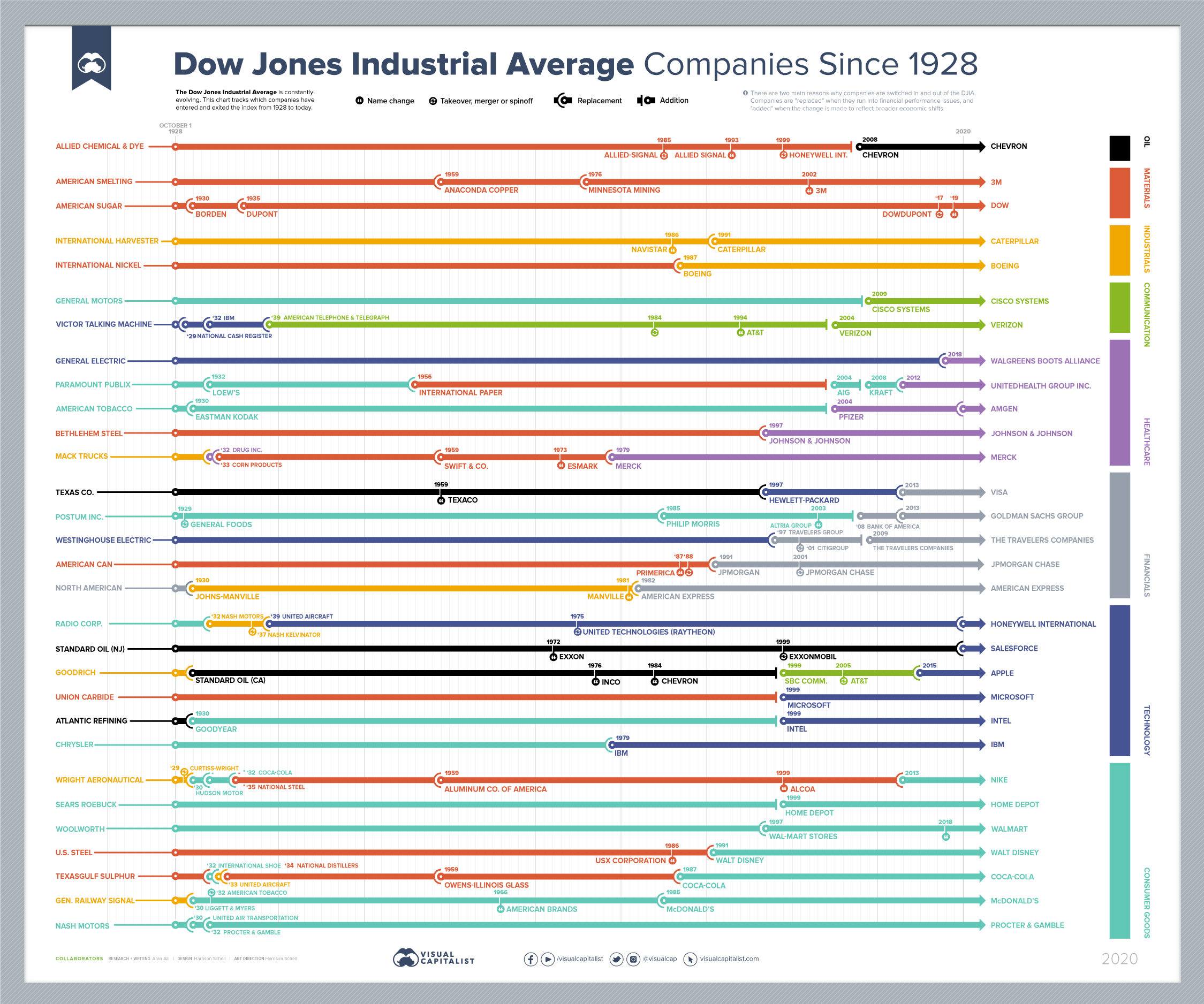
Changes to the Dow’s composition are relatively infrequent, typically occurring only when a merger, bankruptcy, or a fundamental shift in a company’s business model makes it no longer representative of its industry or the broader economy. Each change is a significant event, often signaling a new era or acknowledging the decline of an old one.
Understanding the Composition and Influence
The 30 companies in the Dow are not static; they change over time to reflect the evolving landscape of American industry. These changes, though rare, are important signals of economic shifts.
The Market Capitalization vs. Price-Weighted Debate
A critical aspect of understanding the Dow’s influence stems from its price-weighted nature. In a price-weighted index, a $1 increase in the stock price of a company trading at $300 will have three times the impact on the index’s value as a $1 increase in a company trading at $100. This contrasts sharply with market-capitalization-weighted indices (like the S&P 500), where companies with larger total market values (share price multiplied by the number of outstanding shares) have a greater influence, regardless of their individual share price.
This distinction leads to frequent debate. Critics argue that price-weighting can give undue influence to companies with high nominal stock prices, even if their overall market capitalization is smaller than other components. Conversely, it means that a high-priced stock, even if it represents a smaller portion of the economy than a lower-priced, much larger company, can move the index more significantly. Proponents, however, contend that its simplicity and historical continuity are valuable, offering a different lens through which to view market performance.
Who are the “Titans”? Examples of Current Components
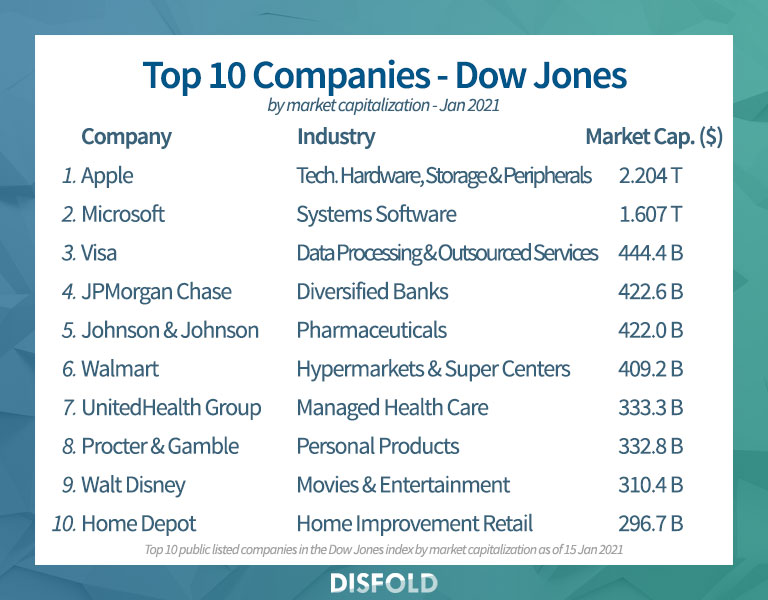
While the exact list of 30 companies changes over time, the types of companies included typically represent global leaders in their respective sectors. For instance, you would commonly find:
- Technology Giants: Companies like Apple, Microsoft, and Salesforce, reflecting the immense growth and importance of the tech sector in the modern economy.
- Financial Powerhouses: Institutions such as JPMorgan Chase and Goldman Sachs, indicative of the financial industry’s critical role.
- Consumer Staples & Discretionary Leaders: Walmart, Procter & Gamble, McDonald’s, and Nike, showcasing the strength of consumer spending.
- Industrial and Manufacturing Stalwarts: Boeing, Caterpillar, and 3M, representing traditional American manufacturing and engineering prowess.
- Healthcare Innovators: UnitedHealth Group and Johnson & Johnson, highlighting advancements in medical and pharmaceutical fields.
These companies are not just leaders in their industries; many are multinational corporations whose performance can be influenced by, and in turn influence, global economic trends, making the Dow a truly international indicator in many respects.
The Role of the Dow in Investment Strategy
For individual and institutional investors, the Dow serves multiple purposes, from a quick gauge of market sentiment to a component of diversified investment portfolios.
Dow as an Economic Barometer
The DJIA is often heralded as a barometer for the overall health of the U.S. economy. When the Dow rises, it’s frequently interpreted as a sign of economic expansion and corporate profitability. Conversely, a falling Dow can signal economic contraction or uncertainty. This perception stems from the fact that its 30 constituents are typically large, well-established companies whose performance is intrinsically linked to broader economic conditions. Strong corporate earnings, robust consumer spending, and positive manufacturing data often translate into gains for Dow components, which then push the index higher.
However, it’s crucial for investors to understand that while the Dow is a good indicator, it’s not a perfect one. Its limited number of companies and price-weighted methodology mean it doesn’t represent the entire market. For a more comprehensive view, investors often look to broader indices like the S&P 500 or Russell 3000. Nevertheless, its high visibility ensures it remains a key reference point for assessing daily market movements and long-term economic trends.
Investing in the Dow: ETFs and Index Funds
Directly investing in all 30 companies of the Dow individually would be cumbersome and expensive for most investors. However, there are popular and accessible ways to gain exposure to the performance of the DJIA through various financial products:
- Exchange-Traded Funds (ETFs): Several ETFs are designed to track the performance of the Dow. The most prominent example is the SPDR Dow Jones Industrial Average ETF (DIA), often referred to as “Diamonds.” These ETFs hold shares of all 30 Dow components in proportions that mimic the index’s price-weighted structure, providing investors with instant diversification across the Dow’s constituents.
- Index Funds: Similar to ETFs, mutual funds that aim to replicate the performance of the DJIA are also available. These funds offer professional management and diversification, making them a suitable option for long-term investors looking for exposure to blue-chip U.S. stocks.
Investing in these Dow-tracking products allows investors to benefit from the collective performance of these 30 influential companies without needing to select individual stocks. This approach aligns with passive investment strategies, where the goal is to match market returns rather than trying to outperform them through active stock picking.
Limitations and Criticisms of the DJIA
Despite its prominence, the Dow is not without its critics. Understanding its limitations is as important as appreciating its strengths.
Representativeness in a Modern Economy
One of the most common criticisms leveled against the DJIA is its limited scope. With only 30 companies, it represents a tiny fraction of the thousands of publicly traded companies in the U.S. stock market. Critics argue that this small sample size cannot accurately reflect the breadth and diversity of the modern American economy, especially with the rise of smaller, innovative companies and rapidly evolving sectors that might not meet the Dow’s stringent criteria for size and reputation.
Furthermore, its historical focus on “industrial” companies can be seen as outdated, despite the committee’s efforts to diversify its constituents. While technology and financial companies now play a significant role, the index might still be perceived as less representative of emerging growth areas compared to broader indices.
Price-Weighting Distortions
As discussed, the price-weighted methodology of the Dow is a frequent target of criticism. It means that a company with a high share price, even if it has a relatively smaller market capitalization, can exert more influence on the index than a low-priced stock from a much larger company. This can lead to a situation where the index’s movement is disproportionately driven by a few high-priced stocks, potentially misrepresenting the overall market trend or the performance of the broader collection of its components.
For instance, a company undergoing a stock split will see its share price drop, automatically reducing its weight in the Dow, even if its market capitalization and economic importance remain unchanged. Conversely, a company with a high stock price might see its influence grow simply due to its price, regardless of underlying fundamental shifts.
Beyond the Dow: Other Key Market Indices
While the Dow holds historical significance, a holistic understanding of the financial markets requires looking at other indices that offer broader or more specialized perspectives.
S&P 500: A Broader Perspective
The S&P 500 is often considered a more comprehensive and accurate representation of the large-cap U.S. stock market than the Dow. Comprising 500 of the largest U.S. publicly traded companies, it offers much broader diversification across various sectors and industries. Unlike the Dow, the S&P 500 is market-capitalization-weighted, meaning that companies with larger total market values have a greater impact on the index. This methodology is generally preferred by financial professionals as it more accurately reflects the relative size and economic importance of each company. For many investors, the S&P 500 serves as the primary benchmark for U.S. stock market performance.
NASDAQ Composite: The Tech Sector’s Pulse
The NASDAQ Composite Index is another crucial market benchmark, primarily known for its heavy concentration of technology and growth companies. While not limited to just tech, it includes all common equities listed on the NASDAQ stock market, which historically has been the listing venue of choice for many innovative and fast-growing firms. As a result, the NASDAQ Composite is often seen as a gauge for the performance of the technology sector and growth stocks. It is also market-capitalization-weighted, making it distinct from the Dow’s methodology. Investors seeking insights into the performance of the technology and innovation segments of the economy typically pay close attention to the NASDAQ.
Conclusion
The Dow Jones Industrial Average, with its precise count of 30 iconic U.S. companies, remains a cornerstone of financial reporting and a powerful symbol of American corporate strength. From its humble beginnings with 12 industrial stalwarts to its current incarnation encompassing a diverse array of global titans, the Dow has consistently aimed to offer a concise, albeit selective, snapshot of the U.S. economy. Its unique price-weighted methodology and the deliberate selection of its constituents by The Wall Street Journal editors contribute to its distinct character and enduring appeal.
While its limited number of components and price-weighted nature draw valid criticism regarding its representativeness compared to broader, market-capitalization-weighted indices like the S&P 500, the Dow’s historical continuity and the collective influence of its 30 constituents ensure its continued relevance. For investors, financial analysts, and anyone interested in the pulse of the market, understanding “how many companies in Dow Jones Industrial” is not just about a number; it’s about appreciating the legacy, the unique construction, and the ongoing dialogue surrounding one of the world’s most enduring financial benchmarks. It serves as an essential tool in the investor’s toolkit, providing a focused lens through which to view the performance of America’s corporate elite.
aViewFromTheCave is a participant in the Amazon Services LLC Associates Program, an affiliate advertising program designed to provide a means for sites to earn advertising fees by advertising and linking to Amazon.com. Amazon, the Amazon logo, AmazonSupply, and the AmazonSupply logo are trademarks of Amazon.com, Inc. or its affiliates. As an Amazon Associate we earn affiliate commissions from qualifying purchases.