
The Dow Jones Industrial Average (DJIA), often referred to simply as “the Dow,” is arguably the most recognizable financial shorthand in the world. When news anchors report that “the market is up,” they are frequently referring to the movement of this specific index. For the casual observer, the Dow represents the health of the American economy, but for the serious investor, it represents a very specific, curated slice of the corporate landscape. Despite its massive influence on global sentiment, the index is surprisingly exclusive.

There are exactly 30 companies in the Dow Jones Industrial Average. This number has remained constant for nearly a century, even as the names within the index have rotated to reflect the changing tides of the global economy. Understanding why there are 30 companies, how they are chosen, and what their selection means for the broader financial markets is essential for any investor looking to master the mechanics of the U.S. stock market.
The History and Evolution of the “Thirty”
When Charles Dow, the founder of the Wall Street Journal, first calculated the average in May 1896, the index looked nothing like it does today. At its inception, the Dow consisted of only 12 companies, most of which were heavily involved in the industrial sector—railroads, cotton, gas, sugar, and tobacco. These were the “smokestack” industries that powered the Gilded Age.
From Twelve to Thirty
The index expanded to 20 stocks in 1916 and finally to 30 stocks in 1928. Since then, the number 30 has become the standard. The decision to cap the index at 30 was a matter of practical calculation in a pre-computer era, but it has endured because it provides a concentrated look at “Blue-Chip” companies—the established, stable, and profitable leaders of their respective industries.
The Changing Guard
While the number of companies remains static at 30, the roster is anything but permanent. The Dow is designed to be a living representation of the U.S. economy. As the economy shifted from heavy industry to consumer goods, then to finance, and finally to technology and healthcare, the index followed suit. For instance, General Electric (GE) was an original member and remained in the index for over a century before being removed in 2018, signaling a symbolic end to the era of the traditional industrial conglomerate.
How the 30 Companies Are Selected
Unlike the S&P 500, which uses a strict mathematical formula based on market capitalization to determine membership, the Dow Jones Industrial Average is curated. The selection process is managed by the Averages Committee at S&P Dow Jones Indices. This committee does not have a rigid set of rules; instead, they follow general guidelines to ensure the index remains a relevant barometer of the economy.
Qualitative Criteria for Membership
To be one of the 30 companies, a firm must typically have an excellent reputation, demonstrate sustained growth, and command significant interest among a large number of investors. The committee looks for companies that are incorporated and headquartered in the United States and that generate a plurality of their revenue from domestic operations, although many Dow components are massive multinationals.
Maintaining Sector Representation
One of the primary goals of the committee is to ensure that the 30 companies represent the broad spectrum of the U.S. economy, excluding transportation and utilities (which have their own specific Dow indices). If the technology sector begins to dominate the GDP, the committee will likely add more tech firms—as seen with the additions of Microsoft, Intel, and more recently, Amazon—to ensure the index doesn’t become an archaic relic of a previous economic era.
The Impact of Corporate Actions
Stock splits and mergers often trigger changes in the Dow. Because the index is price-weighted (meaning a higher stock price gives a company more influence), a significant stock split can reduce a company’s “weight” in the index so much that it no longer accurately represents its industry. When this happens, or when a company is acquired, the committee uses it as an opportunity to re-evaluate the entire 30-stock lineup.
The Price-Weighting Mechanism: A Unique Financial Tool
The most distinctive—and often criticized—feature of the 30-company Dow is that it is a price-weighted index. This stands in stark contrast to most modern indices, like the Nasdaq 100 or the S&P 500, which are market-capitalization-weighted.
Understanding the Price-Weighting Logic
In a price-weighted index, the companies with the highest share prices have the greatest impact on the index’s daily movement, regardless of the company’s actual total size. For example, if a company with a $500 stock price moves 1%, it has a much larger impact on the Dow than a company with a $50 stock price moving 1%, even if the $50 company is technically “larger” in terms of total market value.
The Dow Divisor
To keep the index consistent when companies undergo stock splits or when one company is replaced by another, the Dow uses a mathematical constant known as the “Dow Divisor.” Instead of simply dividing the sum of the 30 stock prices by 30, the sum is divided by this ever-changing divisor. As of recent years, the divisor is actually a fraction less than one, meaning that a $1 move in any of the 30 stocks actually translates to a much larger move in the total index points.
The Significance of “Blue-Chip” Status
Being one of the 30 companies in the Dow is more than just a financial metric; it is a badge of corporate prestige. These companies are referred to as “Blue-Chips,” a term derived from poker where blue chips carry the highest value.
Stability and Dividends
The companies within the Dow are generally characterized by their maturity. They are rarely the “high-growth” startups that see 100% returns in a year; rather, they are the giants that provide stability. Most of the 30 companies are consistent dividend payers, making the Dow a primary focus for income-oriented investors and those looking for lower volatility during market downturns.
Sector Diversity Within the 30
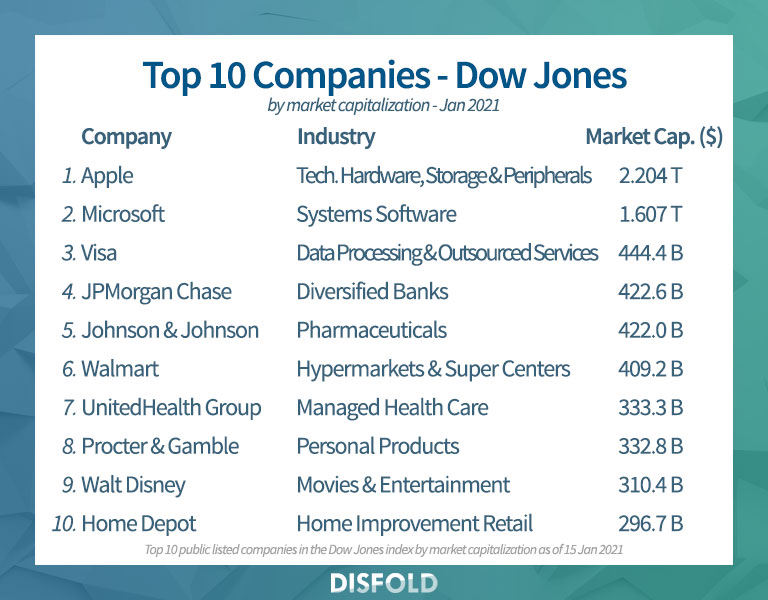
As of the current era, the 30 companies cover various sectors:
-
Information Technology: Including leaders like Apple and Microsoft.
-
Financials: Represented by giants like JPMorgan Chase and Goldman Sachs.
-
Healthcare: Including UnitedHealth Group and Johnson & Johnson.
-
Consumer Discretionary: Featuring companies like Home Depot and Amazon.
-
Consumer Staples: Such as Walmart and Coca-Cola.
-
Industrials: The “roots” of the index, represented by Boeing and Caterpillar.
By limiting the count to 30, the index provides a concentrated “snapshot.” If these 30 companies are struggling, it is usually a sign that the broader consumer and corporate environments are facing headwinds.
Limitations and Criticisms of the 30-Stock Index
Despite its fame, many professional investors and academics argue that 30 companies are not enough to provide a truly accurate picture of the modern, multi-trillion-dollar U.S. stock market.
The Concentration Risk
With only 30 stocks, the Dow is susceptible to “idiosyncratic risk.” If one major component—such as Boeing—faces a specific crisis that crashes its stock price, it can drag down the entire Dow Jones Industrial Average, even if the rest of the economy is performing well. In a broader index like the S&P 500, which tracks 500 companies, the failure of a single firm is diluted by the performance of the other 499.
Missing the “New Economy”
Because the Averages Committee favors established, profitable firms, the Dow is often slow to include the fastest-growing sectors of the economy. It took years for major tech players to be included, and many influential companies in biotech or renewable energy are currently absent. For this reason, many financial advisors suggest using the Dow as a measure of “Old Guard” stability rather than a measure of “New Economy” innovation.
How to Invest in the 30 Dow Companies
For individual investors, the question of “how many companies are in the Dow” is often followed by “how do I own them?” Buying all 30 stocks individually can be expensive and difficult to rebalance. Fortunately, the financial industry has created tools to make this easy.
Index Funds and ETFs
The most popular way to invest in the Dow is through Exchange-Traded Funds (ETFs). The most famous of these is the SPDR Dow Jones Industrial Average ETF Trust, which trades under the ticker symbol DIA (often called “Diamonds”). By purchasing shares of this ETF, an investor gains proportional exposure to all 30 companies in the index.
The Role of the Dow in a Balanced Portfolio
Most financial planners view a Dow-based investment as a “Core Large-Cap” holding. Because these 30 companies are the bedrock of American commerce, they tend to offer better protection during recessions compared to small-cap stocks. However, because the index is so concentrated, it is rarely recommended as an investor’s only holding. It is best used in conjunction with international stocks, small-cap funds, and bonds to create a diversified portfolio.

Conclusion: The Power of Thirty
The Dow Jones Industrial Average remains a cornerstone of the financial world not because 30 is a perfect number, but because of the history and the caliber of the companies that number represents. While it may not have the breadth of the S&P 500 or the tech-heavy focus of the Nasdaq, the Dow’s 30 companies represent the “Heavyweights” of the corporate world.
Whether you are a day trader watching the point swings or a long-term investor looking for dividend-paying stability, the 30 companies of the Dow offer a unique, price-weighted perspective on the American economic machine. As the economy continues to evolve, these 30 seats will continue to be occupied by the leaders of industry, serving as a permanent, yet ever-changing, reflection of financial progress.
aViewFromTheCave is a participant in the Amazon Services LLC Associates Program, an affiliate advertising program designed to provide a means for sites to earn advertising fees by advertising and linking to Amazon.com. Amazon, the Amazon logo, AmazonSupply, and the AmazonSupply logo are trademarks of Amazon.com, Inc. or its affiliates. As an Amazon Associate we earn affiliate commissions from qualifying purchases.