
The question “how many companies are in the Dow Jones?” is a deceptively simple query that opens the door to understanding one of the world’s most iconic and frequently cited stock market indices. For anyone involved in personal finance, investing, or simply following the pulse of the global economy, grasping the composition and significance of the Dow Jones Industrial Average (DJIA) is fundamental. This article delves into the core answer, explores the index’s financial relevance, its methodology, and why its constituent companies are so keenly watched by investors and financial analysts alike.

The Iconic Thirty: Unpacking the Dow Jones Industrial Average
At its heart, the Dow Jones Industrial Average is a benchmark, a barometer of the U.S. stock market’s health, and by extension, a proxy for the broader American economy. Its structure, while appearing straightforward, holds a rich history and unique methodology that differentiates it from other indices.
The Straight Answer: A Constant ‘Thirty’
The most direct answer to “how many companies are in the Dow Jones?” is thirty. The Dow Jones Industrial Average is comprised of exactly thirty large, publicly owned companies trading on the New York Stock Exchange (NYSE) and NASDAQ. This number has been a hallmark of the index since its expansion from twelve to thirty stocks in 1928, maintaining a consistent count ever since. These thirty companies are selected to represent a diverse array of industries, aiming to provide a broad yet concentrated snapshot of the market.
Beyond the Number: What the DJIA Represents
While the S&P 500 tracks 500 companies and the Russell 2000 focuses on small caps, the DJIA’s strength lies in its curation of a smaller, more exclusive group. The thirty companies within the Dow are not chosen at random; they are typically blue-chip stocks—established, financially sound companies with a history of stable earnings and often, dividend payments. They are leaders in their respective sectors and are widely recognized brands, making them bellwethers for economic trends. For investors, these companies often represent a relatively stable and mature segment of the market, offering potential for long-term growth and income. Understanding their collective performance offers insights into business finance health, consumer spending patterns, and overall market sentiment.
A Brief History of an American Bellwether
The Dow Jones Industrial Average was first calculated on May 26, 1896, by Charles Dow, editor of The Wall Street Journal and co-founder of Dow Jones & Company. Initially comprising just twelve companies, primarily industrial stocks like General Electric and American Cotton Oil, its purpose was to provide a clear, simple measure of the market’s direction. Over the decades, it evolved, expanding to twenty companies in 1916 and then to its current thirty in 1928. This long history grants the DJIA a unique perspective, allowing investors to trace market cycles, economic booms, and recessions through its performance data, serving as a powerful financial tool for historical analysis.
The Selection Process: More Than Just Market Cap
Unlike market-capitalization-weighted indices where larger companies naturally exert more influence, the Dow’s composition is carefully managed by a committee. The selection of the thirty companies is not an automatic process based purely on quantitative metrics like market capitalization or industry sector size.
Criteria for Inclusion: Reputation, Growth, and Investor Interest
The committee responsible for maintaining the Dow—S&P Dow Jones Indices—considers several qualitative and quantitative factors when deciding which companies to include or remove. Key criteria include:
- Excellent Reputation: Companies must have an excellent reputation and demonstrate sustained growth.
- Significance to Investors: They should be of interest to a large number of investors.
- Industry Leadership: They are expected to be leaders in their industry, representing a substantial portion of their sector’s activity.
- Broad Investor Base: The company must be incorporated and headquartered in the U.S. and generate a majority of its revenues from the U.S.
- Sector Representation: The committee aims for a balanced representation of the broad U.S. economy, though not strictly adhering to a perfect sector breakdown.
This selective process ensures that the Dow maintains its status as a reflection of established, influential American businesses, which is crucial for individual investors seeking stable investment opportunities and for institutional investors benchmarking their portfolios.
The Role of S&P Dow Jones Indices Committee
The S&P Dow Jones Indices committee makes changes to the index “as needed,” not on a fixed schedule. This means adjustments occur when a company’s business is no longer representative of the broader market, undergoes a significant merger or acquisition, or faces other structural changes that impact its relevance as a bellwether. Such changes are rare and are often driven by the need for the index to continue to accurately reflect the economic landscape. When a company is added or removed, it often triggers significant market attention, impacting stock prices and trading volumes for both the incoming and outgoing entities, a critical consideration in financial analysis.
Understanding the Dow Divisor: A Price-Weighted Index
Perhaps the most distinctive characteristic of the DJIA, from a financial tools perspective, is its price-weighted methodology. Unlike the S&P 500, which is market-capitalization-weighted, the Dow gives more weight to companies with higher stock prices. This means a $1 change in the share price of a $300 stock will have a greater impact on the index’s value than a $1 change in a $100 stock, even if the latter has a much larger overall market capitalization.
To account for stock splits, spin-offs, and changes in the index’s composition, a “Dow Divisor” is used. This divisor is adjusted periodically to ensure that the index’s value remains comparable over time, preventing artificial jumps or drops. The actual calculation of the DJIA involves summing the prices of the thirty stocks and then dividing by this specialized divisor. This unique weighting system is a key point of discussion among financial professionals and investors, highlighting the nuances of different index construction methods and their implications for portfolio tracking and performance measurement.
Why the Dow Matters to Investors and the Economy
Despite its methodological quirks and relatively narrow scope compared to other indices, the Dow Jones Industrial Average holds immense sway in financial markets and public perception. Its movements are closely watched, reported on, and debated, making it an indispensable component of investment strategy and economic analysis.
A Snapshot of Market Health
For many, the DJIA is the simplest and most accessible indicator of how the stock market is performing on a given day. News reports frequently lead with “the Dow was up X points today,” immediately conveying a sense of market optimism or pessimism. This straightforward reporting makes it a vital financial tool for general public understanding of economic trends. For personal finance management, understanding these broad market movements can inform decisions about investment allocation, risk tolerance, and when to consult a financial advisor. While not a comprehensive measure, its direction often correlates with broader market sentiment, influencing investor psychology.
Psychological Impact and Media Focus
The long history and iconic status of the Dow mean it has a significant psychological impact on investors and the public. Major milestones, such as crossing 10,000, 20,000, or 30,000 points, become national news, fueling confidence or concern. This media focus solidifies its role as a key financial indicator, guiding narratives around economic growth, corporate earnings, and investment opportunities. For businesses, the performance of the Dow can be seen as a reflection of the broader economic environment, influencing strategic planning, capital expenditure decisions, and investor relations.
Benchmarking Performance for Funds and Portfolios
Professional money managers and individual investors frequently use the DJIA as a benchmark. While many funds track the S&P 500, the Dow still serves as a relevant comparator for portfolios focused on large-cap, blue-chip stocks. Analyzing whether a portfolio has outperformed or underperformed the Dow provides valuable insights into investment strategy effectiveness. This benchmarking is a critical aspect of financial tools for performance evaluation, helping investors assess the success of their investment choices and make informed adjustments. For those engaging in online income generation through trading or passive investing, understanding how their chosen assets perform relative to the Dow can be a crucial indicator of success.
Limitations and Criticisms of the DJIA
While widely recognized, the Dow Jones Industrial Average is not without its critics. Its unique construction and limited number of constituents lead to several limitations that informed investors and financial professionals must consider.
The Price-Weighted Conundrum
The primary criticism leveled against the Dow is its price-weighted methodology. As discussed, a higher-priced stock, regardless of its company’s size or market capitalization, exerts a greater influence on the index. This can lead to a skewed representation, where a smaller company with an expensive stock price can move the index more than a larger company with a cheaper stock price. This contrasts sharply with market-cap-weighted indices, which more accurately reflect the aggregate wealth of shareholders. For sophisticated investors, understanding this distinction is crucial when using indices as financial tools for portfolio analysis and asset allocation.
Limited Sector Representation
With only thirty companies, the DJIA cannot fully represent the vast diversity of the U.S. economy. While efforts are made to include companies from various sectors, the index often lacks representation from crucial growth areas or emerging industries. For example, some rapidly expanding tech companies might not meet the “blue-chip” criteria for inclusion, or smaller, innovative sectors might be completely absent. This narrow scope means that while the Dow gives a good snapshot of established American industry, it may not fully capture the dynamism or breadth of the entire market. This can be a concern for investors looking to diversify or gain exposure to specific high-growth sectors.
A Narrow Window into a Broad Economy
The U.S. economy is a colossal and multifaceted entity. Relying solely on the performance of thirty companies, even if they are market leaders, provides a relatively narrow perspective. This can be particularly misleading during periods when certain sectors or market segments are performing exceptionally well or poorly, but their impact isn’t fully reflected in the Dow. For comprehensive financial analysis and investment planning, it’s essential to consult a range of indices and economic indicators, including broader market-cap-weighted indices like the S&P 500, small-cap indices, and international benchmarks. Business finance decisions also require a much deeper dive into specific industry trends and macroeconomic factors beyond what the Dow alone can offer.
The Ever-Evolving Dow: Adapting to Economic Shifts
Despite its inherent limitations, the Dow Jones Industrial Average has demonstrated remarkable resilience and adaptability, continuously evolving to remain relevant in a dynamic global economy. Its enduring presence underscores its significance as a financial tool for generations of investors.
Notable Additions and Removals
The history of the Dow is punctuated by significant changes to its composition, reflecting the rise and fall of industrial titans and the emergence of new economic powerhouses. General Electric, an original component, was removed in 2018 after more than a century, making way for Walgreens Boots Alliance. More recently, Salesforce replaced ExxonMobil in 2020, signaling a continued shift from traditional industrial and energy giants to technology and cloud-based services. These changes are not just historical footnotes; they represent the ongoing efforts of the S&P Dow Jones Indices committee to ensure the index remains a relevant barometer of the U.S. economy, adapting to shifts in corporate dominance and sector importance.
Reflecting the Modern Economy
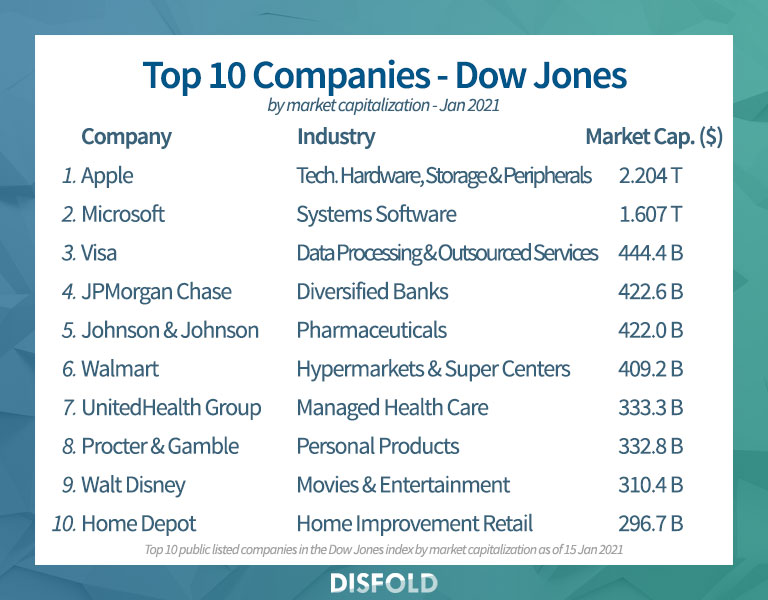
The constant evolution of the Dow’s constituent companies is crucial for its continued relevance. As the U.S. economy has transformed from manufacturing and heavy industry to technology, services, and healthcare, the index has slowly but surely mirrored these shifts. The inclusion of companies like Apple, Microsoft, UnitedHealth Group, and Visa demonstrates this commitment to reflecting the modern economic landscape. For investors, this ensures that the index, despite its limitations, continues to offer a glimpse into the performance of companies that are central to contemporary economic activity and consumer spending, which is vital for understanding current investment opportunities and risks.

The Dow’s Enduring Relevance in a Diverse Market Landscape
In conclusion, while the answer to “how many companies are in the Dow Jones?” is a simple thirty, the implications of that answer are far-reaching. The Dow Jones Industrial Average, with its exclusive group of blue-chip companies, serves as a powerful symbol and a key indicator for investors, financial analysts, and the general public. While it should not be the sole basis for investment decisions or economic analysis due to its price-weighted nature and limited scope, its historical significance, media prominence, and role as a quick gauge of market health solidify its position as an indispensable financial tool. Understanding the Dow is not just about knowing a number; it’s about appreciating its unique place in the tapestry of global finance and its ongoing ability to offer insights into the heartbeat of the American economy. For anyone navigating the complexities of personal finance, investing, or business finance, the Dow remains a foundational concept worthy of attention.
aViewFromTheCave is a participant in the Amazon Services LLC Associates Program, an affiliate advertising program designed to provide a means for sites to earn advertising fees by advertising and linking to Amazon.com. Amazon, the Amazon logo, AmazonSupply, and the AmazonSupply logo are trademarks of Amazon.com, Inc. or its affiliates. As an Amazon Associate we earn affiliate commissions from qualifying purchases.