
In the traditional world of finance, central banks possess the unilateral power to print currency, a practice known as quantitative easing. This often leads to the devaluation of money over time through inflation. In stark contrast, Bitcoin was engineered with a protocol-level scarcity that mimics the properties of precious metals rather than paper money. For investors, the most critical question regarding this digital asset is not just what it is worth today, but how much of it remains to be discovered.
As of late 2024, the Bitcoin network has surpassed several major milestones. Understanding how many Bitcoins are left to mine is not merely a technical curiosity; it is a fundamental pillar of the “digital gold” investment thesis. With a hard cap of 21 million coins, Bitcoin’s supply schedule is one of the most predictable and transparent monetary policies in human history.
The Scarcity Principle: Understanding Bitcoin’s Fixed Supply
At the heart of Bitcoin’s value proposition is its absolute scarcity. Unlike gold, where a massive new discovery could theoretically flood the market, or fiat currency, which can be issued at will by governments, Bitcoin’s total supply is mathematically locked.
The 21 Million Hard Cap
When Satoshi Nakamoto released the Bitcoin whitepaper in 2008, the code specified that only 21,000,000 BTC would ever exist. This limit is enforced by the consensus of the network’s participants. To change this number, a vast majority of the network would have to agree to a protocol upgrade that would effectively devalue their own holdings—a scenario that is economically disincentivized. This hard cap creates a “supply shock” mechanism that becomes more pronounced as we approach the final coins.
Why Scarcity Drives Valuation in Personal Finance
In the context of an investment portfolio, scarcity is a hedge against the debasement of purchasing power. When an asset has a fixed supply and the demand for that asset increases, the price must rise to reach a new equilibrium. This is why many financial advisors now view Bitcoin as a “Store of Value” (SoV). By understanding that there is a finite end to the production of new coins, investors can view Bitcoin as a long-term insurance policy against inflationary pressures in the global economy.
The Current State of Bitcoin Mining and Circulating Supply
To understand how many Bitcoins are left to mine, we must first look at how many are already in circulation. The process of “mining” involves specialized computers solving complex mathematical puzzles to secure the network and verify transactions. In exchange for this work, miners are rewarded with newly minted Bitcoins.
How Many Bitcoins Are Left?
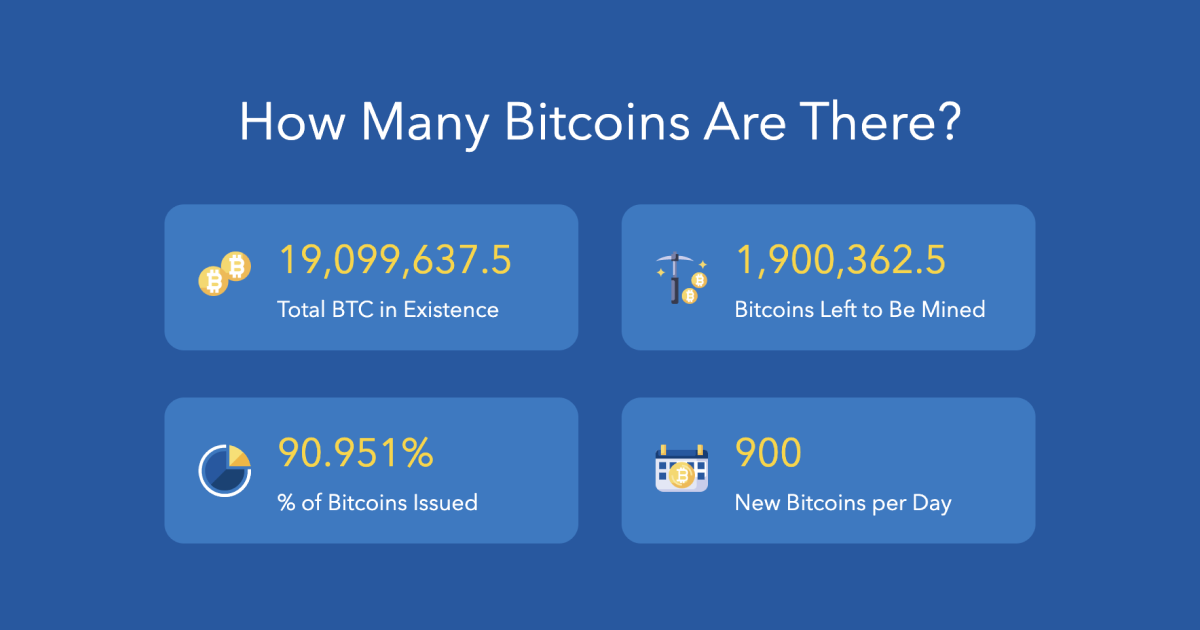
As of current estimates, approximately 19.75 million Bitcoins have already been mined. This means that roughly 94% of the total supply is already in the hands of the public, institutions, or lost in dormant wallets. Consequently, there are only about 1.25 million Bitcoins left to be mined.
This remaining sliver of supply is what the entire global mining industry is competing for over the next century. For the individual investor, this signifies that we have moved past the “early adoption” phase of supply distribution and are entering a phase of extreme digital “land” scarcity.
The Rate of Issuance and the “Block Reward”
New Bitcoins enter the market through “block rewards.” Currently, every ten minutes, a new block is added to the blockchain, and the miner who solved it receives 3.125 BTC. This steady, predictable issuance allows financial analysts to project exactly how much supply will hit the market on any given day, a level of transparency that is impossible to achieve with commodities like oil or silver.
The Halving Mechanism: Slowing the Flow to Zero
One might assume that the remaining 1.25 million Bitcoins will be mined quickly, given the speed of modern computing. However, Bitcoin includes an elegant “Halving” mechanism that ensures the remaining supply is released slower and slower over time.
How the Halving Impacts Supply and Demand
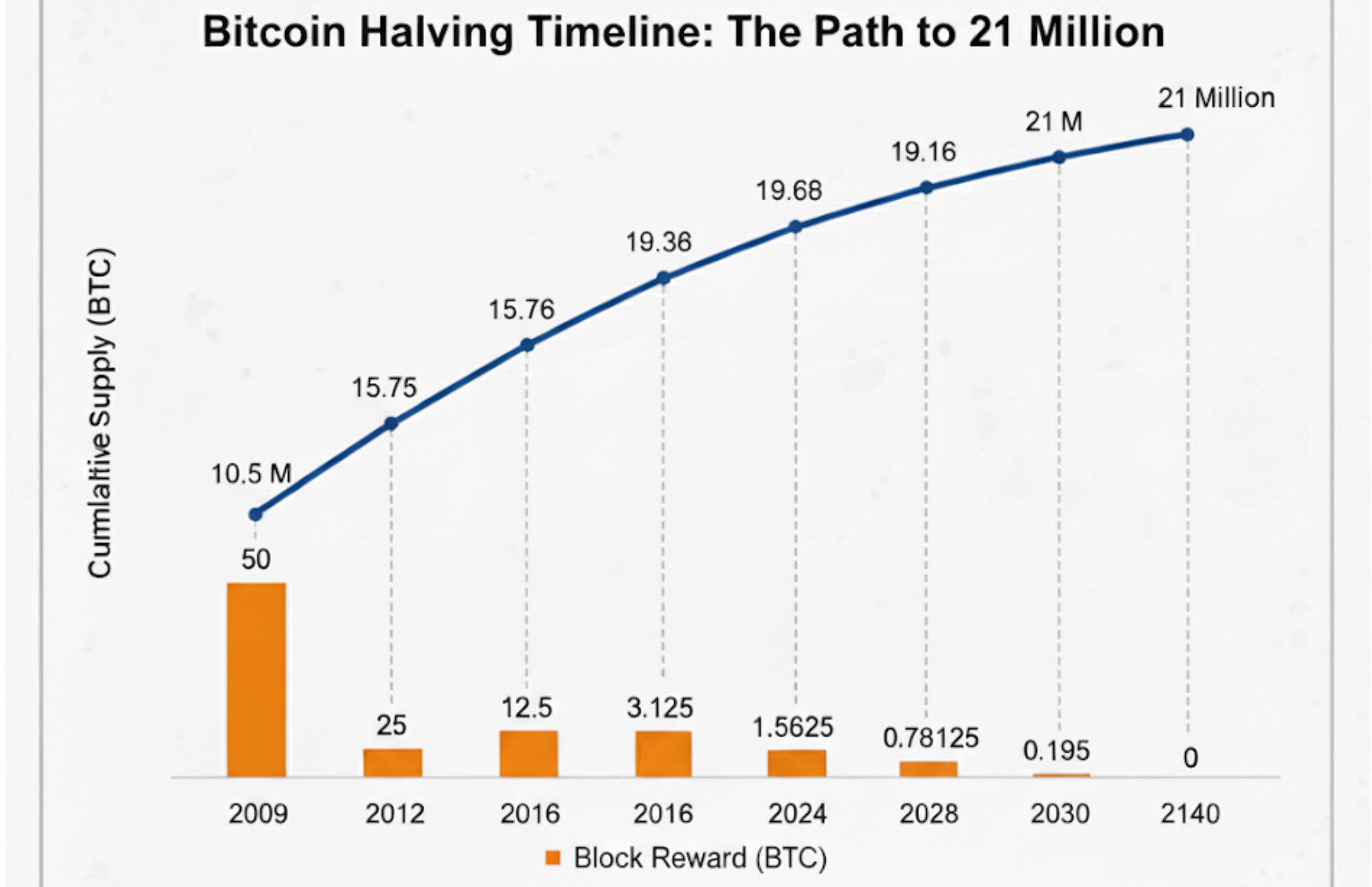
Every 210,000 blocks (roughly every four years), the reward for mining a block is cut in half. We have already seen several halvings:
- 2009: 50 BTC per block
- 2012: 25 BTC per block
- 2016: 12.5 BTC per block
- 2020: 6.25 BTC per block
- 2024: 3.125 BTC per block
From a market perspective, the halving is a “supply side” event. If the demand for Bitcoin remains constant or grows while the production of new supply is cut by 50%, the upward pressure on price is historically significant. This cycle has traditionally been a catalyst for major bull markets in the crypto space.
The Long Road to 2140
Because of the halving mechanism, the rate of new Bitcoin production will continue to diminish until it reaches the smallest unit, a “Satoshi” (0.00000001 BTC), which cannot be halved further. Based on current projections, the very last Bitcoin (or fraction thereof) will not be mined until approximately the year 2140.
This extended timeline is intentional. It allows the Bitcoin ecosystem over a century to transition from a “subsidy-based” economy (where miners are paid in new coins) to a “fee-based” economy (where miners are paid via transaction fees).
Investment Implications: What Happens When the Last Bitcoin is Mined?
For a long-term investor, the eventual end of Bitcoin mining raises questions about the network’s security and the asset’s price floor. If no new coins are being created, why would miners continue to secure the network?
The Shift from Block Rewards to Transaction Fees
When the 21 millionth Bitcoin is mined, the “block subsidy” will vanish. At that point, miners will be compensated exclusively through transaction fees paid by users. As Bitcoin adoption grows and it is used for more high-value settlements and “Layer 2” applications (like the Lightning Network), the cumulative transaction fees per block are expected to provide sufficient economic incentive for miners to continue their work. For investors, this represents a transition of Bitcoin into a mature, self-sustaining financial network.
Deflationary Pressure and Portfolio Strategy
As we approach the 21 million limit, Bitcoin becomes functionally “deflationary” in its issuance. However, it is important to distinguish between “nominal supply” and “effective supply.” While 21 million is the limit, the number of Bitcoins actually available for purchase is much lower.
Strategic investors utilize this information by practicing “Dollar Cost Averaging” (DCA). By buying small amounts regularly, they accumulate a percentage of the finite 21 million regardless of short-term price volatility. The knowledge that the supply can never be diluted provides a level of certainty that is unique to the digital asset class.
Lost Bitcoins and the “Effective” Circulating Supply
While the math says there will be 21 million Bitcoins, the practical reality for the market is quite different. A significant portion of the Bitcoins already mined will never circulate again.
Dead Keys and “Zombie” Coins
In the early days of Bitcoin (2009–2012), the asset had little to no monetary value. Many early miners lost their private keys, threw away hard drives, or passed away without leaving access to their wallets. Chainalysis, a blockchain data firm, estimates that between 3 to 4 million Bitcoins may be lost forever.
From an economic standpoint, lost coins are a “gift” to all other holders. They effectively reduce the total supply even further. If 4 million coins are lost, the actual circulating supply will never exceed 17 million.
Impact on Market Liquidity
As institutional players like BlackRock and Fidelity launch Bitcoin ETFs, they are removing supply from exchanges and placing it into “cold storage” for long-term holding. When you combine the lost coins, the coins held by long-term “HODLers,” and the shrinking mining rewards, the “liquid supply” available for sale on exchanges is hitting multi-year lows. For the investor, this “liquidity crunch” is a fundamental driver of price appreciation.

Conclusion: The Finality of Digital Gold
The question of how many Bitcoins are left to mine is the most important metric for anyone looking at the asset through a financial lens. With only about 1.25 million coins remaining to be issued over the next 116 years, the era of “easy” Bitcoin accumulation is drawing to a close.
Bitcoin represents a paradigm shift in personal finance. It is the first time humanity has had access to a portable, divisible, and verifiable asset with a supply that cannot be manipulated by any person, corporation, or government. As the mining rewards continue to halve and the remaining supply trickles onto the market, the scarcity of Bitcoin will likely become its most dominant economic feature.
For those looking to build wealth in a digital-first economy, understanding this countdown to 21 million is not just about technology—it’s about recognizing the ultimate shift in how value is stored and preserved for the next century. Regardless of market volatility, the math of Bitcoin remains constant: the supply is going down, and the clock is ticking toward the final coin.
aViewFromTheCave is a participant in the Amazon Services LLC Associates Program, an affiliate advertising program designed to provide a means for sites to earn advertising fees by advertising and linking to Amazon.com. Amazon, the Amazon logo, AmazonSupply, and the AmazonSupply logo are trademarks of Amazon.com, Inc. or its affiliates. As an Amazon Associate we earn affiliate commissions from qualifying purchases.