
The Great Depression remains the most significant economic cataclysm in modern history, serving as a somber masterclass in financial fragility and the importance of systemic stability. At the heart of this decade-long crisis was the catastrophic collapse of the American banking system. For today’s investors, business owners, and personal finance enthusiasts, understanding the scale and cause of these failures is not merely a historical exercise; it is essential for understanding the safeguards that protect our wealth today.
Between 1929 and 1939, thousands of financial institutions vanished, taking with them the life savings of millions of citizens and fundamentally altering the landscape of global finance. To answer the question of how many banks failed, one must look at the progression of the crisis, which saw roughly 9,000 banks shutter their doors over the course of the decade.
The Scope of the Collapse: A Decade of Financial Ruin
The banking crisis of the Great Depression did not happen overnight. While the stock market crash of October 1929 is often cited as the starting point, the erosion of the banking sector was a compounding disaster that built momentum over several years. In the 1920s, the United States had a highly fragmented banking system, characterized by thousands of small, independent “unit banks.” This lack of diversification made the system incredibly vulnerable to localized economic shocks.
The Initial Shock (1929–1930)
In 1929, the year of the crash, 659 banks failed. While this number was high compared to modern standards, it was not entirely unprecedented for the era. However, the nature of these failures changed in 1930. As agricultural prices plummeted and the stock market failed to recover, the first of four distinct “banking panics” began. By the end of 1930, the number of failed institutions more than doubled to 1,350.
The most symbolic failure of this period was the Bank of United States in New York City. Despite its name, it was a private commercial bank, but its collapse in December 1930 shattered public confidence. It was the largest bank failure in U.S. history up to that point, holding over $200 million in deposits. When it closed, it signaled to the public that even large, urban institutions were no longer safe.
The Contagion Spreads (1931–1932)
The situation worsened significantly in 1931. International financial instability, including the collapse of major banks in Austria and Germany, put additional pressure on the U.S. gold supply. Domestically, the “contagion of fear” took hold. In 1931 alone, 2,293 banks failed.
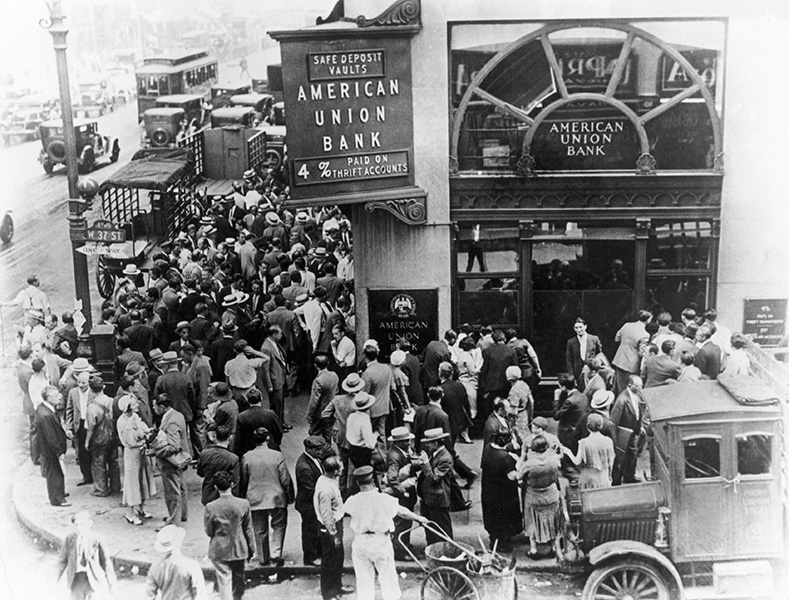
The mechanism was simple but devastating: a “bank run.” Because banks operate on a fractional reserve system—lending out most of the money deposited while keeping only a small fraction on hand—they cannot survive if all depositors demand their cash simultaneously. As news of one bank failure spread, panicked depositors at neighboring banks rushed to withdraw their funds, creating a self-fulfilling prophecy of insolvency. By 1932, another 1,453 banks had collapsed, bringing the total to over 5,000 in just three years.
The Statistics of Failure: Mapping the Numbers
To comprehend the magnitude of the Great Depression, one must look at the density of the failures relative to the total number of banks in existence. In 1929, there were approximately 25,000 banks operating in the United States. By the time the crisis bottomed out in 1933, nearly one-third of those institutions had disappeared.
Year-by-Year Breakdown of Bank Closures
The chronological data provides a clear picture of the escalating crisis:
-
1929: 659 banks (Total deposits lost: $231 million)
-
1930: 1,350 banks (Total deposits lost: $853 million)
-
1931: 2,293 banks (Total deposits lost: $1.7 billion)
-
1932: 1,453 banks (Total deposits lost: $706 million)
-
1933: ~4,000 banks (Total deposits lost: $3.6 billion)
The total loss of deposits during this era was staggering. It is estimated that depositors lost approximately $140 billion in today’s inflation-adjusted dollars. For the average family in the 1930s, a bank failure meant the total evaporation of their emergency fund, their children’s education savings, and their sense of financial security.
The Climax in 1933 and the Bank Holiday
The crisis reached its zenith in early 1933. By March, the banking system was on the verge of a total, nationwide collapse. Governors in several states had already declared “banking holidays” to prevent further runs. Upon his inauguration, President Franklin D. Roosevelt took immediate action by declaring a federal Banking Holiday on March 6, 1933.
For one full week, every bank in the United States was closed. During this time, government inspectors evaluated the solvency of each institution. Only those deemed financially sound were permitted to reopen. This move was a psychological masterstroke. When the banks reopened, more people lined up to deposit money than to withdraw it. While approximately 4,000 banks failed or were forced into mergers during 1933, the “holiday” effectively ended the era of mass bank runs.
Why Did So Many Banks Fail?
Analyzing the “why” behind these failures reveals deep structural flaws in the early 20th-century financial system. These vulnerabilities serve as a cautionary tale for modern business finance and regulatory policy.
Lack of Federal Oversight and the Fractional Reserve Trap
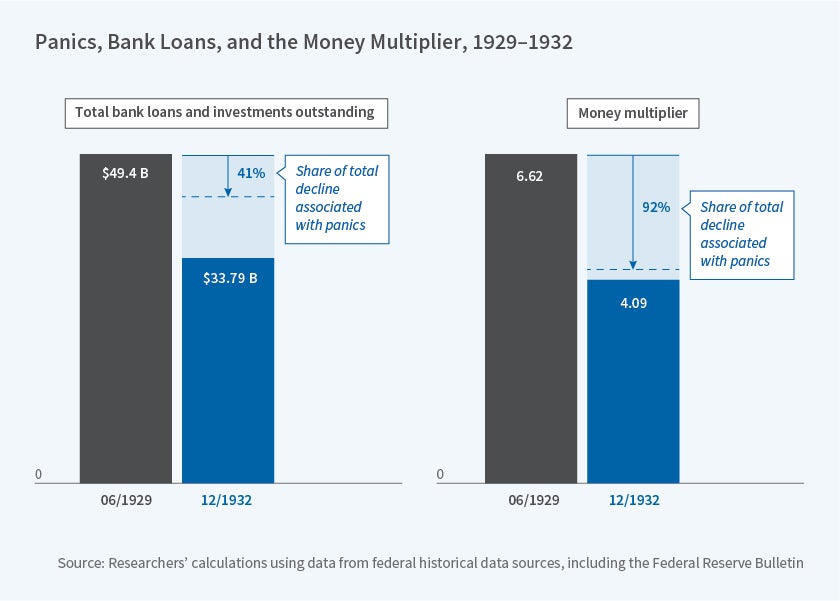
During the 1920s, the Federal Reserve—only a decade and a half old at the time—failed to act as a “lender of last resort.” According to many economists, including Milton Friedman, the Fed’s decision to contract the money supply and raise interest rates during the crisis exacerbated the problem. Instead of pumping liquidity into the system to save solvent but illiquid banks, the Fed allowed the money supply to shrink by nearly one-third, starving the economy of the capital it needed to function.
The Unit Banking System and Rural Vulnerability
Unlike Canada, which had a few large banks with many branches and saw zero bank failures during the Depression, the U.S. relied on “unit banking.” Laws at the time often prohibited banks from opening branches across state lines or even within the same county. This meant that if a local drought hit a farming community, the local bank—whose assets were entirely tied to that community’s ability to repay loans—would inevitably fail. There was no larger corporate entity to absorb the losses, leading to a domino effect across rural America.
The Interplay of Investment and Commercial Banking
In the lead-up to 1929, many commercial banks used depositor funds to speculate in the stock market or lent heavily to affiliates who did. When the market crashed, the value of the banks’ assets plummeted. This blurring of lines between “safe” commercial banking (holding savings and making mortgages) and “risky” investment banking (underwriting securities) created a systemic risk that the 1930s economy could not withstand.
The Lasting Impact on Modern Personal Finance and Banking
The trauma of 9,000 bank failures led to a total overhaul of the American financial system. Most of the protections we take for granted today were born from the wreckage of the 1930s.
The Birth of the FDIC
The most significant outcome was the creation of the Federal Deposit Insurance Corporation (FDIC) through the Banking Act of 1933. For the first time, the federal government guaranteed that if a bank failed, the government would reimburse depositors up to a certain limit (initially $2,500, now $250,000 per depositor). This single piece of legislation virtually eliminated the primary cause of bank runs—fear. Today, even when a bank like Silicon Valley Bank or Signature Bank fails, there is no widespread panic because the public trusts the FDIC safety net.
The Glass-Steagall Act
Another landmark reform was the Glass-Steagall Act, which mandated the separation of commercial and investment banking. The goal was to ensure that the “boring” but essential functions of a bank—taking deposits and providing consumer loans—were never again put at risk by high-stakes market speculation. While parts of this act were repealed in 1999, the core philosophy of ring-fencing consumer deposits remains a central pillar of financial discussion.
Lessons for Today’s Investors and Savers
The history of the Great Depression’s banking failures offers invaluable insights for anyone managing wealth in the modern era. While our system is significantly more robust, the fundamental principles of risk remain the same.
Diversification and Counterparty Risk
The 9,000 failures of the 1930s remind us that no institution is invincible. Modern personal finance experts still advise diversifying “counterparty risk.” This means not keeping all your capital in a single institution, especially if your balances exceed the FDIC or NCUA insurance limits. For business owners, having relationships with multiple financial institutions ensures that a localized or institutional crisis doesn’t freeze the company’s entire payroll and operating capital.
The Importance of Liquidity
Many banks in the 1930s were technically “solvent” (their assets were worth more than their liabilities) but “illiquid” (they couldn’t turn those assets into cash fast enough to pay depositors). For the individual investor, the lesson is to maintain an emergency fund in high-liquidity accounts. During a systemic crisis, the value of “cash on hand” or “cash equivalents” cannot be overstated.
Understanding the Role of the Central Bank
Investors must keep a close watch on central bank policy. The Great Depression proved that the Federal Reserve’s actions—whether they choose to provide liquidity or tighten the money supply—dictate the survival of the financial ecosystem. In the modern era, during crises like 2008 or the 2020 pandemic, the Fed has applied the lessons of the 1930s by aggressively providing liquidity to prevent the kind of mass bank failures that characterized the 1930s.
The story of the 9,000 failed banks is more than a statistic; it is a narrative of human panic and structural evolution. By understanding the scale of this collapse, modern savers can better appreciate the regulatory frameworks that protect their wealth and remain vigilant about the ever-present need for sound financial management. Over eight decades later, the echoes of the Great Depression still shape how we earn, save, and protect our money.
aViewFromTheCave is a participant in the Amazon Services LLC Associates Program, an affiliate advertising program designed to provide a means for sites to earn advertising fees by advertising and linking to Amazon.com. Amazon, the Amazon logo, AmazonSupply, and the AmazonSupply logo are trademarks of Amazon.com, Inc. or its affiliates. As an Amazon Associate we earn affiliate commissions from qualifying purchases.