
Wire transfers are an indispensable tool in modern finance, enabling rapid and secure movement of funds across local and international borders. For individuals and businesses alike, understanding the intricacies of these transactions, particularly when dealing with a major financial institution like Bank of America, is crucial. The question of “how long does a wire transfer take?” is not merely about curiosity; it’s central to financial planning, managing cash flow, and ensuring timely payments. This comprehensive guide delves into the mechanisms, influencing factors, expected timelines, and best practices for conducting wire transfers through Bank of America, aiming to provide clarity and empower users with the knowledge needed for seamless financial operations.
Understanding the Mechanics of a Wire Transfer
Before diving into the specifics of timing, it’s essential to grasp what a wire transfer entails and its fundamental operational framework. This foundation will help demystify the process and explain why certain factors affect its speed.
What is a Wire Transfer?
At its core, a wire transfer is an electronic transfer of funds from one person or entity to another. Unlike checks or Automated Clearing House (ACH) transfers, wire transfers are typically faster because they move money directly between banks, often in real-time or near real-time, without relying on a clearing house. This direct communication makes them ideal for time-sensitive transactions, large sums of money, or international payments where speed and certainty are paramount. The “wire” in the name harks back to the original telegraph wires used to transmit messages between banks, although today the process is entirely digital.
Key Players in a Wire Transfer
A wire transfer involves several key participants, each playing a critical role in its successful execution:
- Sender: The individual or entity initiating the transfer.
- Sending Bank (Originator’s Bank): In this context, Bank of America, which processes the sender’s request and transmits the funds.
- Intermediary Bank (Correspondent Bank): For international transfers or transfers between smaller banks, an intermediary bank might be used to facilitate the routing of funds, especially if the sending and receiving banks don’t have a direct relationship.
- Receiving Bank (Beneficiary’s Bank): The financial institution holding the recipient’s account.
- Recipient (Beneficiary): The individual or entity receiving the funds.
The coordination and communication between these parties are vital to the speed and accuracy of the transfer.
Domestic vs. International Wire Transfers
A fundamental distinction that heavily influences transfer times is whether the wire is domestic or international.
- Domestic Wire Transfers: These occur between banks within the same country. In the U.S., they typically use the Fedwire system (operated by the Federal Reserve) or the Clearing House Interbank Payments System (CHIPS) for large-value payments. They generally involve fewer regulatory hurdles and simpler routing.
- International Wire Transfers: These cross national borders and often involve different currencies and banking systems. They primarily rely on the SWIFT (Society for Worldwide Interbank Financial Telecommunication) network, which is a messaging system that facilitates communication between thousands of financial institutions globally. International transfers are inherently more complex due to currency exchange, varying national regulations, and the potential involvement of multiple intermediary banks.
Factors Influencing Bank of America Wire Transfer Times
The actual time it takes for a wire transfer to complete with Bank of America is subject to a variety of factors. Understanding these can help set realistic expectations and avoid potential delays.
Cut-Off Times and Business Days
One of the most critical factors is the cut-off time of the sending bank (Bank of America) and the receiving bank. Banks typically have specific daily deadlines for processing wire transfers. If a transfer request is submitted after this cut-off time, it will usually be processed on the next business day. Similarly, transfers initiated on weekends or bank holidays will only begin processing on the subsequent business day.
- Bank of America Domestic Wire Transfer Cut-Off: Often around 5:00 PM EST, but it’s crucial to confirm the exact time for your specific transaction type and region directly with Bank of America.
- Bank of America International Wire Transfer Cut-Off: May be earlier than domestic cut-off times, sometimes as early as 3:00 PM EST, due to the additional complexities involved.
Sender and Recipient Information Accuracy
Errors in the transfer details are a leading cause of delays. Even a small discrepancy, such as an incorrect account number, routing number (ABA for domestic, SWIFT/BIC for international), or recipient name, can cause the transfer to be held for review, returned to the sender, or even sent to the wrong account. Bank of America, like other banks, employs stringent checks to ensure funds are sent to the correct beneficiary.
Destination of Funds (Domestic vs. International)
As previously mentioned, the destination fundamentally alters the timeline. Domestic transfers within the U.S. typically move faster than international ones due to a more streamlined regulatory and technical infrastructure. International transfers involve currency conversions, adherence to various national laws, and often transit through correspondent banks, all of which add time.
Receiving Bank’s Policies and Processing
While Bank of America might process the outgoing wire swiftly, the ultimate delivery to the recipient’s account depends on the receiving bank’s internal processing procedures. Some banks may have different cut-off times, hold periods, or internal verification steps before crediting funds to a customer’s account. This is particularly true for smaller banks or those in less-developed financial markets internationally.
Fraud Prevention and Compliance Checks
Banks are legally obligated to comply with anti-money laundering (AML) and counter-terrorist financing (CTF) regulations, such as the Bank Secrecy Act (BSA) in the U.S. Large wire transfers, or those involving certain high-risk jurisdictions or entities, may trigger enhanced scrutiny. These fraud prevention and compliance checks, while vital for security, can occasionally introduce delays as transactions are reviewed and verified.
Expected Timelines for Bank of America Wire Transfers
While the exact duration can vary, there are general expectations for how long different types of wire transfers take with Bank of America.
Domestic Wire Transfers
Domestic wire transfers are typically the fastest.
- Within Bank of America Accounts: Transfers between two Bank of America accounts are often instantaneous or take only a few minutes. This is because the transaction remains within the bank’s internal system, eliminating external processing.
- To Other U.S. Banks: For transfers from a Bank of America account to an account at another U.S. bank, funds generally arrive within a few hours to one business day. If initiated before the cut-off time on a business day, the recipient can often see the funds credited on the same day. Transfers initiated after the cut-off or on non-business days will be processed the next business day.
International Wire Transfers
International wire transfers are inherently more complex and thus take longer.
- SWIFT Network Processing: Most international wires use the SWIFT network. The message is sent instantly, but the actual movement of funds and processing by intermediary banks and the final receiving bank can take time.
- Typical Window: Generally, an international wire transfer from Bank of America can take anywhere from 1 to 5 business days to reach the recipient’s account. Some transfers, particularly to less common destinations or those involving complex routes, might even take longer.
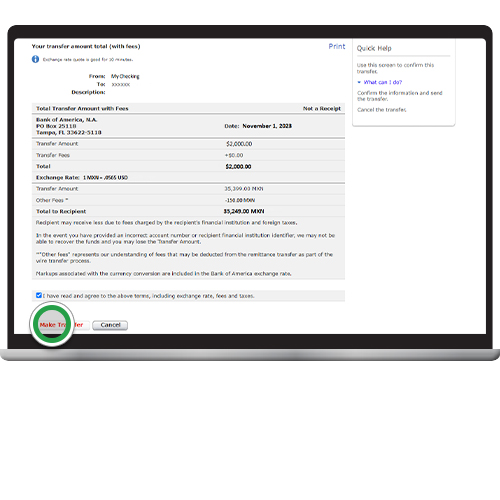
- Currency Conversion Delays: If the transfer involves a currency conversion, this process can add a small amount of time, as the exchange rate needs to be applied and the funds converted.
- Destination Country Regulations: Different countries have varying financial regulations and banking infrastructures. Some countries may have stricter reporting requirements or slower internal processing times, contributing to the overall delay.
Initiating a Wire Transfer with Bank of America: A Step-by-Step Guide
Executing a wire transfer successfully requires careful preparation and adherence to specific steps. Bank of America provides multiple channels for initiating these transactions.
Gathering Necessary Information
Accuracy is paramount. Before you start, ensure you have all the correct details for the recipient and their bank:
- Recipient’s Full Name and Address: As it appears on their bank account.
- Recipient’s Bank Name and Address: The full legal name of the bank and its physical address.
- Recipient’s Account Number: The exact account number where funds will be deposited.
- Domestic Transfers:
- ABA Routing Number: A nine-digit number that identifies the recipient’s bank in the U.S.
- International Transfers:
- SWIFT/BIC Code: The international equivalent of a routing number, identifying the recipient’s bank globally (8 or 11 characters).
- IBAN (International Bank Account Number): Required for transfers to many European countries and some other regions.
- Reason for Transfer: Often required for compliance and reporting, especially for international transfers.
Online Banking vs. Branch Visit
Bank of America offers flexibility in how you initiate a wire transfer:
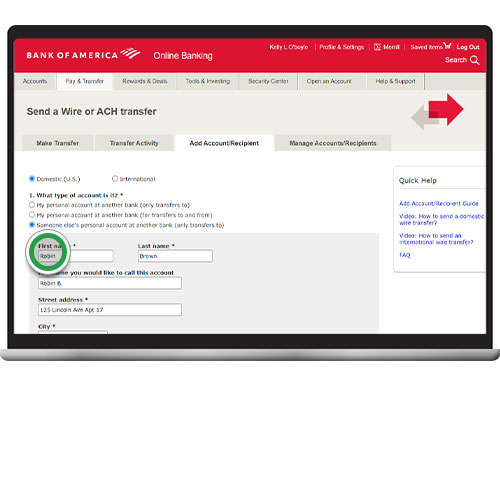
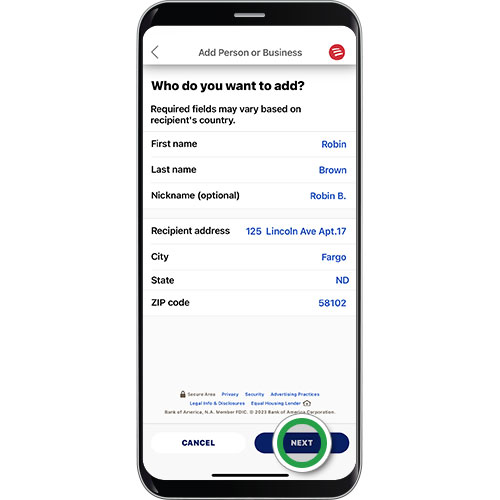
- Online Banking (Bank of America Online/Mobile App): This is often the most convenient method for existing customers. You can initiate domestic and international wires securely from your computer or mobile device. Online wires typically have lower fees than those initiated in a branch, and you can track their status.
- Visiting a Bank of America Branch: For those who prefer in-person assistance, need to send very large sums (potentially exceeding online limits), or are first-time wire senders seeking guidance, a branch visit is an option. Be prepared with your identification and all recipient details. Fees for branch-initiated wires are usually higher.
Understanding Fees and Limits
Wire transfers are not free. Bank of America charges fees for both domestic and international outgoing wires, and there may be different fees for online versus in-branch initiation.
- Domestic Outgoing Wire Fees: Typically range from $25 to $35.
- International Outgoing Wire Fees: Can range from $35 to $50, sometimes more depending on the currency and destination.
- Incoming Wire Fees: The recipient’s bank may also charge a fee for receiving an incoming wire. Bank of America generally charges a small fee (e.g., $15) for incoming international wires, though incoming domestic wires are often free to the recipient.
- Sending Limits: There are usually daily sending limits for online wire transfers, which can vary based on your account type and relationship with Bank of America. If you need to send a sum exceeding these limits, you may need to visit a branch.
Always confirm the latest fees and limits directly with Bank of America, as they are subject to change.
Troubleshooting and Best Practices for Smooth Transfers
While wire transfers are generally reliable, issues can arise. Knowing how to handle them and adopting best practices can prevent headaches.
What to Do If a Wire Transfer is Delayed
If a wire transfer takes longer than expected, here’s a course of action:
- Check Your Records: Verify that all information you provided was accurate.
- Contact Bank of America: Use the confirmation number provided to you. Bank of America’s customer service can often track the status of your transfer.
- Contact the Recipient: Ask them to check with their bank. The funds might have arrived but are pending credit due to the receiving bank’s internal processes.
- Inquire About Intermediary Banks: For international transfers, delays can occur with correspondent banks. Bank of America might be able to provide details on which intermediary banks were involved.
Double-Checking Details Before Sending
This cannot be stressed enough: triple-check all recipient and bank details before confirming the transfer. Unlike many other payment methods, wire transfers are often irreversible once sent. A small error can lead to significant complications, including loss of funds if sent to an incorrect account. Confirming the details directly with the recipient (e.g., through a phone call or secure channel) is a critical step, especially for large sums.
Keeping Records and Confirmation Numbers
Always retain the confirmation number or transaction reference number provided by Bank of America. This serves as your proof of payment and is essential for tracking, inquiries, or resolving any disputes. Keep records of the amount sent, the date, recipient details, and any communication with the bank.
Considering Alternatives to Wire Transfers
While wires are excellent for speed and security, they are not always the only or best option, especially given their fees. For certain situations, alternatives might be more suitable:
- ACH Transfers: For domestic payments that are not time-sensitive, ACH transfers are a more cost-effective alternative. They typically take 1-3 business days.
- Zelle: For small, immediate domestic transfers between individuals, Zelle (integrated into Bank of America’s online banking) offers a fast and free solution.
- Online Payment Platforms (e.g., PayPal, Venmo): Useful for person-to-person payments, but often come with fees for business transactions or international transfers, and may have different consumer protections.
- Checks: For non-urgent payments, traditional checks remain an option, though they are slower and carry different risks.
Understanding the typical duration of a wire transfer through Bank of America is vital for effective financial management. While domestic transfers are generally swift, often completing within a day, international transfers require more patience, typically ranging from 1 to 5 business days. By being meticulous with details, understanding cut-off times, and leveraging Bank of America’s resources, both individuals and businesses can ensure their wire transfers are executed as efficiently and securely as possible, making the most of this powerful financial tool.
aViewFromTheCave is a participant in the Amazon Services LLC Associates Program, an affiliate advertising program designed to provide a means for sites to earn advertising fees by advertising and linking to Amazon.com. Amazon, the Amazon logo, AmazonSupply, and the AmazonSupply logo are trademarks of Amazon.com, Inc. or its affiliates. As an Amazon Associate we earn affiliate commissions from qualifying purchases.