
Navigating the intricacies of tax season can be daunting, and for many, the anticipation of a tax refund is a significant part of the process. H&R Block, as one of the largest tax preparation services, offers various solutions, including the popular “Refund Transfer” option. This service can be incredibly convenient, allowing taxpayers to pay for their tax preparation fees directly from their refund, eliminating the need for upfront payment. However, a common question that arises is: how long does an H&R Block refund transfer actually take? Understanding the timeline involves grasping the interplay between the IRS, H&R Block, and the banking system. This article will break down the process, shed light on factors influencing the speed of your refund, and provide a clear picture of what to expect when you choose an H&R Block refund transfer.

Decoding the Refund Transfer Process with H&R Block
To truly understand the timeline, it’s essential to first demystify what a refund transfer entails and the roles of the key players involved. It’s more than just a direct deposit; it’s a specific financial transaction facilitated by H&R Block through a third-party bank.
What is a Refund Transfer?
A Refund Transfer (often referred to as a “Refund Anticipation Check” or “Refund Processing Service” by other providers) is a service that allows taxpayers to defer the payment of their tax preparation fees until their federal or state tax refund arrives. Instead of paying H&R Block upfront, the refund is first sent to a temporary bank account established by H&R Block’s banking partner. From this account, H&R Block’s fees (along with any associated fees for the refund transfer service itself) are deducted. The remaining balance of the refund is then disbursed to the taxpayer via their chosen method, typically direct deposit to their personal bank account or a prepaid debit card.
This service appeals to individuals who may not have readily available funds to pay for tax preparation at the time of filing or who simply prefer the convenience of having the fees automatically deducted from their refund. It’s crucial to understand that a refund transfer is not a loan or an advance on your refund (unless you specifically opt for a “Refund Advance” product). It is merely a mechanism to facilitate the payment of services.
The Role of the IRS in Your Refund Timeline
Before any refund transfer can occur, the Internal Revenue Service (IRS) must first process your tax return and approve your refund. This is the foundational step that dictates the earliest possible timeline for any refund, regardless of whether you use a refund transfer service.
The IRS typically processes electronically filed tax returns much faster than paper returns. For e-filed returns, the IRS generally issues most refunds within 21 calendar days. However, this is an estimate, and some refunds may take longer due to various factors like the need for manual review, errors, or identity verification. The IRS “Where’s My Refund?” tool is the definitive source for tracking the status of your federal refund. It provides updates from the time the IRS receives your return until the refund is sent to your bank. State tax refunds have their own separate processing times and tracking tools, which can vary significantly by state.
H&R Block, or any tax preparer, has no control over the IRS’s processing speed. Their service kicks in after the IRS has released the refund.
H&R Block’s Involvement: Facilitator, Not Funder
It’s vital to clarify H&R Block’s specific role in the refund transfer process. While H&R Block facilitates the service, they are not the entity that holds or directly disburses your refund. Instead, they partner with a federally insured bank (e.g., Pathward, N.A., formerly MetaBank, N.A.) to manage these temporary accounts.
When you opt for a refund transfer, the IRS sends your refund to this partner bank. The bank then deducts H&R Block’s fees and the refund transfer service fee. Once those deductions are made, the remaining balance is sent to your personal bank account or loaded onto a prepaid card. This extra step, involving an intermediary bank, is what can add a slight delay compared to a direct deposit of your refund directly from the IRS to your personal bank account. H&R Block provides tools to track the status of your refund after the IRS has released it to their banking partner, allowing you to see when the funds have been disbursed to you.
Factors Influencing Your Refund Transfer Speed
Several variables can impact how quickly your refund, especially one processed via an H&R Block refund transfer, lands in your account. Understanding these can help manage expectations.
E-file vs. Paper Returns
This is perhaps the most significant determinant of initial processing speed.
- Electronic Filing (E-file): E-filed returns are processed by the IRS much more quickly and efficiently than paper returns. The IRS can verify information electronically, reducing manual labor and the potential for errors. For most e-filed returns, the IRS issues refunds within 21 days.
- Paper Returns: Filing a paper return can significantly extend your refund timeline. The IRS must manually process these, which can take anywhere from 6 to 8 weeks, and sometimes even longer during peak periods or if there are errors. If you choose an H&R Block refund transfer with a paper return, the transfer process itself won’t begin until after this extended IRS processing period.
Accuracy of Your Return
Errors or discrepancies on your tax return are a leading cause of delays.
- Simple Errors: Incorrect Social Security numbers, bank account numbers, or math errors can trigger a manual review by the IRS, adding weeks or even months to your refund timeline.
- Identity Verification: If the IRS suspects identity theft or needs to verify your identity, they may send you a letter requiring further action, stalling your refund until the issue is resolved.
- Audit Flags: Certain deductions, credits, or income reporting patterns might trigger an audit, leading to a much longer review period.
Type of Refund Transfer Product Chosen
While the standard refund transfer involves a deduction of fees from your refund, H&R Block also offers other products that can affect the timeline or the immediacy of funds.
- Refund Advance: This is a short-term, zero-interest loan (with eligibility requirements) against your expected federal tax refund. If approved, you can receive funds within minutes of approval, often on the same day your return is filed and accepted by the IRS, long before the IRS issues the actual refund. This is a very different product from a standard refund transfer.
- Standard Refund Transfer: As explained, this involves the IRS sending the refund to H&R Block’s partner bank, deduction of fees, and then disbursement to you. This adds a few extra business days to the IRS’s standard 21-day timeline.
Bank Processing Times
Once H&R Block’s partner bank releases the remaining refund amount, it still needs to be deposited into your personal bank account.
- Receiving Bank’s Processing: Different banks have different policies regarding when they post incoming deposits. While many banks will post funds within 1-2 business days, some may take slightly longer, especially if the deposit is received late in the day or on a weekend. This is usually beyond H&R Block’s control.
- Prepaid Debit Cards: If you opt to receive your refund on a prepaid debit card (like the H&R Block Emerald Card), the funds are typically loaded onto the card shortly after the deduction of fees by the partner bank, potentially faster than a direct deposit to an external bank.
Peak Filing Season vs. Off-Peak
The sheer volume of tax returns filed can also impact processing times.
- Peak Season (January-April): During the busiest period of tax season, the IRS and associated financial institutions are handling millions of transactions. While efficiency is high, the sheer volume can sometimes lead to slight increases in processing times.
- Off-Peak Season: Filing later in the year (after April 15th) or amending a return may sometimes result in faster processing simply due to lower overall transaction volume for the IRS and banks.
Typical Timelines and What to Expect
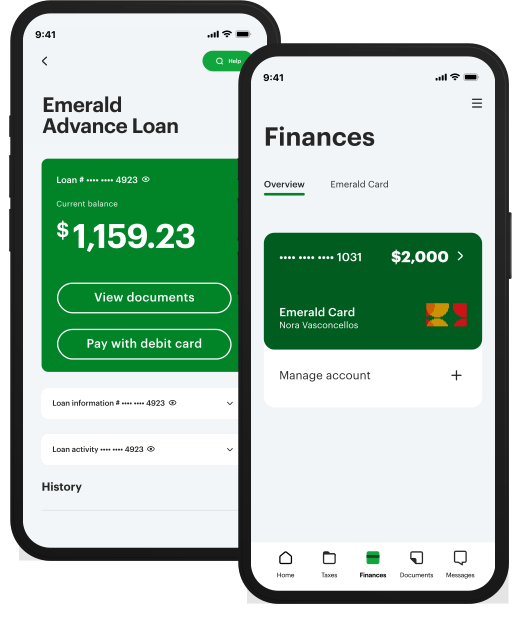
Setting realistic expectations for your refund transfer timeline is crucial. Here’s a general breakdown of what to anticipate.
Standard E-file and Direct Deposit
If you e-file your return and opt for direct deposit without a refund transfer service, the IRS typically issues your refund within 21 calendar days. Once issued, it usually appears in your bank account within 1-3 business days. So, a total of 3-4 weeks is a reasonable baseline.
Refund Transfer with H&R Block’s Bank Partner
When you choose an H&R Block refund transfer, the process introduces an additional layer of processing time. After the IRS issues the refund (typically within 21 days for e-filed returns), it first goes to H&R Block’s partner bank.
- IRS to Partner Bank: This usually takes 1-3 business days after the IRS “send date.”
- Deduction and Disbursement: The partner bank then deducts the fees and disburses the remaining funds to your personal bank account or prepaid card. This internal processing and transfer can take an additional 1-2 business days.
- Partner Bank to Your Account: Finally, your personal bank will process the incoming deposit, which can take 1-3 business days, depending on their policies.
Therefore, for an e-filed return with a refund transfer, you can generally expect your refund to arrive in your personal account approximately 5-7 business days after the IRS “Where’s My Refund” tool indicates your refund has been sent. This means the total wait could be around 3-5 weeks from the date you filed your return.
Refund Advance Program Timelines
If you were approved for an H&R Block Refund Advance, the timeline is significantly different. Funds for the Refund Advance are typically disbursed very quickly – often within minutes to hours of your tax return being filed and accepted by the IRS. This is because it’s a loan based on your expected refund, not the actual refund itself. The actual IRS refund then goes to repay this loan when it eventually arrives at the partner bank.
Checking Your Refund Status
Staying informed is key.
- IRS “Where’s My Refund”: This is your primary resource for tracking your federal refund’s status directly from the IRS. It will tell you when your return was received, approved, and when your refund was sent.
- H&R Block Refund Status Tracker: Once the IRS indicates your refund has been sent, you can use H&R Block’s own tracking tools (often through their website or app) to monitor the progress of the refund from their partner bank to your account. This will show when fees have been deducted and when the remaining balance has been disbursed to you.
Potential Delays and Troubleshooting
While most refund transfers proceed smoothly, unforeseen issues can arise. Knowing common delays and how to troubleshoot them can save you stress.
Common Reasons for Extended Delays
Beyond the standard processing times, certain situations can significantly prolong your wait:
- IRS Audits or Reviews: If your return is flagged for a detailed review or audit, your refund will be held indefinitely until the review is complete.
- Identity Theft: If the IRS suspects identity theft related to your return, they will hold your refund and require you to verify your identity.
- Tax Offsets: If you owe money for federal student loans, back child support, or other federal or state debts, your refund may be offset (reduced or entirely withheld) to cover these debts. The IRS will send you a letter explaining any offset.
- Incorrect Banking Information: Providing an incorrect routing number or account number for your personal bank account will cause the transfer to fail, leading to significant delays as the funds are returned to the partner bank and then reissued.
- Form W-2 or 1099 Verification: Sometimes the IRS needs additional time to verify income information reported on W-2s or 1099s, especially if there’s a discrepancy with what your employer or payer reported.
- Claims for Certain Credits: Returns claiming the Earned Income Tax Credit (EITC) or the Additional Child Tax Credit (ACTC) are subject to specific IRS rules under the PATH Act, meaning the IRS cannot issue refunds before mid-February, regardless of when you filed.
When to Contact the IRS vs. H&R Block
Knowing who to contact for assistance is crucial:
- Contact the IRS: If your refund is taking longer than the standard 21 days, or if the “Where’s My Refund” tool indicates a specific issue (like an identity verification request or audit), the IRS is your primary point of contact. H&R Block cannot intervene with the IRS’s processing of your return.
- Contact H&R Block: If the IRS “Where’s My Refund” tool shows your refund has been sent, but you haven’t received it from H&R Block’s partner bank within the expected 5-7 business days, then you should contact H&R Block or their designated bank partner for assistance in tracking the disbursement. They can help investigate if there was an issue with the transfer from their partner bank to your personal account.
Proactive Steps to Prevent Delays
You can take several actions to minimize potential delays:
- File Electronically: Always choose e-filing for the fastest processing.
- File Early: Submitting your return as early as possible in the filing season (e.g., in January or February) can help avoid some of the peak-season congestion.
- Double-Check All Information: Scrupulously review all personal details, income figures, deductions, credits, and especially bank account and routing numbers before submitting your return.
- Keep Records: Maintain copies of your tax return and all supporting documents.
- Respond Promptly: If the IRS sends you a letter requesting more information, respond immediately.
- Monitor Status: Regularly check both the IRS “Where’s My Refund” tool and H&R Block’s status tracker.
Is an H&R Block Refund Transfer Right for You? Pros and Cons
Deciding whether to use a refund transfer service involves weighing its conveniences against potential costs and minor delays.
Advantages
- No Upfront Tax Preparation Fees: This is the primary benefit. If you don’t have the cash on hand to pay for tax preparation, a refund transfer allows you to get your taxes done without out-of-pocket expenses at the time of filing.
- Convenience: The process is streamlined; the fees are automatically deducted before the refund reaches you, simplifying payment.
- Accessibility for Unbanked Individuals: For those without traditional bank accounts, some refund transfer services allow the remaining refund to be loaded onto a prepaid debit card, providing access to funds.
Disadvantages
- Additional Fees: While seemingly convenient, refund transfers typically come with an additional service fee charged by H&R Block’s partner bank, beyond the standard tax preparation fees. These fees, while often modest, can add up, reducing your overall refund amount.
- Potential Slight Delay: As discussed, the additional step of routing your refund through an intermediary bank means it will generally take a few business days longer to reach your personal account compared to a direct deposit straight from the IRS.
- Limited Control Over Initial Funds: Until the fees are deducted and the remainder disbursed, the funds are temporarily held by the partner bank, giving you slightly less immediate control over the full refund amount.

Cost-Benefit Analysis
An H&R Block refund transfer is often ideal for individuals who prioritize convenience and need to avoid upfront tax preparation costs. If paying fees upfront is a financial burden, the service provides a valuable solution. However, if you have the funds readily available and want to maximize your refund and receive it as quickly as possible, opting to pay H&R Block directly and having your refund directly deposited from the IRS to your bank account would be the more cost-effective and slightly faster choice. Always compare the associated fees with the convenience factor to make the best financial decision for your situation.
In conclusion, while an H&R Block refund transfer offers a practical solution for many taxpayers, it’s not an instantaneous process. Understanding the roles of the IRS, H&R Block, and its partner bank, along with the various factors that influence processing times, will help you accurately gauge when your anticipated refund will ultimately arrive. By being proactive and informed, you can navigate tax season with greater confidence and less uncertainty.
aViewFromTheCave is a participant in the Amazon Services LLC Associates Program, an affiliate advertising program designed to provide a means for sites to earn advertising fees by advertising and linking to Amazon.com. Amazon, the Amazon logo, AmazonSupply, and the AmazonSupply logo are trademarks of Amazon.com, Inc. or its affiliates. As an Amazon Associate we earn affiliate commissions from qualifying purchases.