
When it comes to purchasing a vehicle, the decision-making process often centers on the make, model, and color of the car. However, from a personal finance perspective, the most critical decision happens in the finance office rather than the showroom floor. The duration of a car loan—commonly referred to as the “loan term”—is a pivotal factor that dictates your monthly cash flow, the total cost of ownership, and your long-term financial health.
Historically, a standard car loan lasted between 36 and 48 months. However, as vehicle prices have climbed and consumer appetite for luxury features has grown, loan terms have stretched significantly. Today, it is common to see 72-month or even 84-month contracts. While these longer terms make expensive vehicles feel “affordable” by lowering the monthly payment, they carry hidden financial implications. Understanding how long car loans are, and how that length affects your wealth, is essential for any savvy consumer.

Understanding the Spectrum of Modern Car Loan Terms
The length of a car loan is typically measured in 12-month increments. While the “best” term depends on an individual’s unique financial situation, the industry has shifted toward longer-duration debt. To navigate this landscape, one must first understand the categories into which these terms fall.
Short-Term Loans (24 to 48 Months)
Short-term loans were once the industry standard. These are ideal for buyers who want to own their vehicle outright as quickly as possible. Because the principal is paid down rapidly, the borrower builds equity in the vehicle much faster. From a money-management standpoint, short-term loans are the gold standard because they usually attract the lowest interest rates. Lenders view short-term borrowers as lower risk, as the collateral (the car) is less likely to depreciate below the value of the loan balance.
Mid-Range Loans (60 Months)
Currently, the 60-month (five-year) loan is the most common choice among consumers. It represents a middle ground between manageable monthly payments and a reasonable total interest cost. For many, this is the “sweet spot” that allows for a reliable, modern vehicle without stretching the debt obligation into the next decade.
Long-Term Loans (72 to 96 Months)
The rise of the 72-month and 84-month loan has transformed the automotive industry. These terms are designed to lower the monthly barrier to entry. By spreading the cost over six or seven years, a buyer can technically “afford” a $50,000 SUV on a budget that might otherwise only support a $30,000 sedan. However, as we will explore, these terms often result in the borrower paying significantly more for the vehicle than its sticker price suggests.
The Mathematical Impact of Loan Length on Interest and Principal
In the realm of personal finance, the length of a loan is inextricably linked to the interest rate (APR) and the total amount of interest paid over the life of the loan. It is a common misconception that a longer loan simply “stretches” the payments; in reality, it fundamentally changes the cost of the money you are borrowing.
The Cost of Interest Over Time
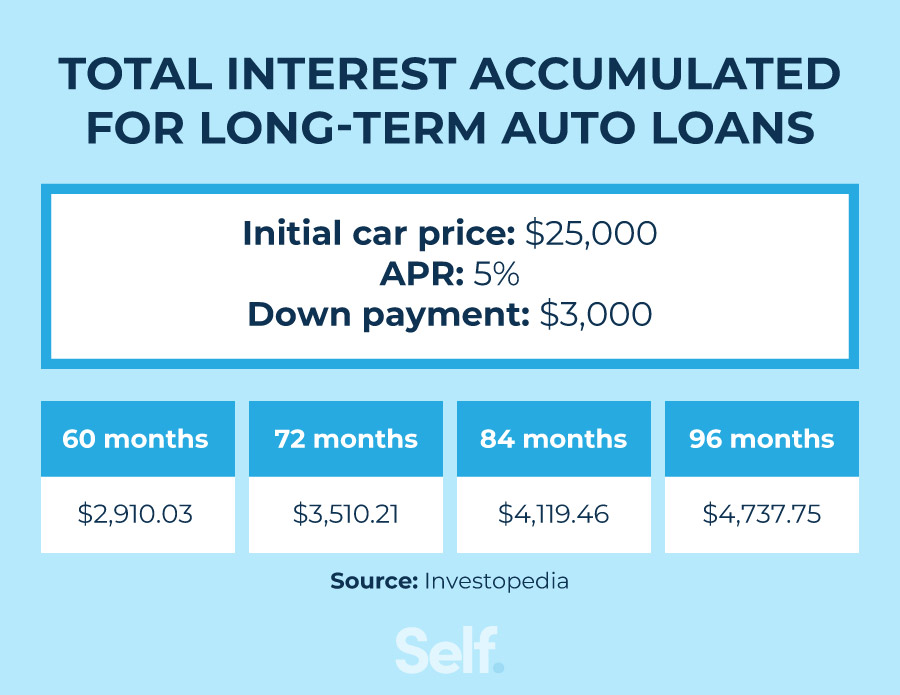
Interest is the price you pay for the privilege of using the bank’s money. When you opt for a 72-month loan instead of a 48-month loan, you aren’t just paying interest for two extra years—you are often paying a higher rate of interest. Lenders perceive longer terms as higher risk. Over six or seven years, there is a greater chance of economic downturns, job loss, or the vehicle being totaled in an accident. Consequently, a 72-month loan might carry an APR 1% to 3% higher than a 48-month loan.
When you combine a higher interest rate with a longer duration, the “total cost of ownership” skyrockets. For example, on a $35,000 loan, the difference in total interest paid between a 4-year term and a 7-year term can be thousands of dollars—money that could have been directed toward an IRA, a high-yield savings account, or other wealth-building instruments.
The Mechanics of Amortization
Car loans are typically amortized, meaning your early payments are weighted more heavily toward interest than the principal. On a long-term loan, the principal balance decreases very slowly in the first few years. This leads to a phenomenon known as being “underwater” or having “negative equity.” This occurs when you owe more on the loan than the car is actually worth. If you need to sell the car or if it is stolen or totaled in the first three years of a 72-month loan, you may find yourself having to pay the bank out of pocket just to close the account.
Strategic Advantages and Disadvantages of Long-Term Financing
While financial purists often argue for the shortest term possible, there are nuanced strategic reasons why some consumers choose longer durations. Understanding the trade-offs is key to making a professional financial decision.
Cash Flow Management and Liquidity
The primary advantage of a long-term car loan is the preservation of monthly liquidity. By lowering the monthly debt obligation, a borrower may have more “breathing room” in their monthly budget. This can be a strategic move if the extra cash is being used for high-return investments. For instance, if a car loan is at 4% interest but the borrower can invest the “saved” monthly cash into a business or a diversified stock portfolio returning 8%, the longer loan could theoretically be a net positive for their net worth. However, this requires immense discipline and a high-interest-rate environment that favors the borrower.
The Risk of the “Debt Trap”
The most significant disadvantage is the psychological and financial burden of “perpetual debt.” When car loans last six or seven years, consumers often find themselves wanting a new vehicle before the old one is paid off. This leads to “rolling over” negative equity into a new loan—a dangerous cycle where the borrower owes $40,000 on a $30,000 car. This erodes wealth over decades and is one of the primary reasons many households struggle to build significant savings.
Maintenance and the “Double Payment” Danger
Cars are depreciating assets that require more maintenance as they age. On an 84-month loan, the vehicle will likely be out of its factory warranty for the final three or four years of the loan. Borrowers may find themselves facing a $2,000 transmission repair while still owing $15,000 on the vehicle. This “double payment”—paying for both the debt and the heavy repairs—can be a breaking point for many personal budgets.
Evaluating Your Ideal Loan Length: A Professional Framework
Choosing the right loan length requires looking past the monthly payment and focusing on the total financial picture. To determine how long your car loan should be, consider the following strategic framework.
The 20/4/10 Rule
A classic rule of thumb in personal finance is the 20/4/10 rule:
- 20% Down: Put down at least 20% of the vehicle’s price to avoid immediate negative equity.
- 4 Years: Limit the loan term to no more than four years (48 months).
- 10% of Income: Ensure that total transportation costs (loan, insurance, fuel, maintenance) do not exceed 10% of your gross monthly income.
Following this rule ensures that you are using the car as a tool for mobility rather than a drain on your future wealth.
Considering Resale Value and Depreciation
Not all cars depreciate at the same rate. A vehicle that holds its value well (such as certain trucks or high-reliability Japanese sedans) might be a safer candidate for a 60-month loan than a luxury European sedan that loses 60% of its value in three years. Before selecting a loan term, research the projected resale value of the vehicle. Your goal should be to ensure that the loan balance is always lower than the car’s market value.
Refinancing as a Tactical Pivot
If you are currently in a long-term car loan that is weighing on your finances, it is important to remember that the term is not always set in stone. As your credit score improves or as market interest rates drop, you may be able to refinance your auto loan. Refinancing can allow you to shorten the term to pay the debt off faster or lower the interest rate to reduce the total cost of ownership.

Conclusion: Balancing Mobility with Financial Freedom
The question of “how long are car loans” is less about the industry average and more about your personal financial strategy. While the market provides options ranging from 24 to 96 months, the most successful financial outcomes usually involve shorter terms, lower interest rates, and a proactive approach to depreciation.
A car is a utility, but a car loan is a financial product. By treating the loan with the same scrutiny you would an investment portfolio or a business contract, you can ensure that your vehicle gets you where you need to go without compromising your journey toward financial independence. In the world of money, time is your greatest asset—don’t give too much of it away to a car lender.
aViewFromTheCave is a participant in the Amazon Services LLC Associates Program, an affiliate advertising program designed to provide a means for sites to earn advertising fees by advertising and linking to Amazon.com. Amazon, the Amazon logo, AmazonSupply, and the AmazonSupply logo are trademarks of Amazon.com, Inc. or its affiliates. As an Amazon Associate we earn affiliate commissions from qualifying purchases.