
The Standard & Poor’s 500 Index, widely known as the S&P 500, serves as the definitive barometer for the health of the United States equity market. It tracks the performance of 500 of the largest companies listed on stock exchanges in the U.S., representing approximately 80% of the available market capitalization. For investors, the index is more than just a list; it is a complex mathematical construction designed to provide a real-time snapshot of corporate America’s prosperity.
To truly understand how the index moves, one must look beyond the daily percentage gains and losses and explore the underlying mechanics. The S&P 500 is not a simple average of stock prices. Instead, it utilizes a free-float market capitalization-weighted methodology, supported by a proprietary figure known as the Index Divisor. This sophisticated structure ensures that the index remains a reliable benchmark even as companies undergo stock splits, mergers, and share buybacks.

The Foundation: Market Capitalization Weighting
The most critical aspect of the S&P 500’s calculation is that it is a market-capitalization-weighted index. This means that companies with larger market values have a greater impact on the index’s movement than smaller companies. If Apple or Microsoft sees a significant price shift, the S&P 500 will move more than if a smaller component, such as a regional utility company, experienced the same percentage change.
Total Market Cap vs. Free-Float Market Cap
In the early days of index tracking, many benchmarks used total market capitalization. However, the S&P 500 transitioned to a “free-float” adjustment in the mid-2000s. Total market capitalization is calculated by multiplying the total number of outstanding shares by the current share price. While this provides a valuation of the entire company, it does not necessarily represent the shares available to the public for trading.
Free-float market capitalization excludes shares held by “insiders”—such as founders, directors, and government agencies—as well as shares that are otherwise restricted. By focusing only on the shares actually circulating in the open market, the S&P 500 provides a more accurate reflection of market liquidity and the actual investment opportunities available to the public.
The Calculation Formula
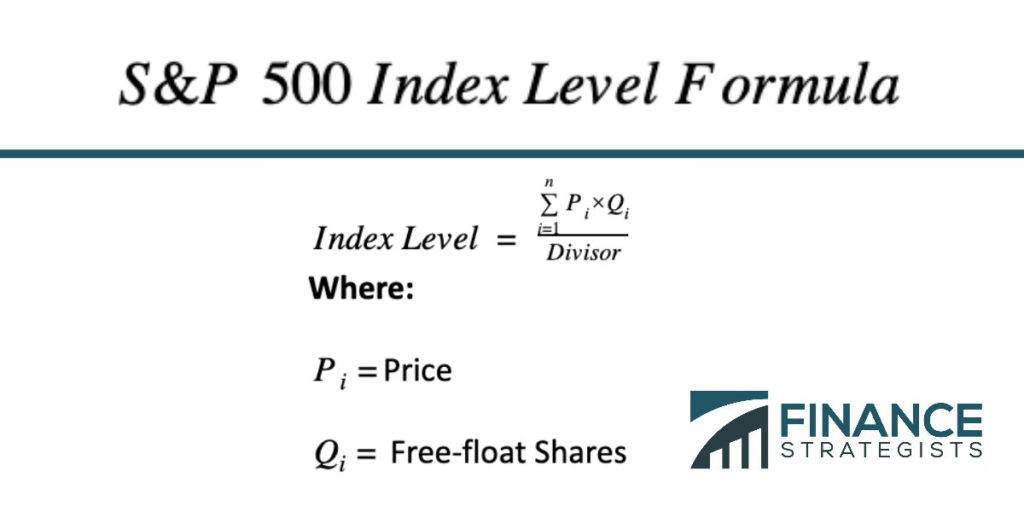
The basic formula for calculating the S&P 500 index level is as follows:
Index Level = (Sum of Float-Adjusted Market Cap of all 500 companies) / Index Divisor
To find the numerator, the index provider multiplies the current share price of each constituent by its specific number of float-adjusted shares. These 500 individual market caps are then added together. This sum is often in the tens of trillions of dollars. Because a number that large is difficult to track as a daily point value, S&P Dow Jones Indices uses a “Divisor” to scale the number down into the familiar four-digit index level (e.g., 5,000) that we see on financial news reports.
The Secret Sauce: The S&P 500 Index Divisor
The Index Divisor is perhaps the least understood but most vital component of the S&P 500 calculation. Without the divisor, the index would fluctuate wildly every time a company issued new shares, performed a stock split, or was replaced by another company. The divisor is a proprietary figure maintained by S&P Dow Jones Indices that ensures these “corporate actions” do not artificially change the value of the index.
Ensuring Continuity Through Corporate Actions
Consider a stock split. If a major company in the index executes a 2-for-1 stock split, its share price will drop by half, but its number of shares will double. Mathematically, the company’s market capitalization remains the same. However, other actions—such as the issuance of new shares or a major share buyback—actually change the market cap.
If the index were a simple sum, these changes would cause the index level to jump or drop, creating “gaps” in the data that don’t reflect actual market performance. To prevent this, the divisor is adjusted. The goal is to keep the index level constant before and after the corporate action.
Why the Divisor Changes
The divisor is adjusted whenever there is a change in the aggregate market value of the index that is not caused by a change in stock prices. Common reasons for divisor adjustments include:
-
Additions and Deletions: When a company is removed from the index and replaced by another, the total market cap of the index changes. The divisor is adjusted to ensure the index price doesn’t move just because a $20 billion company replaced a $15 billion company.
-
Share Issuance or Buybacks: If a company issues a massive amount of new debt-funded equity or retires a large portion of its shares, the total float changes.
-
Rights Offerings and Special Dividends: These financial events can shift the valuation of a company in ways that require a divisor adjustment to maintain index continuity.
By constantly tweaking this denominator, the index providers ensure that the S&P 500 only moves when the underlying stock prices of the companies move.
Index Governance: Who Decides the Components?
The S&P 500 is not a passive list of the 500 largest companies in America. Unlike some other indices that are strictly rule-based and automated, the S&P 500 is “actively managed” by the S&P Dow Jones Indices Index Committee. This committee meets regularly to ensure the index continues to meet its objective of representing the large-cap sector of the U.S. economy.
Eligibility and Quantitative Standards
For a company to even be considered for the S&P 500, it must meet several strict quantitative criteria. These include:
-
Market Capitalization: As of 2024, a company must typically have an unadjusted market cap of $15.8 billion or greater. This threshold is updated periodically to reflect market conditions.
-
Liquidity: The company must have high trading volume to ensure that index funds can buy and sell the stock without causing extreme price volatility.
-
Domicile: The company must be a U.S. company. This is determined by looking at where the company files its regulatory reports and where its primary headquarters and assets are located.
-
Earnings: The company must demonstrate financial viability. Specifically, the sum of its earnings over the most recent four consecutive quarters must be positive, and the most recent quarter must also be positive.
The Role of the Index Committee
Even if a company meets all the mathematical criteria, it is not guaranteed a spot. The Index Committee exercises discretion to ensure the index remains balanced across different sectors. For example, if the technology sector already dominates the index, the committee might delay adding another tech firm in favor of a company that adds industrial or healthcare diversity.
This human element is what distinguishes the S&P 500 from the Russell 1000 or other purely algorithmic indices. The committee’s job is to ensure the index is “representative” rather than just a list of the biggest names.
Rebalancing and Weighting Limitations
The S&P 500 is not static. It undergoes a formal rebalancing process every quarter (in March, June, September, and December). During this time, the share counts and float adjustments for all 500 companies are updated. This ensures that the weights of the companies in the index accurately reflect their current market standing.
The Impact of Mega-Cap Dominance
Because the S&P 500 is market-cap weighted, it is inherently top-heavy. In recent years, a small group of mega-cap technology companies—often referred to as the “Magnificent Seven”—has come to represent a significant percentage of the total index weight.
This concentration means that the performance of the S&P 500 can sometimes diverge from the performance of the “average” American company. If the top 10 companies are performing exceptionally well, the index may reach all-time highs even if the bottom 400 companies are stagnant or declining. This has led some investors to track the S&P 500 Equal Weight Index as a point of comparison, where every company, regardless of size, is given a 0.2% weight.
Why the Calculation Method Matters for Investors
Understanding how the S&P 500 is calculated is essential for anyone involved in personal finance or professional investing. The methodology influences everything from the behavior of mutual funds to the volatility of retirement accounts.
Tracking Errors and ETF Performance
Most investors access the S&P 500 through exchange-traded funds (ETFs) like SPY, VOO, or IVV. These funds aim to replicate the index by holding the underlying stocks in the exact proportions dictated by the S&P 500 calculation. Because the index is float-adjusted and uses a divisor for continuity, it is relatively easy and cost-effective for fund managers to replicate. This is why S&P 500 index funds generally have very low expense ratios; the “rules” of the calculation are transparent and predictable.

Strategic Allocation Considerations
The market-cap-weighting system means the S&P 500 is a “momentum-friendly” index. As a company’s stock price rises, its market cap increases, and its weight in the index grows. This naturally leads the index to allocate more capital to winning companies and less to those that are struggling.
However, for a diversified investor, it is important to recognize that the S&P 500 is not a hedge against sector-specific downturns. Because of its calculation method, if a specific sector—like Information Technology—becomes overvalued, the index will become heavily concentrated in that sector. Understanding the math behind the index allows investors to see when the benchmark is becoming unbalanced and adjust their overall portfolio strategy accordingly.
Ultimately, the S&P 500 is a masterpiece of financial engineering. Through the combination of free-float market capitalization, rigorous committee oversight, and the constant stabilization provided by the Index Divisor, it remains the gold standard for measuring the pulse of the American economy. While the math may be complex, its objective is simple: to provide a clear, uninterrupted view of the value created by the world’s most powerful corporations.
aViewFromTheCave is a participant in the Amazon Services LLC Associates Program, an affiliate advertising program designed to provide a means for sites to earn advertising fees by advertising and linking to Amazon.com. Amazon, the Amazon logo, AmazonSupply, and the AmazonSupply logo are trademarks of Amazon.com, Inc. or its affiliates. As an Amazon Associate we earn affiliate commissions from qualifying purchases.