
For over a century, the Dow Jones Industrial Average (DJIA) has served as the definitive pulse of the American stock market. When evening news anchors report that “the market is up,” they are almost invariably referring to the Dow. Established in 1896 by Charles Dow and Edward Jones, this index has transitioned from a simple average of twelve industrial companies to a sophisticated, albeit uniquely structured, benchmark of thirty “blue-chip” giants. However, despite its ubiquity, the actual methodology behind the Dow’s calculation remains a mystery to many retail investors. Unlike the S&P 500 or the Nasdaq Composite, which rely on market capitalization, the Dow uses a price-weighted system that makes its internal mechanics fundamentally different from almost any other major index in the world.
The Foundation of Price Weighting
To understand how the Dow is calculated, one must first understand the concept of a price-weighted index. In most modern indices, such as the S&P 500, a company’s influence is determined by its total market value (share price multiplied by the number of outstanding shares). In those systems, a trillion-dollar company has a much larger impact on the index than a fifty-billion-dollar company.
The Dow Jones Industrial Average operates on a completely different logic. In the Dow, the weight of a component is determined solely by its stock price per share. This means that a company trading at $200 per share has twice the influence on the index as a company trading at $100 per share, regardless of whether the $100 company is actually ten times larger in terms of total market capitalization.
The Historical Logic
When Charles Dow first calculated the average in the late 19th century, he did so without the aid of computers or advanced financial modeling. The original calculation was simple arithmetic: he added up the stock prices of the 12 original companies and divided that sum by 12. This provided a straightforward “average” price of the industrial sector.
While the number of companies grew to 30 in 1928, the basic principle remained. However, as companies began to undergo stock splits, issue dividends, and merge with other entities, the simple arithmetic of dividing by the number of stocks became unsustainable. If a $100 stock split 2-for-1, its price would drop to $50. Without an adjustment, the Dow would appear to have “crashed” simply because a company made its shares more affordable, even though the company’s value remained unchanged.
The Dow Divisor: The “Secret Sauce” of the Calculation
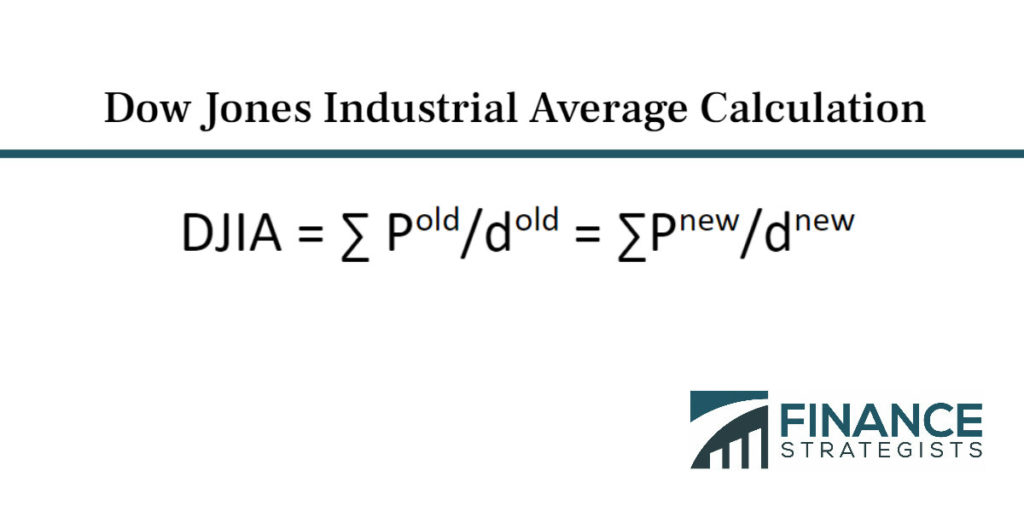
To maintain continuity and account for corporate actions like stock splits, the index uses a mathematical constant known as the “Dow Divisor.” This is the core of the modern DJIA calculation.
The formula for the Dow Jones Industrial Average is:
DJIA = Σp / d
(Where Σp is the sum of the prices of the 30 component stocks, and d is the Dow Divisor.)
How the Divisor Works
The Dow Divisor is a figure that is continuously adjusted to ensure that events like stock splits or changes in the index components do not, by themselves, change the value of the index. When the Dow first began, the divisor was simply the number of companies in the index (12, then later 30). Today, because of decades of downward adjustments to account for splits and spin-offs, the divisor is a number much smaller than one.
As of recent years, the divisor has hovered around 0.15. This creates a leverage effect: because the sum of the 30 stock prices is divided by a number less than one, the value of the index is actually much higher than the raw sum of the share prices.
Adjusting for Stock Splits
Consider a hypothetical scenario where the sum of the 30 stocks is $3,000 and the divisor is 0.15. The Dow would be at 20,000. If one of the companies in the index, currently trading at $200, undergoes a 2-for-1 stock split, its price drops to $100. If nothing else changed, the sum of the prices would drop to $2,900. To prevent the Dow from dropping 666 points overnight due to a mere accounting change, the S&P Dow Jones Indices (the entity that manages the index) recalculates the divisor.
The new divisor is found by solving for x: $2,900 / x = 20,000$. In this case, the divisor would be adjusted downward to 0.145. This ensures that the index level remains at 20,000, providing the historical “bridge” that allows investors to compare the market today to the market of the 1920s or 1980s.
Component Selection: The Human Element

Unlike the Russell 2000 or other indices that use strict, formulaic rules for inclusion (such as ranking companies by size), the Dow Jones Industrial Average is curated. The process of deciding which thirty companies represent the “Industrial Average” is handled by a committee.
The Averages Committee
The selection of stocks is managed by the Averages Committee, which includes the editor-in-chief of The Wall Street Journal and representatives from S&P Dow Jones Indices. There are no rigid quantitative rules for inclusion, but there are clear qualitative guidelines. A company is typically added only if it has an excellent reputation, demonstrates sustained growth, and is of interest to a large number of investors.
Maintaining Sector Representation
While the word “Industrial” remains in the title, the index has long since evolved beyond railroads and steel mills. Today, it includes technology leaders like Microsoft and Apple, healthcare giants like UnitedHealth Group, and financial institutions like Goldman Sachs. The committee aims to maintain a representation of the broader U.S. economy, excluding the transportation and utility sectors, which have their own dedicated Dow averages.
Because the index is price-weighted, the committee must also consider a company’s stock price before adding it. A company with an exceptionally high share price—say, $2,000 per share—would likely never be added to the Dow because its movements would dominate the entire index, effectively rendering the other 29 stocks irrelevant. Conversely, a company with a very low share price might be removed because its movements would have almost no impact on the index’s value.
Criticisms and Modern Relevance
The Dow’s unique calculation method has made it a target for criticism from modern portfolio theorists and data scientists. The primary argument against the Dow is that price weighting is an archaic vestige of the pre-computer era.
The Problem with Price Weighting
The most common critique is that the Dow does not reflect the actual size of the companies it tracks. For instance, if a company with a $500 billion market cap has a share price of $400, it has more influence on the Dow than a $3 trillion company with a share price of $150. Critics argue that this provides a distorted view of the economy. If the $400 stock moves up 1%, it adds more points to the Dow than if the $3 trillion stock moves up 1%, despite the latter representing a much larger shift in actual wealth and market value.
Furthermore, the Dow is criticized for being too narrow. With only 30 stocks, it is often viewed as less representative of the total market than the S&P 500, which tracks 500 of the largest U.S. companies and covers approximately 80% of the available market capitalization.
Why the Dow Still Matters
Despite these mathematical “flaws,” the Dow remains highly relevant for several reasons:
-
Correlation: Historically, the Dow Jones Industrial Average has shown a very high correlation with the S&P 500. Over long periods, they tend to move in the same direction with similar magnitudes.
-
Psychology and Tradition: The Dow is the “people’s index.” Because the numbers are large (in the tens of thousands), a “100-point move” is easy for the general public to conceptualize as a standard day of trading.
-
Blue-Chip Focus: By focusing only on 30 massive, profitable, and stable companies, the Dow serves as a specific barometer for the health of “Corporate America.” It filters out the volatility of smaller, speculative companies that can skew the results of broader indices.
Comparing the Dow to Other Major Indices
To truly understand how the Dow’s calculation influences its behavior, it is helpful to contrast it with its peers.
Dow vs. S&P 500
The S&P 500 is market-cap weighted. This means that a 1% move in Apple or Microsoft has a massive impact on the index, while a 1% move in the 500th company has almost no impact. The Dow, by contrast, gives the most power to whichever company happens to have the highest nominal share price. If UnitedHealth Group (typically a high-priced Dow stock) has a bad day, the Dow might fall even if most other stocks are up. In the S&P 500, UnitedHealth’s impact is moderated by its actual market size relative to other giants.
Dow vs. Nasdaq Composite
The Nasdaq is also market-cap weighted but is heavily skewed toward the technology and growth sectors. The Dow is much more diversified across different industries, including “old economy” sectors like industrials, consumer staples, and energy. While the Nasdaq might soar during a tech boom, the Dow provides a more balanced view of how consumer-facing giants and industrial manufacturers are performing.

Conclusion: The Enduring Legacy of the Average
The calculation of the Dow Jones Industrial Average is a blend of historical tradition and modern mathematical adjustment. While the price-weighted methodology may seem counterintuitive in an era of high-speed algorithmic trading and market-cap dominance, it remains a vital tool for the financial community. By using the Dow Divisor to smooth over the ripples of corporate actions, the index provides a continuous narrative of the American economy that spans over 125 years. Whether one views it as a flawed relic or a prestigious benchmark, understanding how the Dow is calculated is essential for any investor seeking to interpret the signals of the global financial markets. It is not just an average of thirty stocks; it is a meticulously maintained piece of financial history that continues to define how we perceive market success and failure.
aViewFromTheCave is a participant in the Amazon Services LLC Associates Program, an affiliate advertising program designed to provide a means for sites to earn advertising fees by advertising and linking to Amazon.com. Amazon, the Amazon logo, AmazonSupply, and the AmazonSupply logo are trademarks of Amazon.com, Inc. or its affiliates. As an Amazon Associate we earn affiliate commissions from qualifying purchases.