
The Dow Jones Industrial Average (DJIA), often simply referred to as “the Dow,” stands as one of the most venerable and frequently cited stock market indices globally. For over a century, it has served as a widely watched barometer of the U.S. stock market’s health, offering a snapshot of the performance of thirty prominent American companies. For investors, financial enthusiasts, and even casual observers, understanding how this iconic index is calculated is crucial to interpreting its movements and appreciating its historical significance, as well as its inherent limitations. This article delves into the intricate yet fundamentally simple methodology behind the Dow, shedding light on its unique price-weighted approach and the factors that influence its daily fluctuations.
The Legacy and Significance of the Dow Jones Industrial Average
To fully grasp the calculation of the Dow, one must first understand its origins and enduring role in the financial landscape. It’s more than just a number; it represents a slice of American economic history and corporate achievement.
A Brief History of the Dow
Conceived by Charles Dow, co-founder of Dow Jones & Company and The Wall Street Journal, the Dow Jones Industrial Average was first published on May 26, 1896. Initially comprising just twelve industrial companies—a selection that included General Electric (the only original component still active, though it has been removed and re-added multiple times), American Cotton Oil, and U.S. Leather—the index aimed to provide a clear, understandable measure of the industrial sector’s performance. At its inception, it was a simple arithmetic average of the stock prices of its components. Over time, the number of companies grew to twenty in 1916 and finally to thirty in 1928, a number it has maintained ever since. The choice of “industrial” reflected the prevailing economic engines of the era, though its components have diversified significantly over the decades to represent a broader spectrum of the modern economy, including technology, finance, and healthcare. Despite this evolution, the “Industrial” moniker persists as a nod to its heritage.
Why the Dow Matters to Investors
The Dow holds a unique place in the hearts and minds of investors for several reasons. Firstly, its sheer longevity makes it an invaluable historical reference point, allowing for comparisons of market performance across more than a century of economic cycles, wars, and technological revolutions. It often serves as a quick, headline-grabbing indicator of market sentiment, with its daily rises and falls frequently leading news reports on the economy. For many, it’s the simplest and most accessible proxy for “the stock market.” Moreover, the companies comprising the Dow are typically large, well-established “blue-chip” firms with strong track records, often perceived as safer and more stable investments. Monitoring the performance of these companies can offer insights into the health of critical sectors of the U.S. economy and the broader corporate landscape.
Unpacking the Price-Weighted Methodology
Unlike most modern stock market indices, which are market-capitalization-weighted, the Dow employs a distinctive price-weighted methodology. This is the cornerstone of its calculation and the primary reason for its unique characteristics.
The Core Principle: Simple Average (Initially)
In its most basic form, the Dow’s calculation began as a simple average. If we were to imagine a simplified Dow today, with its thirty components, one might initially assume its value is derived by summing the share prices of all thirty companies and then dividing by thirty. For example, if the thirty companies had an average share price of $100, the Dow would be 100. This straightforward approach has the advantage of being easy to understand conceptually. However, the financial markets are dynamic, with events like stock splits, company mergers, and changes in index components occurring regularly. These events, if not accounted for, would artificially inflate or deflate the index’s value, making historical comparisons meaningless. This is where the “Dow Divisor” comes into play.
Introducing the Dow Divisor
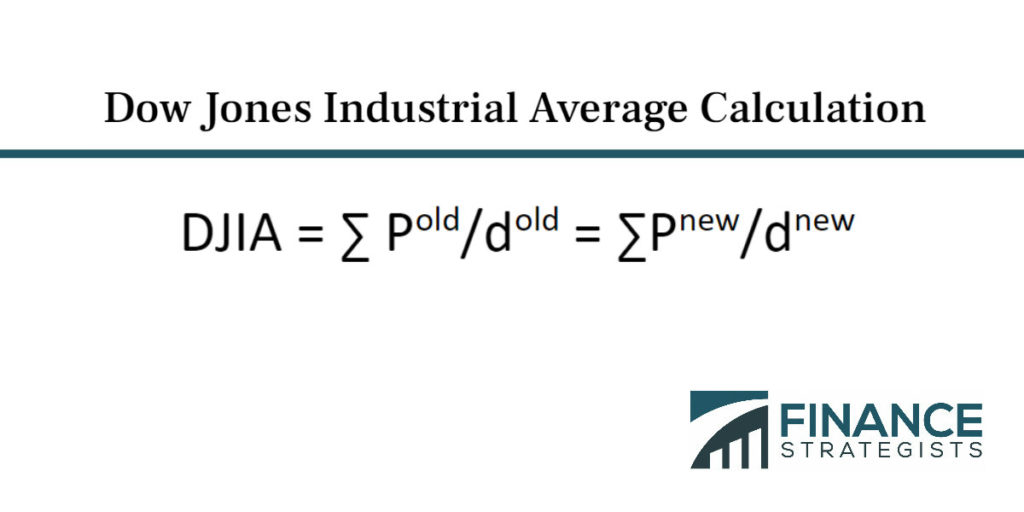
The brilliance, and the complexity, of the Dow’s calculation lies in the “Dow Divisor.” The current Dow value is calculated by summing the prices of the 30 constituent stocks and then dividing that sum by the divisor. The divisor is a crucial number that is continuously adjusted to ensure that stock splits, dividends (specifically stock dividends), changes in the index’s component companies, or other structural alterations do not distort the index’s value. Without the divisor, a stock split (where a single share is divided into multiple shares, reducing its price proportionally) would cause the Dow to drop significantly, even though the total market value of the company and its influence on the overall economy hasn’t changed.
For instance, if a company’s stock trading at $100 undergoes a 2-for-1 split, its new price would be $50. If the Dow were a simple average, this would immediately lower the index’s value. To prevent this artificial drop, the Dow Divisor is adjusted downwards. The adjustment ensures that the index’s value remains unchanged immediately after the split, reflecting the true market movement rather than an administrative change. The divisor is not a static number; it changes frequently, often several times a year, to maintain the historical continuity and integrity of the index. At the time of writing, the Dow Divisor is a small fraction (e.g., around 0.15), meaning that a one-dollar change in the price of any Dow component stock moves the index by approximately 6.5 points (1/0.15).
A Practical Example of Divisor Adjustment
Let’s illustrate with a highly simplified example:
Imagine an index with just two stocks:
- Company A: Share price $100
- Company B: Share price $50
- Sum of prices = $150
- Initial Divisor = 2 (for a simple average)
- Index Value = $150 / 2 = 75
Now, Company A announces a 2-for-1 stock split. Its new price becomes $50.
- If we used the old divisor (2), the new sum of prices ($50 + $50 = $100) divided by 2 would yield an index value of 50. This is an artificial drop from 75, not reflecting any change in underlying market value.
- To avoid this, a new divisor (let’s call it ‘X’) is calculated such that:
New Sum of Prices / X = Old Index Value
$100 / X = 75
X = $100 / 75 = 1.33 - The divisor is adjusted from 2 down to 1.33, ensuring the index value remains constant (75) immediately after the split. From that point forward, future movements are calculated using the new divisor. This ensures that the index accurately reflects market performance changes, not merely cosmetic corporate actions.
The Evolution of Dow Components and Their Impact
The Dow’s identity is inextricably linked to the thirty companies it tracks. These components are not static; they evolve to maintain the index’s relevance and reflective capacity.

Criteria for Stock Selection
The selection of companies for the Dow is not based on a formula but rather on the discretion of a committee at S&P Dow Jones Indices. While subjective, the criteria typically revolve around the companies being large, well-established, U.S.-based “blue-chip” corporations that have an excellent reputation, demonstrate sustained growth, and are of interest to a large number of investors. They are generally leaders in their respective industries and are expected to reflect a significant portion of the U.S. equity market. The goal is to ensure the index remains a credible and representative gauge of the broader economy. Importantly, the committee also considers the need for adequate industry representation, ensuring the index isn’t overly concentrated in a single sector, though certain sectors like transportation and utilities have their own specific Dow averages.
The Rationale Behind Component Changes
Changes to the Dow’s components are relatively infrequent but significant when they occur. They are primarily driven by the need to maintain the index’s relevance in an evolving economy. A company might be added if it has become a dominant player in an emerging or critical industry, or if it better represents a significant sector. Conversely, a company might be removed if its business declines, if it undergoes a major restructuring (like bankruptcy or merger that fundamentally changes its nature), or if it no longer meets the committee’s criteria for market leadership and broad appeal. These changes ensure the Dow continues to reflect the most impactful and influential companies driving the U.S. economy, even as the economy itself transforms. Each time a component is added or removed, the Dow Divisor is adjusted to prevent an artificial change in the index’s value on the day of the alteration, maintaining historical continuity.
Major Component Shifts and Their Historical Significance
Over its long history, the Dow has seen numerous notable shifts in its components, reflecting profound changes in the American industrial and economic landscape. For instance, early industrial giants have given way to technology titans. In the early 2000s, companies like Hewlett-Packard and Intel joined, signifying the rising importance of the tech sector. More recently, Salesforce, Amgen, and Honeywell were added, replacing ExxonMobil, Pfizer, and Raytheon Technologies. These changes highlight a shift away from traditional industrial and energy companies towards healthcare, technology, and cloud computing, demonstrating the committee’s continuous effort to keep the index contemporary. Each such change is not just a company swap; it’s a statement about the changing face of the economy and what truly drives its growth.
Strengths and Limitations of the Dow
While iconic, the Dow is not without its critics, and understanding both its advantages and disadvantages is crucial for any investor.
The Dow’s Advantages
One of the Dow’s primary strengths is its simplicity. Its price-weighted calculation, once the divisor is understood, is relatively straightforward compared to complex market-cap weighted methodologies. This makes it easily digestible for a broad audience. Its historical depth is unparalleled, offering a century-plus perspective on market performance. For new investors, it serves as an excellent entry point into understanding market indices, acting as a familiar benchmark. Furthermore, the companies it tracks are generally robust, financially sound blue-chip firms, making it a reliable, albeit limited, bellwether for the traditional economy’s giants. It also has a strong brand recognition, making it an effective communication tool in financial news.
Criticisms and Drawbacks
Despite its popularity, the Dow faces significant criticism, primarily due to its price-weighted nature. In a price-weighted index, a stock with a higher share price has a greater impact on the index’s movement than a stock with a lower share price, regardless of the company’s actual market capitalization (total value). For example, a $1 move in a $400 stock affects the Dow more than a $1 move in a $100 stock, even if the $100 stock represents a much larger company by market value. This can lead to a distorted view of the market, as smaller, higher-priced companies can exert undue influence.
Secondly, the Dow’s limited number of components (30 stocks) means it is not a comprehensive representation of the broader U.S. stock market. It excludes thousands of other publicly traded companies and may not accurately reflect the performance of mid-cap or small-cap stocks, or even entire sectors. Critics argue that market-capitalization-weighted indices like the S&P 500, which includes 500 companies and weights them by their total market value, offer a far more accurate and broad representation of the overall market. Lastly, its selection process is subjective, relying on a committee rather than a strict quantitative methodology, which can sometimes lead to questions about its impartiality or timeliness in reflecting market shifts.
Implications for Investors and Future Outlook
For investors, understanding the Dow’s calculation and its inherent biases is key to appropriately incorporating it into their investment analysis.
How Investors Use the Dow
Many investors use the Dow as a quick gauge of overall market sentiment or as a benchmark for the performance of a select group of large, established companies. It can be useful for historical analysis or for those who specifically wish to track the performance of blue-chip stocks. Investors can gain exposure to the Dow through various financial instruments, such as exchange-traded funds (ETFs) or mutual funds that track the index (e.g., the SPDR Dow Jones Industrial Average ETF Trust, ticker DIA). However, sophisticated investors often use the Dow in conjunction with broader, market-capitalization-weighted indices like the S&P 500 or the Wilshire 5000 to get a more complete picture of market performance and risk. For personal finance, knowing how the Dow operates can inform decisions about diversified portfolios, ensuring one isn’t over-reliant on a single, potentially biased, indicator.

The Dow in a Modern Investment Landscape
Despite its criticisms and the rise of more analytically robust indices, the Dow Jones Industrial Average maintains its prominence. Its continued relevance stems from its rich history, the enduring power of its constituent companies, and its simple narrative value. It remains a fixture in financial news and serves as a vital touchstone for understanding long-term economic trends. While not the most statistically perfect measure of the market, its role as a cultural and historical icon in finance is undeniable. The ongoing debate about its methodology versus its utility underscores a broader point in investing: no single metric tells the whole story. The Dow, with its unique calculation, offers a valuable, albeit specific, lens through which to view the enduring saga of the U.S. stock market.
In conclusion, the Dow Index is calculated by summing the prices of its thirty component stocks and dividing that sum by a dynamically adjusted “Dow Divisor.” This divisor is meticulously managed to neutralize the impact of corporate actions like stock splits and changes in index components, ensuring the index’s historical continuity. While its price-weighted methodology differs significantly from most modern indices and presents certain limitations, the Dow’s legacy, the quality of its components, and its widespread recognition secure its place as an indispensable, if imperfect, barometer of the financial world. For informed investors, understanding its nuances allows for a more comprehensive and critical interpretation of market movements.
aViewFromTheCave is a participant in the Amazon Services LLC Associates Program, an affiliate advertising program designed to provide a means for sites to earn advertising fees by advertising and linking to Amazon.com. Amazon, the Amazon logo, AmazonSupply, and the AmazonSupply logo are trademarks of Amazon.com, Inc. or its affiliates. As an Amazon Associate we earn affiliate commissions from qualifying purchases.