
Understanding the mechanics of a car loan is a fundamental pillar of personal finance. For most consumers, a vehicle represents the second-largest purchase they will ever make, trailing only a home. However, many buyers focus exclusively on the monthly payment—a figure that can be easily manipulated by lenders—rather than the underlying cost of capital. To master your financial life, you must look beneath the surface and understand exactly how interest on a car loan is calculated, how it accrues, and how it impacts your long-term wealth.
The cost of borrowing is rarely a flat fee. Instead, it is a dynamic calculation based on time, the principal balance, and your perceived risk as a borrower. By deconstructing the math behind auto financing, you can position yourself to save thousands of dollars over the life of a loan.
The Foundation: Simple Interest vs. Compound Interest
In the world of personal finance, there are two primary ways interest is calculated: simple and compound. Fortunately for the consumer, the vast majority of auto loans in the United States and many other regions use a simple interest formula. This is fundamentally different from a credit card or a savings account, which typically uses compound interest.
The Simple Interest Formula
In a simple interest loan, the interest is calculated based only on the outstanding principal balance at the time of the payment. It does not “stack” or interest on interest. The basic formula for simple interest is:
Interest = Principal × Rate × Time
However, because car loans are repaid in monthly installments, the daily reality is slightly more granular. Lenders use a “Daily Periodic Rate” to determine how much interest you owe between payments.
The Daily Periodic Rate
To find out how much interest you are paying every single day, the lender takes your Annual Percentage Rate (APR) and divides it by the number of days in the year (usually 365). For example, if you have a 6% APR, your daily periodic rate is 0.000164 (0.06 / 365).
Every day that a balance sits on your account, the lender multiplies that daily rate by your current principal balance. If you owe $20,000, you are accruing approximately $3.28 in interest every day. When your monthly payment arrives, the lender first covers the interest that has accumulated since your last payment; the remainder of your check is then applied to the principal. This is why the timing of your payment matters significantly in a simple interest loan.
The Role of the Amortization Schedule
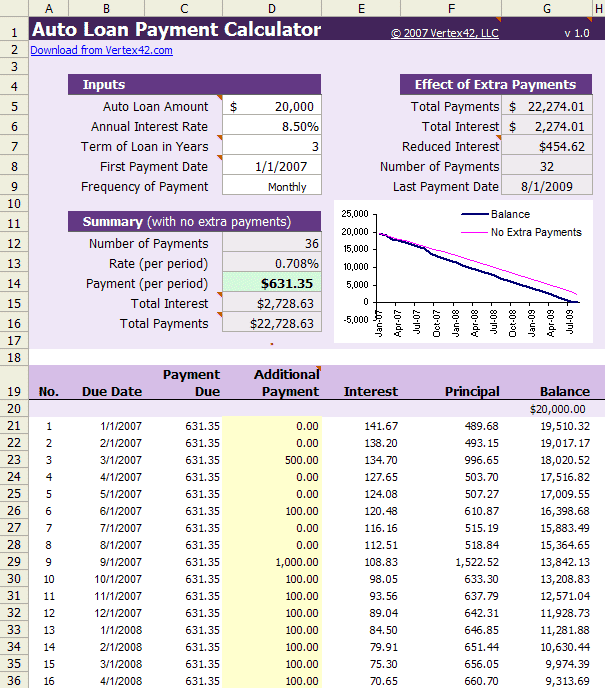
While the interest calculation is “simple,” the way those payments are structured over the life of the loan follows a process called amortization. An amortization schedule is a table that shows exactly how much of each monthly payment goes toward interest versus principal.
Front-Loading Interest
In the early stages of a car loan, your principal balance is at its highest. Because the interest is calculated based on that high balance, a larger portion of your monthly payment is consumed by interest charges in the first year than in the final year. This is often referred to as “front-loading,” though it is a natural mathematical byproduct of the declining balance rather than a hidden fee.
For instance, on a five-year loan, your first payment might be split 40% toward interest and 60% toward principal. By the final year, because the principal is nearly gone, your payment might be split 2% toward interest and 98% toward principal. Understanding this is crucial for anyone considering a trade-in; if you sell the car too early, you have paid a disproportionate amount of interest without making a significant dent in the actual debt.
The Impact of Loan Terms
The length of your loan—the “term”—is one of the most powerful variables in the interest calculation. In recent years, 72-month and 84-month loans have become increasingly common. While these long terms lower the monthly payment, they exponentially increase the total interest paid.
Mathematically, a longer term means the principal balance stays higher for a longer period. Since interest is calculated daily on that balance, a $30,000 loan at 7% APR over 84 months costs significantly more than the same loan over 48 months. Specifically, the 84-month loan would cost roughly $3,000 more in total interest than the 48-month version, even if the interest rate remained identical.
Factors Influencing Your Calculated Rate
The “Rate” part of the interest formula is not arbitrary. It is a reflection of the market environment and your personal financial profile. When a lender calculates your specific interest rate, they are essentially pricing the risk that you might default on the loan.

Credit Score and Risk Tiers
Your credit score is the primary driver of the APR you are offered. Lenders categorize borrowers into “tiers” (e.g., Super Prime, Prime, Subprime). A borrower in the Super Prime tier (780+) might be offered a 4% interest rate, while a Subprime borrower (below 600) might face rates of 15% to 20% or higher.
In the calculation, this difference is staggering. On a $25,000 car, the difference between a 4% rate and an 18% rate over 60 months is over $10,000 in interest alone. This highlights why improving your credit score is the single most effective way to lower the “Rate” variable in your interest calculation.
Loan-to-Value (LTV) Ratio
The amount of money you borrow relative to the value of the car also affects the interest rate calculation. If you provide a substantial down payment, the lender’s risk is reduced because the car’s resale value is likely higher than the loan amount. Conversely, “upside-down” loans—where the borrower finances more than 100% of the car’s value to cover taxes, fees, or negative equity from a previous vehicle—often trigger higher interest rates because they represent a higher risk to the financial institution.
New vs. Used Vehicle Calculations
Generally, interest rates on new cars are lower than those on used cars. This is because new cars have higher resale liquidity and are easier for a bank to value as collateral. When calculating your potential costs, you must account for the fact that a $20,000 used car might actually be more expensive than a $22,000 new car once the higher interest rate of the used vehicle is factored into the total cost of ownership.
Practical Example: Deconstructing the Monthly Payment
To see how these concepts converge, let’s look at a practical calculation. Imagine you are financing $30,000 at an APR of 6% for a term of 60 months.
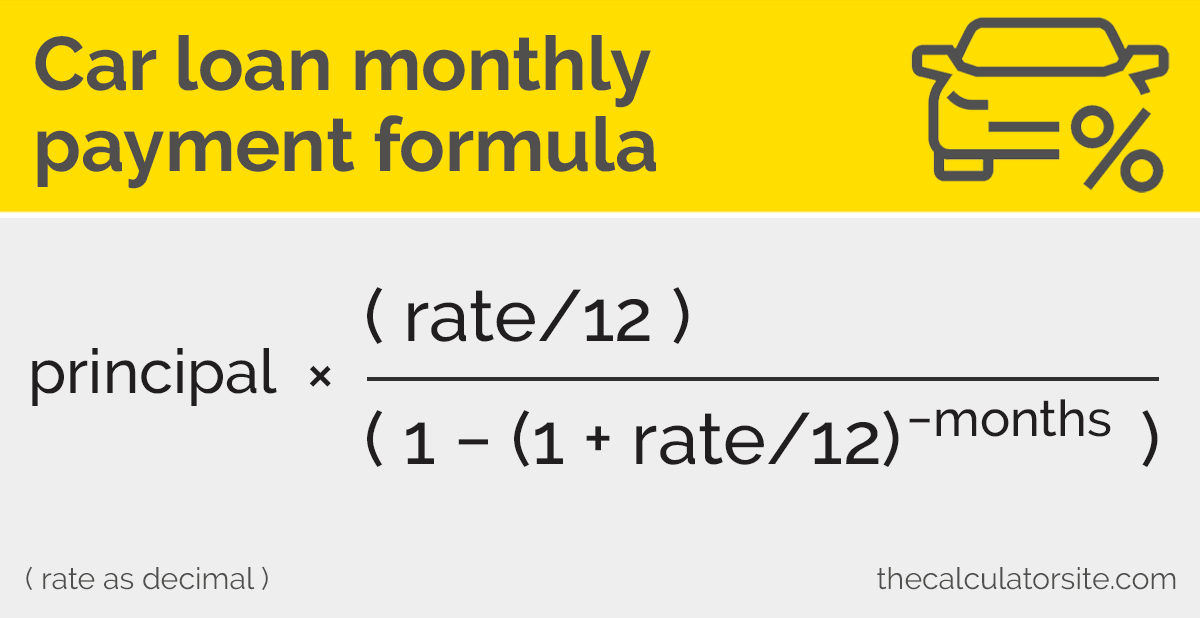
First, the lender determines the monthly payment using the standard formula for an amortizing loan:
M = P [ i(1 + i)^n ] / [ (1 + i)^n – 1 ]
Where M = Monthly Payment, P = Principal, i = Monthly Interest Rate, and n = Number of Months.
In this scenario:
-
Monthly Interest Rate: 0.06 / 12 = 0.005.
-
Number of Payments: 60.
-
Monthly Payment: Approximately $579.98.
In the first month, the interest is calculated: $30,000 × 0.005 = $150.00.
The lender takes that $150.00 from your $579.98 payment. The remaining $429.98 goes toward your principal. Your new balance is $29,570.02.
In the second month, the interest is calculated on the new balance: $29,570.02 × 0.005 = $147.85.
Because the interest is slightly lower, more of your $579.98 payment ($432.13) goes toward the principal.
Over 60 months, this cycle repeats. By the time you reach month 60, your interest charge will be only a few dollars, and almost the entire payment will go toward the final bit of principal.
Strategies to Minimize Interest Costs
Once you understand that interest is a function of daily balance and time, you can use that knowledge to manipulate the math in your favor.
Principal-Only Payments
Because car loans are simple interest, any amount you pay above the monthly minimum goes directly toward reducing the principal balance. By lowering the principal faster, you reduce the base upon which the next month’s interest is calculated. Even adding an extra $50 a month to your payment can shave months off the loan and save hundreds in interest charges.
Bi-Weekly Payment Strategies
Instead of making one monthly payment, some savvy consumers make half-payments every two weeks. Because there are 52 weeks in a year, this results in 26 half-payments—the equivalent of 13 full monthly payments per year. This extra payment, combined with the fact that the principal is reduced more frequently, can significantly lower the total interest calculated over the life of the loan.
The Power of Refinancing
Interest rates fluctuate based on the economy and your personal credit profile. If you took out a loan when your credit score was 620 and it is now 720, the mathematical “Risk” has changed. Refinancing your car loan to a lower APR allows you to reset the interest calculation at a more favorable rate. Even a 2% reduction in APR can result in meaningful savings, provided you do not extend the term of the loan in the process.
Conclusion
Calculating interest on a car loan is not merely an academic exercise; it is a vital skill for anyone looking to optimize their personal finances. By understanding that interest is a daily cost tied to your outstanding principal, you move from being a passive payer to an active manager of your debt. Whether it is through negotiating a lower APR, choosing a shorter loan term, or making aggressive principal-only payments, you have the power to change the variables in the interest equation. In the long run, the money saved on interest is money that can be redirected toward investments, savings, or other financial goals, turning a standard liability into a lesson in wealth preservation.
aViewFromTheCave is a participant in the Amazon Services LLC Associates Program, an affiliate advertising program designed to provide a means for sites to earn advertising fees by advertising and linking to Amazon.com. Amazon, the Amazon logo, AmazonSupply, and the AmazonSupply logo are trademarks of Amazon.com, Inc. or its affiliates. As an Amazon Associate we earn affiliate commissions from qualifying purchases.