
In the realm of personal finance and digital transactions, Venmo stands out as a ubiquitous platform, facilitating seamless peer-to-peer (P2P) payments with an almost casual ease. For millions of users, the app embodies convenience, enabling instant splits of dinner bills, shared rent payments, or quick repayment to friends. Yet, behind this facade of effortless, seemingly free money transfers lies a sophisticated business model designed to generate substantial revenue for its parent company, PayPal. Understanding how Venmo monetizes its massive user base is crucial for grasping the financial intricacies of modern digital payment platforms. This article delves into the various strategies Venmo employs to turn its popular service into a significant profit engine, strictly adhering to the principles of business finance and online income generation.

Beyond Peer-to-Peer: The Foundation of Venmo’s Value Proposition
Venmo’s initial allure was its frictionless approach to social payments. It transformed the often awkward request for money into a playful, emoji-laden exchange. This core offering, the free P2P transfer of funds, built an enormous user base and fostered a strong network effect. However, a business cannot thrive indefinitely by giving away its primary service for free. The challenge for Venmo, and indeed for many platform businesses, has always been how to convert user engagement into tangible financial returns without alienating its loyal audience.
The “Free” Myth: Why Users Flock to Venmo
The perception that Venmo is “free” is a critical component of its success. Users primarily utilize it for instant, no-fee transfers directly from their linked bank accounts or Venmo balance. This convenience, coupled with its social features (like payment feeds), cemented its position as a go-to app for informal financial exchanges. The real genius, from a business finance perspective, lies in understanding that “free” acts as a powerful acquisition and engagement tool. It lowers the barrier to entry, encourages widespread adoption, and builds a massive pool of potential customers who can then be introduced to value-added, monetized services. The apparent cost-free nature of its core function obscures the various points at which Venmo strategically introduces revenue-generating features.
The Network Effect and Market Penetration
Venmo’s value proposition is intrinsically tied to its network effect. The more people who use Venmo, the more useful it becomes for everyone else. This viral growth propelled Venmo into a dominant position in the mobile payment space, particularly among younger demographics. This extensive market penetration provides the robust foundation necessary for any successful monetization strategy. Without a large, engaged user base, the auxiliary services designed to generate income would struggle to gain traction. From a business finance standpoint, this initial investment in user acquisition through a “free” service is justified by the long-term potential for revenue generation across a multitude of diversified offerings.
Core Revenue Streams: Direct Transaction-Based Fees
While P2P transfers remain largely free for standard transactions, Venmo has masterfully introduced a suite of services where convenience, speed, or expanded utility come with a fee. These direct transaction-based fees form the bedrock of Venmo’s revenue model, demonstrating a clear path from user activity to financial gain.
Instant Transfers: Expedited Access to Funds
One of Venmo’s most significant revenue generators is its Instant Transfer feature. While standard transfers to a linked bank account can take 1-3 business days, users can opt for an immediate transfer of funds for a small fee, typically 1.75% of the transferred amount (with a minimum fee of $0.25 and a maximum of $25). This appeals to users who need immediate access to their money, turning a basic financial need into a profitable service. This fee structure is a classic example of valuing speed and convenience in financial services, providing an immediate solution to a common pain point for a reasonable cost. It’s a prime illustration of how a digital platform can monetize an optional, premium service built upon a free core offering.
Business Profiles and Merchant Solutions: Powering Commercial Transactions
Beyond personal payments, Venmo has aggressively expanded into the commercial sphere through Business Profiles and merchant solutions. This is a critical pivot, transforming Venmo from merely a social payment app into a significant player in small business finance. When users pay a business through Venmo, the business incurs a transaction fee, typically 1.9% + $0.10 per transaction. This fee model is standard for merchant services, allowing businesses to accept Venmo payments easily while providing Venmo with a steady stream of revenue from commercial activity.
This service is particularly appealing to small businesses, freelancers, and sole proprietors who benefit from Venmo’s widespread adoption and simplified payment collection. By enabling customers to “Pay with Venmo” in various contexts, from online stores to local service providers, Venmo taps into a much larger market of commercial transactions, diversifying its revenue beyond individual user fees. The ability for businesses to manage payments, track sales, and potentially gain visibility through Venmo’s social feed adds further value, justifying the transaction costs.
Pay with Venmo: Expanding Beyond the App
“Pay with Venmo” extends the platform’s utility beyond direct P2P or Business Profile interactions, allowing users to make purchases at participating online and in-app merchants. When a customer uses Venmo to complete a purchase, the merchant is charged a transaction fee, similar to traditional credit card processing fees. This integration into broader e-commerce ecosystems is a crucial step for Venmo, positioning it as a viable payment option alongside credit cards and PayPal itself. For Venmo, this means tapping into the vast global market of online retail, collecting a percentage of each transaction without needing to manage the logistics of selling goods or services itself. It’s a pure transaction revenue play, leveraging its brand recognition and user base to facilitate third-party sales.
Cash a Check: Bridging the Digital-Physical Divide
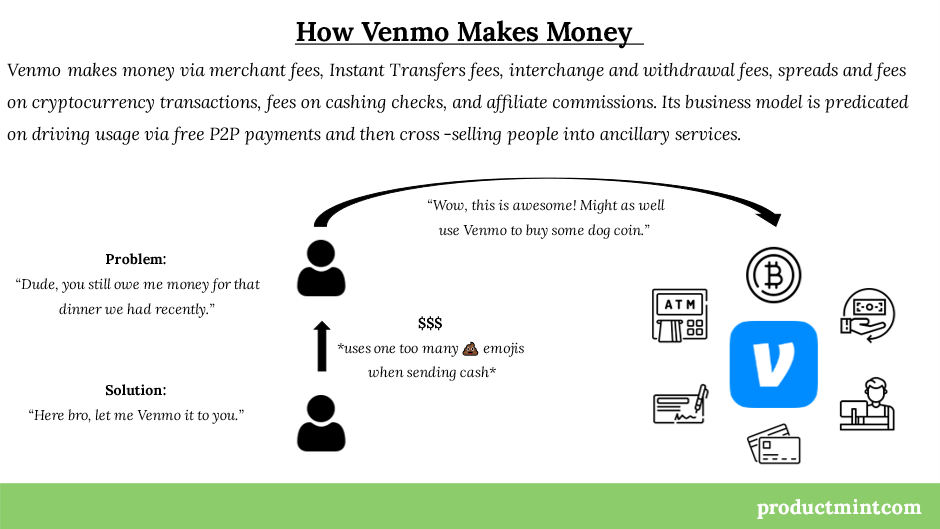
Venmo has also introduced a “Cash a Check” feature, allowing select users to digitally deposit checks into their Venmo balance. While government-issued and payroll checks might be cashed for free, other check types typically incur a fee of 1% (for payroll and government checks with a pre-printed signature) or 5% (for all other checks), with a minimum fee of $5. This service targets users who might not have traditional bank accounts or prefer the convenience of immediate digital access to funds from a physical check. It’s a strategic move to capture another segment of financial transactions, monetizing a service that bridges the gap between traditional paper-based finance and modern digital wallets.
Expanding the Ecosystem: Card Products and Financial Services
Recognizing the need to retain user funds within its ecosystem and expand its financial offerings, Venmo has diversified into card products and emerging financial services. These initiatives not only generate new revenue streams but also deepen user engagement and loyalty.
The Venmo Debit Card: Interchange Fees and ATM Access
The Venmo Debit Card, issued in partnership with MasterCard, allows users to spend their Venmo balance anywhere MasterCard is accepted. While using the card generally incurs no direct fees for the user for everyday purchases, Venmo (or rather, its issuing bank partner) earns revenue through interchange fees. These are small fees charged to merchants by the card issuer for processing transactions. While individually small, across millions of transactions, these fees accumulate into a significant revenue stream. Additionally, while certain ATM withdrawals are free, out-of-network ATM fees also contribute to the card’s overall profitability. The debit card acts as a crucial tool for keeping user funds within the Venmo ecosystem, encouraging more active use of their balance rather than immediate transfers to a bank account.
The Venmo Credit Card: A Broader Financial Product
Building on the success of its debit card, Venmo introduced a co-branded credit card, again leveraging the Mastercard network. The Venmo Credit Card operates like a standard credit card but integrates seamlessly with the Venmo app, offering customizable rewards and allowing users to manage their spending and rewards directly within the platform. For Venmo, the credit card opens up new, substantial revenue channels:
- Interchange Fees: Like the debit card, Venmo earns a portion of the interchange fees from every purchase made with the credit card.
- Interest on Balances: A significant portion of credit card revenue comes from interest charged on outstanding balances that are carried over month-to-month.
- Late Payment Fees: Fees incurred by users who miss their payment due dates.
- Cash Advance Fees: Fees for withdrawing cash using the credit card.
The credit card represents a significant expansion into traditional lending, allowing Venmo to capture a broader range of financial behaviors and generate revenue from credit-based services, which typically have higher profit margins than simple transaction processing.
Cryptocurrency: Tapping into Emerging Financial Markets
In a move to embrace emerging financial technologies, Venmo launched a feature allowing users to buy, hold, and sell cryptocurrencies like Bitcoin, Ethereum, Litecoin, and Bitcoin Cash directly within the app. For each cryptocurrency transaction (buy or sell), Venmo charges a service fee, which varies based on the transaction amount. This venture into cryptocurrency trading appeals to a younger, tech-savvy demographic, offering a simplified entry point into the crypto market. From a financial perspective, it’s a strategic diversification of revenue, capitalizing on the growing interest in digital assets and positioning Venmo as a comprehensive financial tool for its users. The fees, while seemingly small per transaction, can accumulate rapidly given the volatility and frequent trading nature of cryptocurrencies.
Strategic Imperatives and the Future of Venmo’s Monetization
Venmo’s journey from a niche social payment app to a multi-faceted financial platform highlights a deliberate strategy to diversify revenue and deepen its integration into users’ financial lives. Its monetization model is not just about individual fees but also about the cumulative value it provides within the broader PayPal ecosystem.
Leveraging Data and Advertising: Indirect Revenue Opportunities
While not as prominent or direct as transaction fees, the vast amount of user data Venmo collects holds significant value. Insights into spending habits, merchant preferences, and demographic trends can be leveraged for targeted advertising and partnerships. While Venmo explicitly states it does not sell personal user data, aggregated and anonymized data can inform strategic business decisions, enhance advertising effectiveness within its own platform, or be used for broader market analysis by PayPal. These indirect revenue opportunities, while harder to quantify, contribute to the platform’s overall economic value.
Synergies with PayPal: A Parent Company’s Vision
It’s impossible to discuss Venmo’s earnings without acknowledging its relationship with PayPal. Acquired by PayPal in 2013 (as part of its Braintree acquisition), Venmo serves a crucial strategic role. PayPal benefits from Venmo’s strong brand recognition and deep penetration among younger demographics, which complements PayPal’s more established user base. Venmo also acts as a powerful user acquisition engine, funneling new users into the broader PayPal ecosystem, where they might eventually adopt other PayPal products or services. The combined strength allows PayPal to maintain dominance in the digital payment space, fend off competitors, and offer a comprehensive suite of financial tools under one corporate umbrella. Venmo’s profitability is therefore not just about its standalone revenue but also its immense strategic value to PayPal’s overall market position and financial health.

Sustaining Growth in a Competitive Landscape
The digital payments landscape is fiercely competitive, with traditional banks, tech giants, and agile startups all vying for market share. Venmo’s ongoing success hinges on its ability to continually innovate, expand its services, and find new ways to monetize its user base without sacrificing the user experience that made it popular. This involves a delicate balancing act of introducing new revenue-generating features while maintaining the simplicity and “free” perception of its core P2P service. Future monetization efforts could involve further integration with budgeting tools, investment platforms, or even expanded international services, all carefully designed to offer value for a price, ensuring Venmo remains a dominant and profitable force in the evolving world of digital finance.
aViewFromTheCave is a participant in the Amazon Services LLC Associates Program, an affiliate advertising program designed to provide a means for sites to earn advertising fees by advertising and linking to Amazon.com. Amazon, the Amazon logo, AmazonSupply, and the AmazonSupply logo are trademarks of Amazon.com, Inc. or its affiliates. As an Amazon Associate we earn affiliate commissions from qualifying purchases.